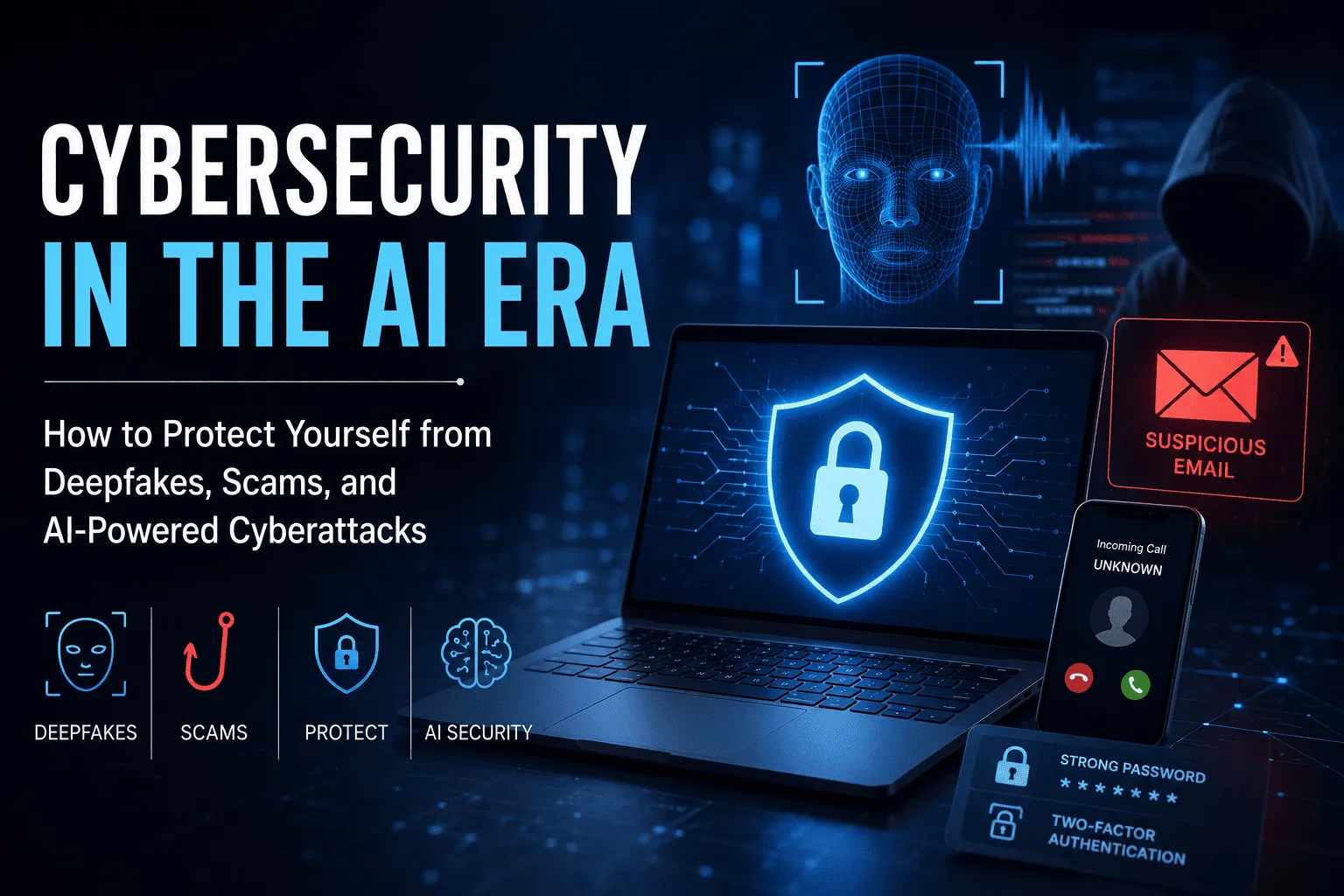
Cybersecurity in the AI Era: How to Protect Yourself from Deepfakes, Scams, and AI-Powered Cyberattacks
Artificial intelligence is transforming the world at an extraordinary pace. It is helping doctors diagnose diseases faster, enabling businesses to automate routine tasks, improving scientific research, and making everyday technology smarter. But like every powerful innovation, AI has a darker side.
Cybercriminals are increasingly using artificial intelligence to launch attacks that are faster, more convincing, and more difficult to detect than ever before.
From realistic deepfake videos and cloned voices to highly personalized phishing emails and automated hacking tools, AI is changing the cybersecurity landscape for individuals, businesses, and governments alike.
The good news is that the same technology helping attackers is also strengthening digital defenses.
AI-powered security systems can detect threats in real time, identify unusual behavior, and respond to attacks before significant damage occurs.
As artificial intelligence becomes more deeply integrated into daily life, understanding modern cybersecurity is no longer optional—it’s an essential life skill.
Whether you’re an individual protecting personal data or a business securing sensitive information, knowing how AI-powered threats work is the first step toward staying safe.
For a broader introduction to the subject, see our Ultimate Guide to Business Cybersecurity.
Why Cybersecurity Matters More Than Ever
Nearly every aspect of modern life now depends on digital technology.
We use the internet to:
- Bank online
- Shop
- Work remotely
- Communicate
- Store photos
- Access healthcare
- Manage businesses
This growing digital dependence has created enormous opportunities for cybercriminals.
Every connected device becomes a potential target.
Artificial intelligence has made many cyberattacks faster, cheaper, and far more sophisticated.
What Is AI-Powered Cybersecurity?
AI-powered cybersecurity uses artificial intelligence to detect, analyze, and respond to cyber threats.
Unlike traditional security software that relies mainly on known attack signatures, AI systems continuously learn from massive amounts of data.
They can identify:
- Unusual login attempts
- Suspicious network activity
- Malware behavior
- Fraudulent transactions
- Data breaches
- Emerging cyber threats
Because AI adapts quickly, it can often recognize new attack methods before traditional systems do.
AI is increasingly being incorporated into areas such as security operations and threat detection, where security teams monitor systems and investigate suspicious activity.
How Criminals Are Using Artificial Intelligence
Unfortunately, cybercriminals have embraced AI just as quickly as security professionals.
Instead of creating entirely new attacks, AI often makes existing scams more convincing and scalable.
Common AI-powered threats include:
- Deepfakes
- Voice cloning
- AI-generated phishing emails
- Automated malware
- Password attacks
- Fake customer support scams
Understanding these threats helps users recognize warning signs before becoming victims.
Deepfakes: When Seeing Is No Longer Believing
One of the most concerning AI developments is the rise of deepfakes.
Deepfakes use artificial intelligence to create highly realistic:
- Videos
- Images
- Audio recordings
Modern deepfakes can convincingly imitate public figures, business executives, family members, or friends.
Cybercriminals may use them to:
- Spread misinformation
- Commit financial fraud
- Damage reputations
- Bypass identity verification
- Manipulate public opinion
As the technology improves, verifying digital content becomes increasingly important.
Voice Cloning Scams
AI can now recreate a person’s voice using only a short audio sample.
Criminals have already used cloned voices to impersonate:
- Family members
- Company executives
- Bank representatives
- Government officials
Imagine receiving a phone call that sounds exactly like a loved one urgently requesting money.
Without verification, many people may believe the request is genuine.
Experts recommend confirming unexpected financial requests through another trusted communication method.
This type of manipulation is closely related to broader social engineering attacks and human behavior.
AI-Generated Phishing Emails
Phishing has existed for decades.
Artificial intelligence makes it far more dangerous.
Older phishing emails often contained:
- Poor grammar
- Obvious spelling mistakes
- Generic greetings
Modern AI can generate highly personalized emails that closely resemble legitimate business communications.
These messages may reference:
- Your employer
- Recent purchases
- Social media activity
- Banking services
- Business relationships
Because the language appears natural, users must become even more cautious.
Understanding the differences between phishing and social engineering can help users recognize how attackers manipulate their targets.
Smarter Malware
Malware is malicious software designed to damage computers or steal information.
Artificial intelligence allows some malware to:
- Change its behavior
- Avoid detection
- Adapt to security software
- Spread more efficiently
Although advanced AI-powered malware remains relatively uncommon, cybersecurity experts expect these techniques to become increasingly sophisticated.
For a deeper explanation of malicious software, see our Complete Guide to Malware and Malicious Software.
Password Attacks
Weak passwords remain one of the biggest cybersecurity risks.
AI enables attackers to analyze enormous password datasets and identify common patterns much faster than before.
Simple passwords such as:
- 123456
- password
- qwerty
can often be cracked within seconds.
Strong password management has never been more important.
How to Create Strong Passwords
Security professionals recommend:
- Long passwords
- Unique passwords for every account
- Password managers
- Multi-factor authentication
A strong password should contain a combination of:
- Uppercase letters
- Lowercase letters
- Numbers
- Symbols
Avoid using personal information such as birthdays or names.
For a more comprehensive look at protecting accounts, see our Password Security Guide.
Multi-Factor Authentication (MFA)
One of the simplest ways to improve security is enabling multi-factor authentication (MFA).
Instead of relying only on a password, MFA requires an additional verification step.
Examples include:
- Authentication apps
- Security keys
- Fingerprint recognition
- Face recognition
- One-time verification codes
Even if attackers obtain your password, MFA makes unauthorized access significantly more difficult.
Learn more about the benefits and implementation of MFA in our guide to How Multi-Factor Authentication Improves Account Security.
Protecting Yourself from Deepfakes
As AI-generated media becomes more convincing, critical thinking becomes essential.
Before trusting a video or audio recording:
- Check the original source.
- Look for independent reporting.
- Watch for unusual facial movements.
- Listen for unnatural speech.
- Verify extraordinary claims.
If something seems suspicious, pause before sharing it online.
Keeping Software Updated
Software updates often include important security improvements.
Delaying updates leaves devices vulnerable to known attacks.
Regularly update:
- Operating systems
- Web browsers
- Mobile apps
- Antivirus software
- Routers
- Smart home devices
Automatic updates provide the strongest protection.
Software security is another important part of this process. Our Guide to Software Security explains how security considerations can be incorporated into software throughout its lifecycle.
Safe Browsing Habits
Many cyberattacks begin with simple mistakes.
Good browsing practices include:
- Avoid clicking suspicious links.
- Download software only from trusted sources.
- Verify website addresses.
- Avoid unknown email attachments.
- Be cautious with public Wi-Fi.
Small habits often provide significant protection.
For additional guidance, see Staying Safe in the Digital World.
Protecting Your Personal Information
Cybercriminals frequently gather information from social media.
Oversharing can help attackers answer security questions or create convincing phishing scams.
Consider limiting public access to:
- Birthdays
- Phone numbers
- Home addresses
- Travel plans
- Family details
The less information criminals have, the harder it becomes to impersonate you.
Protecting personal information is also an important part of digital privacy.
How Businesses Are Responding
Organizations increasingly rely on AI-powered security systems.
Modern cybersecurity platforms can:
- Monitor employee behavior
- Detect unusual activity
- Block suspicious logins
- Analyze network traffic
- Identify malware
- Automate incident response
Rather than replacing human security teams, AI acts as an intelligent assistant capable of analyzing enormous amounts of data within seconds.
Organizations also use structured incident response processes to manage security events when they occur.
AI Fighting AI
One of the most fascinating developments in cybersecurity is that artificial intelligence now defends against artificial intelligence.
Security systems increasingly use machine learning to:
- Detect AI-generated attacks
- Identify deepfakes
- Analyze phishing emails
- Monitor network anomalies
- Predict emerging threats
The cybersecurity landscape has become an ongoing technological arms race between attackers and defenders.
The Future of Cybersecurity
As AI continues advancing, cybersecurity will likely become even more automated.
Future security systems may:
- Detect attacks instantly.
- Predict vulnerabilities.
- Automatically isolate infected systems.
- Verify digital identities.
- Authenticate media content.
At the same time, cybercriminals will continue developing more sophisticated techniques.
This ongoing competition means cybersecurity education will remain essential.
Businesses can strengthen their overall approach by combining AI-powered defenses with cybersecurity risk management and proactive security planning.
Frequently Asked Questions
What is a deepfake?
A deepfake is AI-generated media that realistically imitates a person’s face, voice, or appearance.
Can AI hack computers by itself?
AI can assist cybercriminals by automating certain tasks, but human attackers still direct most sophisticated cyberattacks.
Is multi-factor authentication worth using?
Yes.
MFA significantly improves account security by requiring additional verification beyond a password.
How can I identify phishing emails?
Look for unexpected requests, suspicious links, unusual urgency, and verify messages directly through trusted channels before responding.
Protecting Yourself in an AI-Driven Digital World
Artificial intelligence is reshaping cybersecurity in profound ways.
The same technology driving innovation across healthcare, business, education, and scientific research is also empowering cybercriminals to create more convincing scams, sophisticated malware, and highly realistic deepfakes.
Yet the future is not defined by attackers alone.
Organizations, governments, and technology companies are increasingly deploying AI-powered defenses capable of detecting threats faster than ever before.
For individuals, the most effective protection still begins with awareness.
Using strong passwords, enabling multi-factor authentication, keeping software updated, verifying suspicious communications, and thinking critically before trusting online content remain some of the most powerful defenses available.
As artificial intelligence continues evolving, cybersecurity will become less about reacting to attacks and more about preventing them before they happen.
One thing is certain:
In the AI era, staying safe online isn’t just about having better technology—it’s about combining smart digital habits with intelligent security tools to protect yourself in an increasingly connected world.