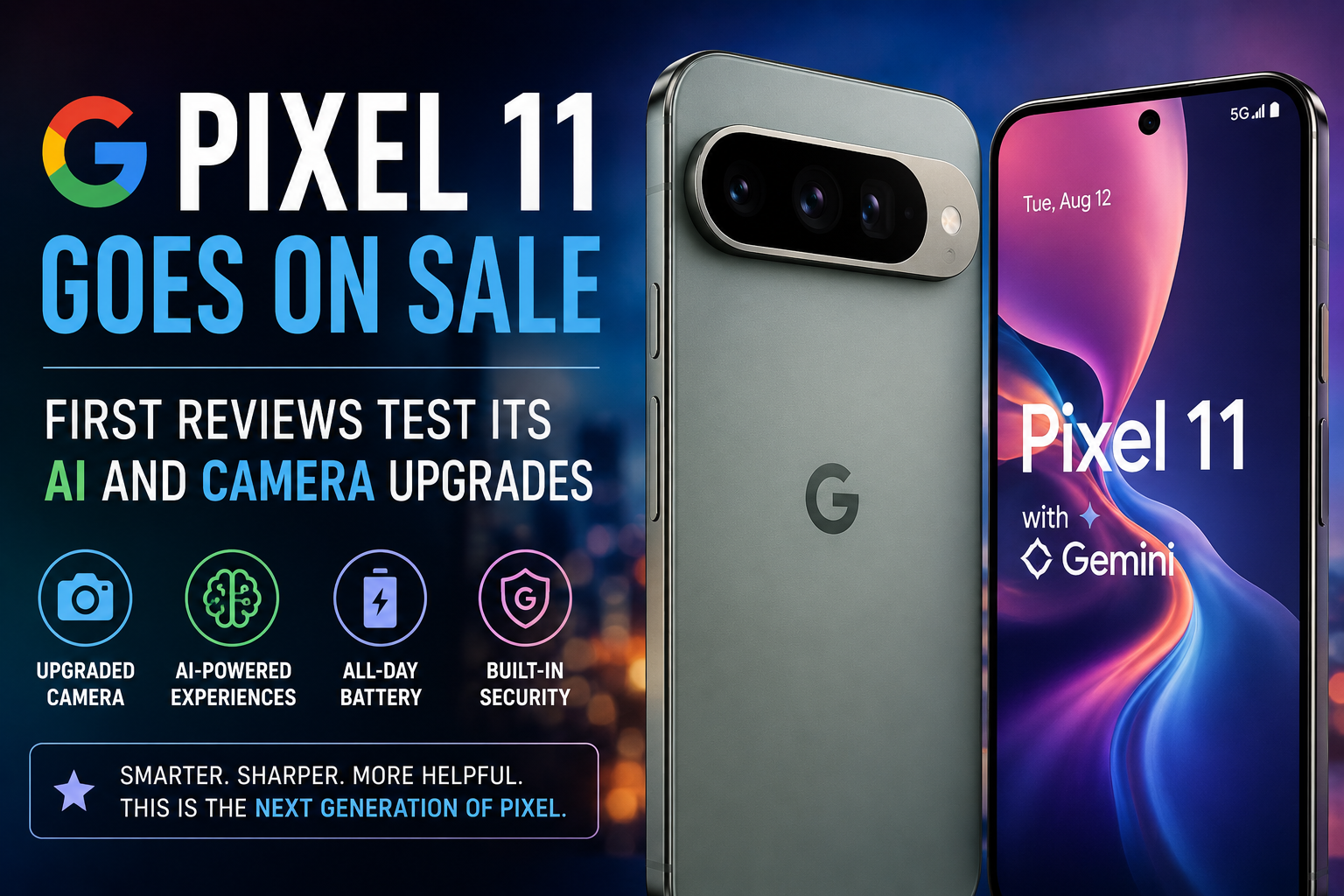
Google Pixel 11 Goes on Sale as First Reviews Test Its AI and Camera Upgrades
Google’s Pixel 11 has officially reached stores, putting the company’s latest flagship smartphone in the hands of consumers after a launch centered heavily on artificial intelligence, photography and Google’s increasingly personalized vision for Android.
The Pixel 11 series was unveiled on August 12, with the phones initially opening for preorders before reaching shelves. Google says the lineup includes the Pixel 11, Pixel 11 Pro, Pixel 11 Pro XL and Pixel 11 Pro Fold, with prices starting at $899 for the standard model, $1,099 for the Pro, $1,299 for the Pro XL and $1,899 for the foldable. (blog.google)
Now that reviewers have had time with the devices, an early consensus is emerging: Google has made meaningful improvements to cameras and AI, but the Pixel 11 is a relatively modest hardware upgrade over its predecessor.
Pixel 11 Puts AI at the Center
Google’s strategy with the Pixel 11 is clear. Rather than competing primarily through dramatic hardware changes, the company is using its own Tensor G6 processor and Gemini technology to make the phone more proactive.
The Tensor G6 powers the new generation of Gemini Nano and is designed specifically to handle increasingly sophisticated AI tasks directly on the device. Google says the chip’s AI-focused Tensor Processing Unit delivers 50% more compute power, while some Gemini Nano workloads can run up to 3.5 times faster. (Android Authority)
That extra processing capability is being used for features that go beyond conventional chatbot interactions.
Google is positioning Gemini as an assistant that can understand more context and help users complete tasks. In selected countries and languages, Google’s new AI capabilities can assist with activities such as ordering groceries, booking rides and getting coffee. (TechCrunch)
The company is also introducing Rambler, a voice transcription feature designed to work with natural speech, and HiLight, a new notification system intended to keep users informed without requiring them to constantly look at their screens. (blog.google)
The bigger question for buyers is whether these AI features are genuinely useful in everyday life or simply another layer of technology that sounds more impressive in a product announcement than it feels after several weeks of use.
Early Reviews Like the AI, With Some Reservations
Initial reviews suggest that Google’s AI strategy is becoming one of the Pixel 11’s strongest differentiators.
WIRED rated the standard Pixel 11 8/10, praising its camera, battery life, performance and contextual AI features. The publication described the phone as a strong Android option while also noting that the changes from the Pixel 10 are relatively minor. (WIRED)
The Verge reached a similarly favorable conclusion about the standard Pixel 11’s overall value, describing it as the most sensible buy in Google’s 2026 Pixel lineup. The publication highlighted its Tensor G6 processor, 12GB of RAM, 256GB base storage and new AI-powered photography tools. (The Verge)
But reviewers have been more skeptical about some of the new AI experiences.
T3’s Pixel 11 Pro review described Gemini as a major strength while finding HiLight less compelling in everyday use. The publication characterized HiLight as an interesting early step toward a more agentic smartphone, but not necessarily a feature users will depend on constantly. (T3)
That distinction could become increasingly important as Google, Apple and other smartphone manufacturers compete to make AI a central part of the mobile experience.
The Camera Gets a Significant Hardware Boost
Photography remains one of the Pixel’s defining strengths, and Google has made more substantial changes to the camera system this year.
The standard Pixel 11 gets a new, larger 48-megapixel main sensor that Google says provides 56% greater light sensitivity in certain conditions. The company says this should improve photographs and video, particularly when lighting becomes difficult. (blog.google)
The phone also combines Tensor G6 processing with its telephoto camera to support 30x Super Zoom.
Google is not relying exclusively on sensors and lenses. Computational photography remains central to the Pixel experience, with the company’s AI models helping process images and extend what the hardware can capture.
For the Pro models, the upgrades are more substantial.
The Pixel 11 Pro and Pro XL receive a new main sensor and an upgraded 48-megapixel telephoto camera. Google says the redesigned telephoto sensor offers 30% greater light sensitivity, while Tensor G6 and Google’s imaging models enable 120x Pro Zoom. Portrait Mode is also available at 5x zoom on the Pro models. (blog.google)
Magic Capture Could Be One of the More Useful Camera Features
One of the more interesting additions is Magic Capture.
The feature is designed to help users recover still images from moments that were recorded as video. The idea addresses a familiar smartphone photography problem: something happens quickly, you start recording rather than taking a photograph, and the perfect still frame exists somewhere inside that video.
Google says Magic Capture is intended to make those fleeting moments easier to preserve. (blog.google)
This is a good example of Google’s broader approach to AI on the Pixel.
Rather than presenting artificial intelligence simply as a chatbot, the company is embedding it into everyday tasks such as photography, transcription, notifications and communication.
Camera Software Is Becoming More Personalized
Google is also introducing Camera Looks, which gives users more control over the visual style of their photographs.
That reflects a broader trend in smartphone photography. Consumers increasingly expect cameras to produce attractive images automatically, but they also want creative control without having to become professional photographers.
The Pixel 11 attempts to sit between those two approaches.
Users can rely on Google’s computational photography when they want convenience while also applying more deliberate visual styles when they want their photos to look different.
For casual photographers, that could be more meaningful than a specification-sheet upgrade that is difficult to notice in everyday use.
The Standard Pixel 11 Still Looks Familiar
If there is one area where the Pixel 11 does not dramatically reinvent itself, it is the physical design.
The phone retains the general design language introduced in previous Pixel generations. Google’s focus this year is clearly on refinement rather than a radical redesign.
WIRED described the changes as incremental, noting that the display remains a 6.3-inch OLED panel and that the overall device is still very familiar to Pixel 10 owners. (WIRED)
Ars Technica was even more blunt, describing the Pixel 11 lineup as polished but visually and mechanically familiar. The publication noted that Google’s 2026 phones make relatively few hardware changes compared with their predecessors. (Ars Technica)
That could be either a strength or a weakness depending on who is buying.
Someone upgrading from a much older Pixel may find the Pixel 11 substantially better. A Pixel 10 owner, however, may struggle to find enough new hardware to justify replacing a relatively recent phone.
Tensor G6 Focuses More on AI Than Benchmarks
Google has historically taken a different approach to smartphone processors from companies that emphasize raw benchmark performance.
The Tensor G6 continues that strategy.
Google says the new chip delivers up to 25% faster web browsing and improved power efficiency compared with the previous generation. Review testing has found more modest improvements in traditional performance, while the GPU has not dramatically changed. (Ars Technica)
The more important improvement may therefore be the AI hardware.
The new TPU is designed to accelerate machine-learning workloads, allowing Google to move more AI processing directly onto the phone.
That approach could become increasingly important as smartphones evolve from passive tools into devices capable of performing more autonomous tasks.
Battery Life and Charging Receive Less Attention
The Pixel 11’s improvements are not limited to AI and cameras, but they are less dramatic in areas such as battery and charging.
The phone supports 25W Qi2 wireless charging, an upgrade that gives Google’s standard model a more competitive wireless charging experience. (WIRED)
Reviewers have generally found battery life to be a strength.
WIRED specifically praised the Pixel 11’s battery performance, while other reviews have described the phone as reliable for everyday use. (WIRED)
Still, the Pixel 11 does not appear to be trying to win the smartphone market through charging speed or battery capacity alone.
Google’s pitch remains centered on the overall experience.
The $899 Price Puts the Pixel 11 in a Competitive Position
The standard Pixel 11 starts at $899, putting it firmly into the premium smartphone category. The Pro models climb significantly higher, while the Pixel 11 Pro Fold reaches $1,899. (blog.google)
That pricing makes the standard Pixel 11 particularly interesting.
It is expensive enough to compete with premium smartphones from Apple and Samsung, but Google has positioned it below the Pro models while retaining many of the same underlying technologies.
The standard model gets Tensor G6, 12GB of RAM and 256GB of base storage, giving it a relatively strong specification for its price. (The Verge)
Google is effectively betting that consumers will see AI capabilities and camera performance as more valuable than having the most advanced possible hardware.
Should Pixel 10 Owners Upgrade?
This may be the most difficult question surrounding the Pixel 11.
For people using a Pixel from several generations ago, the new model offers plenty of reasons to upgrade. The improved camera system, newer processor, AI features, display experience and longer-term software ecosystem can make the difference noticeable.
For Pixel 10 owners, the calculation is less straightforward.
Several reviewers have characterized the Pixel 11 as an incremental upgrade, and Android Central argued that users with phones less than two years old may have little reason to switch because many of the new software features could eventually reach older devices. (Android Central)
That is an important consideration.
If Google’s competitive advantage increasingly comes from software, the company needs to convince consumers that the combination of new hardware and AI features provides enough value to justify upgrading rather than simply waiting for software updates.
The Bigger Pixel 11 Story Is Google’s AI Strategy
The Pixel 11 is less significant as a dramatic smartphone redesign than it is as a statement about where Google believes phones are heading.
The company is moving toward smartphones that anticipate needs, process more information locally and use AI to perform tasks rather than simply responding to commands.
That could eventually change how people interact with their phones.
Instead of opening an application, finding a setting and manually completing several steps, users may increasingly tell an AI assistant what they want and allow the phone to handle the underlying actions.
Google’s challenge is making that experience reliable, understandable and genuinely useful.
Consumers are likely to be less impressed by AI simply because it exists. They will judge it by whether it saves time, reduces friction and performs tasks accurately.
A Strong Pixel, But Not a Radical One
The first wave of Pixel 11 reviews paints a fairly consistent picture.
Google has delivered a polished premium Android phone with better cameras, a more capable AI engine, strong battery life and a refined software experience. The Tensor G6 gives the company additional room to expand Gemini-powered features, while the camera upgrades reinforce Pixel’s reputation for computational photography. (WIRED)
But the standard Pixel 11 is not a dramatic departure from the Pixel 10.
Its design is familiar, traditional performance improvements are relatively modest and some of the most interesting AI features are still evolving.
That may ultimately be the defining characteristic of Google’s 2026 flagship strategy: less emphasis on reinventing the smartphone’s hardware and more emphasis on making the existing smartphone smarter.
For consumers buying a new premium Android phone, the Pixel 11 looks increasingly competitive. For recent Pixel owners, however, the decision may come down to whether Google’s latest AI and camera improvements are compelling enough to make an otherwise familiar phone feel new.