Python Programming Guide
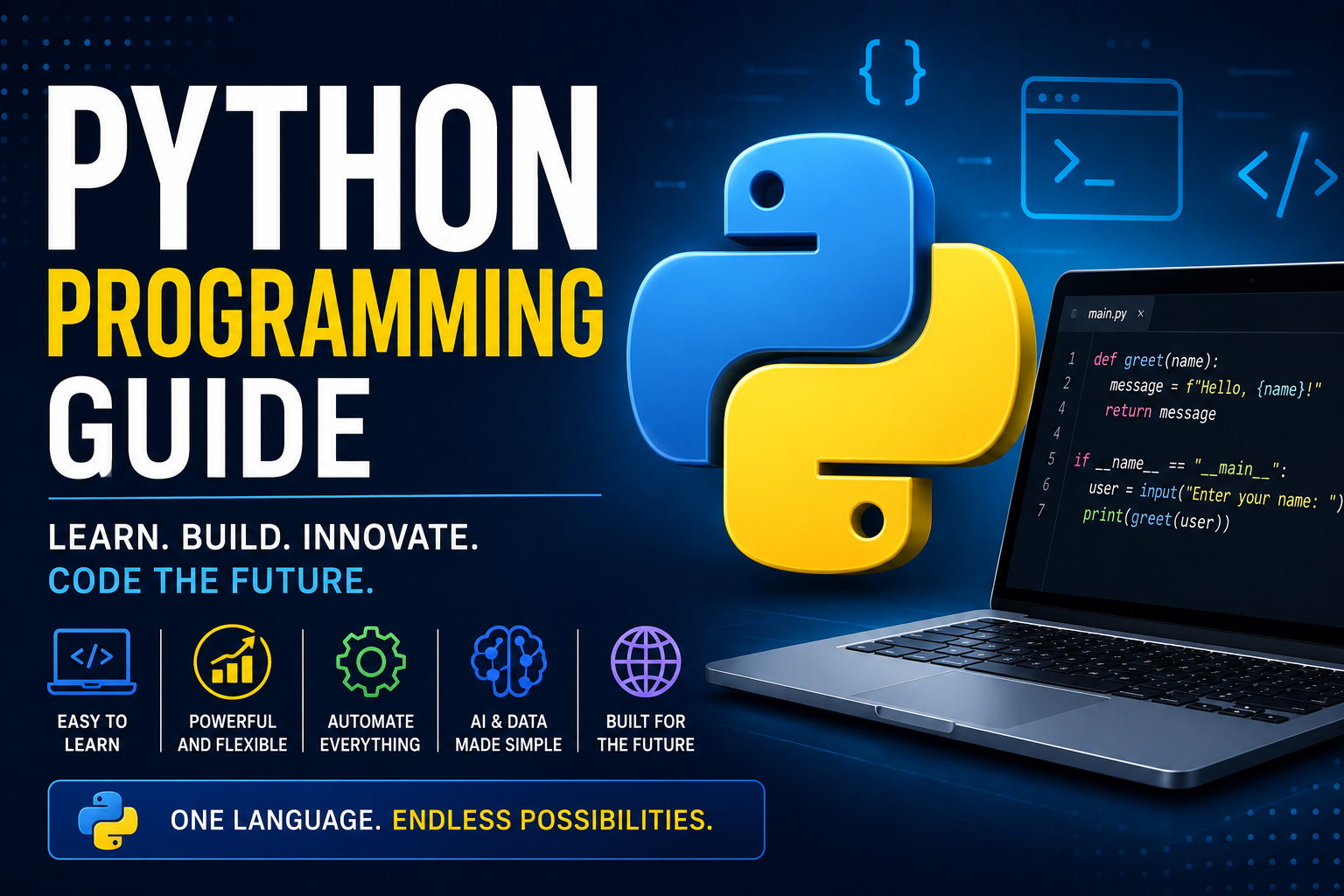
Python has become one of the world’s most popular programming languages, powering everything from websites and mobile applications to artificial intelligence, cybersecurity tools, scientific research, and automation. Its clean syntax, readability, and extensive ecosystem of libraries make it an excellent choice for beginners while remaining powerful enough for experienced software developers.
Whether you’re interested in building web applications, analyzing data, creating machine learning models, or automating repetitive tasks, Python offers a flexible and accessible foundation for modern software development.
This guide explains what Python is, why it has become so widely adopted, its core features, common applications, and practical advice for getting started.
## What Is Python?
Python is a high-level, interpreted, general-purpose programming language designed to emphasize readability, simplicity, and developer productivity.
Created by Guido van Rossum and first released in 1991, Python allows developers to write clear, concise code that is often easier to understand than many other programming languages.
Python supports multiple programming styles, including:
-
Procedural programming
-
Object-oriented programming
-
Functional programming
Its versatility has helped make it one of the most widely used languages across the technology industry.
## Why Python Is So Popular
Python’s popularity continues to grow because it combines ease of learning with professional-grade capabilities.
Key advantages include:
-
Simple syntax
-
Large standard library
-
Cross-platform compatibility
-
Strong community support
-
Extensive third-party packages
-
Rapid development
-
Excellent documentation
-
Wide industry adoption
These characteristics make Python suitable for both beginners and experienced developers.
## How Python Works
Unlike compiled languages that are converted directly into machine code before execution, Python is generally interpreted.
The basic workflow includes:
-
Writing source code.
-
Running the Python interpreter.
-
Executing instructions line by line.
-
Producing program output.
This development process allows developers to test and modify code quickly.
Understanding this workflow is part of understanding the broader software development process used to turn source code into reliable software.
## Installing Python
Getting started with Python typically involves:
-
Installing the latest Python release.
-
Configuring system environment variables if necessary.
-
Verifying installation using the command line.
-
Installing a code editor or integrated development environment (IDE).
Popular development environments include:
-
Visual Studio Code
-
PyCharm
-
Jupyter Notebook
-
Spyder
-
IDLE
Choosing the right editor depends on your workflow and project requirements.
## Python Syntax
One of Python’s defining features is its clean and readable syntax.
A simple example:
print(“Hello, World!”)
Python uses indentation to organize code blocks instead of braces, making programs easier to read and maintain.
## Variables and Data Types
Variables store information that programs use during execution.
Common data types include:
-
Integer (
int) -
Floating-point number (
float) -
String (
str) -
Boolean (
bool) -
List (
list) -
Tuple (
tuple) -
Dictionary (
dict) -
Set (
set)
Python automatically determines variable types during assignment, reducing the need for manual declarations.
## Control Flow
Programs often make decisions based on conditions.
Python supports:
### Conditional Statements
Examples include:
-
if -
elif -
else
These allow programs to execute different code depending on specific conditions.
### Loops
Python provides:
-
forloops -
whileloops
Loops automate repetitive tasks efficiently.
## Functions
Functions group reusable blocks of code.
Benefits include:
-
Improved organization
-
Code reuse
-
Easier maintenance
-
Better readability
Functions can accept parameters and return values, making programs more modular.
These reusable blocks are one of the fundamental concepts of programming, where instructions are organized to perform specific tasks.
## Object-Oriented Programming
Python supports object-oriented programming (OOP), allowing developers to organize code into reusable objects.
Core concepts include:
-
Classes
-
Objects
-
Inheritance
-
Encapsulation
-
Polymorphism
-
Abstraction
These principles help simplify large software projects.
## Python Libraries
One of Python’s greatest strengths is its enormous collection of libraries.
Popular libraries include:
### Data Science
-
NumPy
-
pandas
-
SciPy
### Data Visualization
-
Matplotlib
-
Plotly
### Machine Learning
-
scikit-learn
-
TensorFlow
-
PyTorch
### Web Development
-
Django
-
Flask
-
FastAPI
### Automation
-
Selenium
-
Requests
-
Beautiful Soup
### Cybersecurity
-
Scapy
-
Paramiko
These libraries allow developers to build sophisticated applications without writing every component from scratch.
## Common Uses of Python
Python is used across many industries.
### Web Development
Python powers dynamic websites, APIs, and backend services.
### Artificial Intelligence
Machine learning and deep learning frameworks are heavily based on Python.
### Data Analysis
Analysts use Python to process, visualize, and interpret large datasets.
### Automation
Python simplifies repetitive administrative and operational tasks.
### Cybersecurity
Security professionals use Python for penetration testing, network analysis, and automation.
### Scientific Computing
Researchers rely on Python for simulations, statistical analysis, and engineering applications.
### Game Development
Python can also be used to build games and prototypes using specialized frameworks.
## Package Management
Python uses package managers to install additional libraries.
The most common package manager is pip, which allows developers to install, update, and manage thousands of open-source packages.
Virtual environments are also widely used to isolate project dependencies and avoid conflicts between applications.
## Debugging and Testing
Reliable software depends on thorough testing.
Python developers commonly use:
-
Print debugging
-
Interactive debuggers
-
Unit testing
-
Integration testing
-
Automated testing frameworks
-
Static analysis tools
Testing helps identify bugs before software reaches users.
## Best Practices
Writing clean code improves maintainability and collaboration.
Recommended practices include:
-
Use meaningful variable names.
-
Write small, reusable functions.
-
Follow consistent formatting.
-
Add comments only when helpful.
-
Handle exceptions properly.
-
Organize projects logically.
-
Keep dependencies updated.
-
Write automated tests.
-
Use version control.
-
Document your code.
These habits become increasingly valuable as projects grow.
## Common Beginner Mistakes
New Python programmers often encounter similar challenges.
Examples include:
-
Incorrect indentation
-
Variable naming errors
-
Infinite loops
-
Ignoring exceptions
-
Mixing data types unintentionally
-
Forgetting to install required packages
-
Not testing code thoroughly
-
Writing overly complex functions
Practice and debugging experience help overcome these issues.
## Python in Modern Software Development
Python continues to play an important role in today’s technology landscape.
It is widely used in:
-
Artificial intelligence
-
Cloud computing
-
Automation
-
Data engineering
-
Financial technology
-
Healthcare software
-
Scientific research
-
Cybersecurity
-
Internet of Things (IoT)
-
Education
Its broad adoption means developers can find opportunities across many industries.
## The Future of Python
Python’s future remains strong as demand for AI, automation, cloud services, and data science continues to grow.
Emerging areas where Python is expected to remain influential include:
-
Generative AI
-
Large language models
-
Robotics
-
Edge computing
-
Quantum computing research
-
Intelligent automation
-
Cybersecurity analytics
-
Scientific simulation
Its extensive ecosystem and active community continue to drive innovation.
## Tips for Learning Python
If you’re beginning your programming journey:
-
Start with the basics before advanced topics.
-
Practice coding every day.
-
Build small projects.
-
Read other developers’ code.
-
Learn debugging techniques.
-
Explore Python libraries gradually.
-
Use version control systems.
-
Contribute to open-source projects.
-
Solve programming challenges.
-
Keep experimenting.
Consistent practice is one of the most effective ways to improve programming skills.
## Final Thoughts
Python has earned its reputation as one of the world’s most versatile and beginner-friendly programming languages. Its clear syntax, extensive libraries, and broad range of applications make it an excellent choice for anyone interested in software development, data science, artificial intelligence, automation, or cybersecurity.
Whether you’re writing your first “Hello, World!” program or developing large-scale enterprise applications, Python provides the tools needed to transform ideas into working software. By mastering the fundamentals, following best practices, and building real-world projects, developers can create a strong foundation for a successful career in modern technology.
For beginners who want to understand the broader foundation behind Python, the programming process provides useful context for how instructions become functioning software.
The way Python projects move through planning, development, testing, deployment, and maintenance also connects directly with the wider software development life cycle.