What Are Programming Languages and How Do Different Languages Work?
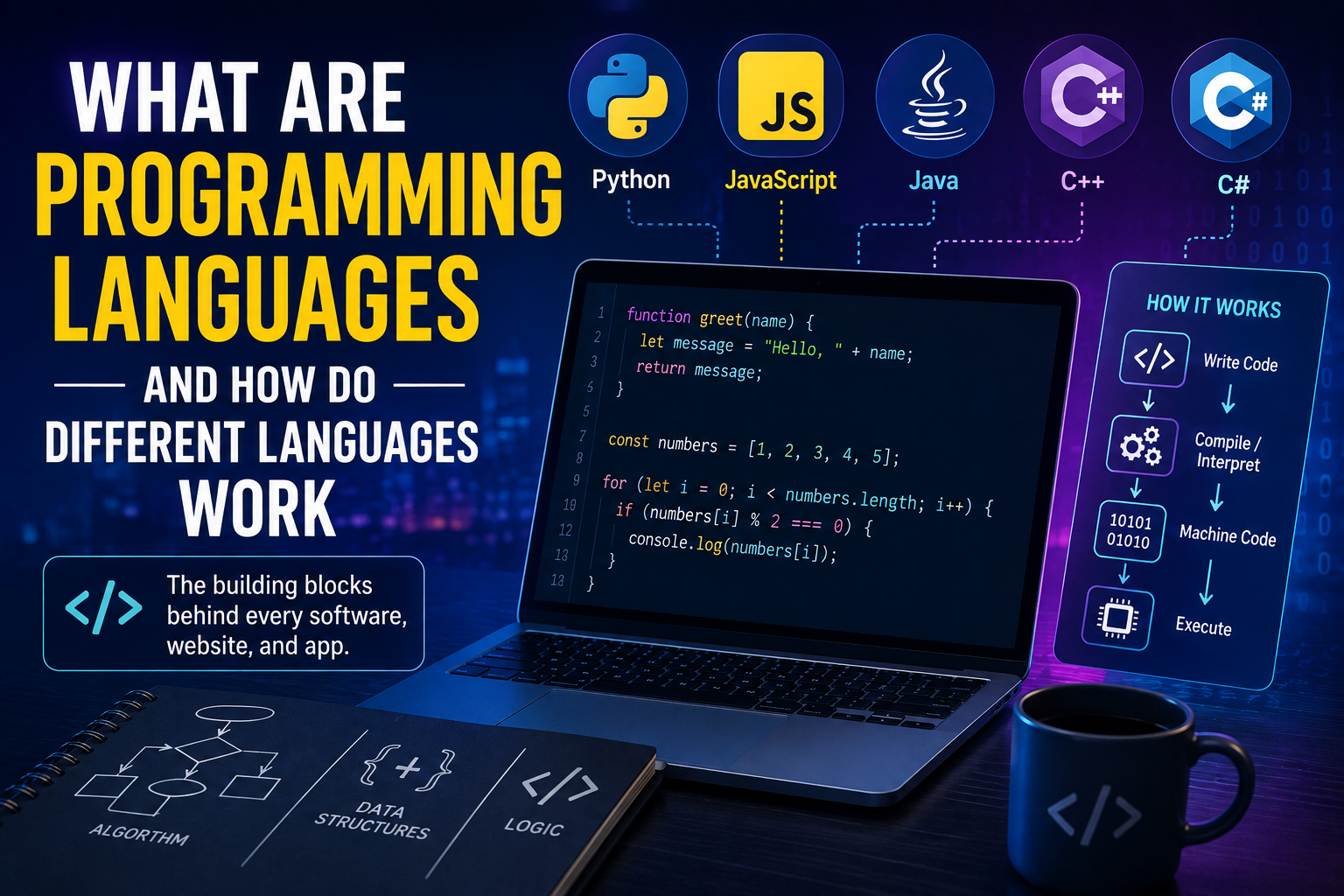
Programming languages are the foundation of modern software. Every website, mobile application, video game, operating system, business platform, and many of the technologies people use every day depend on instructions written in one or more programming languages.
Yet programming languages are not all designed to solve the same problems. Some are built for controlling hardware, while others focus on websites, data analysis, artificial intelligence, mobile applications, or large business systems. They also differ in how they translate human-readable instructions into operations that computers can execute.
Understanding how programming languages work provides a useful foundation for anyone interested in software development, technology, or computer science.
## What Is a Programming Language?
A programming language is a formal system used to write instructions that a computer can process and execute.
Computers ultimately operate using machine-level instructions represented as binary data. Humans, however, cannot efficiently build complex applications by writing long sequences of zeros and ones. Programming languages provide a more understandable way to express logic, calculations, data processing, and other operations.
A simple program might tell a computer to:
-
Receive information from a user.
-
Store that information.
-
Perform a calculation.
-
Make a decision based on the result.
-
Display an answer.
The programming language provides the rules and vocabulary needed to express those instructions.
Languages have syntax, which defines how code must be written, and semantics, which determine what that code means.
For example, many languages use concepts such as variables, functions, conditions, loops, and objects, although they implement those concepts differently.
## How Does Computer Code Become an Executable Program?
A computer processor does not normally execute high-level programming languages directly. Code must be translated or processed into instructions the computer can execute.
Understanding this translation is one part of the broader software development process, which covers how software moves from requirements and design through development, testing, deployment, and maintenance.
There are three important approaches to this process:
-
Compilation
-
Interpretation
-
Just-in-time compilation
The boundaries between these approaches can sometimes overlap. Modern programming environments frequently combine multiple techniques.
### Compilation
A compiler translates source code into another form before the program runs.
For example, a developer might write code in C or C++. A compiler can transform that source code into machine instructions appropriate for a particular processor and operating system.
The resulting executable can then be run without translating the original source code instruction by instruction each time.
Compilation can provide strong performance because much of the translation work happens before execution.
### Interpretation
An interpreter processes program instructions during execution rather than producing a traditional standalone machine-code executable beforehand.
Languages commonly associated with interpreted execution include Python and JavaScript, although modern implementations often use additional compilation techniques.
Interpretation can make development more flexible because code can be executed without the same traditional compilation workflow.
### Just-in-Time Compilation
Just-in-time, or JIT, compilation combines characteristics of compilation and interpretation.
Instead of translating everything before execution, a runtime environment can compile portions of a program while it is running. Frequently executed code can be optimized based on information discovered during execution.
This approach is used by several modern language runtimes and helps explain why the traditional distinction between “compiled” and “interpreted” languages is not always sufficient.
## What Are the Main Types of Programming Languages?
Programming languages can be classified in several ways. One useful approach is to consider how closely a language operates to the underlying hardware.
### Machine Language
Machine language consists of instructions that a processor can execute directly.
It is extremely difficult for humans to write and maintain because the instructions depend on the architecture of the processor.
### Assembly Language
Assembly language provides symbolic representations of low-level processor instructions.
Instead of writing raw binary instructions, developers can use human-readable mnemonics that correspond closely to operations performed by a processor.
Assembly is still used in areas where precise control over hardware and performance is important.
### High-Level Languages
High-level programming languages are designed to make software development more understandable and productive.
Languages such as Python, Java, JavaScript, C#, Go, and many others allow developers to express complex operations using abstractions that hide much of the underlying hardware complexity.
This makes it possible to build sophisticated applications without manually controlling individual processor instructions.
## How Do Different Programming Languages Work?
Although languages share many fundamental concepts, their execution models and design philosophies can be very different.
### Python
Python is a high-level, general-purpose language known for relatively readable syntax.
It is widely used for:
-
Web development
-
Data analysis
-
Scientific computing
-
Automation
-
Artificial intelligence and machine learning
-
Education
-
Scripting
Python code is commonly executed through an implementation that first converts source code into an intermediate representation and then executes it through a runtime environment.
One reason Python is popular is that developers can accomplish complex tasks with comparatively concise code.
### JavaScript
JavaScript was originally developed to add interactive behavior to web pages.
It has since become a major general-purpose language used both in browsers and on servers.
Modern JavaScript engines use sophisticated techniques, including parsing, intermediate representations, optimization, and JIT compilation.
JavaScript is particularly important because it can interact directly with web pages through browser APIs and the Document Object Model, commonly called the DOM.
### Java
Java was designed around the idea of writing code that could run across different computing environments through a virtual machine.
Java source code is commonly compiled into bytecode. The Java Virtual Machine, or JVM, then executes that bytecode.
The JVM can use interpretation and JIT compilation to execute and optimize programs.
Java remains widely used for enterprise software, backend systems, Android-related development, and large-scale applications.
### C
C is a powerful programming language that provides relatively direct access to memory and system resources while still offering higher-level programming features.
It is commonly used in:
-
Operating systems
-
Embedded systems
-
Device software
-
System utilities
-
Performance-sensitive applications
C is usually compiled into machine code, allowing developers to produce highly efficient native programs.
### C++
C++ builds on many concepts introduced by C while adding features such as classes, templates, exceptions, and extensive support for object-oriented and generic programming.
It is frequently used for:
-
Game engines
-
Desktop applications
-
High-performance software
-
Systems programming
-
Financial technology
-
Real-time applications
### C#
C# is a modern programming language strongly associated with the .NET ecosystem.
It is used for:
-
Web applications
-
Desktop software
-
Cloud services
-
Enterprise applications
-
Game development
C# programs commonly run through the .NET runtime, which provides services such as memory management, type handling, and execution support.
### Go
Go, sometimes called Golang, was designed with simplicity, efficiency, and concurrent programming in mind.
It is widely used for:
-
Cloud infrastructure
-
Network services
-
Backend applications
-
Developer tools
-
Distributed systems
Go programs are commonly compiled into native machine code.
### Rust
Rust focuses heavily on performance and memory safety.
One of its distinctive characteristics is its ownership and borrowing system, which allows many memory-related problems to be detected during compilation rather than after a program is running.
Rust is increasingly used for systems software, infrastructure, command-line tools, and other applications where performance and safety are important.
## What Are Variables and Data Types?
Almost every programming language provides mechanisms for storing and manipulating information.
A variable is a named location or reference associated with a value.
For example, a program might store:
-
A person’s name
-
An age
-
A temperature
-
A product price
-
A list of items
Programming languages also define data types, which describe the kinds of values programs can work with.
Common data types include:
-
Integers
-
Floating-point numbers
-
Strings
-
Booleans
-
Arrays
-
Objects
-
Structures
Some languages require developers to specify types explicitly, while others can infer types automatically.
## How Do Programming Languages Make Decisions?
Programs frequently need to make decisions.
A conditional statement allows software to perform different actions depending on whether a condition is true or false.
For example, a banking application might conceptually perform an operation such as:
If the account balance is sufficient:
approve the transaction Otherwise:
reject the transactionDifferent languages use different syntax for expressing this logic, but the underlying concept is similar.
Conditional logic is one of the fundamental building blocks of software.
## How Do Loops Work?
Programs often need to repeat an operation.
A loop allows developers to execute a section of code multiple times.
For example, a program could loop through a list of customers and perform an operation for each one.
Common types of loops include:
-
forloops -
whileloops -
Iterators
-
Recursion-based repetition
The exact implementation varies between languages, but the purpose is generally the same: automate repeated operations without requiring developers to write the same instructions manually.
## What Are Functions?
Functions allow developers to organize reusable pieces of logic.
Instead of writing the same instructions repeatedly, a programmer can place those instructions inside a function and call the function whenever needed.
A function can:
-
Receive input.
-
Process that input.
-
Produce an output.
For example, an application might have a function that calculates the total price of an order.
Functions make programs easier to organize, test, maintain, and reuse.
## What Is Object-Oriented Programming?
Object-oriented programming, or OOP, organizes software around objects that combine data and behavior.
Common OOP concepts include:
-
Classes
-
Objects
-
Encapsulation
-
Inheritance
-
Polymorphism
-
Abstraction
Languages such as Java, C#, C++, and Python support object-oriented programming, although they differ in how strongly they encourage or structure the approach.
OOP can be particularly useful for large applications where developers need to organize complex relationships between different parts of a system.
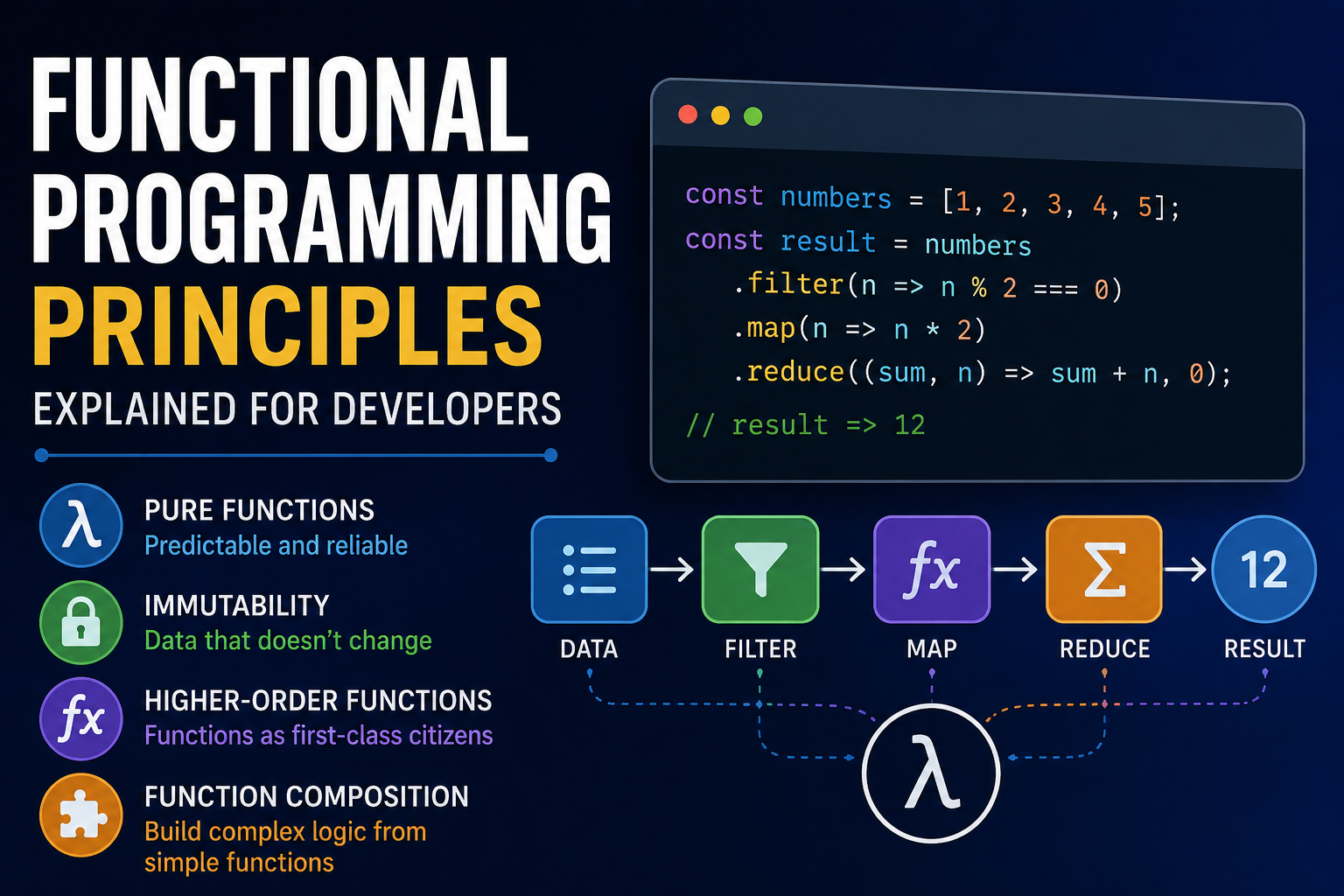
## What Is Functional Programming?
Functional programming approaches software differently.
It emphasizes concepts such as:
-
Functions as first-class values
-
Immutability
-
Pure functions
-
Function composition
-
Declarative programming
Languages such as Haskell are strongly associated with functional programming, while languages including JavaScript, Python, Scala, Kotlin, and others provide varying levels of functional programming support.
Functional techniques can make certain programs easier to reason about, particularly when managing complex transformations of data.
## Why Are There So Many Programming Languages?
No single programming language is ideal for every type of software.
Different languages make different trade-offs involving:
-
Performance
-
Safety
-
Simplicity
-
Flexibility
-
Development speed
-
Memory management
-
Hardware access
-
Concurrency
-
Ecosystem support
-
Maintainability
A language designed for embedded hardware may prioritize memory efficiency and hardware control. A language intended for rapid application development may prioritize developer productivity and readability.
This specialization explains why the software industry continues to use many different languages.
## Programming Languages Versus Frameworks
Programming languages are sometimes confused with frameworks or libraries.
A programming language provides the fundamental syntax and semantics used to write software.
A library is a collection of reusable functionality that developers can call from their programs.
A framework provides a broader structure for building applications and often determines how different components interact.
For example, JavaScript is a programming language, while frameworks such as React and Angular provide tools and structures for building applications with JavaScript or related technologies.
The distinction matters because learning a programming language and learning its surrounding ecosystem are separate but connected skills.
## How Programming Languages Communicate With Hardware
High-level code eventually has to interact with physical computing resources.
Depending on the language and runtime, a program may interact with:
-
The processor
-
Memory
-
Storage
-
Network interfaces
-
Graphics hardware
-
Sensors
-
Cameras
-
Input devices
Some languages provide direct mechanisms for interacting with these resources, while others rely heavily on operating systems and runtime environments.
For example, a high-level application might request that an operating system read a file. The operating system then handles the underlying hardware operations.
This layered approach allows developers to build applications without needing to understand every electrical or processor-level detail involved in a hardware operation.
## What Makes One Programming Language Different From Another?
Several characteristics can distinguish one language from another.
### Syntax
Syntax determines how code must be written.
Two languages may perform the same operation while requiring completely different syntax.
### Type System
A language’s type system determines how it handles different kinds of data.
Languages can have static or dynamic typing, among other approaches.
### Memory Management
Some languages require developers to manage memory manually. Others provide automatic memory management through systems such as garbage collection.
### Programming Paradigm
Languages may emphasize object-oriented, functional, procedural, declarative, or other programming approaches.
### Runtime Environment
Some languages depend heavily on a runtime environment that provides services between the application and the operating system.
### Ecosystem
A language’s usefulness also depends heavily on its libraries, frameworks, developer tools, documentation, and community.
## Which Programming Language Should Beginners Learn?
There is no universally correct first programming language.
The best choice depends on what someone wants to build.
| Goal | Languages Worth Considering |
| —– | —– |
| Web development | JavaScript, TypeScript |
| Data analysis | Python, R |
| Artificial intelligence | Python |
| Systems programming | C, C++, Rust |
| Mobile development | Kotlin, Swift |
| Enterprise applications | Java, C#, TypeScript |
| Game development | C++, C#, GDScript |
| Automation | Python, JavaScript |
| Cloud and backend systems | Go, Java, Python, C#, Rust |
For many beginners, Python is attractive because its syntax is relatively accessible and its ecosystem covers a broad range of applications.
Someone specifically interested in web development, however, may benefit from learning JavaScript or TypeScript early.
The most important factor is usually not choosing the theoretically “best” language, but learning fundamental programming concepts that can transfer between languages.
## Why Programming Concepts Matter More Than Syntax
A developer who understands variables, data structures, algorithms, functions, debugging, abstraction, version control, testing, and software architecture can often learn additional languages much faster.
Syntax changes from language to language.
The underlying principles frequently do not.
For example, once someone understands what a loop does, learning the syntax for loops in another language becomes a relatively small task.
This is why strong programming education focuses on problem-solving rather than memorizing individual commands.
For a broader introduction to the subject, learning how programming works provides useful context for understanding how these concepts become functioning software.
## The Role of Programming Languages in Modern Technology
Programming languages are behind nearly every layer of modern digital infrastructure.
They are used to create:
-
Websites
-
Mobile applications
-
Operating systems
-
Cloud platforms
-
Databases
-
Games
-
Artificial intelligence systems
-
Scientific simulations
-
Financial systems
-
Internet services
-
Embedded devices
-
Automation tools
Modern software projects often use multiple languages rather than relying on one language exclusively.
A web application, for example, might use TypeScript for its interface, another language for backend services, SQL for database operations, and additional languages for infrastructure or data processing.
## Where Programming Languages Are Heading
Programming languages continue to evolve as software development becomes more complex.
Several long-term priorities are shaping language design, including:
-
Memory safety
-
Parallel and concurrent computing
-
Developer productivity
-
Cloud computing
-
Artificial intelligence
-
Energy efficiency
-
Hardware acceleration
-
Security
-
Cross-platform development
AI-assisted programming is also changing how developers interact with code. Instead of relying exclusively on manually written syntax, programmers can increasingly describe desired behavior in natural language and use development tools to generate, explain, test, or modify code.
That does not eliminate the need to understand programming. In many cases, it makes fundamental knowledge more valuable because developers still need to evaluate whether generated code is correct, secure, efficient, and appropriate for the problem.
## Understanding Code Is Understanding How Software Thinks
Programming languages provide the vocabulary through which humans communicate instructions to computers. While Python, JavaScript, C, Java, Rust, Go, and other languages differ considerably, they share fundamental ideas about data, logic, computation, abstraction, and problem-solving.
Learning those underlying ideas provides a foundation that extends well beyond any single language.
For anyone beginning a software career, the goal should therefore be more than memorizing syntax. Understanding why programs work, how code is executed, how data moves through a system, and how different programming approaches solve different problems provides the durable knowledge that can remain useful even as individual languages and technologies evolve.