What Makes Code Clean and Maintainable?
Software can work perfectly today and still become a serious problem tomorrow.
A program may produce the right results, pass its tests, and satisfy its users while quietly becoming harder to understand with every new feature. Over time, developers may struggle to determine what a particular function does, where a bug originated, or how a seemingly simple change could affect the rest of the application.
This is where clean and maintainable code becomes important.
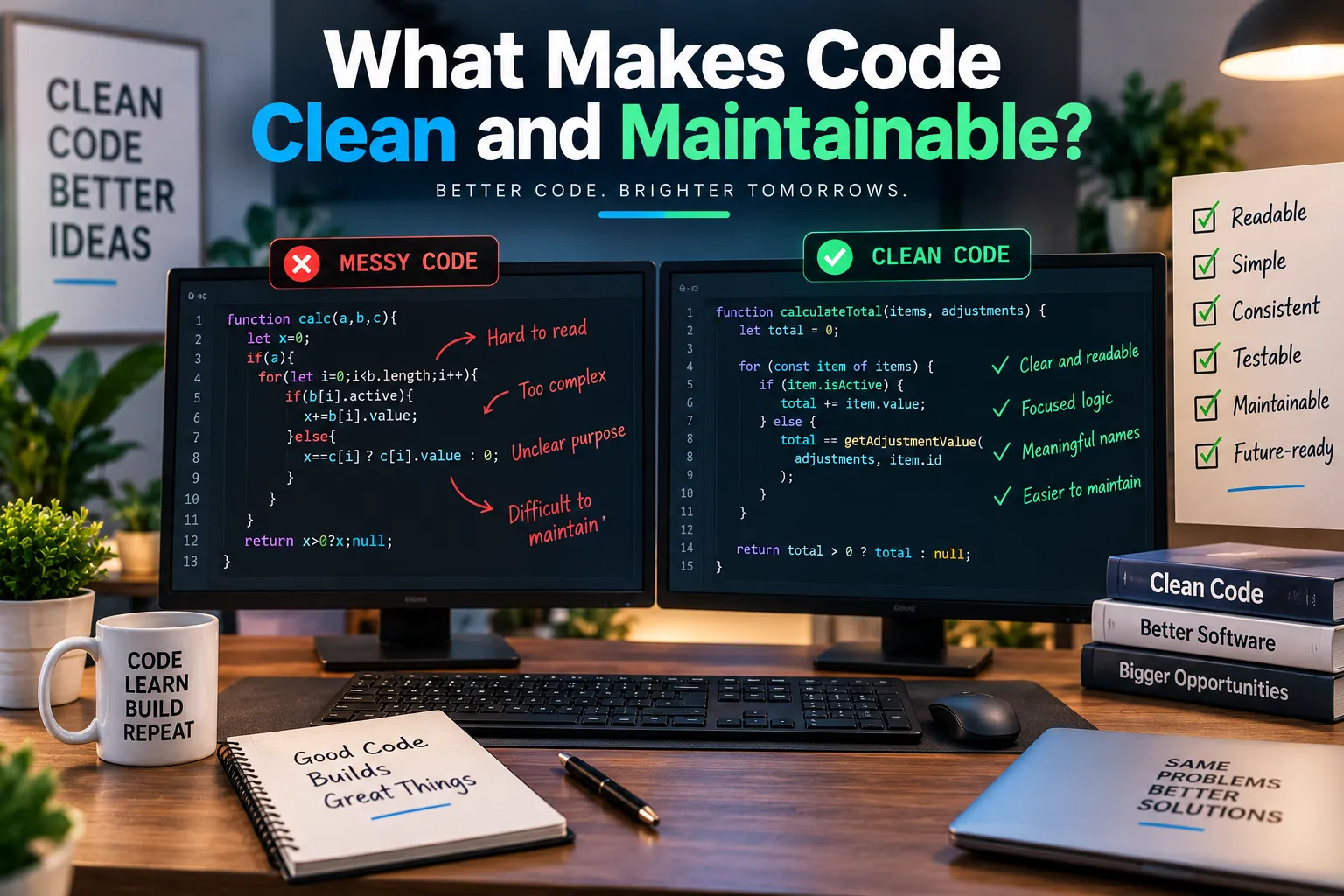
Clean code is not simply code that looks attractive or follows a particular formatting style. It is code that is easy to understand, predictable, well organized, appropriately documented, testable, and relatively safe to change.
Maintainable code reduces the amount of effort required to fix problems, add features, onboard developers, and adapt software as requirements change.
The difference can have a major impact on the long-term cost and reliability of a software project.
What Is Clean Code?
Clean code is code written in a way that makes its purpose and behavior relatively easy for other developers to understand.
A developer reading clean code should not have to decipher complicated logic unnecessarily or reconstruct the author’s intentions from scattered clues.
Clean code generally emphasizes:
- Readability
- Simplicity
- Consistency
- Clear naming
- Small and focused functions
- Logical organization
- Appropriate abstraction
- Limited duplication
- Predictable behavior
- Easy testing
- Straightforward modification
Clean code does not necessarily mean short code.
Sometimes a longer implementation is clearer than an extremely compressed one. The goal is not to minimize the number of lines but to minimize unnecessary complexity and confusion.
What Does Maintainable Code Mean?
Maintainability describes how easily software can be understood, modified, repaired, tested, and extended over time.
Software rarely remains unchanged.
Requirements evolve. Customers request new features. Operating systems change. Security vulnerabilities are discovered. Dependencies are updated. Businesses change direction. New developers join the project.
Maintainable code makes these changes less painful.
For example, imagine two applications that perform the same task.
In the first application, adding a new feature requires modifying several unrelated files, changing complicated conditional statements, and manually checking dozens of behaviors.
In the second application, the feature can be added by extending one clearly defined component with a few well-tested changes.
Both applications may work today, but the second one is likely to be significantly easier to maintain.
Clean Code and Maintainability Are Closely Connected
Clean code and maintainability are not identical concepts, but they reinforce each other.
Readable code makes maintenance easier.
Simple logic makes debugging easier.
Good structure makes changes easier.
Well-designed interfaces reduce unintended side effects.
Tests make future modifications safer.
Consistent conventions make unfamiliar parts of a codebase easier to understand.
This is why writing maintainable software requires more than following formatting rules. Developers must think about how the code will be understood and modified months or years after it was originally written.
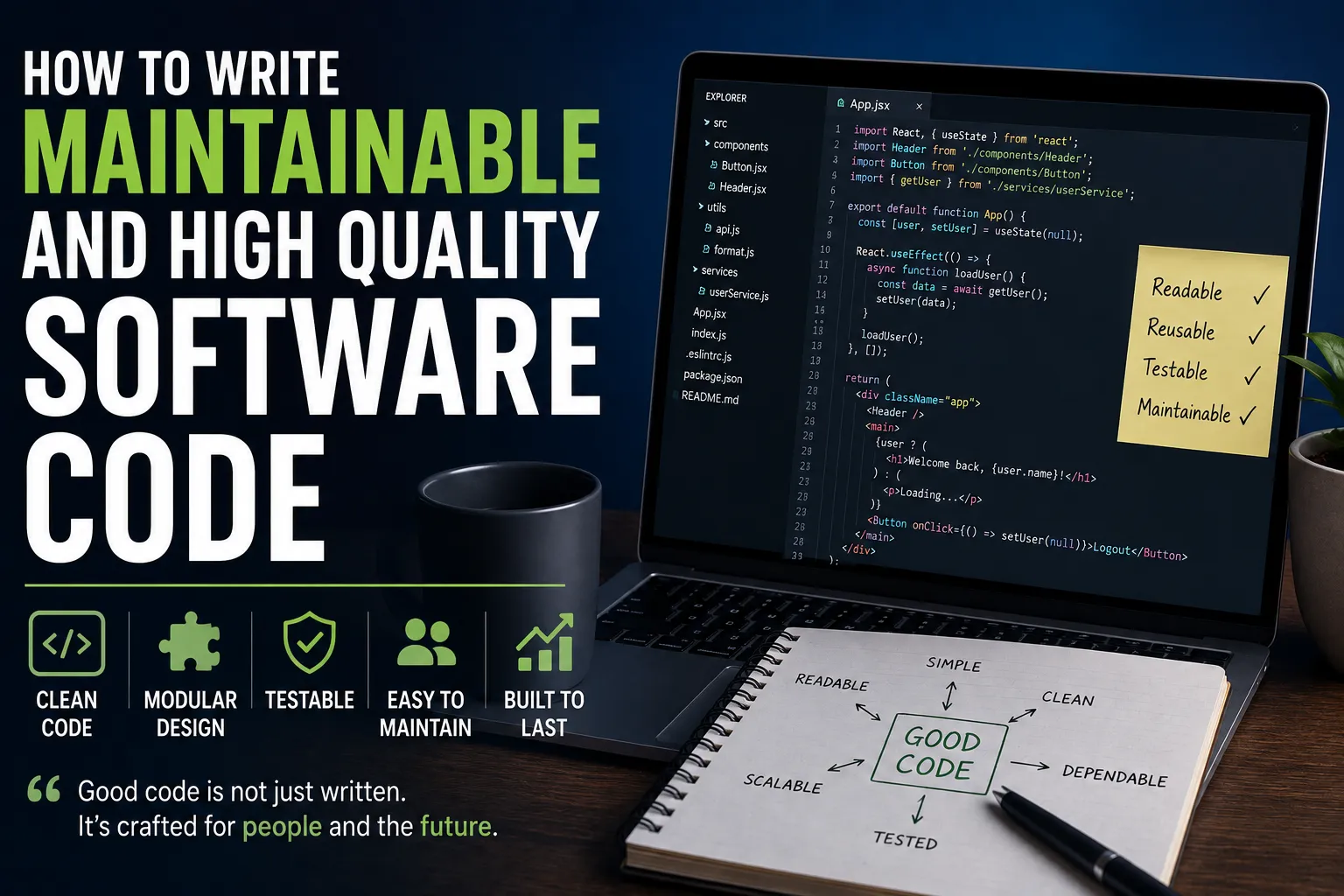
For a broader look at these practices, how to write maintainable and high-quality software code provides a useful foundation.
Clear and Descriptive Naming
One of the simplest ways to improve code quality is to give variables, functions, classes, and other elements meaningful names.
Consider a variable called:
x
It tells the reader almost nothing.
Compare it with:
customerCount
The second name immediately communicates its likely purpose.
The same principle applies to functions.
A function called:
processData()
is vague.
A function called:
calculateMonthlyRevenue()
provides substantially more information.
Good names reduce the amount of explanation the reader needs to understand the code.
Good Names Answer Questions
A useful name can communicate:
- What something represents
- What a function does
- What a value measures
- What a class is responsible for
- What a boolean condition means
For example:
if (isAccountActive) {
…
}
is easier to understand than:
if (flag) {
…
}
The code becomes almost self-explanatory.
Keep Functions Focused
Functions become difficult to maintain when they attempt to do too many unrelated things.
A function might:
- Retrieve customer information
- Validate an order
- Calculate taxes
- Format an email
- Save the order
- Send a notification
- Record an analytics event
Even if this works, it creates a large amount of responsibility in one location.
A change to one part of the process could unexpectedly affect another.
A cleaner approach is often to divide responsibilities into smaller units.
For example:
getCustomer()
validateOrder()
calculateTax()
saveOrder()
sendConfirmation()
recordOrderEvent()
Each function has a clearer purpose.
This makes individual components easier to understand and test.
Avoid Unnecessary Complexity
Complexity is one of the biggest enemies of maintainability.
Developers sometimes introduce complicated solutions when a simpler approach would accomplish the same goal.
This can happen because of:
- Overengineering
- Excessive abstraction
- Clever but obscure programming techniques
- Deeply nested conditions
- Large functions
- Complicated inheritance structures
- Unnecessary design patterns
- Excessive configuration
- Premature optimization
A sophisticated solution is not automatically a better solution.
The best implementation is often the simplest one that satisfies the actual requirements while leaving enough structure for reasonable future changes.
Reduce Deep Nesting
Nested logic can quickly become difficult to follow.
For example:
if (user) {
if (user.isActive) {
if (user.hasPermission) {
if (account) {
// perform operation
}
}
}
}
The reader must mentally track several conditions before reaching the actual operation.
In many situations, guard clauses can make the logic easier to follow:
if (!user) return;
if (!user.isActive) return;
if (!user.hasPermission) return;
if (!account) return;
// perform operation
The specific technique will depend on the language and situation, but the underlying principle is broadly useful:
Make the main path of execution easy to see.
Follow the Principle of Single Responsibility
The Single Responsibility Principle is commonly associated with object-oriented software design.
At a high level, it suggests that a component should have a focused responsibility rather than becoming responsible for many unrelated concerns.
A class responsible for authentication, database management, email delivery, reporting, and payment processing is likely doing too much.
Breaking those responsibilities into appropriate components can make the system easier to reason about.
This does not mean every class or function needs to contain only a few lines.
Instead, the goal is to establish cohesive responsibilities.
Keep Related Code Together
Good organization helps developers find things quickly.
If authentication logic is scattered throughout the application, developers may have difficulty understanding how authentication works.
If related functionality is grouped logically, navigating the project becomes easier.
This becomes particularly important as applications grow.
Developers should think about:
- Folder structure
- Module boundaries
- Component responsibilities
- Naming conventions
- Dependency relationships
- Separation of concerns
Code organization is one part of a larger architectural picture. Understanding how software architecture organizes applications can help explain how individual pieces of code fit into larger systems.
Avoid Excessive Code Duplication
Duplicated code can create maintenance problems.
Imagine the same business rule appears in five different places.
If that rule changes, developers must remember to update all five locations.
If one is missed, the application may behave inconsistently.
This is commonly described through the principle DRY, or Don’t Repeat Yourself.
However, eliminating duplication should not become an obsession.
Sometimes two pieces of code look similar but represent different concepts. Combining them too aggressively can create abstractions that are more complicated than the original duplication.
The better question is not simply:
Can these lines be combined?
Instead, ask:
Do these pieces of logic represent the same underlying responsibility?
If they do, sharing the implementation may make sense.
Use Abstraction Carefully
Abstraction can make software easier to maintain by hiding unnecessary implementation details.
For example, an application might expose a simple interface such as:
sendEmail()
without requiring every part of the application to know how the email provider works internally.
However, excessive abstraction can have the opposite effect.
A developer may encounter several layers of interfaces, wrappers, factories, adapters, and helper classes before reaching the actual operation.
Good abstraction should reduce complexity for the people using it.
If an abstraction makes the system harder to understand than the underlying implementation, it may not be helping.
Comments Should Explain Why
Comments can be useful, but they should not compensate for confusing code.
Consider:
// Increment i by one
i++;
The comment adds little value because the code is already obvious.
A more useful comment might explain why an unusual operation exists:
// Retry once because the external service occasionally
// returns a temporary authorization response during token refresh.
The code shows what is happening.
The comment explains why.
That distinction makes documentation much more valuable.
Documentation Has a Role
Not everything should be explained inside source code.
Larger projects benefit from documentation covering areas such as:
- Installation
- Configuration
- Architecture
- APIs
- Development workflows
- Deployment
- Security requirements
- Troubleshooting
- Contribution guidelines
Good documentation reduces the amount of knowledge that exists only in one developer’s head.
That becomes particularly important when teams grow or developers move between projects.
Write Code That Is Easy to Test
Testability is an important characteristic of maintainable software.
Code that is tightly coupled and dependent on global state can be difficult to test.
Code with clear inputs and outputs is often easier to verify.
For example:
function calculateTotal(price, tax) {
return price + (price * tax);
}
The function has clear inputs and a predictable output.
A test can provide values and verify the result without needing to configure an entire application.
Testing is not merely a quality-control activity performed after development. The way code is designed can make testing easier or harder from the beginning.
For more context, what software testing is and how developers ensure software quality explores the role testing plays in software development.
Handle Errors Deliberately
Poor error handling can make software difficult to diagnose and maintain.
Developers should think carefully about what happens when something goes wrong.
Possible failures include:
- Invalid user input
- Missing files
- Network failures
- Database errors
- Authentication problems
- External service outages
- Unexpected application states
Silently ignoring errors can make debugging extremely difficult.
At the same time, exposing technical error details to end users can create security and usability problems.
Good error handling should provide useful information to developers while presenting appropriate messages to users.
Make Code Consistent
Consistency is one of the most underrated aspects of maintainability.
A project becomes easier to understand when developers follow common conventions for:
- Naming
- Formatting
- File organization
- Error handling
- Function structure
- Imports
- API design
- Testing
- Documentation
A developer should not have to learn a completely different style every time they open another file.
Automated formatting and linting tools can help enforce many basic conventions automatically.
This allows developers to spend more time thinking about behavior and design rather than debating indentation or formatting.
Keep Dependencies Under Control
Modern software rarely exists in isolation.
Applications often depend on external libraries, frameworks, APIs, and services.
Dependencies can accelerate development, but they also introduce maintenance responsibilities.
Developers need to consider:
- Whether a dependency is actively maintained
- How frequently it receives security updates
- Whether its license is appropriate
- Whether the project actually needs it
- How difficult it would be to replace
- Whether updates could introduce breaking changes
Adding a dependency simply because it solves a small problem may create unnecessary long-term complexity.
Sometimes a small internal implementation is easier to maintain than another external package.
Design for Change Without Overengineering
Maintainability does not mean predicting every possible future requirement.
Developers cannot know exactly how an application will evolve.
Instead, they should create reasonable boundaries that make likely changes easier without building a complicated system for hypothetical scenarios.
For example, if an application is likely to support multiple payment providers, designing a clean payment interface may be sensible.
Building an elaborate plugin ecosystem before the application has its first customer may not be.
Good maintainability sits between two extremes:
Rigid code that is difficult to change and overengineered code that is difficult to understand.
Refactoring Is Part of Software Development
Even good code can become messy over time.
Requirements change. Features accumulate. Developers make compromises under deadlines. New functionality interacts with old assumptions.
This is why refactoring is an important part of software development.
Refactoring means improving the internal structure of code without intentionally changing its externally observable behavior.
Examples include:
- Renaming confusing variables
- Splitting large functions
- Removing duplication
- Simplifying conditional logic
- Extracting reusable components
- Improving module boundaries
- Removing obsolete code
Refactoring does not necessarily produce visible features for users, but it can significantly improve the health of a codebase.
Technical Debt Can Accumulate
When developers choose a quick or imperfect solution to meet an immediate requirement, they may create technical debt.
Technical debt is not always bad.
Sometimes a deliberate shortcut is appropriate when speed matters.
The problem occurs when accumulated shortcuts make future development increasingly expensive.
Technical debt can appear as:
- Outdated dependencies
- Duplicated business logic
- Poor architecture
- Missing tests
- Temporary workarounds that become permanent
- Unclear code
- Inconsistent interfaces
- Fragile integrations
A healthy development process recognizes technical debt and addresses important problems before they become significantly more expensive.
Understanding the wider development lifecycle is useful here. The complete guide to software development processes provides broader context for how planning, development, testing, deployment, and maintenance fit together.
Clean Code Is a Team Practice
One developer can write excellent code, but maintaining a healthy codebase requires team-wide consistency.
Teams can establish shared standards through:
- Code reviews
- Style guides
- Automated linting
- Automated formatting
- Testing requirements
- Documentation standards
- Architecture guidelines
- Continuous integration
- Refactoring practices
Code reviews are particularly valuable because they introduce another perspective.
A reviewer may notice that:
- A function is doing too much
- A name is unclear
- A security concern was overlooked
- A simpler implementation exists
- A test is missing
- A new dependency is unnecessary
The objective should not be to criticize the person who wrote the code.
The objective is to improve the software.
Readability Often Beats Cleverness
Developers sometimes take pride in solutions that are technically clever.
But clever code can be difficult for other developers to understand.
Consider a developer who discovers an extremely compact way to solve a problem. If the technique requires extensive mental effort to understand, it may be less maintainable than a straightforward implementation that takes several additional lines.
Software is usually read far more often than it is written.
A developer might spend ten minutes writing a function but other developers could spend hours reading, debugging, testing, and modifying it over its lifetime.
Optimizing for readability can therefore save significant time.
Security Should Be Part of Maintainability
Maintainable code is not merely convenient code.
Poorly structured software can also make security vulnerabilities harder to identify and fix.
For example:
- Duplicated authentication logic can produce inconsistent security checks.
- Unclear data flows can make sensitive information difficult to track.
- Poor dependency management can leave vulnerable packages in use.
- Complex authorization logic can result in access-control mistakes.
- Missing tests can allow security regressions to go unnoticed.
Security should therefore be considered during design, development, testing, deployment, and maintenance rather than added only after a vulnerability appears.
A Practical Clean-Code Checklist
Before considering a piece of code complete, developers can ask:
Readability
- Are names clear?
- Can another developer understand the code quickly?
- Is the main purpose obvious?
Simplicity
- Is the implementation more complicated than necessary?
- Are there unnecessary abstractions?
- Can deeply nested logic be simplified?
Organization
- Does each component have a clear responsibility?
- Is related functionality logically grouped?
- Are module boundaries sensible?
Reliability
- Are errors handled appropriately?
- Are important edge cases considered?
- Does the code behave predictably?
Testing
- Can important behavior be tested?
- Are critical paths covered?
- Would a future change be likely to break something unnoticed?
Maintenance
- Will another developer know where to make a change?
- Is unnecessary duplication present?
- Are dependencies justified and manageable?
Documentation
- Are unusual decisions explained?
- Is important project knowledge documented?
- Can a new developer understand how to work with the codebase?
The Long-Term Value of Clean Code
Clean code is ultimately about reducing friction.
When software is well structured, developers can understand it faster, make changes with greater confidence, identify problems more easily, and spend less time fighting the existing codebase.
That does not mean clean code eliminates bugs or guarantees that software will remain easy forever. Every sufficiently complex system accumulates challenges.
But good code creates a stronger foundation for dealing with those challenges.
The most maintainable code is not necessarily the most sophisticated code. It is code that communicates its intentions clearly, keeps responsibilities manageable, limits unnecessary complexity, handles failure deliberately, and gives future developers a reasonable path forward.
In software development, today’s code becomes tomorrow’s foundation. Writing it with the next developer—and the future version of the application—in mind is one of the most practical ways to build software that can continue to evolve without becoming increasingly difficult to manage.