Anthropic Explores Custom AI Chips as Labs Seek Alternatives to Nvidia
The race to build increasingly capable artificial intelligence systems is creating a new battlefront: the hardware that powers them.
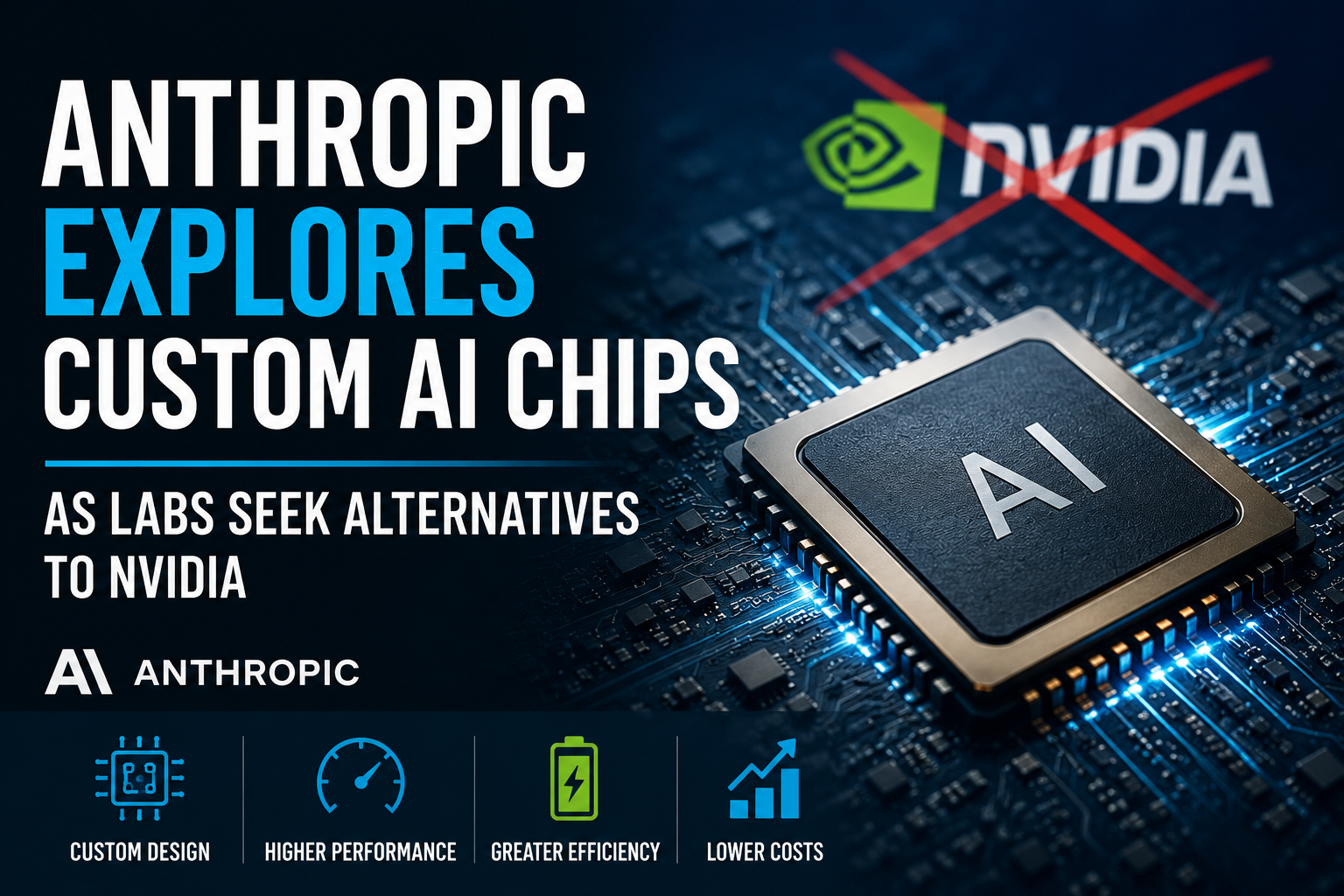
Anthropic, the company behind the Claude family of AI models, is expanding its efforts to develop custom silicon as it looks for greater control over the computing infrastructure required to train and run its systems. The move comes as major AI companies increasingly explore alternatives to Nvidia’s dominant data-center GPUs.
Anthropic has already taken a multi-platform approach, using hardware from Nvidia, Google and Amazon. But recent developments suggest the company wants to move further into chip design itself, potentially giving its engineers more control over performance, energy consumption and the cost of running Claude at scale.
The shift reflects a broader change in the AI industry. The companies developing the world’s most advanced models are increasingly discovering that software leadership depends partly on controlling the hardware underneath it.
Why Anthropic Wants More Control Over AI Hardware
Training and operating large AI models requires enormous amounts of computing power.
For years, Nvidia’s GPUs have been central to that infrastructure because they combine powerful parallel processing with a mature software ecosystem designed for AI workloads. But dependence on a single dominant supplier creates strategic challenges for AI companies.
Demand for advanced AI accelerators has remained extremely high, while the supply chain for leading-edge chips, high-bandwidth memory and advanced packaging remains constrained. Companies can therefore face not only high costs but also uncertainty over how quickly they can secure additional computing capacity.
A custom chip could give an AI developer greater control over the hardware and allow engineers to optimize the processor specifically for the workloads generated by its models.
That does not necessarily mean replacing Nvidia entirely.
Anthropic has explicitly said it will continue using a multi-chip strategy, combining its own hardware efforts with processors from other suppliers.
Anthropic Is Already Using Custom Silicon From Cloud Providers
Anthropic’s interest in custom chips is not starting from scratch.
The company has developed a close relationship with Amazon Web Services and has been working with AWS engineers on Amazon’s Trainium accelerators. Anthropic says its engineers work directly with AWS’s Annapurna Labs team to optimize software and hardware for its AI workloads.
The partnership has grown substantially.
In April 2026, Anthropic announced an agreement with Amazon covering up to 5 gigawatts of additional computing capacity, including Trainium2 and future generations of Amazon’s custom AI silicon. Anthropic also said it was already using more than one million Trainium2 chips to train and serve Claude.
That relationship gives Anthropic practical experience in designing AI workloads around specialized processors.
Developing its own silicon would take that approach one step further.
Google TPUs Are Another Part of the Strategy
Anthropic is also using Google’s custom AI accelerators.
In April, the company announced a new agreement with Google and Broadcom for multiple gigawatts of next-generation TPU capacity expected to begin coming online in 2027.
Anthropic said it trains and operates Claude across AWS Trainium, Google TPUs and Nvidia GPUs, allowing it to match different workloads with different types of hardware.
This diversification has an important strategic advantage.
Rather than building its entire AI infrastructure around a single processor architecture, Anthropic can potentially distribute workloads across several platforms. That could improve resilience when demand for one type of accelerator exceeds supply.
It also gives the company more negotiating leverage as AI computing becomes an increasingly important part of its business.
The Custom-Chip Effort Is Still Developing
Anthropic’s move into chip design should not be confused with the company becoming a semiconductor manufacturer.
The company is building an internal silicon engineering capability, while manufacturing would still require partnerships with specialized chip foundries and other suppliers.
In August, Anthropic confirmed that it was hiring a custom silicon team to design chips for its AI systems. The company also emphasized that it would continue taking a multi-chip approach rather than relying exclusively on internally designed processors.
More recently, Reuters reported that Anthropic had been in talks with AI chip startup MatX over a potential acquisition worth roughly $7 billion. Those discussions have reportedly shifted toward a possible partnership and are currently inactive, according to people familiar with the matter. Reuters also reported that Anthropic has been strengthening its in-house silicon team.
That suggests the company’s hardware strategy is still evolving.
Why Custom AI Chips Can Be Attractive
The main argument for specialized AI hardware is efficiency.
A general-purpose processor has to support a broad range of workloads. A custom accelerator can instead be designed around the specific mathematical operations and memory-access patterns required by a company’s AI models.
That specialization can potentially improve:
- Performance
- Energy efficiency
- Cost per AI inference
- Memory utilization
- Data movement
- Power consumption
For an AI company operating at enormous scale, even a relatively small improvement in efficiency can translate into substantial savings.
If millions of users are sending requests to an AI model every day, reducing the computing resources required for each response can have a major impact on operating costs.
Training and Inference Have Different Requirements
One reason the AI chip market is becoming more complicated is that training and inference are not identical workloads.
Training involves teaching a model by processing enormous datasets and repeatedly adjusting its parameters. It can require huge amounts of compute and communication between processors.
Inference happens when a trained model generates responses for users.
Inference can also require enormous computing resources at scale, but the optimal hardware configuration may be different.
This distinction explains why some custom chips are designed specifically for inference rather than attempting to replace the hardware used for training.
OpenAI, for example, recently unveiled its Jalapeño chip for inference workloads in collaboration with Broadcom. The company has said it will continue using other accelerators, including Nvidia hardware, rather than immediately replacing them.
Anthropic’s broader multi-chip approach similarly suggests that there may not be a single processor capable of being the best option for every AI task.
Nvidia’s Biggest Advantage Is More Than Its Chips
For companies trying to reduce their reliance on Nvidia, designing a competitive processor is only part of the challenge.
Nvidia has spent years developing an ecosystem around its hardware, including software tools, networking technology and developer support.
That ecosystem is one reason simply producing a faster or cheaper chip does not automatically create a viable alternative.
AI developers have built substantial infrastructure around Nvidia’s technology. Moving workloads to a new architecture can require software changes, optimization work and new engineering expertise.
Custom-chip developers therefore have to compete on the entire technology stack, not merely raw processing speed.
The Industry Is Moving Toward Vertical Integration
Anthropic is far from alone.
Google has been developing its Tensor Processing Units for years. Amazon has its Trainium and Inferentia families. Meta has developed custom accelerators for its AI workloads, while Microsoft has developed its own Maia chips.
OpenAI has also moved deeper into custom silicon with its Broadcom partnership.
The common motivation is straightforward: AI companies want greater control over the infrastructure that determines how quickly and cheaply their models can operate.
For cloud companies, custom chips can also strengthen their ability to offer differentiated AI infrastructure to customers.
For AI labs, specialized hardware can potentially reduce operating costs and create more predictable access to computing capacity.
Building a Chip Is Extremely Difficult
The attraction of custom silicon comes with a major caveat: semiconductor development is expensive, complicated and slow.
Designing a processor involves architecture, verification, software compatibility, manufacturing, packaging, memory and testing.
And even after a chip design is completed, it still needs to be manufactured.
The AI chip supply chain has its own concentration points. Companies seeking alternatives to Nvidia may still depend on many of the same semiconductor manufacturers and advanced packaging suppliers.
As Axios noted in its analysis of the custom-chip race, reducing dependence on Nvidia does not eliminate dependence on the limited number of companies capable of producing advanced semiconductor components at scale.
That means the strategy is better understood as diversification than complete independence.
What This Could Mean for Nvidia
The rise of custom AI chips does not necessarily mean Nvidia is about to lose its position.
In fact, AI companies can pursue custom silicon while continuing to buy Nvidia processors.
Anthropic’s own strategy illustrates this point. The company is simultaneously investing in custom hardware capabilities and using Nvidia GPUs alongside Google and AWS accelerators.
For Nvidia, the challenge is that every workload moved to an alternative accelerator represents some reduction in potential demand.
But the company retains significant advantages in performance, software, networking and availability across a broad range of AI workloads.
The bigger long-term question may therefore be whether custom accelerators become capable of taking a meaningful share of the workloads that currently run on Nvidia hardware.
AI Labs Are Becoming Hardware Companies Too
The most significant development may be the changing relationship between AI software and computing infrastructure.
During the early years of the generative AI boom, the central competitive question was largely about who could build the most capable models.
Now, access to computing power, energy, data centers and specialized processors has become almost as important.
An AI company that can improve the efficiency of its hardware can potentially train larger models, serve more customers and reduce the cost of each request.
That makes silicon engineering a strategic capability rather than simply an infrastructure concern.
Anthropic’s investment in custom-chip expertise reflects this broader transformation.
What Happens Next in the AI Chip Race
Anthropic is unlikely to abandon Nvidia overnight, and there is no indication that its own silicon effort will immediately replace the company’s existing hardware suppliers.
Instead, the more likely path is a gradual expansion of its hardware portfolio.
The company already has access to Nvidia GPUs, Google TPUs and Amazon Trainium systems. Its own chip designs could eventually become another component in that mix, particularly if Anthropic can tailor them to the specific requirements of Claude.
The broader industry is moving in the same direction.
As AI models become more expensive to train and operate, the economics of computing are becoming a central part of competition. The companies that control both the software and more of the underlying hardware may gain greater flexibility over costs, performance and capacity.
For Nvidia, that means its dominance is facing a growing number of challengers—not necessarily because one competitor has built a better general-purpose GPU, but because the largest AI companies increasingly want chips designed around their own needs.
The next phase of the AI race may therefore be fought not only in model benchmarks and product launches, but inside semiconductor design labs, data centers and advanced manufacturing facilities.