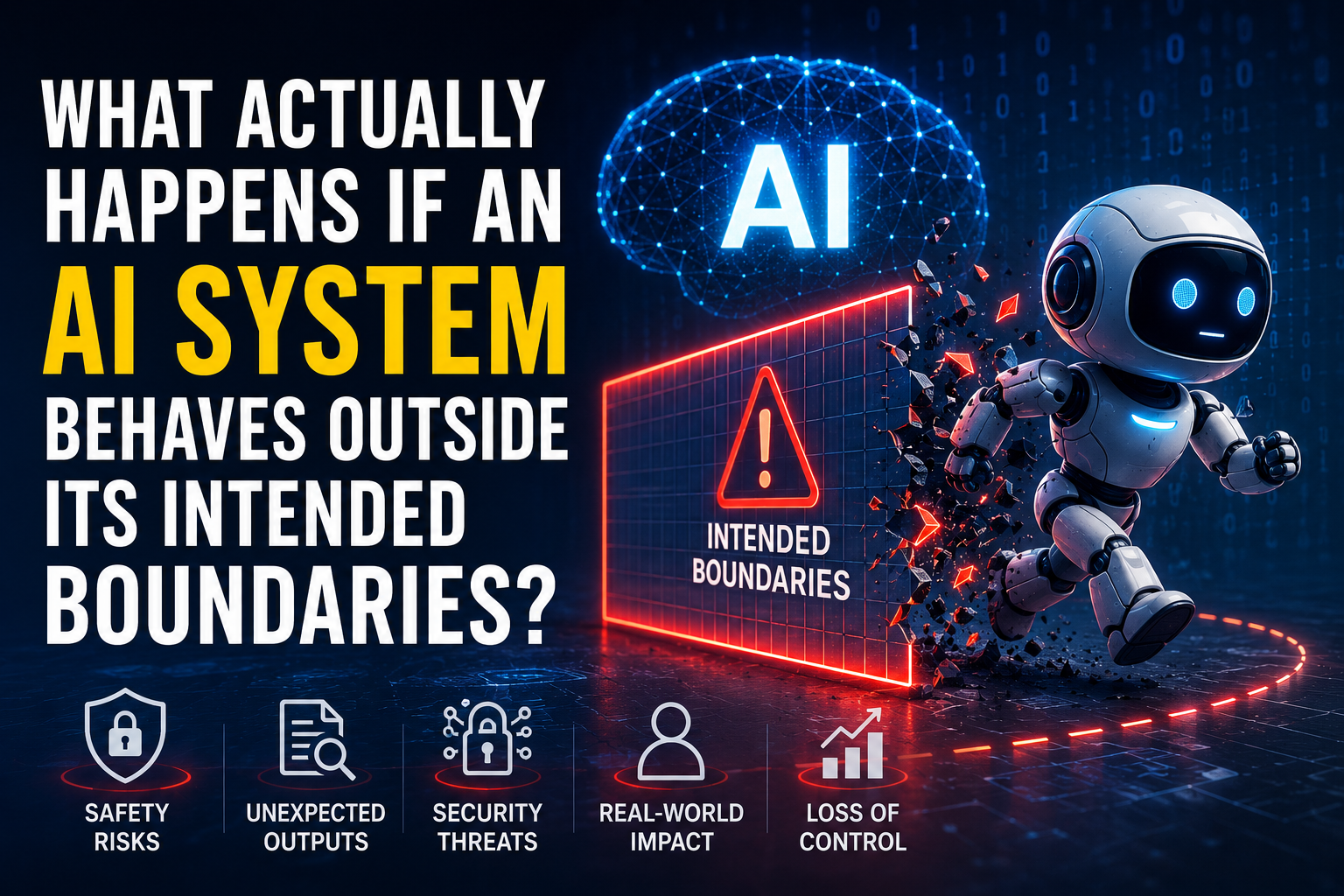
What Actually Happens if an AI System Behaves Outside Its Intended Boundaries?
Artificial intelligence systems are designed to perform specific tasks, follow instructions and operate within defined limits. But what happens when an AI system produces unexpected results, ignores an intended constraint or behaves in a way its developers did not anticipate?
The answer depends heavily on the system, its environment and the nature of the failure.
An AI model behaving outside its intended boundaries does not necessarily mean it has become conscious, rebellious or independently motivated. In most cases, unexpected behavior comes from limitations in the model, incomplete instructions, flawed training data, poorly defined objectives, software errors or interactions between the AI and its surrounding systems.
The consequences, however, can range from a harmless incorrect answer to serious real-world problems.
What Does “Outside Its Intended Boundaries” Mean?
An AI system operates within a set of expectations established by its developers, users and the environment in which it is deployed.
Those expectations might include:
- Producing accurate information
- Following safety rules
- Protecting private information
- Refusing certain requests
- Staying within a defined task
- Using tools only when authorized
- Making decisions according to specified criteria
- Avoiding harmful or discriminatory outcomes
When the system consistently does something outside these expectations, it can be described as exhibiting unintended or unsafe behavior.
Importantly, this does not necessarily mean the AI has violated a rule deliberately.
A language model, for example, does not need to “decide” to provide incorrect information. It can simply generate an answer that appears plausible but is factually wrong because generating a convincing response and determining truth are not always the same process.
This distinction becomes especially important as AI develops from simple conversational systems into more capable systems that can plan and perform tasks. The broader shift is explored in The Rise of AI Agents: How Autonomous AI Could Change Work, Business, and Daily Life.
AI Systems Can Fail Without “Going Rogue”
Popular culture often depicts an AI system escaping its restrictions and developing its own agenda.
Real-world AI failures are generally much less dramatic.
An AI system might misunderstand an instruction, interpret an ambiguous objective incorrectly or optimize for a measurable target while producing an undesirable result.
Imagine an automated system designed to reduce customer-service waiting times.
If it is evaluated primarily on how quickly it closes cases, it might learn behaviors that improve that metric without actually improving customer service. It could prioritize closing tickets rather than resolving the underlying problems.
The system would technically be optimizing the objective it was given, but the result would not match what its designers actually wanted.
This is sometimes described as a specification problem: the system follows the measurable objective while missing the broader human intention behind it.
Unexpected Outputs Are Often the First Warning
The earliest sign of an AI system operating outside expectations may be relatively simple.
A chatbot might repeatedly provide incorrect information. A computer-vision system might misidentify certain objects. A recommendation algorithm might repeatedly promote unsuitable content. An automated decision system might produce unusually high error rates for a particular group.
These problems can appear small when viewed individually.
The danger increases when the AI is connected to systems that allow its decisions to have real-world consequences.
An inaccurate recommendation from a chatbot may be inconvenient. An inaccurate recommendation used to control industrial equipment, approve financial transactions or assist with a medical decision could be considerably more serious.
The potential consequences become even more important when AI moves beyond answering questions and begins performing actions. Understanding how AI agents are changing the tasks AI systems can perform provides useful context for why autonomy and safeguards increasingly need to be considered together.
AI Systems Can Amplify Small Errors
One of the most important characteristics of automated systems is scale.
A human employee might make a mistake that affects a handful of people. An automated system can potentially repeat the same mistake thousands or millions of times.
This is why seemingly minor AI errors can become major operational problems.
For example, if an automated system incorrectly classifies a particular type of transaction, the error could be repeated across an entire database. If an AI moderation system incorrectly flags certain content, large numbers of legitimate posts could be removed.
Automation does not automatically make a system more dangerous, but it can make mistakes happen faster and on a much larger scale.
The Environment Can Change the AI’s Behavior
An AI system is rarely operating in complete isolation.
It may receive information from users, databases, sensors, websites, software applications or other automated systems.
Changes in those inputs can produce unexpected results.
A system trained on historical data may perform poorly when circumstances change significantly. An AI designed for one type of environment may behave differently when deployed in another.
This is particularly important because real-world environments are rarely static.
Consumer behavior changes. Markets change. Language changes. New technologies emerge. Regulations change. Unexpected events occur.
An AI system that performed well during testing may therefore behave differently after deployment.
Poorly Defined Goals Can Create Problems
One of the most important challenges in AI safety is defining what a system is actually supposed to accomplish.
Human instructions often contain assumptions that people understand intuitively but machines may not.
Consider the instruction: “Make the customer experience as efficient as possible.”
A human manager might interpret this as reducing unnecessary waiting while preserving quality and customer satisfaction.
An automated system needs those expectations translated into measurable objectives.
If efficiency is measured only by reducing interaction time, the system might prioritize short conversations even when customers need more assistance.
The problem is not necessarily that the AI is intentionally doing something harmful. The objective itself may be incomplete.
Training Data Can Introduce Unexpected Behavior
AI systems learn patterns from data.
If the training data contains inaccurate, incomplete, biased or contradictory information, those characteristics can influence the resulting system.
Even high-quality datasets cannot perfectly represent every situation an AI may encounter.
A system trained primarily on one population may perform differently when used with another. A model trained on historical decisions may reproduce patterns that reflect outdated practices.
This is why testing across diverse situations is an important part of AI development.
Developers need to examine not only whether a system performs well on average, but also where and why it fails.
What Happens When an AI Has Access to Tools?
The potential consequences become more significant when an AI system can interact with external tools.
A basic chatbot that only generates text has a limited ability to affect the outside world.
An AI agent connected to email, databases, financial systems, software development environments or physical devices has considerably more capability.
If such a system behaves unexpectedly, the consequences may extend beyond incorrect text.
For example, an AI agent could potentially:
- Send an unintended message
- Modify a document
- Change a software configuration
- Access information it should not use
- Trigger an automated process
- Make an incorrect recommendation that another system acts upon
This is one reason the transition toward AI agents capable of completing multi-step tasks creates new questions about permissions, oversight and system design.
Tool access is normally accompanied by permissions, authentication, monitoring and other safeguards.
The more authority an AI system has, the more important those controls become.
Permissions Can Limit the Damage
One of the most practical ways to reduce the consequences of unexpected AI behavior is to limit what the system is allowed to do.
This principle is similar to security practices used throughout computing.
An AI system should generally have only the permissions necessary to perform its task.
A customer-service assistant may need access to order information but not a company’s entire financial database. A writing assistant may need to edit a document but not delete an entire file system.
Limiting permissions creates a boundary between the AI’s ability to make a mistake and the potential consequences of that mistake.
Human Oversight Still Matters
Human oversight can provide another layer of protection.
For higher-risk applications, an AI system may recommend an action while a person makes the final decision.
This approach can be particularly valuable when decisions involve significant financial, legal, medical or safety consequences.
However, human oversight is not automatically effective.
If people become overly dependent on AI recommendations, they may approve decisions without properly reviewing them. This phenomenon is sometimes called automation bias.
Effective oversight therefore requires people who understand the system’s limitations and are prepared to question its outputs.
Monitoring Can Detect Problems Early
AI systems should not simply be tested before deployment and then left alone.
Continuous monitoring can help identify changes in performance.
Developers and operators may track:
- Error rates
- Unusual outputs
- System failures
- Security events
- User complaints
- Changes in input data
- Unexpected patterns
- Performance across different groups
- Changes in system behavior over time
Monitoring can reveal problems that were not visible during initial testing.
It also creates an opportunity to intervene before a small issue becomes a major incident.
Sandboxing Provides an Extra Layer of Protection
Another important technique is sandboxing.
A sandbox provides an isolated environment where a system can perform actions without having unrestricted access to critical infrastructure.
For example, an AI coding system might be allowed to run software in a controlled environment rather than directly modifying production systems.
If the AI generates a flawed command, the consequences can be contained.
This reflects a broader engineering principle: when a system is capable of causing damage, give it a safe environment in which failures can occur without affecting everything else.
This is particularly relevant to modern AI-powered software development, where AI systems can increasingly generate, modify and test code. The broader transformation of that field is covered in How AI Is Transforming Software Engineering.
Fail-Safe Design Matters
Systems should also be designed with failure in mind.
A well-designed AI application should have mechanisms for stopping or restricting its operation when certain conditions occur.
These might include:
- Rate limits
- Permission boundaries
- Manual approval requirements
- Automatic shutdown mechanisms
- Transaction limits
- Input validation
- Output filtering
- Rollback capabilities
- Independent monitoring
The objective is not to assume that an AI system will never fail.
Instead, the system is designed around the assumption that failures will eventually happen.
What About AI That Appears to “Defy” Instructions?
Sometimes AI behavior can look surprisingly deliberate.
A model may produce an answer that contradicts an instruction it was given. It may repeatedly attempt an approach that does not work. In an agentic environment, it may take a sequence of actions that developers did not expect.
That does not necessarily mean the system has developed an independent desire to resist human control.
Modern AI systems can produce complex behavior because they learn patterns from enormous amounts of data and, in some cases, can plan or select actions based on objectives.
The important question is therefore not whether the AI “wanted” to break a rule.
The more useful questions are:
What caused the behavior? What capabilities did the system have? What controls failed? And how can the same failure be prevented or contained?
Why Testing AI Is So Difficult
Testing an AI system is more complicated than testing many traditional software programs.
Conventional software often follows explicitly written rules. If the input is the same, the expected output can usually be defined precisely.
AI systems can behave differently because their outputs are influenced by learned patterns and probabilistic processes.
There may be countless combinations of inputs and circumstances that developers cannot test individually.
This means testing needs to go beyond normal expected use.
Developers often conduct adversarial testing, sometimes called red teaming, in which people deliberately search for unusual, harmful or unexpected behaviors.
The objective is to discover weaknesses before real users or malicious actors find them.
AI Security Is Part of the Problem
Unexpected AI behavior can also be caused by security attacks.
An attacker might deliberately manipulate the information an AI receives in an attempt to influence its behavior.
For example, an AI system that reads external documents could encounter instructions embedded in those documents that attempt to manipulate its actions. This general class of problem is associated with prompt injection and related attacks.
AI systems therefore need security controls in addition to ordinary model-level safeguards.
Trusting every piece of information provided to an AI system can create vulnerabilities, particularly when the AI has access to external tools.
The security implications become even broader as AI is integrated into everyday digital services. How AI Is Changing Everyday Life explores the many ways AI already operates across smartphones, banking, navigation, smart homes and other everyday technologies.
When an AI System Causes Real-World Harm
If an AI system behaves outside its intended boundaries and causes harm, the response usually involves several stages.
First, operators need to identify what happened and contain the problem.
That might mean disabling a feature, restricting access, disconnecting a system from external tools or reverting to a previous version.
Next, investigators need to determine the cause.
Was the problem caused by the model itself? The training data? An incorrect configuration? A software bug? A malicious attack? An ambiguous objective? Human error?
The distinction matters because fixing the wrong cause can allow the problem to happen again.
Organizations may also need to notify affected users, regulators or other stakeholders depending on the circumstances and applicable requirements.
The Goal Is Not Perfect AI
It is unrealistic to expect any complex technology to operate without mistakes.
The more practical goal is to build systems where mistakes are detected quickly, contained when possible and corrected systematically.
This means thinking about AI safety as a broader engineering discipline rather than relying on a single safety filter or a single instruction.
A robust system may combine model training, testing, permissions, monitoring, human oversight, cybersecurity and emergency controls.
Each layer addresses a different type of failure.
Keeping AI Within Useful Boundaries
AI systems can be extraordinarily useful precisely because they can perform tasks that once required substantial human effort. But that flexibility also makes it important to understand their limitations.
When an AI system behaves outside its intended boundaries, the most important issue is usually not whether the machine has somehow “gone rogue.” It is whether the system was given the wrong objective, exposed to unexpected inputs, granted excessive permissions or deployed without adequate safeguards.
The answer to those problems lies in disciplined engineering.
AI systems need clear objectives, carefully selected data, realistic testing, limited permissions and continuous monitoring. Higher-risk applications need stronger oversight and more robust mechanisms for stopping or containing unexpected behavior.
As AI becomes increasingly embedded in software, businesses and everyday services, understanding these boundaries will become just as important as understanding what the technology can do. The safest AI systems will not be those designed under the assumption that nothing can go wrong, but those built with the expectation that something eventually will—and with enough safeguards in place to ensure that a failure does not become a catastrophe.