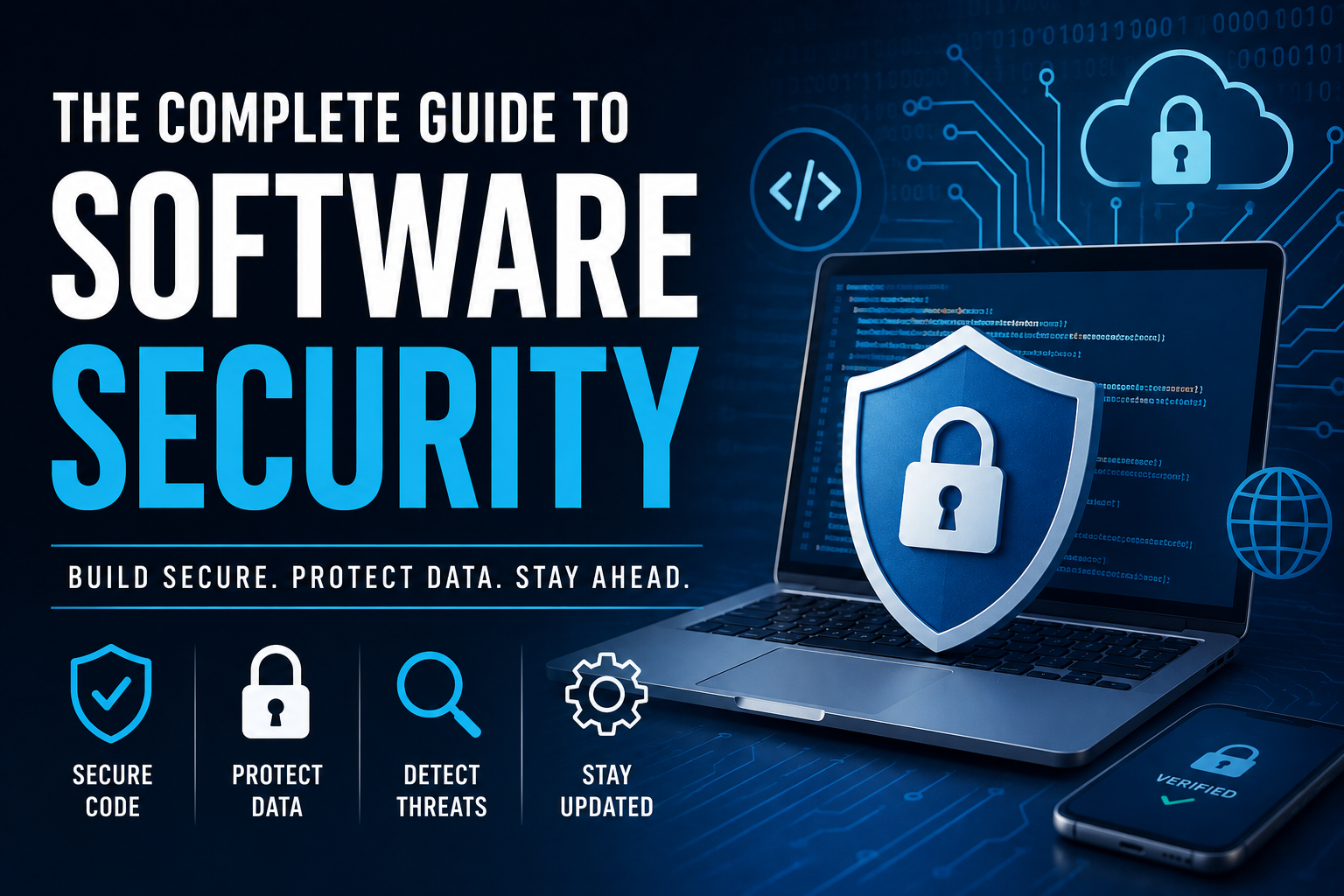
The Complete Guide to Software Security
Software has become part of nearly every aspect of modern life. People use applications to communicate, manage finances, store personal information, work with sensitive business data, and control connected devices.
That convenience also creates risk. Poorly secured software can expose passwords, financial information, private communications, business records, and other sensitive data to unauthorized access.
Software security is therefore no longer just a concern for cybersecurity specialists. Developers, businesses, organizations, and everyday users all have a role to play in reducing software-related security risks.
For organizations looking at the broader cybersecurity picture, software security is only one part of a much larger strategy. Our Ultimate Guide to Business Cybersecurity explains how software security fits alongside network protection, data security, identity management, incident response, and other essential defenses.
What Is Software Security?
Software security is the practice of designing, developing, testing, deploying, and maintaining software in ways that protect it from unauthorized access, misuse, modification, disruption, and data loss.
Security can be considered throughout the entire software development lifecycle rather than added only after an application has been completed.
A secure application should be designed to anticipate potential threats and minimize the damage that could occur if an attacker discovers a weakness.
This involves more than protecting a login page. Software security can include everything from secure coding and authentication to data protection, dependency management, access controls, monitoring, and vulnerability testing.
Why Software Security Matters
A software vulnerability can have consequences far beyond the application itself.
An attacker who exploits a weakness may gain access to sensitive information, compromise user accounts, disrupt services, or use one compromised system as a pathway into another.
For businesses, a security incident can also result in financial losses, operational disruption, reputational damage, regulatory consequences, and the cost of investigating and recovering from the incident.
For individual users, compromised software can expose personal accounts, photographs, messages, payment information, and other private data.
Security is therefore an essential part of software quality.
Common Software Security Threats
Software can be attacked in many different ways. Understanding common threats helps developers and organizations build stronger defenses.
Injection Attacks
Injection vulnerabilities occur when untrusted input is interpreted as part of a command or query.
One well-known example is SQL injection, in which malicious input can manipulate database queries when an application does not properly handle user-provided data.
Other forms of injection can affect different technologies and systems.
Input validation, parameterized queries, and appropriate output handling are among the techniques that can reduce these risks.
Broken Authentication
Authentication determines whether someone is who they claim to be.
Weak authentication systems can allow attackers to gain access to accounts through stolen credentials, predictable passwords, poorly implemented login mechanisms, or inadequate session management.
Strong authentication practices can include secure password handling, multi-factor authentication, session protection, and controls against repeated automated login attempts.
Businesses should also consider authentication as part of a broader identity and access strategy. Our Complete Guide to Identity and Access Security explores how authentication, authorization, and access controls work together.
Authorization Problems
Authentication and authorization are not the same.
Authentication asks, “Who are you?”
Authorization asks, “What are you allowed to access?”
An application can correctly identify a user while still giving that user access to information or functions they should not be able to use.
Strong authorization controls should be applied consistently to sensitive operations and resources.
Cross-Site Scripting
Cross-site scripting, commonly known as XSS, can occur when an application improperly handles content that is displayed to users.
Depending on the vulnerability, attackers may be able to execute malicious scripts in another user’s browser.
Careful input handling, output encoding, and appropriate security controls can help reduce XSS risks.
Insecure File Handling
Applications that allow users to upload or process files need to treat those files carefully.
Improper validation can allow attackers to upload malicious content, access unintended files, or interfere with application behavior.
File type validation, safe storage locations, access restrictions, and careful processing are important considerations.
Vulnerable Dependencies
Modern applications rarely operate entirely on code written by their own developers.
They commonly depend on open-source libraries, frameworks, packages, APIs, and other external components.
If one of those dependencies contains a known vulnerability, an application using it may also become exposed.
Keeping dependencies inventoried, updated, and monitored is therefore an important part of software security.
Secure Software Development
Security is strongest when it is incorporated from the beginning of the development process.
Developers can consider security requirements during planning, identify potential threats during design, apply secure coding practices during implementation, and test for vulnerabilities before deployment.
This approach is sometimes described as shifting security left because security activities are introduced earlier in the software development lifecycle.
However, security should not stop once software reaches production.
Applications need continued monitoring, maintenance, patching, testing, and review.
Organizations should also treat software security as one component of their wider cybersecurity program rather than as an isolated development task. The broader Ultimate Guide to Business Cybersecurity covers the additional controls organizations can use to protect systems, data, employees, and operations.
The Role of Secure Coding
Secure coding involves writing software in ways that reduce predictable vulnerabilities.
Some fundamental practices include:
- Validate and appropriately handle untrusted input.
- Use secure authentication mechanisms.
- Apply authorization checks consistently.
- Protect sensitive information.
- Avoid exposing secrets in source code.
- Handle errors without revealing unnecessary internal details.
- Use secure communication protocols.
- Keep third-party dependencies maintained.
- Follow established security guidelines for the programming language and framework being used.
Secure coding does not eliminate every possible vulnerability, but it can substantially reduce common sources of risk.
Protecting Sensitive Data
Data protection is one of the most important parts of software security.
Applications should identify what information they collect, why it is needed, where it is stored, who can access it, and how long it should be retained.
Sensitive information should receive appropriate protection both while it is being transmitted and while it is stored.
Encryption can help protect data from unauthorized access, although encryption alone does not solve every security problem.
Access controls, secure key management, authentication, monitoring, and appropriate data-handling policies must work together.
Businesses looking beyond application-level controls should also consider their overall approach to protecting digital information. The guide to data security covers broader methods for protecting sensitive digital information.
Authentication and Multi-Factor Security
Passwords remain a common component of authentication, but passwords alone can be vulnerable to phishing, credential theft, reuse, and brute-force attacks.
Multi-factor authentication adds another layer by requiring users to provide additional evidence of their identity.
Depending on the system, this could involve something the user knows, something they possess, or a biometric characteristic.
For applications handling sensitive information, stronger authentication can significantly improve account security.
Organizations can learn more about this control in our guide on how multi-factor authentication improves account security.
Managing Software Dependencies
Dependency management deserves special attention because vulnerabilities can enter an application through components developers did not create themselves.
Organizations should maintain an accurate inventory of important software components and monitor them for security updates.
Automated dependency scanning can help identify outdated or vulnerable packages.
However, automated tools should support human review rather than replace it. A vulnerability needs to be assessed in context to determine whether it affects the application’s actual environment and how urgently it should be addressed.
Security Testing
Security testing helps identify weaknesses before attackers discover them.
Different testing approaches can reveal different types of problems.
Static Application Security Testing
Static analysis examines source code or other representations of an application without necessarily executing it.
It can help identify patterns associated with certain classes of vulnerabilities.
Dynamic Application Security Testing
Dynamic testing evaluates an application while it is running.
This can reveal weaknesses that may not be obvious from source-code analysis alone.
Dependency Scanning
Dependency scanners examine external components for known vulnerabilities and outdated versions.
Penetration Testing
Penetration testing involves authorized security professionals attempting to identify and exploit weaknesses in a controlled environment.
The objective is not simply to find vulnerabilities but to understand how they could potentially be chained together and what impact they might have.
The Importance of Security Updates
Even well-designed software can develop security weaknesses over time.
New vulnerabilities may be discovered after an application has already been deployed. New attack techniques can also change the threat environment.
Regular updates and patches are therefore essential.
Organizations should establish processes for identifying important security updates, evaluating their impact, testing them where appropriate, and deploying them within a reasonable timeframe.
Users should also avoid ignoring security updates for operating systems, applications, browsers, and other software.
Secrets and Credential Management
Applications frequently require credentials such as API keys, database passwords, authentication tokens, or encryption keys.
Hard-coding these secrets directly into application source code can create serious security problems.
Secrets can accidentally be exposed through source repositories, logs, error messages, or shared development environments.
Dedicated secrets-management mechanisms and carefully controlled access can reduce this risk.
Credentials should also be rotated appropriately and limited to the permissions actually required.
Logging and Security Monitoring
Security does not end when software is deployed.
Monitoring can help organizations identify unusual activity, failed authentication attempts, suspicious requests, unexpected changes, and other potential warning signs.
Logs should provide enough information to support investigation without unnecessarily exposing sensitive data.
Organizations also need processes for responding when monitoring identifies a potential incident.
A security control is far more useful when someone is prepared to act on the information it provides.
The Principle of Least Privilege
Least privilege means giving users, applications, and services only the permissions they actually need.
For example, an application component that only needs to read certain information should not automatically receive permission to modify an entire database.
Limiting permissions reduces the potential impact of compromised accounts and software components.
It also makes unauthorized activity easier to isolate.
Security and the Software Supply Chain
Software increasingly depends on a complex supply chain.
An application may include open-source packages, commercial libraries, development tools, cloud services, build systems, and external APIs.
Each component can introduce dependencies and potential risks.
Organizations therefore need to consider not only the security of their own code but also the security and provenance of important components they incorporate.
Software bills of materials, dependency inventories, vendor assessments, and controlled build processes can help improve visibility into the software supply chain.
Security for Cloud Applications
Cloud computing has changed how software is built and operated.
Cloud platforms provide powerful infrastructure and security capabilities, but organizations still remain responsible for properly configuring the services they use.
Common areas requiring attention include identity management, access permissions, storage configuration, network controls, encryption, logging, and secrets management.
A cloud environment is not automatically secure simply because the underlying infrastructure is operated by a major provider.
Configuration remains critical.
Security in the Development Lifecycle
A mature software security program can integrate security activities across multiple development stages:
- Planning — Identify security requirements and sensitive data.
- Design — Analyze potential threats and define security controls.
- Development — Apply secure coding practices.
- Testing — Search for vulnerabilities and configuration weaknesses.
- Deployment — Secure production environments and access controls.
- Monitoring — Watch for suspicious behavior and emerging threats.
- Maintenance — Patch vulnerabilities and update dependencies.
- Review — Learn from incidents and improve security practices.
This continuous approach is more effective than treating security as a one-time inspection.
Common Software Security Mistakes
Even organizations with experienced development teams can make security mistakes.
Some common problems include:
- Treating security as an afterthought.
- Using outdated dependencies.
- Giving applications excessive permissions.
- Storing secrets insecurely.
- Failing to validate untrusted input.
- Relying entirely on passwords.
- Exposing sensitive information through error messages.
- Ignoring security logs.
- Delaying important patches.
- Assuming third-party software is automatically safe.
- Testing security only immediately before release.
The most effective security programs address these risks systematically rather than relying on individual developers to remember every potential vulnerability.
Building a Stronger Security Culture
Technology alone cannot create a secure software environment.
Developers, security teams, managers, and other stakeholders need clear responsibilities and processes.
Security training can help developers understand common vulnerabilities and secure development practices. Code reviews can provide another layer of protection. Automated security tools can identify certain problems early, while security specialists can investigate more complex risks.
Most importantly, organizations should make security part of normal software engineering rather than treating it as an obstacle to development.
Software security should also connect with the organization’s broader cybersecurity strategy. Businesses can review that wider framework in the Ultimate Guide to Business Cybersecurity.
A Practical Software Security Checklist
Before deploying or significantly changing an application, teams can consider questions such as:
- Are sensitive data flows documented?
- Are authentication mechanisms appropriately protected?
- Are authorization controls enforced consistently?
- Is user input handled safely?
- Are dependencies monitored for vulnerabilities?
- Are secrets stored securely?
- Is sensitive data appropriately protected?
- Are unnecessary permissions removed?
- Has the application undergone appropriate security testing?
- Are logging and monitoring capabilities available?
- Is there a process for handling vulnerabilities?
- Are security updates applied regularly?
- Is the production environment properly configured?
- Are backups protected and tested?
- Is there an incident response process?
A checklist cannot replace expert security analysis, but it can help teams avoid overlooking fundamental controls.
Where Software Security Is Heading
As applications become more connected and software becomes increasingly embedded in business operations and everyday devices, security will remain a fundamental engineering concern.
Artificial intelligence, cloud computing, open-source development, connected devices, and increasingly complex software supply chains are creating new opportunities while also introducing new security considerations.
The strongest approach is not to search for a single security tool that solves every problem. Instead, organizations need layers of protection that combine secure design, careful development, testing, access controls, monitoring, maintenance, and informed users.
Security Has to Be Built In
Software security is ultimately a continuous process rather than a feature that can simply be switched on.
Applications change, dependencies change, infrastructure changes, and threats change. A secure system therefore requires ongoing attention throughout its entire lifecycle.
For developers and organizations, the goal is not to create software that is impossible to attack. It is to build systems that make vulnerabilities harder to introduce, easier to detect, and less damaging when they occur.
That mindset can turn security from a last-minute technical requirement into a fundamental part of building reliable software.
Businesses should also remember that software is only one layer of organizational protection. Strong cybersecurity requires a combination of secure applications, protected networks, properly managed identities, secure data, trained employees, monitoring, backups, and incident response. For that broader perspective, explore the Ultimate Guide to Business Cybersecurity.