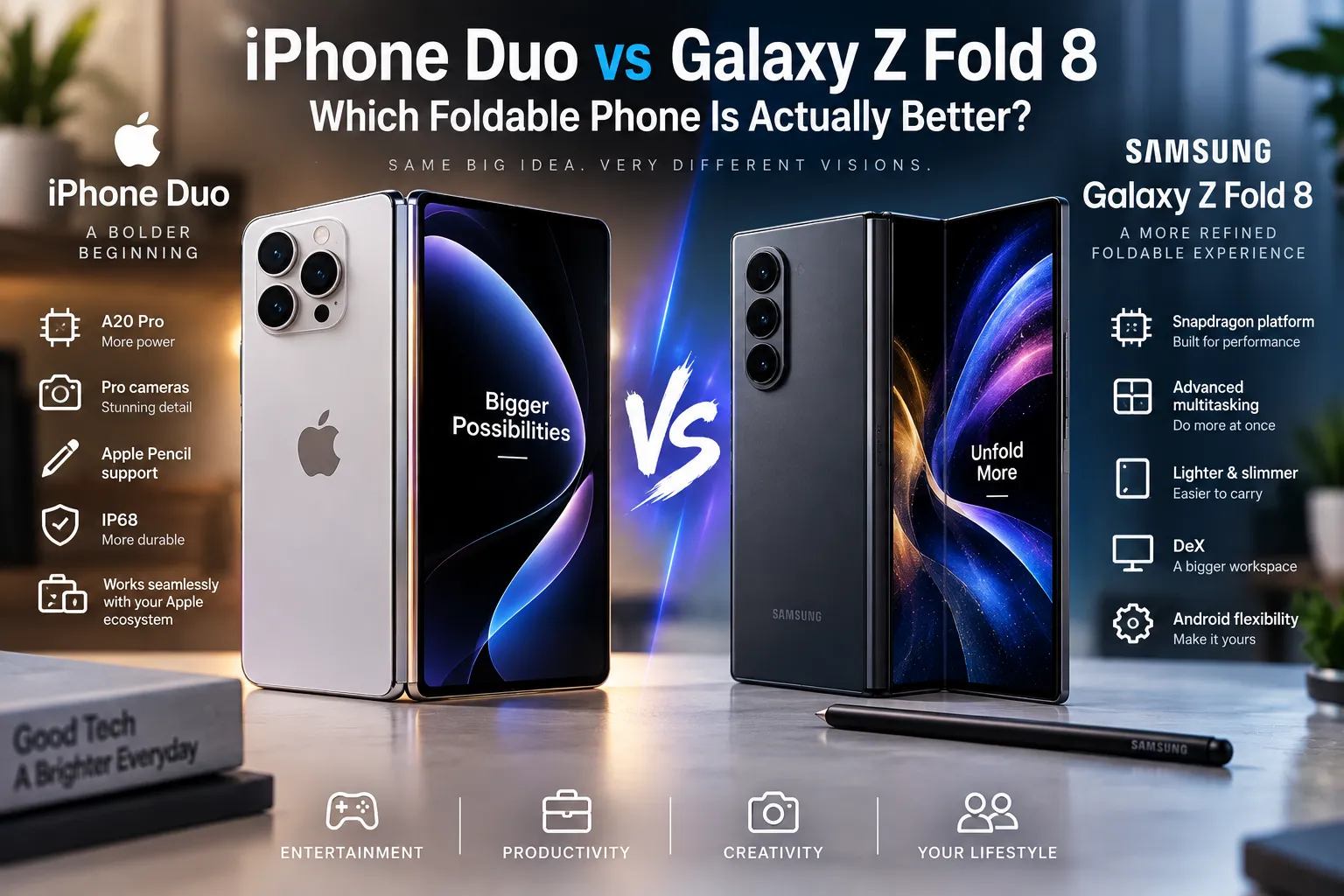
iPhone Duo vs Galaxy Z Fold 8: Which Foldable Phone Is Actually Better?
Apple has finally entered the foldable smartphone market, and its first attempt immediately creates one of the most interesting premium phone comparisons of 2026.
The iPhone Duo brings Apple’s ecosystem, A20 Pro chip, iOS and a 7.6-inch foldable display to a category Samsung has been developing for years. The Galaxy Z Fold 8, meanwhile, represents Samsung’s latest refinement of its book-style foldable design, combining a large inner display with Android multitasking and a more mature foldable software experience.
The two phones are surprisingly similar in their basic concept. Both open into roughly 7.6-inch tablet-like displays, while offering a smaller exterior screen when folded. But their philosophies are quite different.
Apple is emphasizing design, integration, display quality, privacy and the familiar iPhone experience. Samsung is emphasizing productivity, multitasking, flexibility and the advantages of Android.
So which one is actually better?
The answer depends heavily on what you want from a foldable phone.
iPhone Duo vs Galaxy Z Fold 8 at a Glance
| Feature | iPhone Duo | Galaxy Z Fold 8 |
|---|---|---|
| Starting U.S. price | $1,999 | $1,899.99 |
| Inner display | 7.6-inch OLED | 7.6-inch LTPO AMOLED |
| Cover display | 5.4-inch OLED | 5.5-inch LTPO AMOLED |
| Processor | Apple A20 Pro | Qualcomm Snapdragon platform |
| Weight | About 254g | About 201g |
| Folded thickness | About 11.3mm | About 9.7mm |
| Stylus support | Apple Pencil support | No S Pen digitizer |
| Water/dust resistance | IP68 | IP48 |
| Software | iOS 27.1 | Android 17 / One UI 9 |
| Storage | Up to 2TB | Up to 1TB |
| Multitasking | Split View and paired apps | Multi-window and DeX |
| 5G | Yes | Yes |
| Wireless charging | MagSafe/Qi2 | Wireless charging |
| Best strength | Apple ecosystem and hardware integration | Multitasking and versatility |
Apple officially introduced the iPhone Duo on September 9, 2026, with a 7.6-inch inner display and 5.4-inch outer display. Samsung introduced the Galaxy Z Fold 8 earlier in the year, with a similar 7.6-inch internal screen but a more established foldable design.
Design: Apple Goes Wider, Samsung Goes Lighter
The first major difference becomes obvious as soon as you hold the two phones.
The iPhone Duo is substantially heavier than the Galaxy Z Fold 8. Current specifications put the Duo at around 254 grams, compared with approximately 201 grams for the Fold 8. Samsung’s phone is also thinner both when folded and unfolded.
That difference matters more than it might sound.
A foldable phone is already larger and heavier than a conventional smartphone. Adding another 50 grams can make the device noticeably more tiring to hold for long periods.
Samsung therefore has an advantage for people who want a foldable that feels closer to a conventional smartphone when carried around.
Apple, however, has taken a different approach.
The Duo uses a titanium frame and a design intended to provide a premium, tightly integrated hardware experience. Apple has also emphasized its precision hinge and structural durability as major parts of the device.
Winner: Galaxy Z Fold 8
For portability and weight, Samsung has the clear advantage.
The iPhone Duo’s design may appeal more to people who prioritize Apple’s materials and hardware philosophy, but the Fold 8 is considerably lighter.
Displays: Two Excellent Approaches
Both phones provide a large internal screen of approximately 7.6 inches.
That means both can transform from a conventional smartphone into something closer to a compact tablet.
Apple’s inner display uses OLED technology and supports ProMotion up to 120Hz. Apple also gives the Duo a special nano-texture finish designed to reduce reflections and glare.
Samsung uses an LTPO AMOLED panel with a 1–120Hz adaptive refresh rate.
The practical difference is less dramatic than the specifications might suggest.
Both displays are designed for high-end video, gaming, reading and productivity.
The more important difference is how each company uses the additional screen space.
Apple is building iOS around the larger display, while Samsung has spent several generations developing software specifically for foldable multitasking.
Winner: Tie
For basic display quality, both are premium choices.
Samsung has the stronger foldable software history, while Apple has an intriguing advantage with its glare-reducing display treatment.
The Cover Screen Changes the Experience
A foldable phone is not just about the large internal display.
You will probably use the exterior screen many times throughout the day.
Apple’s Duo has a 5.4-inch outer display, while Samsung provides a 5.5-inch cover screen. Both are designed to let users handle normal smartphone tasks without opening the device.
This creates an interesting difference in philosophy.
The iPhone Duo attempts to maintain visual continuity between its exterior and interior displays.
Samsung’s approach feels more like a conventional smartphone on the outside and a tablet when opened.
If you frequently check messages, respond to notifications and perform quick tasks without unfolding your phone, the cover-screen experience becomes particularly important.
Multitasking: Samsung Still Has the Edge
This is probably the most important category for productivity users.
Samsung has spent years developing multitasking features for large foldable displays.
The Galaxy Z Fold 8 supports multiple applications simultaneously, floating windows and Samsung DeX, allowing the phone to function more like a miniature computer when connected to compatible displays and accessories.
The iPhone Duo introduces expanded multitasking capabilities to the iPhone experience, including split-screen functionality and support for multiple app windows.
But Samsung’s software has a major advantage: maturity.
Foldable multitasking has been part of Samsung’s strategy for several generations.
Apple is entering this category with its first foldable.
That does not mean Apple’s implementation is poor. It simply means Samsung has had more time to develop workflows around the large screen.
For anyone buying a foldable specifically because they want to replace some tablet or laptop functions, this difference matters.
Winner: Galaxy Z Fold 8
Samsung remains the stronger choice for serious multitasking.
Performance: Both Phones Are Built for Heavy Workloads
The iPhone Duo is powered by Apple’s A20 Pro chip, while the Galaxy Z Fold 8 uses a flagship Qualcomm Snapdragon platform.
Both are designed for demanding workloads.
That includes:
- Gaming
- Video editing
- AI applications
- Multitasking
- Photography
- Productivity
- High-resolution video
Raw benchmark numbers should not be the only consideration here.
The more important question is how effectively each company integrates the processor with its operating system.
Apple controls the processor, operating system and much of the surrounding hardware ecosystem.
Samsung has more flexibility through Android and Google’s services while adding its own software layer and hardware features.
Winner: iPhone Duo
On paper and in Apple’s tightly integrated ecosystem, the Duo has an impressive performance platform.
But the real-world difference for ordinary users is unlikely to justify choosing one phone solely because of processor performance.
Cameras: Apple’s Approach Is Different
Cameras are another area where the two companies have made compromises.
Neither phone is designed around the enormous camera systems found on some conventional flagship smartphones.
The iPhone Duo uses a dual-camera system built around a main camera and ultra-wide camera, while Samsung similarly focuses on a main camera and ultra-wide configuration rather than adding a dedicated long-range telephoto camera.
Apple is putting significant emphasis on computational photography and video.
The Duo also introduces foldable-specific camera features designed around the two displays, including tools that allow people being photographed to see themselves on the exterior screen.
Samsung has its own foldable camera features, including dual recording and cover-screen preview functions.
The result is an interesting situation.
Neither device is necessarily the obvious winner for users who want the most versatile camera hardware.
Instead, the competition is increasingly about image processing, video quality and how the foldable form factor changes photography.
Winner: iPhone Duo for video and computational photography
Samsung remains competitive, particularly for users who appreciate its camera controls and Android ecosystem.
Battery Life Matters More on Foldables
Foldable phones have a difficult battery challenge.
They need to power two displays and often support more complex multitasking than conventional smartphones.
Samsung equips the Galaxy Z Fold 8 with a 4,800mAh battery, while reported specifications for the iPhone Duo place its battery capacity below Samsung’s figure. However, battery capacity alone does not determine real-world endurance.
Processor efficiency, software optimization, display technology and usage patterns all matter.
Apple has emphasized its thermal-management system and dual-battery architecture as part of the Duo’s design.
Samsung has also refined its battery and thermal-management approach over multiple generations of foldables.
Winner: Too Close to Call
Real-world battery testing will be more useful than comparing capacity numbers.
For users who frequently run demanding apps on the large display, battery performance could become one of the biggest deciding factors.
Durability: Apple Has an Important Advantage
Foldable phones have historically raised concerns about durability because they contain moving hinges and flexible displays.
Apple is entering the market with a major emphasis on structural design and durability.
The iPhone Duo carries an IP68 rating for water and dust resistance according to current specifications, while the Galaxy Z Fold 8 is rated IP48.
That gives Apple an important advantage for users who want stronger resistance against environmental exposure.
However, an IP rating does not eliminate the mechanical risks associated with a folding device.
A foldable remains more mechanically complex than a traditional smartphone.
Winner: iPhone Duo
Apple’s IP68 rating is a meaningful advantage.
Stylus Support Gives Apple an Unexpected Advantage
For years, Samsung was associated with stylus-enabled productivity.
The Galaxy Z Fold line, however, does not currently provide the S Pen experience that some users might expect from Samsung’s larger foldables.
Apple’s Duo takes a different route.
The iPhone Duo supports Apple Pencil, giving users another way to interact with the large internal display.
This could make the device particularly interesting for:
- Note-taking
- Sketching
- Marking up documents
- Creative work
- Education
- Productivity
For users who want their foldable to function as a small tablet, stylus support could be one of the Duo’s most compelling features.
Winner: iPhone Duo
Apple’s decision to bring Pencil support to the foldable makes the larger display more useful for creative and productivity tasks.
Software: iOS vs Android
This may ultimately be the biggest deciding factor.
The hardware differences are significant, but the two phones belong to completely different ecosystems.
The iPhone Duo runs Apple’s iOS platform, giving users access to Apple’s broader ecosystem of Macs, iPads, Apple Watch, AirPods, iCloud and other services.
Samsung’s Fold 8 runs Android with Samsung’s One UI interface.
That gives users more customization and greater flexibility in how they organize apps and workflows.
Samsung also has a longer history of designing Android specifically for foldable displays.
Apple, meanwhile, has the advantage of controlling its entire hardware-and-software stack.
For existing iPhone users, switching to Samsung can mean leaving behind familiar services and accessories.
For Android users, moving to Apple can create the opposite problem.
Winner: Depends on Your Ecosystem
If you already own multiple Apple products, the iPhone Duo becomes significantly more attractive.
If you rely heavily on Google’s services, Android customization or Samsung’s productivity tools, the Fold 8 may be the better choice.
AI Could Become a Major Differentiator
AI is increasingly becoming part of the smartphone experience.
Both companies are using AI to improve areas such as:
- Photography
- Writing
- Search
- Translation
- Productivity
- Personal assistance
- Image editing
Foldable phones create another opportunity because their larger displays provide more room for AI-assisted workflows.
For example, users can potentially keep an AI assistant open alongside documents, websites or communication apps.
This is part of a broader shift in which foldable phones are becoming productivity devices rather than simply unusual smartphones.
Our related article, Foldable Smartphones Evolving With AI, explores how artificial intelligence is changing what users can do with flexible-screen devices.
What About Google’s Pixel Foldable?
Samsung and Apple are not the only companies competing in premium foldables.
Google’s Pixel line also demonstrates how AI can become part of the smartphone experience.
Our coverage of the Google Pixel 11 Goes on Sale as First Reviews Test Its AI and Camera Upgrades provides additional context for Google’s broader approach to smartphones, AI and computational photography.
This matters because the foldable market is increasingly becoming a three-way competition between hardware design, software ecosystems and AI capabilities.
Storage: Apple Goes Further
Storage is another area where the iPhone Duo stands out.
Apple offers configurations extending as high as 2TB, while the Galaxy Z Fold 8 reaches 1TB in its top configuration.
For most consumers, 256GB or 512GB will be sufficient.
But users who record large amounts of video, store extensive offline media or work with large files may appreciate Apple’s higher ceiling.
The important caveat is price.
More storage pushes the Duo further into luxury-phone territory.
Price: Neither Phone Is Cheap
The iPhone Duo starts at $1,999 in the United States, while the Galaxy Z Fold 8 starts at $1,899.99.
That makes the Duo roughly $100 more expensive at the entry level.
Neither phone is designed to compete on affordability.
Buyers are paying for:
- Foldable displays
- Premium materials
- High-end processors
- Advanced cameras
- Specialized hinges
- Large amounts of engineering
- Premium software ecosystems
This is a luxury segment, and the price difference between the two is relatively small compared with the overall cost.
Which Phone Is Better for Productivity?
For pure productivity, the Galaxy Z Fold 8 has a strong argument.
Its mature multitasking environment, multi-window support and DeX capabilities make it feel closer to a miniature computer.
The iPhone Duo is more interesting for users who want a combination of productivity and Apple’s ecosystem.
Apple Pencil support also gives the Duo a useful advantage for handwriting and creative work.
Productivity Winner: Galaxy Z Fold 8
Samsung’s software maturity gives it the edge.
Which Phone Is Better for Photography?
The answer depends on what you photograph.
For video, computational photography and Apple’s broader camera ecosystem, the iPhone Duo is compelling.
Samsung’s camera system is also capable, but the Fold 8 is not positioned as a camera-first device in the same way some traditional flagship phones are.
Camera Winner: iPhone Duo
Apple’s video capabilities and computational photography make it the stronger choice for many creators.
Which Phone Is Better for Everyday Carry?
Samsung wins this category primarily because of weight and thickness.
At roughly 201 grams, the Fold 8 is dramatically lighter than the 254-gram Duo.
That difference can matter when the phone spends all day in your pocket or hand.
The Fold 8 also retains a more conventional smartphone-like exterior shape.
Everyday Carry Winner: Galaxy Z Fold 8
Which Phone Has the Better Ecosystem?
This one is straightforward.
If you already use an iPhone, Mac, Apple Watch and AirPods, the Duo fits naturally into your existing setup.
If you use Android phones, Windows PCs, Google services and Samsung hardware, the Fold 8 is likely to feel more natural.
This is one of the reasons that choosing a phone is not simply about comparing specifications.
The best device is often the one that works most effectively with everything you already own.
Which Foldable Should You Actually Buy?
The iPhone Duo makes the most sense for someone who:
- Already lives in the Apple ecosystem
- Wants a premium foldable
- Values video and computational photography
- Wants Apple Pencil support
- Wants strong water and dust resistance
- Prefers iOS
- Wants very high storage capacity
- Values Apple’s hardware-software integration
The Galaxy Z Fold 8 is better suited to someone who:
- Wants a lighter foldable
- Prioritizes multitasking
- Wants Android flexibility
- Uses Samsung and Google services
- Wants DeX
- Wants a more mature foldable software experience
- Prefers a slightly lower starting price
- Wants a physical SIM option in supported markets
What Should Buyers Consider Beyond Specifications?
Specifications are useful, but they should not be the only basis for a purchasing decision.
Before spending nearly $2,000 on a foldable, consider:
- How often you will actually use the large display
- Whether you need a stylus
- How much multitasking you perform
- Your existing ecosystem
- Camera requirements
- Battery expectations
- Repair and warranty options
- Storage needs
- Software support
- Weight and portability
Our broader resource, How to Choose the Right Technology Devices, provides a useful framework for evaluating technology purchases beyond simply comparing headline specifications.
The Verdict: Samsung for Flexibility, Apple for Integration
The iPhone Duo and Galaxy Z Fold 8 are not simply competing on hardware.
They represent two different ideas about what a foldable smartphone should become.
Samsung sees the foldable as a productivity machine that can transform from a phone into a compact computer.
Apple sees the foldable as an extension of the iPhone experience, adding a much larger display while preserving the company’s emphasis on hardware integration, ecosystem continuity and premium design.
For multitasking and portability, the Galaxy Z Fold 8 is the stronger choice.
For video, ecosystem integration, durability and Apple Pencil support, the iPhone Duo has compelling advantages.
For overall value, Samsung has the edge because it costs less and delivers a more mature foldable experience.
For Apple users who have been waiting for a foldable iPhone, however, the Duo may be worth the premium simply because it finally brings Apple’s ecosystem into this form factor.
The Foldable Phone Battle Has Finally Become Interesting
For years, Samsung effectively defined what a mainstream book-style foldable could be.
The arrival of the iPhone Duo changes that.
Apple does not need to reinvent every aspect of the foldable category to make an impact. It simply needs to give its enormous existing user base a credible reason to consider folding their iPhone.
Samsung, meanwhile, now has a much stronger reason to keep improving its Fold line.
That competition should benefit consumers.
The biggest question is no longer whether foldable phones are the future. It is which company can make a foldable phone useful enough that consumers stop thinking of it as a compromise and start treating it as the best version of a smartphone.