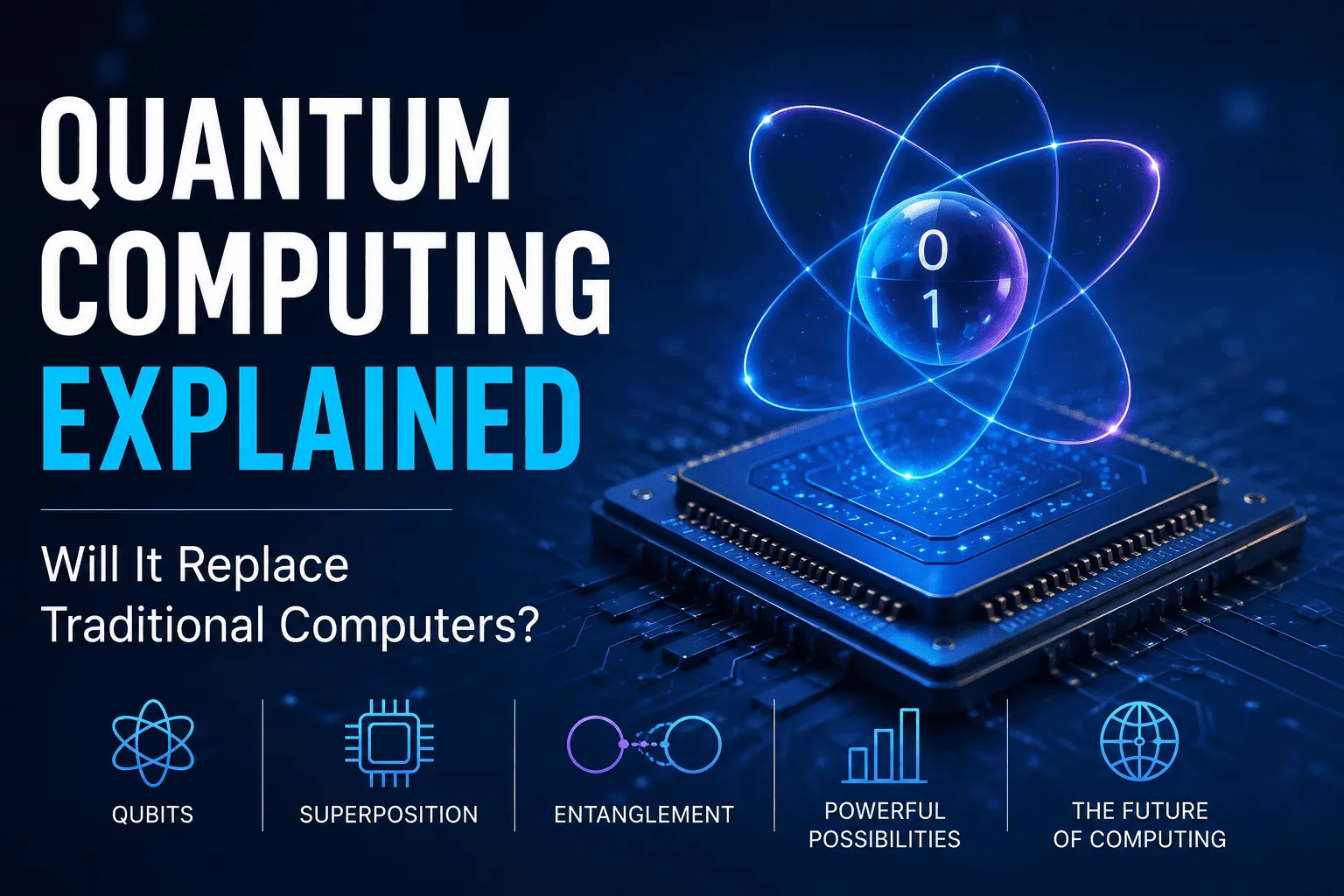
Quantum Computing Explained: Will It Replace Traditional Computers?
For more than 70 years, classical computers have powered nearly every technological breakthrough of the digital age. They’ve taken humanity to the Moon, connected billions through the internet, enabled artificial intelligence, and transformed nearly every industry. But as scientists confront increasingly complex problems, a new kind of computing is emerging—one that doesn’t simply perform calculations faster but solves problems in an entirely different way.
Welcome to the world of quantum computing.
Long considered one of science’s most ambitious frontiers, quantum computing promises to revolutionize fields ranging from medicine and cybersecurity to finance, logistics, climate science, and artificial intelligence.
Unlike traditional computers that process information using bits—zeros and ones—quantum computers use qubits, which can exist in multiple states simultaneously thanks to the strange laws of quantum mechanics.
This extraordinary capability has led some researchers to believe quantum computers could eventually solve problems that would take today’s fastest supercomputers thousands—or even millions—of years.
But does that mean your laptop, smartphone, or desktop computer will soon become obsolete?
Probably not.
The future of computing is far more likely to involve collaboration than replacement.
What Is Quantum Computing?
Quantum computing is a new approach to processing information based on the principles of quantum mechanics, the branch of physics that describes how matter and energy behave at extremely small scales.
Instead of following the same binary logic as conventional computers, quantum computers perform calculations using quantum properties that allow them to explore many possible solutions simultaneously.
This makes them especially powerful for solving highly complex mathematical problems.
Rather than replacing classical computing, quantum computing is designed to tackle challenges that conventional computers struggle with.
Quantum computing is one of the major areas covered in our Complete Guide to Emerging Technology and Innovation, alongside developments in artificial intelligence, robotics, advanced batteries, spatial computing and other rapidly evolving technologies.
How Traditional Computers Work
Every digital device you use today relies on binary bits.
A bit can have only one value at any given moment:
- 0
- 1
Everything—from photos and videos to websites and video games—is ultimately represented by enormous combinations of these two values.
Modern processors perform billions of operations every second by manipulating these bits through electrical circuits.
This system has proven incredibly effective.
However, certain problems become exponentially more difficult as they grow in size.
That’s where quantum computing enters the picture.
What Is a Qubit?
The basic unit of quantum computing is the qubit, or quantum bit.
Unlike a classical bit, which must be either 0 or 1, a qubit can exist in a combination of both states simultaneously.
This property is known as superposition.
Instead of representing a single possibility, qubits can represent multiple possibilities at once.
As more qubits are added, the number of possible calculations grows dramatically.
This is one reason quantum computers have the potential to solve certain problems much faster than traditional machines.
The Strange Science Behind Quantum Computing
Quantum computing depends on several unusual principles of quantum physics.
Superposition
Superposition allows qubits to exist in multiple states simultaneously.
Rather than evaluating one solution after another, quantum computers can explore many possibilities in parallel.
Entanglement
Quantum entanglement links qubits together in ways that classical physics cannot explain.
Changes to one entangled qubit instantly influence its partner, even when separated.
Researchers use this phenomenon to coordinate complex quantum calculations.
Quantum Interference
Quantum interference helps strengthen correct solutions while reducing incorrect ones.
This improves the probability of finding the desired answer efficiently.
Together, these principles give quantum computers capabilities that differ fundamentally from classical computers.
Why Quantum Computers Are So Powerful
The strength of quantum computing isn’t simply speed.
Instead, it’s the ability to solve particular types of problems that become practically impossible for traditional computers.
Examples include:
- Complex molecular simulations
- Cryptography
- Large-scale optimization
- Drug discovery
- Financial modeling
- Climate simulations
- Materials science
For these specialized applications, quantum computing could produce enormous breakthroughs.
Where Quantum Computing Could Change the World
Healthcare and Medicine
Developing new medicines often requires understanding how molecules interact.
These interactions become incredibly complex.
Quantum computers may eventually simulate molecular behavior with much greater accuracy.
Potential benefits include:
- Faster drug discovery
- Personalized medicine
- Improved cancer treatments
- Better vaccine development
Researchers believe this could significantly reduce the time required to develop lifesaving therapies.
Artificial Intelligence
Artificial intelligence already requires enormous computing resources.
Quantum computing could accelerate certain AI tasks involving:
- Optimization
- Pattern recognition
- Complex modeling
- Machine learning research
Although quantum AI remains an emerging field, many experts believe it holds significant long-term promise.
The potential convergence of quantum computing with other emerging technologies is one reason The Future of Robotics and other advanced technology fields may eventually benefit from quantum-enhanced optimization and simulation.
Climate Science
Understanding Earth’s climate requires processing enormous amounts of data.
Quantum computing may improve simulations involving:
- Weather prediction
- Ocean currents
- Carbon emissions
- Renewable energy systems
More accurate climate models could help governments make better environmental decisions.
Financial Services
Banks and investment firms constantly solve optimization problems involving risk, pricing, and portfolio management.
Quantum computing may improve:
- Fraud detection
- Investment strategies
- Market simulations
- Risk analysis
Financial institutions around the world are actively researching quantum technologies.
Logistics and Transportation
Finding the most efficient routes for airplanes, delivery vehicles, and shipping networks involves countless variables.
Quantum optimization could help companies:
- Reduce fuel consumption
- Improve delivery schedules
- Lower operating costs
- Optimize supply chains
Even small improvements could save billions of dollars annually.
Can Quantum Computers Break Encryption?
One of the most discussed aspects of quantum computing involves cybersecurity.
Many of today’s encryption systems rely on mathematical problems that are extremely difficult for classical computers to solve.
Powerful quantum computers could eventually solve some of these problems much more efficiently.
This has prompted governments, technology companies, and security experts to develop post-quantum cryptography—new encryption methods designed to remain secure in a quantum future.
Fortunately, researchers are already preparing well before large-scale quantum computers become widely available.
Why Quantum Computers Won’t Replace Your Laptop
Despite their remarkable potential, quantum computers are not suitable for everyday computing tasks.
They are extremely specialized.
Tasks such as:
- Browsing the internet
- Writing documents
- Watching videos
- Gaming
- Social media
remain far better suited to traditional computers.
Classical computers are faster, cheaper, more reliable, and easier to operate for general-purpose workloads.
Quantum computers excel only in specific categories of highly complex problems.
The Challenges of Quantum Computing
Although progress has accelerated, significant obstacles remain.
Error Rates
Qubits are extremely sensitive to environmental disturbances.
Even tiny changes in temperature or electromagnetic activity can introduce errors.
Researchers continue developing advanced error-correction methods.
Cooling Requirements
Many quantum computers operate at temperatures close to absolute zero.
These ultra-cold environments require highly specialized refrigeration systems.
Scalability
Building machines with thousands—or millions—of stable qubits remains an enormous engineering challenge.
Today’s systems are still relatively small compared to what researchers ultimately hope to achieve.
Which Companies Are Leading Quantum Computing?
Many of the world’s largest technology companies are investing heavily in quantum research.
Major players include:
- IBM
- Microsoft
- Amazon
- Intel
- IonQ
- Rigetti Computing
- Quantinuum
Governments across North America, Europe, and Asia are also investing billions of dollars into quantum technologies.
Many experts consider quantum computing strategically important for scientific leadership and national security.
Quantum Computing and Artificial Intelligence
AI and quantum computing are increasingly viewed as complementary technologies.
Artificial intelligence excels at learning from data.
Quantum computing excels at solving certain optimization and simulation problems.
Together, they may enable breakthroughs in areas such as:
- Drug development
- Robotics
- Autonomous vehicles
- Scientific research
- Financial modeling
Although practical quantum AI remains years away, research continues expanding rapidly.
The combination illustrates the broader convergence taking place across emerging technology and innovation.
Common Myths About Quantum Computing
Myth 1: Quantum Computers Are Faster at Everything
False.
Quantum computers outperform classical systems only for certain specialized tasks.
Myth 2: Your Laptop Will Become Obsolete
Highly unlikely.
Classical computers will continue powering everyday computing for the foreseeable future.
Myth 3: Quantum Computers Already Exist Everywhere
Only a relatively small number of research institutions and technology companies currently operate advanced quantum systems.
Most remain experimental.
Myth 4: Quantum Computing Will Replace AI
No.
Quantum computing and AI solve different problems and are expected to complement one another rather than compete.
What Does the Future Look Like?
Most experts believe computing will become increasingly hybrid.
Classical computers will continue handling everyday applications.
Quantum computers will solve highly specialized scientific and industrial problems.
Cloud providers already allow researchers limited access to experimental quantum processors via the internet.
As technology matures, businesses may use quantum computing through cloud services without ever owning a quantum computer themselves.
This broader shift toward combining different computing architectures is part of the larger evolution taking place across emerging technology.
Frequently Asked Questions
Will quantum computers replace normal computers?
No.
Quantum computers are expected to complement rather than replace traditional computers.
Can I buy a quantum computer?
Not for personal use.
Most quantum systems remain research machines operated by technology companies and scientific institutions.
How soon will quantum computing become common?
Experts expect meaningful commercial progress during the coming decade, although widespread adoption for specialized industries will likely take many years.
Why are quantum computers difficult to build?
Qubits are extremely fragile.
Maintaining stable quantum states requires sophisticated engineering, ultra-low temperatures, and advanced error correction.
Final Thoughts
Quantum computing represents one of the most exciting technological frontiers of the 21st century.
By harnessing the unusual principles of quantum mechanics, these remarkable machines have the potential to transform medicine, artificial intelligence, cybersecurity, logistics, climate science, and countless other fields.
Yet despite the excitement, quantum computing is not destined to replace the laptops, smartphones, and desktop computers we use every day.
Instead, it will likely become a powerful partner to classical computing, solving the kinds of problems that have remained beyond humanity’s reach for decades.
As researchers continue overcoming technical challenges and technology companies invest billions into quantum innovation, one thing is becoming increasingly clear:
The future of computing isn’t about choosing between classical and quantum computers—it’s about combining the strengths of both to solve problems once thought impossible.