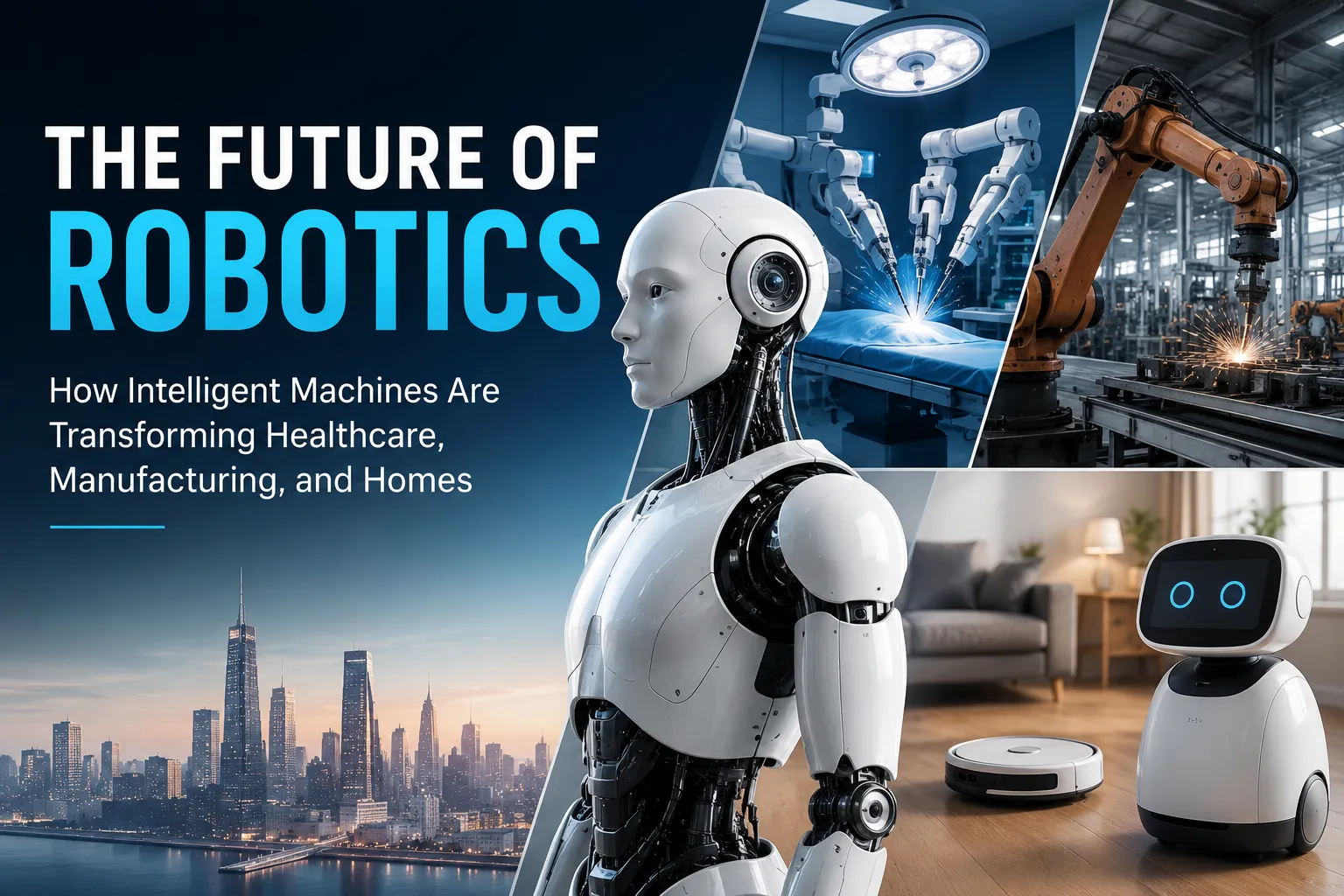
The Future of Robotics: How Intelligent Machines Are Transforming Healthcare, Manufacturing, and Homes
Not long ago, robots existed mainly in science fiction. They were portrayed as futuristic machines capable of thinking, learning, and working alongside humans. Today, that future is rapidly becoming reality.
From robotic surgeons performing life-saving operations to warehouse robots moving thousands of packages every hour, intelligent machines are becoming an increasingly important part of modern society.
Robotics is no longer limited to factories.
Today’s robots assist doctors in hospitals, vacuum living rooms, inspect dangerous industrial sites, harvest crops, explore the ocean floor, and even help scientists investigate other planets.
What makes this new generation of robots different is the growing integration of artificial intelligence (AI).
Instead of simply following pre-programmed instructions, many modern robots can recognize objects, navigate unfamiliar environments, make decisions, and continuously improve through machine learning.
As advances in computing power, sensors, and AI continue accelerating, experts believe robotics will reshape industries, redefine the workplace, and transform daily life over the coming decades.
The question is no longer whether robots will become part of our future.
It’s how they will change the way we live, work, and interact with the world.
This broader evolution is explored in the Complete Guide to Robotics and Consumer Robots, which covers the technologies, applications, and limitations of modern robotic systems.
—
What Is Robotics?
Robotics is the branch of science and engineering focused on designing, building, programming, and operating robots.
A robot is a machine capable of carrying out physical tasks either automatically or with human guidance.
Unlike traditional machines that perform one repetitive function, modern robots can often:
- Sense their surroundings
- Process information
- Make decisions
- Move independently
- Interact with people and objects
Many of today’s most advanced robots combine:
- Artificial intelligence
- Computer vision
- Sensors
- Machine learning
- Mechanical engineering
- Advanced software
Together, these technologies allow robots to perform increasingly complex tasks.
—
How Robots Have Evolved
Early industrial robots first appeared in manufacturing during the 1960s.
These machines performed repetitive jobs such as:
- Welding
- Painting
- Assembly
- Packaging
They were highly effective but lacked flexibility.
Every movement had to be carefully programmed.
Today’s intelligent robots are dramatically different.
Many can:
- Learn from data
- Recognize faces
- Navigate obstacles
- Respond to voice commands
- Adapt to changing environments
This evolution has been made possible by advances in AI, computing, and sensor technology.
—
The Role of Artificial Intelligence
Artificial intelligence has become the “brain” behind modern robotics.
Without AI, robots simply repeat instructions.
With AI, robots can:
- Analyze information
- Recognize patterns
- Learn from experience
- Make decisions
- Improve performance over time
For example, a warehouse robot can now identify shelves, avoid collisions, calculate efficient routes, and adjust to unexpected obstacles without constant human supervision.
The combination of robotics and AI is creating machines that are increasingly capable of working alongside people rather than simply replacing repetitive labor.
Robotics is also becoming increasingly connected to immersive computing. Technologies such as augmented and virtual reality can provide new ways to visualize, control, train, and interact with intelligent machines. The broader relationship between these technologies is explained in How Augmented and Virtual Reality Technology Works Using Displays, Sensors, Tracking and Spatial Computing.
This convergence is part of a much broader technology shift explored in the Complete Guide to Emerging Technology and Innovation.
—
Robotics in Healthcare
Healthcare is one of the fastest-growing areas for robotics.
Robots now assist medical professionals in numerous ways.
## Robotic Surgery
Surgical robots allow doctors to perform highly precise procedures through tiny incisions.
Benefits include:
- Greater precision
- Smaller scars
- Less blood loss
- Faster recovery
- Reduced risk of complications
Importantly, these systems do not replace surgeons.
Instead, they enhance human skill by providing greater accuracy and control.
—
## Hospital Assistance
Hospitals increasingly use robots to:
- Deliver medications
- Transport medical supplies
- Disinfect patient rooms
- Monitor inventory
Automating routine tasks allows healthcare professionals to spend more time caring for patients.
—
## Rehabilitation
Specialized robotic devices help patients recovering from:
- Stroke
- Spinal injuries
- Orthopedic surgery
- Neurological disorders
These systems support physical therapy while tracking patient progress.
—
## Elderly Care
As populations age, companion robots are being developed to:
- Remind patients to take medication
- Detect falls
- Monitor health conditions
- Provide social interaction
Although they cannot replace human caregivers, they can improve independence and quality of life.
—
Robotics in Manufacturing
Manufacturing remains robotics’ largest application.
Modern factories increasingly rely on automation to improve efficiency.
Industrial robots perform tasks such as:
- Welding
- Painting
- Assembly
- Packaging
- Quality inspection
- Material handling
Unlike humans, robots can operate continuously with remarkable precision.
This improves productivity while reducing repetitive workplace injuries.
—
Collaborative Robots (Cobots)
One of the most exciting developments is the rise of collaborative robots, often called cobots.
Unlike traditional industrial robots that operate inside safety cages, cobots are designed to work directly alongside people.
They assist workers by handling repetitive or physically demanding tasks while humans focus on activities requiring creativity, judgment, and problem-solving.
Many experts believe collaboration—not replacement—will define the next generation of workplace robotics.
—
Smart Warehouses and Logistics
E-commerce has transformed warehouse automation.
Large fulfillment centers now employ fleets of mobile robots that:
- Transport inventory
- Organize products
- Assist order picking
- Optimize storage
- Reduce delivery times
Artificial intelligence continuously calculates the most efficient movement throughout these facilities.
Consumers benefit through faster shipping and improved inventory accuracy.
—
Robotics in Agriculture
Agriculture is also embracing automation.
Modern farming robots help with:
- Planting crops
- Harvesting fruit
- Monitoring soil conditions
- Detecting plant diseases
- Precision spraying
- Weed removal
These technologies improve efficiency while reducing waste and supporting more sustainable farming practices.
—
Smart Robots in Our Homes
Household robotics has expanded rapidly over the past decade.
Popular examples include:
- Robot vacuum cleaners
- Robotic lawn mowers
- Smart security robots
- Window-cleaning robots
Future home robots may assist with:
- Cooking
- Laundry
- Home maintenance
- Elderly care
- Child supervision
- Household organization
As AI improves, home robots are expected to become increasingly versatile and affordable.
The growing role of connected household devices also overlaps with the Internet of Things, where physical devices can communicate, exchange information, and respond to their environments.
Consumer-facing robots are also increasingly connected to wearable and personal devices, creating new possibilities for hands-free control, notifications, and human-machine interaction. The Wearable Technology Guide explains how smartwatches, trackers, and other connected wearables fit into this broader technology ecosystem.
Smart homes themselves represent another important part of the connected technology landscape. The Complete Guide to Building an Intelligent Home explores how connected household systems bring devices, sensors, automation, and intelligent software together.
—
Robotics Beyond Earth
Space exploration depends heavily on robotics.
Because many environments remain too dangerous for humans, robotic explorers perform critical scientific missions.
Examples include:
- Mars rovers
- Lunar exploration vehicles
- Space station robotic arms
- Planetary probes
These machines gather data, collect samples, and conduct experiments in places humans cannot yet safely reach.
Future missions to the Moon and Mars are expected to combine human astronauts with increasingly sophisticated robotic assistants.
—
The Rise of Humanoid Robots
Perhaps the most recognizable form of robotics is the humanoid robot.
These machines resemble the human body with:
- Arms
- Legs
- Hands
- Cameras resembling eyes
- AI-powered speech
Researchers hope humanoid robots will eventually perform tasks designed specifically for human environments.
Potential applications include:
- Customer service
- Disaster response
- Warehouse work
- Hospitality
- Healthcare
- Home assistance
Although impressive progress has been made, fully capable humanoid robots remain under active development.
As robots become more capable of operating in environments designed for humans, technologies for spatial awareness and immersive interfaces may also become increasingly important. Virtual environments can help engineers train, simulate, and evaluate robotic systems before deploying them in the physical world. Readers interested in this relationship can explore Virtual Reality Explained.
—
Benefits of Robotics
The growing adoption of robotics offers many advantages.
## Improved Safety
Robots perform dangerous tasks involving:
- Toxic chemicals
- Extreme temperatures
- Heavy lifting
- Hazardous environments
Reducing human exposure improves workplace safety.
—
## Greater Precision
Robots consistently perform repetitive tasks with exceptional accuracy.
This is particularly valuable in:
- Manufacturing
- Electronics
- Medicine
—
## Increased Productivity
Unlike humans, robots do not require breaks or shift changes.
They can often operate continuously, increasing production capacity.
—
## Better Quality
Automation reduces human error while maintaining consistent product standards.
—
Challenges Facing Robotics
Despite rapid progress, important challenges remain.
## High Costs
Advanced robots remain expensive for many businesses.
Although prices continue falling, initial investments can be substantial.
—
## Job Displacement
Automation may reduce demand for certain repetitive jobs.
However, robotics also creates new careers involving:
- Programming
- Engineering
- Maintenance
- AI development
- System integration
Many economists believe workforce retraining will become increasingly important.
—
## Ethical Questions
As robots become more intelligent, society must address questions involving:
- Privacy
- Accountability
- Safety
- Decision-making
- Human oversight
Clear regulations will likely play a growing role as robotics expands.
—
The Future of Human-Robot Collaboration
Rather than replacing humans entirely, many experts predict robots will increasingly serve as intelligent assistants.
People excel at:
- Creativity
- Empathy
- Critical thinking
- Complex judgment
Robots excel at:
- Precision
- Speed
- Repetition
- Heavy lifting
- Data processing
Combining these strengths allows humans and machines to accomplish tasks neither could perform as effectively alone.
This collaborative future is already emerging across healthcare, manufacturing, logistics, and research.
Robotics is also expanding into transportation, where autonomous machines must combine perception, navigation, decision-making, and physical control. How Self-Driving Cars Work provides a closer look at one of the most advanced examples of this convergence.
The same convergence is becoming important in electric transportation, where robotics, autonomous systems, sensors, software, and advanced power systems increasingly work together. Electric Vehicles Explained provides a broader look at the technologies behind modern electric transportation.
As autonomous machines move beyond individual vehicles and into wider transportation networks, robotics will also play an important role in the future of transportation technology.
Drones represent another example of autonomous machines extending robotics beyond traditional ground-based systems. Their combination of sensors, navigation, software, and automated flight is explored in The Complete Guide to Drones.
Advanced batteries are also increasingly important to mobile robotics and autonomous machines because operating without a fixed power source requires efficient energy storage. How Next-Generation Battery Technology Works explores the technologies that could influence the future of battery-powered machines.
—
Frequently Asked Questions
## Will robots replace all human jobs?
No.
While automation will change many occupations, new jobs involving robotics, AI, maintenance, software development, and system management are expected to emerge.
—
## What’s the difference between AI and robotics?
Artificial intelligence enables machines to think, learn, and make decisions.
Robotics focuses on building physical machines.
Many modern robots combine both technologies.
—
## Are robots safe?
When properly designed and regulated, robots are generally safe.
Industrial robots, collaborative robots, and medical robots include numerous safety systems to protect users.
—
## What industries use robotics today?
Major industries include:
- Healthcare
- Manufacturing
- Agriculture
- Logistics
- Retail
- Construction
- Space exploration
- Defense
- Hospitality
—
Final Thoughts
Robotics has evolved from a niche engineering discipline into one of the most transformative technologies of the 21st century.
Powered by advances in artificial intelligence, computer vision, sensors, and machine learning, intelligent robots are moving beyond factory floors and becoming valuable partners in hospitals, warehouses, farms, research laboratories, and homes.
While challenges surrounding cost, regulation, ethics, and workforce adaptation remain, the long-term trajectory is clear.
Future robots are likely to become smarter, safer, more affordable, and increasingly capable of working alongside humans rather than replacing them.
The next generation of intelligent machines won’t simply automate repetitive tasks—they’ll help solve complex problems, improve healthcare, boost productivity, and make everyday life more convenient.
As robotics continues to advance, one thing is becoming increasingly certain:
The future won’t be built by humans or robots alone—it will be shaped by how effectively the two learn to work together.