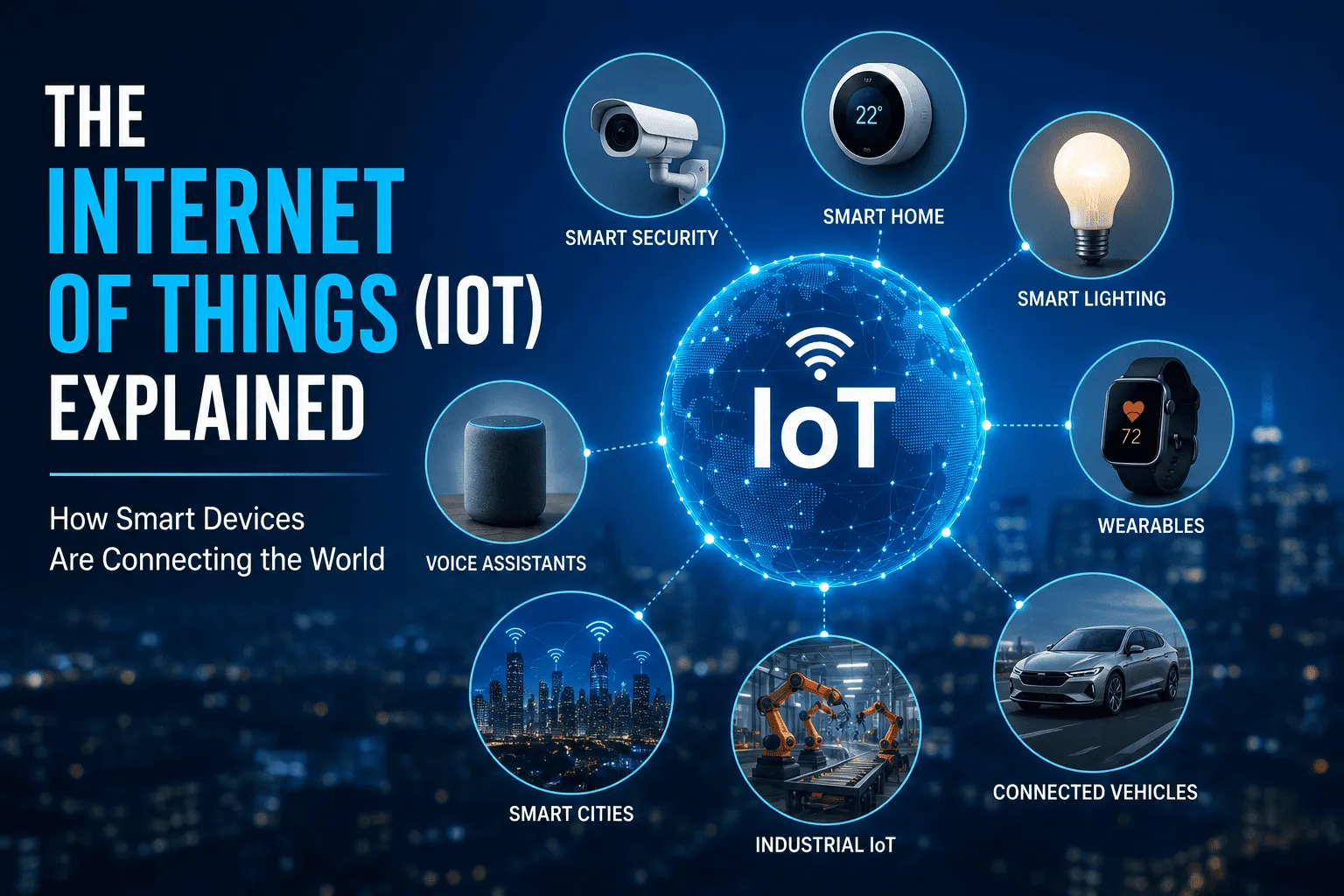
The Internet of Things (IoT) Explained: How Smart Devices Are Connecting the World
Imagine waking up to a home that has already adjusted the temperature, brewed your coffee, turned on the lights, and reminded you of your first meeting—all before you’ve even stepped out of bed. It may sound futuristic, but for millions of people, this is already everyday life thanks to the Internet of Things (IoT).
The Internet of Things is quietly transforming how people live, work, travel, and interact with technology. From smart homes and wearable fitness trackers to connected factories and intelligent cities, billions of devices are now communicating with one another over the internet.
Unlike traditional computers and smartphones that require constant human interaction, IoT devices collect data, exchange information, and often make decisions automatically.
This growing network of connected technology is improving efficiency, reducing costs, enhancing safety, and creating entirely new ways of living and working.
As artificial intelligence, cloud computing, and 5G networks continue to advance, the Internet of Things is expected to become one of the most influential technologies of the coming decades. IoT is also part of a much broader wave of connected, intelligent technologies covered in the Complete Guide to Emerging Technology and Innovation.
So, what exactly is the Internet of Things—and why is it becoming so important?
What Is the Internet of Things (IoT)?
The Internet of Things (IoT) refers to a network of physical devices connected to the internet that can collect, share, and exchange data with minimal human intervention.
These “things” include everyday objects embedded with:
- Sensors
- Software
- Internet connectivity
- Processors
- Artificial intelligence
Instead of operating independently, IoT devices communicate with each other to automate tasks and improve decision-making.
Simply put:
IoT allows ordinary objects to become “smart.”
How Does IoT Work?
Although IoT systems vary widely, most operate using the same basic process.
1. Data Collection
Smart devices use sensors to gather information.
Examples include:
- Temperature
- Motion
- Location
- Heart rate
- Air quality
- Humidity
- Energy usage
For a closer look at how connected devices collect and exchange this information, see How Internet of Things Devices Collect, Exchange and Process Data.
2. Internet Connection
The collected data is transmitted through technologies such as:
- Wi-Fi
- Bluetooth
- 5G
- Ethernet
- Satellite
- Cellular networks
Reliable connectivity is fundamental to IoT systems, which is why understanding the different technologies in the Complete Guide to Wireless Connectivity is useful when evaluating connected devices.
3. Cloud Processing
The information is sent to cloud servers where it can be:
- Stored
- Processed
- Analyzed
- Compared with historical data
Artificial intelligence often helps identify patterns and make predictions.
Cloud platforms provide much of the computing and storage infrastructure behind these connected systems. The Cloud Computing Explained guide provides a broader look at how cloud technology supports modern digital services.
4. Action
Based on the analysis, the system performs an action automatically or sends information to users.
For example:
A smart thermostat detects that you’re leaving work.
It automatically adjusts your home’s temperature before you arrive.
Everyday Examples of IoT
Many people already use IoT without realizing it.
Common examples include:
- Smart speakers
- Smart TVs
- Smart thermostats
- Robot vacuum cleaners
- Smartwatches
- Fitness trackers
- Smart doorbells
- Connected security cameras
These devices continuously exchange information to improve convenience and efficiency.
Smart Homes
One of IoT’s most visible applications is the smart home.
Connected devices can control:
- Lighting
- Heating
- Air conditioning
- Security systems
- Appliances
- Entertainment systems
Imagine leaving your house.
Your smart home automatically:
- Locks the doors.
- Turns off lights.
- Adjusts the thermostat.
- Activates security cameras.
All without requiring manual input.
These connected systems form the foundation of intelligent homes. For a broader look at how the devices, automation, AI, and connectivity work together, see The Complete Guide to Building an Intelligent Home.
Wearable Technology
Wearable devices have become increasingly sophisticated.
Smartwatches and fitness trackers monitor:
- Heart rate
- Sleep quality
- Daily activity
- Blood oxygen levels
- Calories burned
- Exercise performance
Some devices even detect irregular heart rhythms and alert users to seek medical attention.
The broader development of connected watches, fitness trackers, and other body-worn devices is covered in the Wearable Technology Guide.
Healthcare and Connected Medicine
Healthcare is one of IoT’s fastest-growing sectors.
Connected medical devices allow doctors to monitor patients remotely.
Examples include:
- Glucose monitors
- Blood pressure monitors
- Heart monitors
- Smart inhalers
- Remote patient monitoring systems
This improves patient care while reducing unnecessary hospital visits.
Smart Cities
Cities around the world increasingly rely on IoT to improve urban life.
Smart city technologies help manage:
- Traffic signals
- Public transportation
- Street lighting
- Waste collection
- Parking
- Air quality monitoring
Real-time data allows city officials to make faster, more informed decisions.
IoT in Manufacturing
Factories are becoming more connected through Industrial IoT (IIoT).
Smart manufacturing systems monitor:
- Equipment performance
- Production speed
- Machine health
- Energy consumption
- Inventory
Predictive maintenance can detect equipment problems before costly breakdowns occur.
This improves productivity while reducing downtime.
Agriculture Goes Smart
Farmers increasingly use IoT technologies to improve food production.
Connected sensors monitor:
- Soil moisture
- Weather conditions
- Crop health
- Livestock
- Irrigation systems
These technologies help reduce water usage while increasing crop yields.
Transportation and Connected Vehicles
Modern vehicles increasingly function as connected computers.
IoT supports features such as:
- GPS navigation
- Remote diagnostics
- Vehicle tracking
- Predictive maintenance
- Emergency assistance
- Traffic updates
Future autonomous vehicles will rely heavily on IoT to communicate with roads, traffic systems, and nearby vehicles.
This connection between IoT and autonomous transportation is particularly important because vehicles increasingly need to communicate with infrastructure and other machines. How Self-Driving Cars Work explains how sensors, AI, onboard computing, and other technologies enable autonomous vehicles to understand and respond to their surroundings.
Retail and Shopping
Retailers use IoT to improve customer experiences.
Applications include:
- Smart shelves
- Inventory tracking
- Automated checkout
- Personalized promotions
- Supply chain monitoring
Connected systems help businesses respond more quickly to customer demand.
Energy and Smart Grids
Electric utilities increasingly use IoT to manage energy distribution.
Smart grids help:
- Balance electricity demand
- Detect outages
- Integrate renewable energy
- Reduce waste
- Improve efficiency
Consumers also benefit from smart electricity meters that provide real-time usage information.
The Role of Artificial Intelligence
Artificial intelligence greatly expands IoT’s capabilities.
AI helps connected devices:
- Learn user behavior
- Predict future events
- Detect abnormalities
- Automate decisions
- Improve performance over time
For example, a smart thermostat doesn’t simply follow schedules.
It learns household routines and automatically adjusts heating and cooling for greater comfort and efficiency.
The combination of connected sensors and intelligent decision-making also overlaps with robotics. Autonomous machines can use similar technologies to perceive their surroundings and act on collected data, as explored in The Future of Robotics.
Why Businesses Love IoT
Organizations increasingly invest in IoT because it offers significant advantages.
Better Efficiency
Automation reduces repetitive work and improves productivity.
Cost Savings
Monitoring equipment prevents expensive failures and reduces maintenance costs.
Better Decision-Making
Real-time data provides valuable business insights.
Improved Customer Experience
Connected services allow companies to personalize products and respond more quickly to customer needs.
IoT also creates a larger connected technology environment for businesses. Devices, applications, networks, cloud services, and other systems must work together reliably, making The Complete Guide to Business Networking relevant to organizations deploying connected technologies at scale.
Challenges Facing IoT
Despite its enormous potential, IoT also presents challenges.
Security
Every connected device creates a potential cybersecurity risk.
Weak security can expose personal information or business systems.
Manufacturers continue improving device protection through stronger encryption and authentication.
Because IoT devices can provide pathways into larger networks, Complete Guide to Network Security explains the broader principles organizations can use to protect connected systems and digital infrastructure.
Privacy
Many IoT devices collect sensitive personal data.
Consumers increasingly expect transparency regarding how their information is stored and used.
Compatibility
Different manufacturers sometimes use incompatible standards.
Improving interoperability remains an important industry goal.
Internet Dependence
Most IoT systems rely on reliable internet connectivity.
Poor network performance can limit functionality.
The Future of IoT
Experts expect billions of additional connected devices over the next decade.
Future developments may include:
- AI-powered smart homes
- Connected healthcare systems
- Fully autonomous factories
- Smart agriculture
- Intelligent transportation
- Smart energy infrastructure
- Advanced environmental monitoring
The rollout of faster 5G and future wireless technologies will allow even more devices to communicate instantly.
As these systems become more capable, the distinction between individual connected gadgets and larger intelligent environments will continue to blur. Homes, vehicles, infrastructure, and industrial systems could increasingly operate as interconnected networks rather than isolated technologies.
IoT will also increasingly depend on the broader IT infrastructure that connects devices, applications, networks, data, and cloud services. Businesses building these environments can benefit from understanding the Complete Guide to IT Infrastructure for Businesses.
Frequently Asked Questions
What does IoT stand for?
IoT stands for Internet of Things, referring to internet-connected devices that collect and exchange data.
Is a smartphone an IoT device?
Although smartphones connect to the internet, they are generally considered control devices rather than traditional IoT devices.
However, smartphones often manage and communicate with IoT systems.
Is IoT safe?
IoT devices can be very secure when manufacturers implement strong cybersecurity measures and users keep devices updated with the latest software.
How many IoT devices exist today?
Industry estimates suggest there are already tens of billions of connected IoT devices worldwide, with continued rapid growth expected over the coming years.
Final Thoughts
The Internet of Things is quietly reshaping the modern world by connecting billions of everyday devices to the internet and enabling them to communicate, analyze information, and make intelligent decisions with minimal human intervention.
From smart homes and wearable health monitors to connected factories, intelligent cities, and autonomous transportation, IoT is improving efficiency, convenience, safety, and productivity across nearly every sector of society.
While challenges involving cybersecurity, privacy, and interoperability remain, ongoing advances in artificial intelligence, cloud computing, and high-speed wireless networks continue to unlock new possibilities.
As more devices become connected and capable of working together, the Internet of Things will move even closer to fulfilling its promise of creating a smarter, more responsive, and increasingly automated world.
One thing is already clear:
The Internet of Things isn’t simply connecting devices—it’s connecting people, businesses, and entire communities in ways that are transforming how the world functions every single day.
Key Takeaways
-
IoT connects physical devices through sensors, software, processors, and internet connectivity.
-
Connected devices can collect data, exchange information, analyze conditions, and trigger automated actions.
-
IoT is used across smart homes, healthcare, manufacturing, agriculture, transportation, retail, energy, and smart cities.
-
Artificial intelligence makes connected systems more capable by helping them identify patterns, make predictions, and automate decisions.
-
Security, privacy, compatibility, and reliable connectivity remain important challenges.
-
IoT is becoming increasingly interconnected with robotics, autonomous transportation, wearable technology, and other emerging technologies.