The Rise of AI Agents: How Autonomous AI Could Change Work, Business, and Daily Life
Artificial intelligence has evolved rapidly over the past few years. What began as chatbots capable of answering questions and generating text is now entering a new phase—one where AI doesn’t just respond to requests but actively completes tasks on behalf of users. Welcome to the era of AI agents.
Unlike traditional AI assistants that wait for instructions one prompt at a time, AI agents are designed to plan, reason, make decisions, and execute complex workflows with minimal human intervention.
Imagine asking an AI to organize your vacation.
Instead of simply recommending destinations, it researches flights, compares hotel prices, creates an itinerary, checks weather forecasts, books reservations, and updates your calendar automatically.
That is the promise of autonomous AI.
Major technology companies, startups, and research organizations are investing heavily in AI agents, believing they represent the next major leap in artificial intelligence.
Supporters argue these systems could dramatically improve productivity across nearly every industry.
Critics, however, raise important questions about privacy, security, employment, and how much autonomy machines should ultimately have.
One thing is already becoming clear:
AI agents may soon become as common as smartphones are today.
What Is an AI Agent?
An AI agent is an artificial intelligence system capable of performing tasks independently to achieve a specific goal.
Unlike traditional AI chatbots that primarily answer questions, AI agents can:
- Plan tasks
- Make decisions
- Execute multiple actions
- Learn from outcomes
- Adapt to changing situations
- Interact with software and digital services
Rather than responding to one instruction at a time, an AI agent can manage an entire workflow from start to finish.
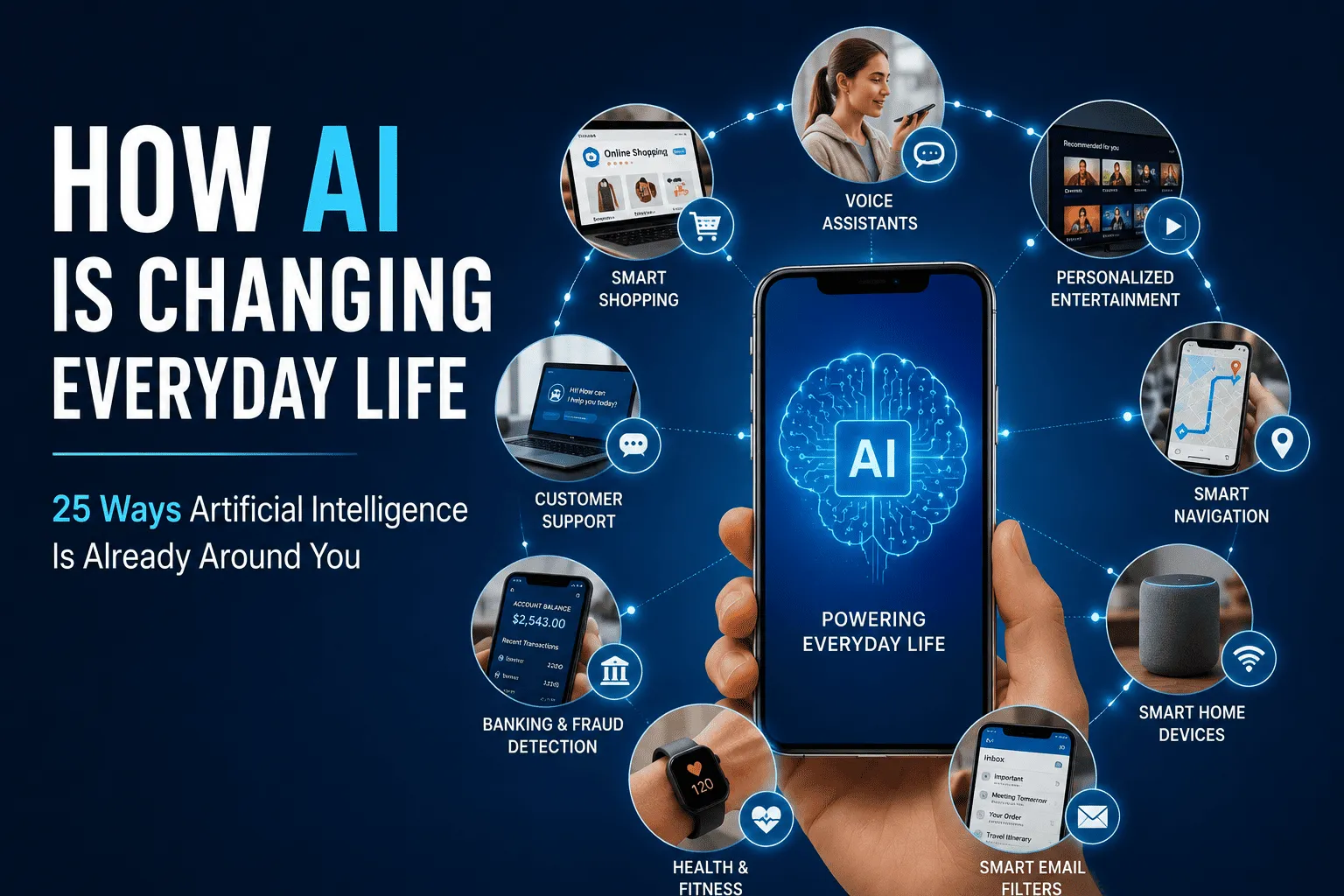
For a broader explanation of how AI works and is changing everyday activities, see our guide to how AI is changing life.
In simple terms:
A chatbot answers questions.
An AI agent completes jobs.
How AI Agents Differ from Chatbots
Although the two technologies share similarities, their capabilities are very different.
| Traditional Chatbot | AI Agent |
|---|---|
| Answers questions | Completes tasks |
| Waits for prompts | Plans multiple steps |
| Limited memory | Maintains context |
| Generates content | Takes action |
| Reactive | Proactive |
For example:
A chatbot can explain how to create a spreadsheet.
An AI agent may actually build the spreadsheet, analyze the data, generate charts, and email the finished report.
This distinction is part of the broader evolution of modern software and intelligent systems. To understand the software foundation behind many AI-powered applications, see our complete guide to apps.
How AI Agents Work
Modern AI agents combine several advanced technologies.
Large Language Models
Powerful language models provide reasoning, communication, and problem-solving abilities.
These models help agents understand natural language instructions and determine how to respond to complex goals.
Memory
Unlike traditional chatbots, many AI agents can maintain information from previous interactions.
This allows them to maintain context while working on long or complex tasks.
Memory can be particularly important when an agent is working across multiple applications or handling a project over an extended period.
Planning
AI agents break large objectives into smaller steps.
For example:
Goal: Launch a new website.
The agent might automatically:
- Create a project timeline
- Generate website content
- Design page layouts
- Schedule meetings
- Track progress
- Produce reports
Planning is one of the characteristics that separates agentic systems from simple rule-based automation. For more background, see our guide on how automation software uses rules and workflows to perform repetitive tasks.
Tool Usage
Modern AI agents increasingly interact with external tools such as:
- Calendars
- Databases
- Web browsers
- Documents
- Business software
This ability transforms them from information providers into digital workers.
Agents can also depend heavily on APIs and integrations to communicate with other applications. Our API and integrations guide for developers explains how these connections allow different software systems to exchange information and functionality.
AI Agents in the Workplace
Businesses are among the earliest adopters of AI agents.
Organizations see enormous potential for improving efficiency while reducing repetitive work.
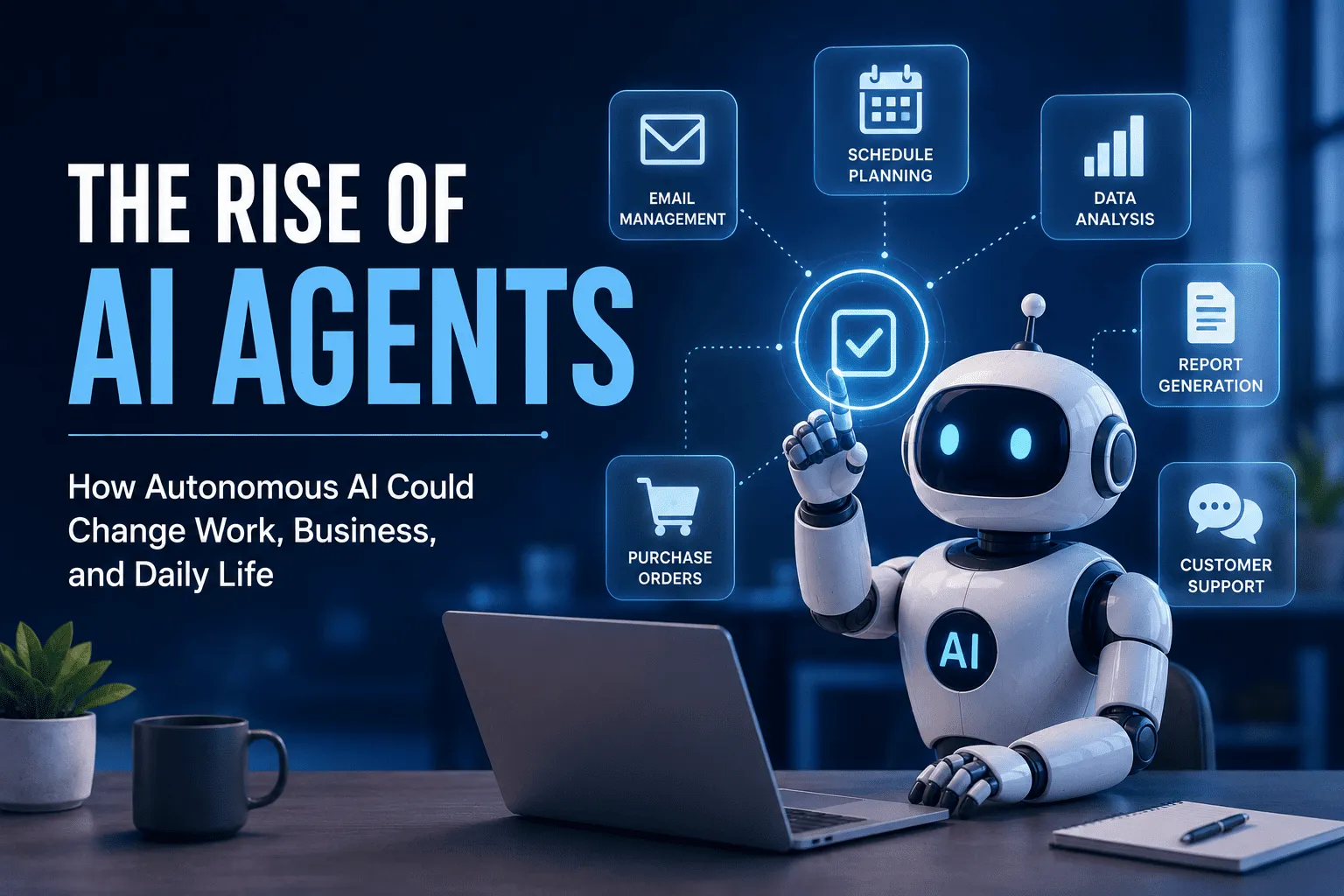
Common applications include:
- Customer support
- Scheduling meetings
- Managing emails
- Preparing reports
- Data analysis
- Project management
- Workflow automation
Instead of replacing entire teams, many companies may use AI agents to handle repetitive administrative tasks while employees focus on creative and strategic work.
This fits into the larger movement toward digital transformation. Businesses interested in the broader technology landscape can explore our complete guide to digital transformation for businesses.
Transforming Customer Service
Customer support has already been transformed by AI.
The next generation goes even further.
Future AI agents may:
- Understand customer problems
- Access account information
- Process refunds
- Schedule repairs
- Escalate complex cases
- Follow up automatically
This could significantly reduce response times while improving customer satisfaction.
AI agents could also become connected to CRM systems, customer databases, ticketing platforms, and other business applications.
AI Agents in Healthcare
Healthcare presents exciting possibilities for intelligent automation.
Future AI agents may assist by:
- Scheduling appointments
- Monitoring patient records
- Summarizing medical histories
- Supporting clinical documentation
- Managing administrative tasks
Importantly, these systems are expected to support healthcare professionals—not replace doctors or nurses.
Human oversight remains essential for medical decision-making.
Smarter Businesses Through Automation
Businesses increasingly rely on software across multiple departments.
AI agents can connect these systems together.
For example, an AI agent could:
- Monitor inventory
- Predict demand
- Place supplier orders
- Update accounting software
- Notify managers
Instead of employees switching between multiple applications, AI can coordinate information and workflows automatically.
This builds on the broader role of business automation, where software is used to reduce repetitive manual processes and improve operational efficiency.
Personal AI Assistants
Consumers may soon use AI agents daily.
Imagine saying:
“Plan my week.”
An AI agent could:
- Check your calendar
- Schedule appointments
- Prioritize tasks
- Order groceries
- Book transportation
- Set reminders
The assistant could continue working after the initial conversation ends.
This represents a major shift from today’s conversational AI.
Instead of simply asking an assistant for information, people could increasingly delegate entire digital workflows.
Education and Learning
Students may also benefit from intelligent AI agents.
Potential capabilities include:
- Personalized study plans
- Homework assistance
- Progress tracking
- Language tutoring
- Practice quizzes
- Research support
Teachers could also automate lesson planning, grading support, and classroom administration.
The technology could therefore become another layer of digital education rather than simply another chatbot.
Software Development
Programming is another field experiencing rapid AI adoption.
AI agents increasingly assist developers by:
- Writing code
- Testing software
- Finding bugs
- Reviewing security issues
- Updating documentation
- Managing deployments
Rather than replacing software engineers, these systems can accelerate development by handling repetitive coding tasks.
Developers who want to understand the wider discipline can explore our complete guide to software development processes, as well as our guide to writing maintainable and high-quality software code.
AI agents can also interact with version-control systems and development workflows, making Git and version control increasingly relevant to agent-assisted development.
AI Agents and Scientific Research
Researchers spend enormous amounts of time reviewing literature and analyzing data.
Future AI agents may:
- Search scientific publications
- Summarize research
- Identify trends
- Generate hypotheses
- Assist with experiments
- Analyze results
This could dramatically accelerate discovery across medicine, engineering, biology, and physics.
However, researchers will still need to verify evidence, evaluate methodology, and distinguish genuine findings from incorrect AI-generated conclusions.
Challenges and Risks
Despite their promise, AI agents present important challenges.
Privacy
Many AI agents require access to:
- Emails
- Calendars
- Financial information
- Business systems
Protecting sensitive data remains essential.
The growing use of autonomous software makes understanding digital privacy and why it matters increasingly important.
Users should understand what information an agent can access, where that information is stored, and which actions the system is authorized to perform.
Security
If an AI agent gains broad access to digital services, cybersecurity becomes even more important.
Strong authentication, restricted permissions, monitoring, and careful oversight are necessary.
Our guide to software security provides broader context on how software systems can be protected.
Organizations should also understand data security and how digital information can be protected.
Accuracy
AI agents can still make mistakes.
Incorrect decisions involving healthcare, finance, or legal matters could have serious consequences.
Human review remains critical, especially when an agent has permission to perform actions rather than simply provide information.
Employment
Automation may reduce demand for some repetitive administrative roles.
At the same time, AI is expected to create new jobs involving:
- AI management
- Prompt engineering
- System integration
- AI governance
- Human-AI collaboration
Historically, technological revolutions often transform work rather than eliminate it entirely.
The Importance of Human Oversight
Most responsible approaches to AI agents treat them as tools that operate within defined boundaries rather than unrestricted independent decision-makers.
Humans continue providing:
- Ethics
- Judgment
- Creativity
- Empathy
- Accountability
AI excels at speed and automation.
People excel at context and critical thinking.
The most effective future will likely combine both.
This is especially important as AI systems gain access to sensitive systems and information. Organizations need appropriate identity and access security so that agents receive only the permissions necessary to complete their assigned tasks.
Which Companies Are Building AI Agents?
Competition is accelerating.
Major technology companies and startups are investing heavily in autonomous AI systems.
Current participants include:
- OpenAI
- Microsoft
- Anthropic
- Amazon
- Salesforce
- Nvidia
- Meta
Many enterprise software companies are also integrating AI agents into business platforms.
The broader AI ecosystem is developing rapidly, with improvements in models, infrastructure, software tools, and integrations all contributing to the growth of agentic systems.
What Could Daily Life Look Like?
Within the next decade, AI agents may quietly manage many routine activities.
Imagine waking up to discover your AI assistant has already:
- Organized your schedule
- Responded to routine emails
- Paid recurring bills
- Ordered groceries
- Rescheduled appointments
- Planned your commute
- Suggested healthy meals
Instead of replacing human decision-making, AI could increasingly handle repetitive digital tasks behind the scenes.
This vision also connects with the broader development of intelligent homes, where connected devices and software systems can work together automatically.
Frequently Asked Questions
Are AI agents the same as chatbots?
No.
Chatbots mainly answer questions.
AI agents are designed to perform multi-step tasks and interact with software more independently.
The distinction is not absolute, because many modern AI products combine conversational interfaces with agentic capabilities.
Will AI agents replace jobs?
Some repetitive tasks may become automated, but new opportunities involving AI development, oversight, integration, governance, and human-AI collaboration are also likely to emerge.
The larger impact may initially involve changing what people do rather than eliminating entire occupations.
Are AI agents safe?
They can be safer when designed with appropriate security, transparency, restricted permissions, monitoring, and human oversight.
However, privacy and cybersecurity remain important concerns.
When will AI agents become common?
Many businesses are already experimenting with or adopting early forms of AI agents.
Broader consumer adoption will depend on improvements in reliability, cost, security, integrations, and ease of use.
A New Role for AI in Everyday Work
Artificial intelligence is entering a new chapter.
Rather than simply answering questions, the next generation of AI is learning to plan, reason, and complete complex tasks with increasing independence.
From managing business operations and supporting healthcare professionals to organizing personal schedules and accelerating scientific research, AI agents have the potential to transform how people work and interact with technology.
At the same time, their growing capabilities bring important responsibilities.
Ensuring privacy, maintaining security, protecting jobs through workforce adaptation, and preserving meaningful human oversight will be essential as autonomous AI becomes more widespread.
The future of AI is no longer just about creating smarter software.
It’s about building intelligent digital partners capable of helping people solve increasingly complex problems.
Whether in offices, homes, hospitals, or classrooms, one reality is becoming increasingly difficult to ignore:
The rise of AI agents marks the beginning of a new era—one where intelligent machines don’t simply respond to commands but actively collaborate with humans to get work done faster, smarter, and more efficiently than ever before.