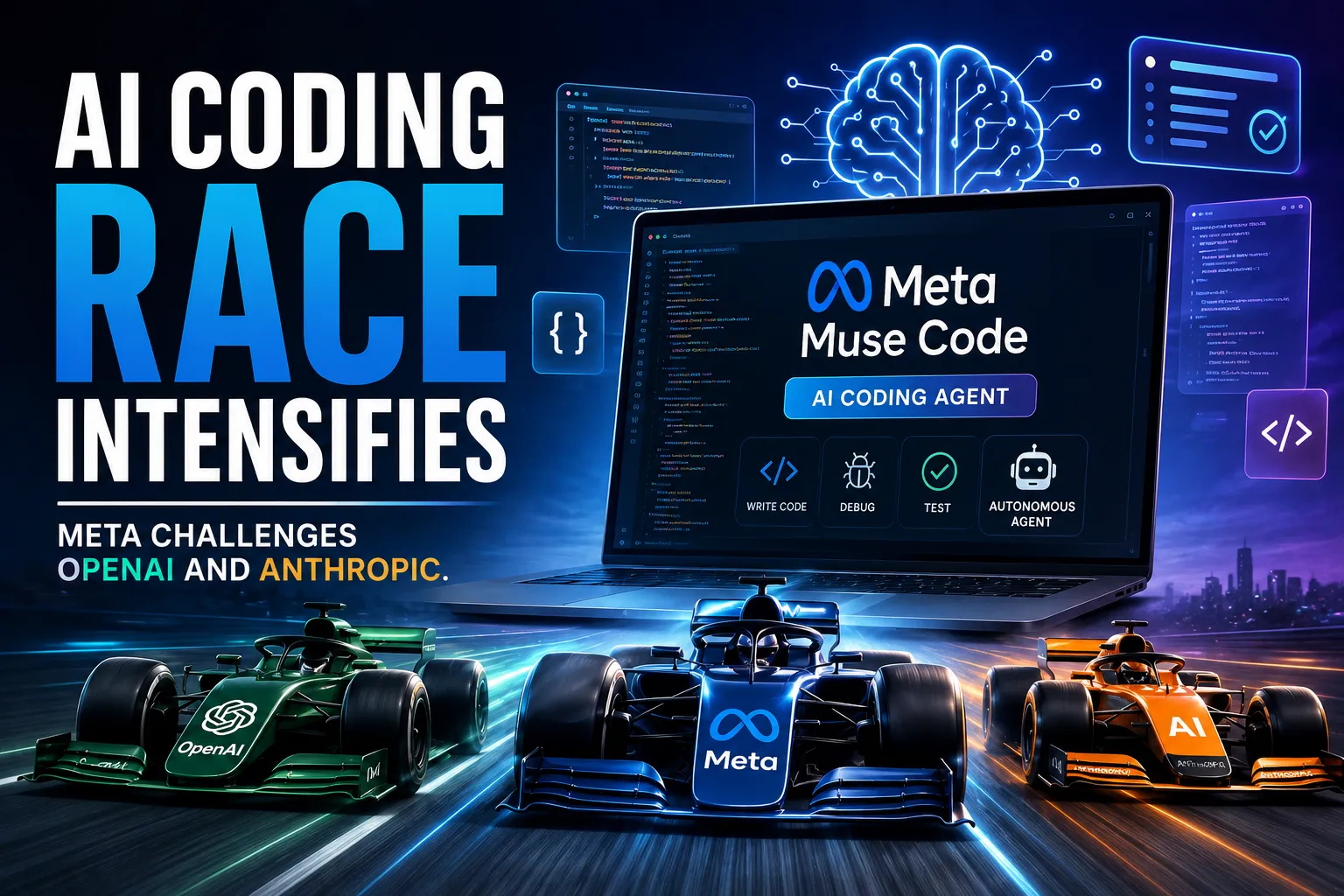
AI Coding Race Intensifies as Meta Challenges OpenAI and Anthropic
The race to build the most capable AI coding tools is entering another phase, with Meta taking a more direct shot at established competitors OpenAI and Anthropic.
Meta recently launched Muse Code, an AI-powered coding agent designed to write, debug and test software while handling longer, more complex development tasks. The tool is powered by Meta’s Muse Spark 1.2 model and is positioned as a direct competitor to OpenAI’s Codex and Anthropic’s Claude Code.
The move highlights how quickly AI coding is evolving from simple autocomplete features into systems capable of carrying out substantial portions of a software-development workflow.
Meta Enters a Crowded AI Coding Market
Meta’s Muse Code is designed to do more than generate snippets from a developer’s instructions. According to Reuters, the system can write and debug code, tackle lengthy development tasks and run multiple sub-agents concurrently.
The tool is currently available in beta and uses a pay-as-you-go pricing model. Meta has set pricing at $1.25 per million input tokens and $4.25 per million output tokens, giving developers another pricing model alongside the subscription approaches used by some competing services.
That positioning could become one of Meta’s biggest advantages.
Rather than competing only on model intelligence, Meta can compete on cost, flexibility and access, particularly among developers and smaller teams that may be sensitive to recurring software subscriptions.
OpenAI and Anthropic Already Have Strong Positions
Meta is entering a market where OpenAI and Anthropic have already invested heavily in agentic coding.
OpenAI’s Codex is designed to handle software-engineering tasks ranging from routine pull requests to complex refactoring and migrations. OpenAI says Codex can work with large codebases, use development tools, run tests and prepare changes for human review.
OpenAI has also reported rapid growth in the use of agentic coding. A June 2026 research paper analyzing Codex usage found that the number of active users grew more than fivefold during the first half of 2026, while increasingly complex tasks were being delegated to coding agents.
Anthropic has similarly made coding agents a major part of its AI strategy. Its Claude Code platform allows developers to use AI systems that can autonomously write and execute analysis code and work through software-development tasks.
The result is a market where the competition is no longer simply about which chatbot writes the best code.
It is increasingly about which AI agent can function most effectively as a software engineer.
The Shift From Code Suggestions to AI Developers
Traditional AI coding assistants primarily helped developers complete lines of code, generate functions or explain programming concepts.
Agentic coding systems operate at a different level.
A developer can increasingly give an AI system a higher-level objective and allow it to:
- Understand an existing codebase.
- Determine which files need to change.
- Write or modify code.
- Run tests.
- Identify failures.
- Debug its own work.
- Repeat the process.
- Prepare the resulting changes for human review.
This shift matters because it changes the economics of software development.
AI is moving from being a tool that assists programmers toward becoming a system that performs parts of the programming workflow.
Research into coding-agent adoption at Microsoft found that engineers using command-line AI coding tools merged roughly 24% more pull requests than they otherwise would have during the study period, although the researchers cautioned that a merged pull request is not necessarily equivalent to business value.
Why Meta’s Entry Matters
Meta has historically been an important player in open AI models, particularly through the Llama family and its broader open-model strategy.
Its latest move suggests that the company sees developer workflows as an increasingly important battleground.
The introduction of Muse Spark 1.1 in July already emphasized improvements in coding, tool use, computer use and multimodal reasoning. Meta described the model as an upgrade for agentic tasks and opened access through its Model API.
Muse Code extends that strategy into a dedicated developer product.
For Meta, the opportunity is significant: coding agents can become both a commercial product and a way to expand the practical use of its AI models among developers.
Price Could Become a Major Competitive Weapon
One of the most interesting aspects of Meta’s approach is its pricing.
Muse Code’s token-based model gives developers the option of paying according to usage rather than simply subscribing to a fixed monthly plan. Meta is also offering a contributor tier with different economics, according to reporting on the launch.
That could appeal to:
- Independent developers
- Startups
- Students
- Open-source contributors
- Small software teams
- Developers experimenting with AI agents
However, price alone will not determine the winner.
Developers care about how reliably an agent modifies code, how well it understands large repositories, how frequently it makes mistakes and how much supervision its work requires.
A cheap coding agent that needs constant correction may ultimately cost more in engineering time than a more expensive system that produces dependable results.
The Biggest Challenge Is Reliability
As coding agents become more autonomous, reliability and security become increasingly important.
Giving an AI system permission to read files, execute commands and interact with external tools creates risks that traditional autocomplete systems largely avoided.
Recent research has highlighted vulnerabilities in modern AI coding agents, including attacks involving malicious instructions embedded in software-development tasks. One July 2026 study found that many malicious issue requests could penetrate the defenses of tested coding agents, underscoring the security challenges associated with giving AI systems greater autonomy.
This means the competition will not be decided solely by benchmark scores.
The strongest coding platforms will need to combine:
- Strong reasoning
- Accurate code generation
- Reliable testing
- Repository-level understanding
- Tool-use capabilities
- Security controls
- Human oversight
- Predictable costs
Developers May Benefit From the Competition
For developers, intensifying competition could be a positive development.
More capable competitors can push prices down while improving the quality of coding assistance. Developers may also gain greater choice over how they use AI in their workflows.
Instead of being locked into a single platform, teams could increasingly choose tools based on the type of work they need to perform.
For example, one system might be better for large-scale refactoring, another for debugging, and another for rapid prototyping.
The emergence of specialized coding agents could therefore make AI-assisted development more competitive rather than creating a single dominant platform.
The Real Race Is About Autonomous Software Engineering
Meta’s Muse Code launch is significant because it shows where the AI industry is heading.
The competition between Meta, OpenAI and Anthropic is increasingly centered on agentic software development rather than conventional chatbot-based coding assistance.
OpenAI is pushing Codex deeper into enterprise workflows, Anthropic has established Claude Code as a major coding-agent product, and Meta is now bringing Muse Code into the same competitive arena.
The next stage of the race may therefore be less about asking an AI to write code and more about asking it to build, test, maintain and improve software with minimal human intervention.
For developers and businesses, that could ultimately be the most important change of all: the best coding AI may no longer be the one that produces the most impressive snippet, but the one that can reliably take a complex software task from instruction to working implementation.