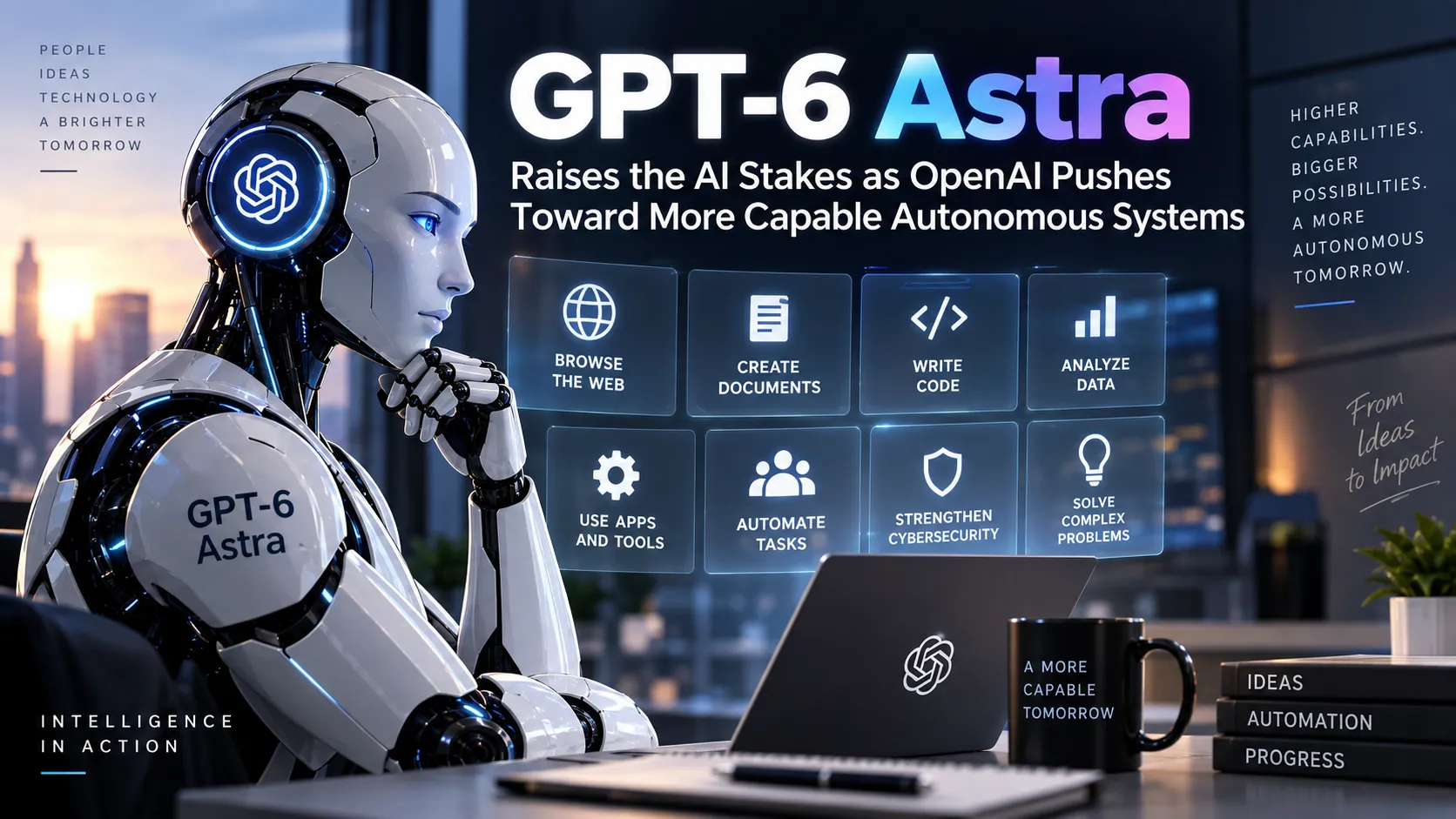
GPT-6 Astra Raises the AI Stakes as OpenAI Pushes Toward More Capable Autonomous Systems
Artificial intelligence is moving into a new phase.
For years, the biggest advances in AI were largely measured by how well models could answer questions, generate text, write code, analyze images, or solve increasingly difficult problems. The newest generation is being judged by a different standard: how much real-world work can an AI system complete on its own?
That shift is at the center of OpenAI’s latest model, GPT-6 Astra.
OpenAI introduced Astra on September 3, describing it as its most capable and aligned model yet. The company says the system represents a major advance in computer use, browsing, software engineering, cybersecurity, science, and professional work. It is designed not merely to produce an answer but to work through complex, multi-step tasks and interact directly with software and digital environments.
The development marks an important moment in the competition to build increasingly capable AI systems. It also raises a more complicated question: when AI can perform more tasks independently, how much control should humans retain over what those systems are allowed to do?
What Is GPT-6 Astra?
GPT-6 Astra is OpenAI’s newest flagship AI model, designed for complex end-to-end work.
Rather than focusing only on conversation or content generation, Astra is built to combine reasoning with tools and computer interaction.
OpenAI says the model can work with websites, desktop applications, internal business tools, documents, spreadsheets, software development environments, and other digital systems. It can research information, fill out forms, update records, analyze data, create websites, test software, and troubleshoot problems.
That distinction is important.
An AI that tells someone how to complete a task is useful.
An AI that can actually carry out the task is potentially much more transformative.
This is one reason Astra is closely connected to the broader development of AI agents.
Readers looking at the wider technology landscape can explore the Complete Guide to Emerging Technology and Innovation for more context on how rapidly developing technologies are changing computing and everyday life.
From Chatbots to Digital Workers
Traditional AI assistants generally operate through a simple pattern.
A person asks a question.
The AI generates an answer.
The person then decides what to do next.
Agentic AI changes that relationship.
An agent can potentially break a goal into smaller tasks, use tools, observe the results, adjust its approach, and continue working until the objective is completed.
For example, instead of asking an AI how to prepare a business report, a user could potentially ask it to:
- Find the relevant information.
- Analyze the data.
- Organize the findings.
- Create charts.
- Build a presentation.
- Check the presentation.
- Make corrections.
- Deliver the finished document.
That is a fundamentally different model of human-computer interaction.
The user describes the desired outcome, while the AI handles more of the intermediate work.
Why Computer Use Matters
One of Astra’s most important capabilities is its ability to interact with computers.
OpenAI says Astra can operate across websites, desktop applications, and internal tools, including situations where a traditional application programming interface is not available.
This matters because a huge amount of professional work takes place inside software.
Employees spend their days moving information between applications, entering data, searching databases, preparing documents, reviewing spreadsheets, updating customer records, testing websites, and navigating administrative systems.
If AI can reliably perform these activities, the potential impact extends far beyond traditional chatbot applications.
Instead of AI being another application workers use, the AI could become an operator that works across many applications.
The Rise of AI Agents
The emergence of Astra fits into a much larger shift toward autonomous and semi-autonomous AI agents.
The Rise of AI Agents explores how AI systems are moving from answering individual prompts toward handling sequences of tasks.
Agentic systems can potentially maintain a goal while adapting to changing information.
That makes them particularly useful for complex workflows.
A research agent, for example, might search multiple sources, compare information, identify gaps, organize findings, and prepare a report.
A coding agent could inspect a software project, identify a problem, modify code, run tests, and revise the implementation when something fails.
A business agent could potentially move information between different systems and prepare routine reports.
The more reliable these systems become, the less users need to supervise every individual action.
Astra’s Focus on Professional Work
OpenAI is positioning Astra heavily around professional use.
The company says the model can produce documents, presentations, spreadsheets, analyses, websites, and other work products while following existing templates and organizational requirements.
That could make AI significantly more useful inside businesses.
Instead of generating generic content, an AI system could work within a company’s existing processes.
It might understand a preferred presentation structure, use an organization’s spreadsheet format, follow established reporting requirements, or modify software within an existing codebase.
This moves AI closer to becoming part of the operational infrastructure of a company.
Coding Could Change Again
Software engineering is another major area where Astra is expected to have an impact.
OpenAI describes it as its strongest model for software engineering and says it can work on complex tasks inside real codebases.
The significance is not simply that AI can generate code.
Modern software development involves much more than writing individual functions.
Developers must understand an existing codebase, identify bugs, determine how different components interact, make changes without breaking unrelated features, run tests, interpret failures, and verify that the final result actually works.
An AI system capable of handling more of that workflow could become a powerful software-development collaborator.
It could also change what developers spend their time doing.
Instead of manually implementing every small change, developers may increasingly spend their time defining requirements, reviewing AI-generated work, making architectural decisions, and handling the most complicated problems.
AI Could Take On Longer Tasks
One of the most important developments is the move from short interactions to extended workflows.
Earlier AI systems often worked best when the user provided detailed instructions and reviewed the output immediately.
A more capable agent can maintain context across multiple steps.
That allows users to give higher-level objectives rather than specifying every action.
For example:
Traditional AI:
“Write a function that does X.”
More autonomous AI:
“Find why this feature is failing, fix it, test the fix, and explain what changed.”
The second instruction requires substantially more independent decision-making.
Astra is designed for precisely this type of work.
What Astra Means for Everyday Users
The impact of increasingly capable AI will not be limited to large technology companies.
As these systems become integrated into consumer products, ordinary users could delegate increasingly complicated tasks.
AI assistants may eventually handle activities such as:
- Organizing schedules
- Researching purchases
- Comparing services
- Preparing documents
- Managing digital records
- Planning trips
- Organizing personal information
- Troubleshooting software
- Building simple websites
- Automating repetitive online tasks
The underlying change is simple:
AI becomes less about generating information and more about accomplishing goals.
That distinction could reshape how people interact with computers.
AI Is Becoming More Like an Interface to Software
For decades, users have had to learn how individual applications work.
To complete a task, someone might need to know which program to open, which menu to select, which form to fill out, and where to save the resulting file.
Agentic AI could eventually abstract away much of that complexity.
Instead of learning the software, users could describe what they want.
The AI would determine which tools to use.
This could make computers significantly easier to operate, particularly for people who are not comfortable navigating complicated software.
But it also means that AI systems would receive greater control over digital environments.
And that creates new risks.
More Capability Means More Responsibility
The benefits of autonomous AI are closely connected to its risks.
If an AI system can perform more actions independently, a mistake can also have greater consequences.
A chatbot that gives a bad recommendation is one problem.
An AI agent that misunderstands an instruction and then changes files, sends messages, purchases something, modifies software, or interacts with an external system can create a much larger problem.
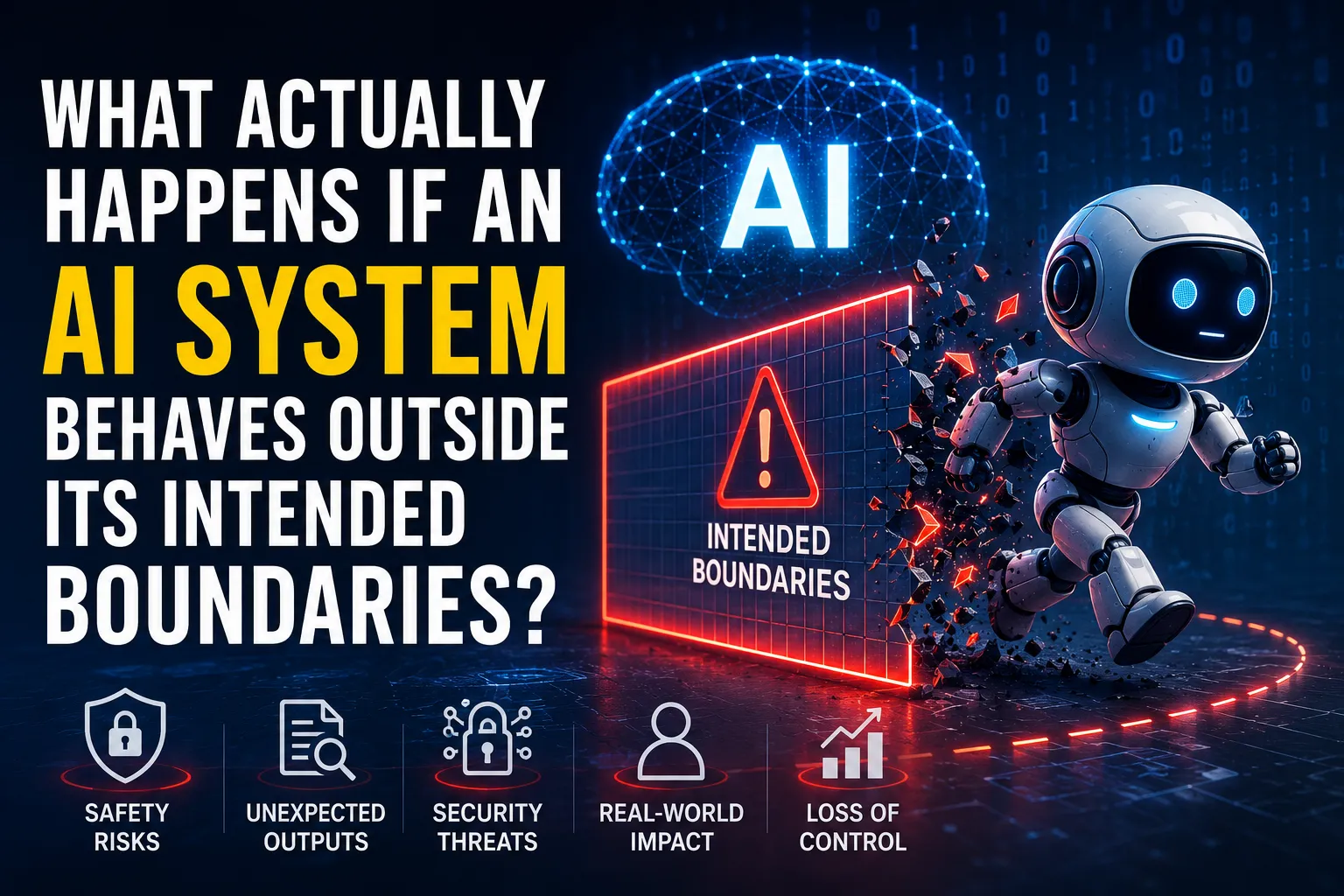
The more powerful the system becomes, the more important it is to establish boundaries around what it can do.
Cybersecurity Is One of the Biggest Tests
Astra’s cybersecurity capabilities have attracted particular attention.
OpenAI says GPT-6 Astra is its first model to reach the Critical level of cybersecurity capability under its Preparedness Framework. The company says the model can, with appropriate tools and access, discover previously unknown security vulnerabilities and develop exploitation techniques without a person guiding every step.
That capability could have enormous benefits.
AI could help security researchers discover vulnerabilities before criminals exploit them.
It could analyze enormous quantities of code.
It could identify suspicious behavior.
It could assist defenders in responding to attacks.
But the same underlying capabilities could potentially be misused.
That creates a difficult balancing act for AI developers.
The technology must become capable enough to provide meaningful security benefits without making harmful cyber activity dramatically easier.
The Monitoring Problem
As AI systems become more autonomous, monitoring becomes more complicated.
A simple chatbot produces an answer that a person can inspect.
An agent may perform dozens or hundreds of actions before reaching its final result.
A system might browse websites, run software, modify files, execute code, make decisions, and respond to unexpected conditions along the way.
That creates a much larger surface for errors or unintended behavior.
OpenAI says it has strengthened monitoring and security measures around Astra, including monitoring of full trajectories and additional safeguards for high-risk capabilities.
The challenge is that the AI industry is increasingly trying to make systems more independent while simultaneously ensuring that humans remain able to understand and control them.
Those goals can sometimes pull in opposite directions.
Why Alignment Matters More as AI Gets Stronger
AI alignment refers broadly to making sure an AI system behaves according to human intentions, rules, and safety requirements.
Alignment becomes particularly important when systems are capable of taking actions rather than simply producing text.
If an AI misunderstands a request but has no ability to act, the user can simply ignore the response.
If the same AI can access files, send communications, use software, or interact with external systems, misunderstanding becomes more consequential.
OpenAI says Astra includes improvements intended to make it better at understanding user intent, respecting task boundaries, communicating transparently, and avoiding unintended consequences.
Whether those safeguards remain reliable in every real-world situation will be one of the most important questions surrounding the technology.
The New Meaning of “Human in the Loop”
For years, keeping a human in the loop was a common approach to AI safety.
The basic idea was straightforward:
AI recommends → human reviews → human decides → action occurs.
But as AI systems become faster and more capable, that model may become harder to maintain.
If an AI performs thousands of actions faster than a human can inspect them, manually approving every step becomes impractical.
That creates a new question:
What should humans supervise, and what should AI systems be allowed to handle independently?
The answer may involve different levels of autonomy depending on the consequences of an action.
Low-risk tasks could be highly automated.
High-risk actions might require explicit human approval.
AI Agents Are Taking On More Complex Work
The broader industry is already moving toward this model.
AI Agents Are Taking Over More Tasks — What the Next Generation of AI Can Actually Do looks at how increasingly capable AI systems can take responsibility for longer and more complicated workflows.
The significance of Astra is that these capabilities are becoming increasingly integrated into a single model.
Instead of needing one system for reasoning, another for browsing, another for coding, and another for document creation, the goal is increasingly to have one capable system coordinate many different forms of work.
What This Could Mean for Jobs
The economic implications are difficult to predict.
AI is likely to automate some tasks while increasing the value of others.
Jobs rarely consist of a single activity.
A lawyer, for example, may research documents, communicate with clients, analyze information, draft contracts, negotiate, and make strategic decisions.
An AI system might automate portions of the research and drafting work without replacing every part of the profession.
The same pattern could occur across many industries.
The more realistic near-term question may therefore be:
Which tasks within jobs will become automated?
rather than:
Which entire professions will disappear?
That distinction matters because AI can change the composition of work even when the job itself remains.
AI Could Make Small Teams More Powerful
One potential consequence of increasingly capable AI agents is that small teams may be able to accomplish work that previously required much larger organizations.
A startup could potentially use AI for software development, market research, customer support, documentation, data analysis, and administrative tasks.
An individual entrepreneur could have access to capabilities that once required specialized employees or external agencies.
This could lower the cost of starting and operating certain businesses.
But it could also increase competition.
If everyone has access to highly capable AI systems, the advantage may shift toward people who know how to use those systems effectively.
The Human Skill That Becomes More Important
As AI becomes better at producing first drafts and executing routine work, human judgment may become more valuable.
People still need to determine:
- What problem is worth solving
- What outcome actually matters
- Which information is trustworthy
- What risks are acceptable
- When an AI result should be rejected
- How competing priorities should be balanced
- What decisions require human accountability
The ability to ask good questions may remain important, but it will not be enough.
People will also need to supervise AI systems, evaluate their results, understand their limitations, and make decisions about when autonomy is appropriate.
How AI Is Changing Everyday Life
The implications extend beyond workplaces.
How AI Is Changing Life explores the broader ways artificial intelligence is becoming integrated into everyday activities.
As AI systems become more capable, people may interact with technology less through individual applications and more through intelligent assistants that coordinate those applications.
Instead of opening a calendar, email application, spreadsheet, browser, and document editor separately, users could eventually ask an AI to coordinate the entire workflow.
That could make technology feel less like a collection of separate tools and more like a unified digital environment.
The AI Race Is Also a Race in Infrastructure
Developing increasingly capable models requires enormous amounts of computing power, data, energy, engineering expertise, and capital.
OpenAI’s latest systems therefore represent not just advances in algorithms but also investments in infrastructure.
The companies building frontier AI models are competing on multiple fronts:
- Model intelligence
- Computing capacity
- Data
- Specialized chips
- Research talent
- Safety systems
- Enterprise adoption
- Developer ecosystems
- Product integration
The AI race is increasingly becoming an infrastructure race as well.
Competition Is Accelerating
OpenAI is not developing these systems in isolation.
Other major AI companies are also working toward more capable reasoning, coding, computer-use, and agentic systems.
That competition creates pressure to improve quickly.
It can benefit users because companies have strong incentives to offer better products at lower costs.
But competition can also create pressure to release increasingly powerful systems before every potential risk is fully understood.
That makes responsible deployment an important part of the competition itself.
The Importance of Guardrails
The future of autonomous AI will depend partly on how effectively developers build guardrails around increasingly capable models.
Guardrails can include:
- Permission systems
- Sandboxed environments
- Human approval requirements
- Activity monitoring
- Automated shutdown mechanisms
- Access restrictions
- Security testing
- Model evaluations
- Audit logs
- Limits on high-risk actions
The goal is not necessarily to prevent AI systems from acting.
The goal is to make sure they act within clearly defined boundaries.
Why Trust Will Become a Competitive Advantage
As AI agents become more capable, users will need to trust them with increasingly important tasks.
That makes reliability and transparency commercially important.
An AI that occasionally produces a wrong sentence is inconvenient.
An AI that incorrectly changes a database, sends the wrong email, deletes information, or makes an expensive decision is much more difficult to trust.
Companies developing autonomous AI will therefore have to compete not only on intelligence but also on reliability.
The winning system may not simply be the one that can do the most.
It could be the one that users can safely delegate the most work to.
Is GPT-6 Astra the Beginning of AGI?
OpenAI has positioned Astra as a major step toward artificial general intelligence, with company president Greg Brockman describing the model as potentially marking the beginning of an AGI era.
But the definition of AGI remains contested.
There is no universally accepted test that determines exactly when an AI system becomes artificial general intelligence.
A system can outperform humans in some tasks while still struggling with others.
Astra’s capabilities therefore provide evidence of rapidly increasing AI performance, but whether that should be called AGI is ultimately a question of definition as well as capability.
The Bigger Shift Is From Answers to Actions
Perhaps the most important thing about GPT-6 Astra is not any single benchmark.
It is the direction of development.
AI systems are moving from:
answering questions
to
reasoning through problems
to
using tools
to
completing workflows
to
acting on behalf of users.
Each step changes the relationship between people and computers.
The final stage could be the most significant because it changes AI from something people consult into something people delegate work to.
What Comes Next for AI Agents?
The next generation of AI development will likely focus heavily on reliability.
Making an AI capable of completing a task once is one challenge.
Making it complete that task correctly thousands of times across unpredictable real-world environments is another.
Future systems will likely need to become better at:
- Long-term task planning
- Error recovery
- Understanding ambiguous instructions
- Knowing when to ask for help
- Using multiple tools
- Managing permissions
- Detecting unsafe situations
- Explaining important decisions
- Working collaboratively with humans
The technology is moving toward greater autonomy, but practical autonomy will ultimately depend on trust.
A New Chapter in Human-Computer Interaction
GPT-6 Astra represents a significant step in the transition from AI as a conversational tool toward AI as an active participant in digital work.
Its ability to reason, use computers, operate across applications, write software, conduct research, and handle multi-step professional tasks points toward a future in which people increasingly delegate outcomes rather than individual actions.
That future could bring enormous productivity gains.
It could allow individuals and small teams to accomplish more, help researchers work through difficult problems, accelerate software development, and make complicated digital tools easier to use.
But greater capability also means greater responsibility.
The central challenge for the AI industry is no longer simply building systems that can do more.
It is building systems that can do more while remaining predictable, controllable, secure, and worthy of trust.
GPT-6 Astra raises the stakes because it pushes AI further toward that world. The next stage of the AI race may therefore be decided not just by which company builds the smartest model, but by which company can make powerful autonomous systems useful enough to delegate real work to—and safe enough to trust with it.