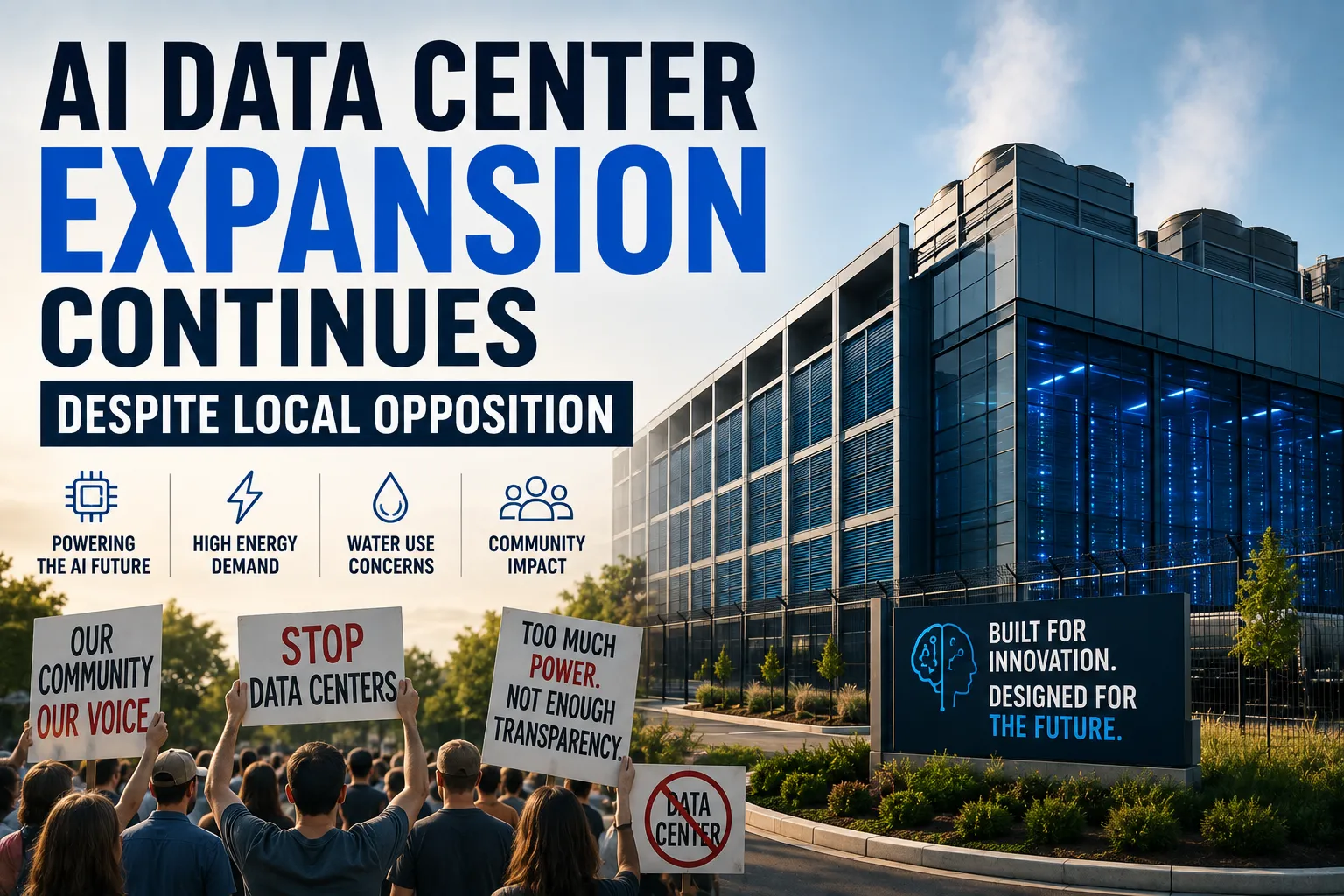
AI Data Center Expansion Continues Despite Local Opposition
The rapid growth of artificial intelligence is creating a new demand for the infrastructure needed to power it. Across the technology sector, companies are expanding data center capacity to support increasingly sophisticated AI models, cloud services, and computing workloads.
But while the expansion promises economic investment and technological progress, it is also generating opposition in communities where new facilities are being proposed.
Why AI Needs More Data Centers
Modern AI systems require enormous amounts of computing power. Training large models and operating AI applications at scale can involve thousands of specialized processors working simultaneously.
Data centers provide the physical infrastructure behind that computing power. They house servers, networking equipment, cooling systems, backup power infrastructure, and other systems required to keep computing operations running around the clock.
As businesses incorporate AI into software, customer service, research, manufacturing, finance, and other industries, demand for computing capacity continues to grow.
The result is a significant expansion of data center development, particularly in regions with reliable electricity, strong telecommunications networks, available land, and favorable business conditions.
Local Communities Raise Concerns
The economic benefits of a large data center can be substantial, including construction activity, infrastructure investment, tax revenue, and jobs associated with building and operating the facility.
However, those benefits do not always outweigh concerns among nearby residents.
One of the most common objections involves electricity consumption. Large AI-focused data centers can require significant amounts of power, raising questions about whether local electricity infrastructure can accommodate additional demand without increasing costs or placing pressure on the grid.
Water use is another concern, particularly for facilities that rely on water-intensive cooling systems. In areas already dealing with limited water resources, residents and local officials may question whether data center operations are an appropriate use of the available supply.
Communities can also raise concerns about noise from cooling equipment and backup generators, traffic during construction, land use, and the environmental impact associated with additional energy consumption.
The Infrastructure Challenge Behind AI Growth
The debate over data centers highlights an important reality about artificial intelligence: AI development is not purely a software story.
Behind every AI service is a physical infrastructure network that includes semiconductor manufacturing, electricity generation, fiber-optic connections, cooling systems, data centers, and specialized hardware.
That means continued AI expansion depends partly on whether infrastructure can keep pace with technological demand.
Utilities and policymakers therefore face a complicated balancing act. They must determine how to accommodate new electricity demand while maintaining reliability and considering the costs borne by existing customers.
In some areas, this can require upgrades to transmission infrastructure, new power capacity, or changes to long-term energy planning.
Why Companies Continue Building
Despite local resistance, the underlying business incentives for expanding computing infrastructure remain strong.
AI has become an important part of enterprise software, search, productivity tools, cloud computing, scientific research, and other technology services. Companies that expect AI workloads to grow need sufficient computing capacity to support those services.
Data centers also have long operational lifespans. Decisions about infrastructure made today can support computing demand for many years, making capacity planning particularly important for technology companies and cloud providers.
For developers, locations with suitable power availability and network connectivity can therefore become strategically valuable.
The Economic Argument
Supporters of data center development often point to the investment associated with these projects.
Construction can generate work for contractors, engineers, electricians, equipment suppliers, and other businesses. Once operational, facilities may also create technical, security, maintenance, and management positions.
Local governments may benefit from property taxes, business taxes, or other forms of revenue depending on the structure of a project and local regulations.
There can also be broader economic effects when improved infrastructure attracts additional businesses and investment.
However, the actual benefits vary considerably from one project to another. The number of permanent jobs, tax arrangements, infrastructure costs, and public incentives can all influence whether residents view a development as economically worthwhile.
The Environmental Question
AI data centers have also placed greater attention on the environmental footprint of computing.
Electricity consumption is particularly important. The environmental impact of a facility depends partly on how the electricity supplying it is generated. A data center powered primarily by lower-carbon energy has a different emissions profile from one relying heavily on fossil-fuel generation.
Companies are therefore increasingly interested in renewable energy contracts, energy-efficient equipment, improved cooling systems, and other approaches designed to reduce resource consumption.
Efficiency improvements can help, but rapidly growing AI workloads may offset some of the gains. As AI systems become more widely used, the overall amount of computing performed could continue increasing even as individual systems become more efficient.
A Growing Policy Debate
The expansion of AI infrastructure is increasingly becoming a local policy issue as much as a technology issue.
Planning authorities may need to consider zoning rules, environmental reviews, electricity requirements, water availability, noise standards, and the effects on surrounding communities.
Some communities may welcome data centers as a source of investment, while others may demand stricter conditions before approving new developments.
This can create lengthy debates over where facilities should be built, who should pay for infrastructure upgrades, and how potential environmental costs should be managed.
Finding a Balance Between Innovation and Communities
The central challenge is not simply whether data centers should be built. It is how they can be developed in ways that balance technological growth with local interests.
Greater transparency around electricity consumption, water requirements, expected employment, tax arrangements, and environmental impacts can help communities evaluate proposed projects more effectively.
Companies can also work with utilities, local governments, and residents before construction begins rather than treating community engagement as an afterthought.
For policymakers, the challenge is creating rules that encourage infrastructure investment while ensuring that the costs of expansion are not unfairly transferred to local residents.
What Comes Next for AI Infrastructure
The demand for computing capacity is unlikely to disappear as long as organizations continue adopting AI.
That does not mean every proposed data center will be approved, nor does it guarantee that expansion will happen at the same pace everywhere. Access to electricity, land, water, financing, regulations, and community support can all influence where new facilities are ultimately developed.
The growing debate does, however, demonstrate that the future of AI will increasingly depend on decisions made far beyond technology companies and their engineering teams.
As artificial intelligence expands, the infrastructure supporting it will become a more visible part of everyday economic and community life. The next stage of AI development may therefore depend not only on building more powerful models, but also on finding sustainable and publicly acceptable ways to power them.