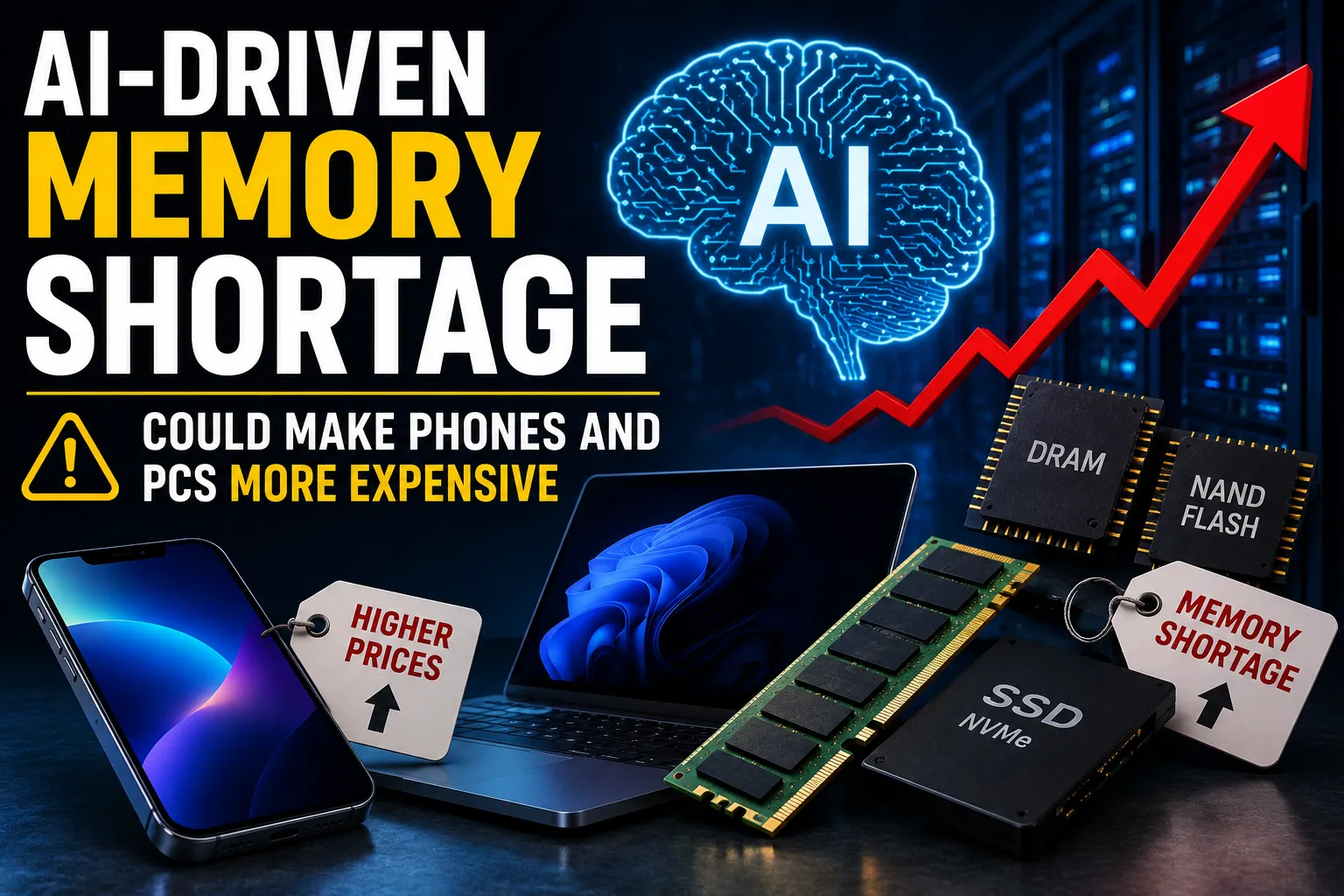
AI-Driven Memory Shortage Could Make Phones and PCs More Expensive
The artificial intelligence boom is creating an unexpected problem for consumers: the same memory chips powering the world’s AI infrastructure are also essential to smartphones, laptops and PCs.
For years, memory was one of the components consumers could expect to become cheaper and more capable over time. That pattern has now been disrupted.
Demand for AI infrastructure is putting enormous pressure on DRAM and NAND supply, while major memory manufacturers are directing more production capacity toward higher-value components used in AI servers. The result is a squeeze that is already affecting the economics of consumer electronics. (IDC)
Industry analysts expect the pressure to remain significant through 2026 and potentially into 2027 or beyond. IDC has already cut its outlook for both the PC and smartphone markets, forecasting declining unit shipments even as average selling prices rise. (IDC)
For consumers, that could mean more expensive devices, fewer discounts and difficult choices over how much RAM and storage to buy.
Why AI Needs So Much Memory
Artificial intelligence requires enormous computing resources.
Training and running large AI models involves processors working with huge amounts of information simultaneously. That creates demand for specialized forms of memory, particularly high-bandwidth memory (HBM).
HBM is designed to move data between memory and processors extremely quickly. It has become an important component of AI accelerator systems used in large data centers.
The problem is that memory manufacturing capacity is limited.
Samsung Electronics, SK hynix and Micron dominate much of the global memory market, and industry analysis indicates that these manufacturers have been shifting capacity toward HBM and other products aimed at AI infrastructure. That reduces the relative availability of conventional DRAM used in PCs, smartphones and other consumer electronics. (S&P Global)
In other words, the AI boom isn’t simply creating demand for a completely separate category of chips.
It is competing for manufacturing resources within the broader memory ecosystem.
DRAM and NAND: What’s the Difference?
Two types of memory are particularly important to consumer electronics: DRAM and NAND flash.
DRAM
Dynamic random-access memory is the fast working memory used by computers and smartphones.
It temporarily holds the information that applications and processors need to access quickly.
More RAM can allow a device to keep more applications and data readily available.
NAND Flash
NAND is primarily used for persistent storage.
It powers:
- SSDs
- Smartphone storage
- USB drives
- Memory cards
- Other flash-storage devices
Unlike DRAM, NAND retains information when a device is turned off.
Both are experiencing pressure from AI-related demand, although the supply dynamics are somewhat different.
Morgan Stanley describes DRAM as the fast memory used by servers, PCs and phones, while NAND is used for storage such as solid-state drives. (Morgan Stanley)
Why AI Data Centers Are Changing the Memory Market
AI data centers are fundamentally different from traditional computing infrastructure.
A conventional server might require a certain amount of memory for business applications, databases or web services.
An AI server can require enormous quantities of high-performance memory to keep accelerators supplied with data.
And AI workloads aren’t limited to training anymore.
Inference—the process of actually using trained models—is becoming an increasingly important source of computing demand.
That means AI infrastructure needs to operate continuously as people and businesses interact with AI systems.
The expansion of AI inference is also creating new demand for storage and memory architectures. Sandisk, for example, has highlighted the growing role of NAND in AI workloads, including storage applications associated with AI inference. (Barron’s)
Why Memory Manufacturers Prefer AI Customers
From a business perspective, the economics are difficult to ignore.
AI customers are willing to pay premium prices for specialized memory.
Consumer electronics manufacturers, by contrast, operate in highly competitive markets where even relatively small increases in component costs can significantly affect margins.
That creates an incentive for memory manufacturers to prioritize higher-margin products.
IDC describes the situation as a strategic reallocation of manufacturing capacity toward AI-oriented memory, rather than simply another ordinary memory-market cycle. (IDC)
This is one reason the current shortage could prove more persistent than a conventional supply disruption.
How the Memory Shortage Could Affect Smartphone Prices
Smartphones use memory for both working memory and storage.
A typical device may contain:
- LPDDR memory
- NAND storage
- Processor
- Display
- Camera components
- Battery
- Modem
- Other semiconductor components
When memory becomes substantially more expensive, manufacturers have several choices.
They can:
- Raise device prices.
- Accept lower profit margins.
- Reduce memory configurations.
- Use cheaper components.
- Delay product launches.
- Shift toward higher-priced models.
- Negotiate longer-term supply agreements.
The likely outcome will vary between manufacturers.
But the pressure is particularly significant for low-cost smartphones, where component costs make up a larger proportion of the final retail price.
One analysis reported that memory’s share of the bill of materials for some low-end smartphones had risen dramatically as memory prices surged. (Indian Express)
Budget Phones Could Feel the Pressure First
Premium smartphones have an advantage: manufacturers have more room to absorb higher component costs.
A flagship phone selling for $1,000 has considerably more pricing flexibility than a budget phone selling for $150.
For low-cost devices, even a relatively small increase in memory costs can have a noticeable effect on margins.
That could encourage manufacturers to:
- Increase entry-level prices
- Reduce RAM
- Reduce storage
- Offer fewer configurations
- Push consumers toward midrange models
This could gradually make inexpensive smartphones less inexpensive.
What Happens to PC Prices?
The PC market could be even more directly exposed to memory pricing.
Desktop computers and laptops commonly use replaceable or configurable memory and SSD storage.
When DRAM and NAND prices increase, manufacturers face higher costs for two major components.
IDC has already forecast a substantial decline in global PC shipments for 2026 while expecting revenue to increase because of higher average selling prices. Its current forecast calls for PC shipments to fall 11.3% in 2026, with revenue rising 1.6% as prices increase. (IDC)
That creates a strange market environment:
PC companies can generate more revenue while selling fewer computers.
The difference comes from higher prices.
Why SSDs Could Become More Expensive
The memory shortage isn’t limited to RAM.
AI data centers also consume enormous quantities of storage.
Large AI systems need to store:
- Training datasets
- Model checkpoints
- User information
- Logs
- Cached data
- Application data
- AI-generated content
Enterprise SSDs are particularly important in this environment.
Recent industry data reported that enterprise SSDs accounted for a much larger share of NAND shipments in 2026 as AI infrastructure absorbed more flash memory capacity. (Tom’s Hardware)
When manufacturers prioritize enterprise customers, consumer SSD supply can become tighter.
That can eventually affect:
- Laptop prices
- Desktop PC prices
- SSD upgrade prices
- Game consoles
- External storage
- Memory cards
The Hidden Cost of AI Could Be Storage
Most discussions about AI hardware focus on GPUs.
But AI systems require an enormous supporting infrastructure.
That includes:
- Processors
- HBM
- DRAM
- SSDs
- Networking
- Power systems
- Cooling
- Data-center buildings
As AI models become larger and services become more widely used, storage requirements can increase alongside computing requirements.
This is why the memory shortage could have consequences well beyond traditional RAM.
Why Memory Prices Don’t Fall Quickly
Memory manufacturing is capital-intensive.
Building additional semiconductor capacity isn’t like opening another factory for a conventional consumer product.
New facilities require:
- Billions of dollars
- Specialized equipment
- Cleanrooms
- Engineering expertise
- Supply-chain infrastructure
- Long qualification periods
- Significant construction time
TechInsights argues that the current memory shortage differs from traditional memory cycles because AI demand is creating a structural shift in how memory capacity is allocated. (TechInsights)
Samsung has also warned that the current memory crunch could remain significant through 2028, with new manufacturing capacity taking years to come online. (theregister)
That makes a rapid return to old pricing levels difficult.
Could Memory Prices Eventually Fall Again?
Yes.
Memory markets are historically cyclical.
Higher prices create incentives for manufacturers to invest in additional capacity.
Eventually, additional production can catch up with demand.
But the timing is uncertain.
Several things could improve the situation:
- New fabrication capacity
- Higher manufacturing efficiency
- Increased HBM production
- Reduced AI infrastructure spending
- Better memory utilization
- New memory technologies
- Changes in consumer demand
- Additional suppliers entering the market
The problem is that AI demand continues to grow at the same time manufacturers are attempting to expand supply.
Why 2027 Could Still Be Difficult
IDC expects memory supply challenges to persist throughout 2026 and likely into 2027, with prices remaining elevated rather than returning to 2025 levels within its forecast horizon. (IDC)
Other industry analysis has suggested that meaningful new capacity may not arrive until late 2027 or 2028.
That doesn’t mean prices will rise continuously until then.
Prices can fluctuate.
But it does suggest consumers shouldn’t assume that a temporary shortage will necessarily disappear within a few months.
How Manufacturers Could Respond
Consumer technology companies have several strategies available.
Increase Prices
This is the simplest approach.
The downside is that higher prices can reduce demand.
Reduce Memory Configurations
Manufacturers could offer less RAM or storage at similar prices.
This effectively transfers some of the cost increase to consumers through reduced specifications.
Prioritize Premium Devices
Companies could focus production on more profitable products.
Negotiate Long-Term Contracts
Large manufacturers may secure memory supplies through longer-term agreements with chipmakers.
Diversify Suppliers
Companies may seek alternative memory suppliers to reduce dependence on the largest manufacturers.
Some brands are already exploring alternative sources as memory costs rise. (Business Standard)
Will Phones Have Less RAM?
Not necessarily.
The situation is more complicated than simply saying smartphones will contain less memory.
AI itself is increasing the importance of memory.
Modern phones increasingly use AI for:
- Image processing
- Voice recognition
- Translation
- Search
- Photography
- Personal assistants
- Generative features
Running more AI functions locally can require additional memory.
That creates a contradiction.
Consumers want more memory for AI features at exactly the time memory is becoming more expensive.
Manufacturers must balance those competing pressures.
Why On-Device AI Makes Memory More Important
Cloud-based AI sends information to remote data centers.
On-device AI performs at least some processing directly on the smartphone or PC.
Local processing can provide benefits such as:
- Lower latency
- Better privacy
- Offline functionality
- Reduced network dependence
But local AI can require substantial computing resources.
That means the hardware inside consumer devices is becoming increasingly important.
The irony is that AI is simultaneously:
creating demand for more capable devices while making some of their essential components more expensive.
What This Means for Laptop Buyers
If you’re planning to buy a laptop, memory pricing is worth considering.
A sensible approach is to focus on the configuration you’ll actually need rather than buying the cheapest model and expecting to upgrade later.
Consider:
- RAM capacity
- SSD capacity
- Whether RAM is upgradeable
- Whether storage is replaceable
- Processor capability
- AI-related hardware
- Expected lifespan
A slightly more expensive configuration can sometimes provide better long-term value if upgrading later is difficult or impossible.
Should Consumers Buy Devices Now?
There is no universal answer.
If your current phone or PC works well, there’s no reason to replace it simply because memory prices are rising.
But if you already need a new device, delaying indefinitely may not guarantee a cheaper purchase.
The key is to distinguish between:
“I want the latest device”
and
“I need a device.”
For necessary purchases, compare current prices and specifications rather than trying to predict the exact bottom of the memory market.
Could This Make Used Electronics More Attractive?
Potentially.
If new devices become more expensive, consumers may keep existing hardware longer or turn toward refurbished and used products.
That could extend the useful life of:
- Smartphones
- Laptops
- Desktop PCs
- Tablets
It could also encourage repair and upgrades where devices support them.
The secondary market may therefore become more important if elevated component costs persist.
The Impact on PC Upgrades
PC enthusiasts are particularly exposed to memory-market volatility.
A computer that already has a capable processor and graphics card may not need a complete replacement.
But adding:
- More RAM
- A larger SSD
- Faster storage
could become more expensive.
This may encourage users to evaluate whether an upgrade is genuinely necessary.
For some people, optimizing software and removing unnecessary files may be more economical than immediately purchasing additional hardware.
What About Gaming PCs?
Gaming PCs use both system RAM and storage extensively.
A modern gaming setup can require substantial:
- RAM
- SSD storage
- Graphics memory
- CPU resources
If RAM and SSD prices rise, the total cost of building a gaming PC can increase.
Gamers may respond by:
- Reusing existing components
- Buying used hardware
- Delaying upgrades
- Choosing slightly lower specifications
- Buying prebuilt systems when pricing is favorable
The best option depends on component pricing at the time of purchase.
Could AI Make Consumer Electronics More Expensive for Years?
Possibly.
The biggest reason is that AI isn’t simply creating a temporary spike in demand.
AI infrastructure is becoming an ongoing industry.
Cloud providers and technology companies are building long-lived data centers designed to support AI services for years.
As a result, memory demand could remain structurally higher than it was before the generative AI boom.
TechInsights argues that AI has fundamentally changed the memory market by making data-center demand a central driver rather than leaving consumer electronics as the dominant force. (TechInsights)
The “Chipflation” Problem
The term chipflation has emerged to describe the broader phenomenon of semiconductor components becoming more expensive instead of following the long-term trend of declining costs.
Memory is particularly important because it appears in an enormous range of products.
Higher memory costs can potentially affect:
- Smartphones
- PCs
- Laptops
- Tablets
- Game consoles
- Cameras
- Servers
- Cloud storage
- Automotive electronics
Axios recently reported that AI-driven memory demand is contributing to higher prices across consumer technology and could represent a significant break from the historical pattern of falling memory costs. (Axios)
Why This Is Different From Traditional Chip Shortages
The semiconductor industry has experienced shortages before.
The COVID-era chip shortage, for example, caused major disruptions across electronics and automotive industries.
But the current memory problem has a different characteristic.
It is being driven partly by where manufacturers choose to allocate limited production capacity.
AI memory products can be more profitable than conventional consumer memory.
That means supply isn’t simply struggling to keep up with demand.
Manufacturers are also making strategic decisions about which types of demand they want to serve.
Could Chinese Memory Manufacturers Help?
Potentially.
Additional production from Chinese memory companies could increase global supply, particularly in consumer-oriented markets.
Yangtze Memory Technologies Corp., for example, has expanded its position in NAND flash and was reported to have entered the global top three by shipment share in the second quarter of 2026. (Tom’s Hardware)
However, geopolitical restrictions, technology access and market segmentation can affect which companies can supply particular categories of memory.
Additional capacity therefore doesn’t automatically solve every part of the shortage.
What Happens If AI Demand Slows?
A significant slowdown in AI infrastructure investment could dramatically change the memory market.
If hyperscalers reduce capital spending, demand for specialized AI memory could weaken.
That could free capacity for conventional products.
Memory prices could then fall.
But predicting such a slowdown is difficult.
AI infrastructure spending remains substantial, and recent industry developments indicate that demand for AI-related memory continues to be strong. (Reuters)
What Consumers Should Watch
If you’re planning to buy technology over the next year or two, several indicators are worth monitoring.
RAM Prices
Watch the cost of common DDR and LPDDR products.
SSD Prices
NAND pricing can influence consumer storage costs.
Smartphone Specifications
Manufacturers may change RAM and storage configurations.
Laptop Pricing
Look for changes in average selling prices rather than just headline discounts.
AI PC Requirements
Increasing AI workloads could change the minimum hardware specifications manufacturers consider appropriate.
Memory Manufacturer Investment
New factories and capacity expansions could eventually improve supply.
Frequently Asked Questions
Why Is AI Causing a Memory Shortage?
AI data centers require enormous quantities of high-performance memory. Memory manufacturers are allocating more capacity toward AI-focused products such as HBM, tightening the supply of conventional DRAM and NAND used in consumer electronics. (IDC)
Will Phones Become More Expensive Because of AI?
They could. Higher memory costs increase manufacturers’ component expenses, and some of those costs may eventually be passed to consumers through higher prices or reduced specifications.
Will Computers Become More Expensive?
PC prices are under pressure from higher memory costs. IDC expects worldwide PC shipments to decline in 2026 while average selling prices increase. (IDC)
Is RAM Getting More Expensive?
Yes. Conventional DRAM prices have risen sharply as AI-related demand and capacity reallocation have tightened supply. (TechInsights)
Will SSD Prices Also Rise?
They can. AI infrastructure is consuming increasing amounts of NAND flash, particularly enterprise SSD capacity, which can tighten supply available for consumer storage. (Tom’s Hardware)
How Long Could the Memory Shortage Last?
There is considerable uncertainty, but current industry assessments indicate that elevated memory prices could persist through 2026 and into 2027 or beyond. Samsung has warned that the broader memory crunch could remain significant through 2028. (IDC)
Should I Buy a New Phone or PC Now?
If you need a new device, compare current prices and specifications rather than waiting solely in the hope that memory prices will fall. If your existing device works well, there is usually little reason to replace it simply because market prices are changing.
The Bigger Consumer Technology Shift
The memory shortage highlights an important change in the technology industry.
For decades, consumers benefited from a powerful assumption: computing hardware would become more capable while becoming cheaper or staying roughly the same price.
AI is challenging that assumption.
The technology industry is now competing for the same semiconductor resources from two directions.
On one side are billions of consumers buying phones, laptops and other electronics.
On the other are enormous AI data centers demanding increasingly sophisticated computing infrastructure.
The companies supplying those systems have strong financial incentives to prioritize the most profitable demand.
That competition ultimately reaches the consumer.
The AI Boom May Have a Price Tag on Your Next Device
The next time you see a smartphone, laptop or SSD becoming unexpectedly expensive, the reason may not be the processor, display or camera.
It could be the memory inside it.
AI is turning memory from a relatively invisible commodity into one of the most strategically important resources in computing. The industry is responding by directing capacity toward AI infrastructure, while consumer-device manufacturers are being forced to deal with higher costs and tighter supplies. (IDC)
For consumers, that could mean a new era in which more RAM, larger storage and longer-lasting hardware come at a premium.
And as AI becomes more deeply embedded in everyday technology, the competition for memory is unlikely to disappear anytime soon.