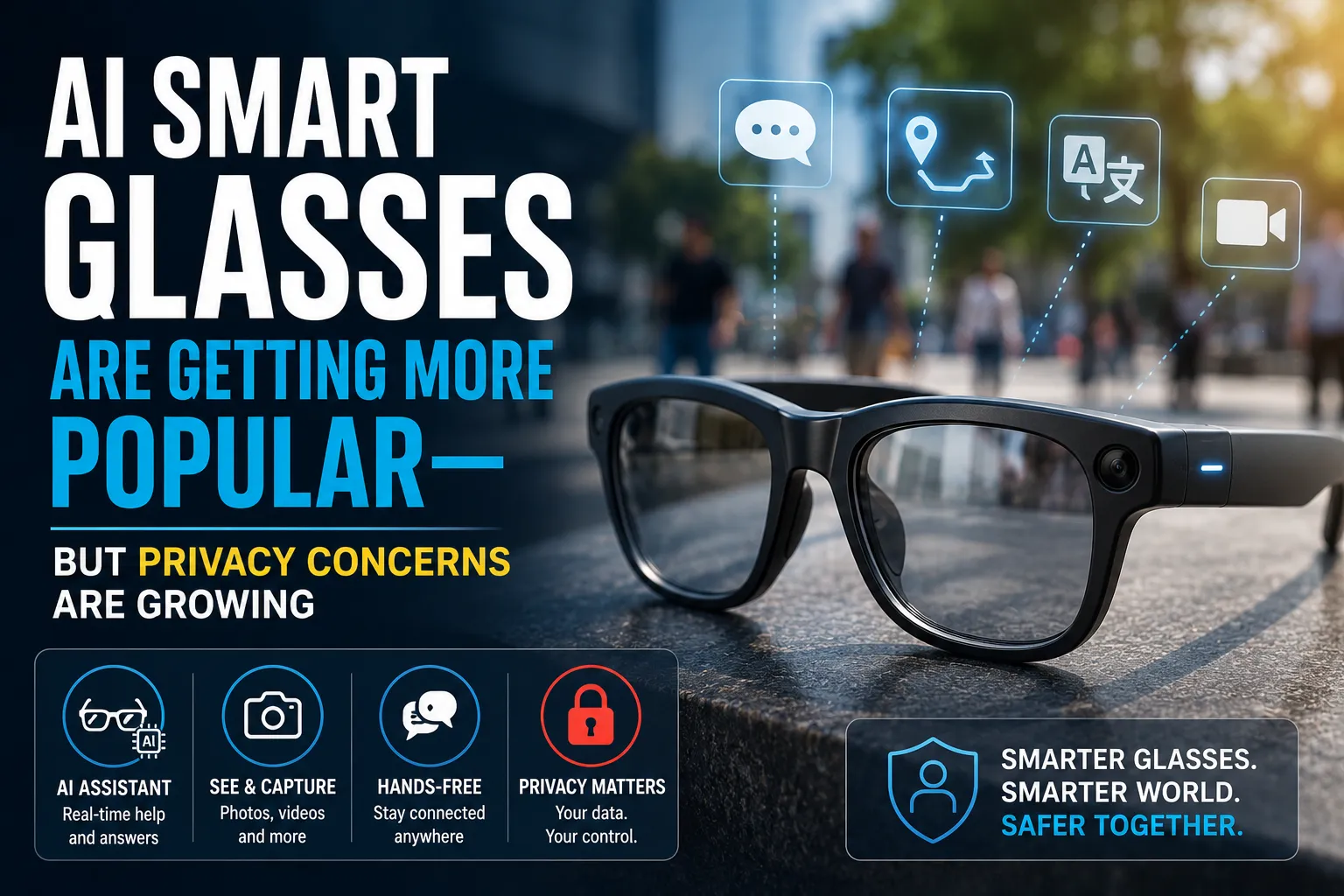
AI Smart Glasses Are Getting More Popular but Privacy Concerns Are Growing
Smart glasses have spent years hovering between futuristic concept and niche gadget. That may be changing.
The latest generation of AI-powered smart glasses is making the technology considerably more useful. Instead of simply displaying notifications or recording video, newer devices can answer questions, recognize objects, translate information, describe surroundings, capture photos and videos, and interact with users through voice commands.
That convenience is helping AI smart glasses move closer to the mainstream.
But there is another side to the rapid adoption: privacy.
A pair of glasses equipped with cameras, microphones, artificial intelligence and an internet connection can potentially collect far more information about the world around the wearer than a conventional smartphone. And unlike a phone, a pair of glasses can capture information while appearing to be an ordinary accessory.
That creates difficult questions about consent, surveillance and how personal data should be handled.
Why AI Smart Glasses Are Becoming More Useful
Earlier smart glasses often struggled to find a compelling reason for people to wear them every day.
AI is changing that equation.
Modern AI-enabled glasses can act as a hands-free assistant. A user might ask a question while walking, request directions, identify an object or ask the glasses to summarize something they are looking at.
Cameras also give these devices a form of visual awareness that traditional voice assistants do not have.
For example, an AI system could potentially analyze what the wearer is seeing and provide information about it. That could make smart glasses useful for travel, education, accessibility, navigation and everyday tasks.
The technology also removes one of the biggest obstacles associated with smartphones: having to take the device out of a pocket.
Instead of stopping to look at a screen, users can interact with an assistant through voice.
That hands-free experience may become one of the strongest reasons consumers adopt the category.
The Camera Creates a Different Kind of Privacy Problem
Cameras are not new. Smartphones, security cameras and laptops have been recording images for years.
Smart glasses are different because the camera is attached to a person’s face.
That makes it possible to capture images or video from approximately the wearer’s natural field of view without requiring the device to be held up.
This creates an uncomfortable possibility for people nearby.
Someone sitting across from a smart-glasses wearer may not know whether they are being recorded. A person walking past on a sidewalk may not realize that their face has been captured. A conversation taking place in a public or semi-private environment could potentially occur within the range of a microphone.
The wearer may know that their device is active.
Everyone else may not.
Recording Indicators May Not Solve Everything
Manufacturers can include visible lights or other indicators showing when cameras are being used. These features are intended to provide transparency and discourage covert recording.
But indicators alone do not completely solve the problem.
A person unfamiliar with the technology may not know what a particular light means. Others may not even notice it.
There is also a broader question about what happens after something is captured.
A photo or video may contain the faces of several people, license plates, documents, computer screens, home interiors or other sensitive information.
The privacy implications therefore extend beyond the person wearing the glasses.
AI Adds Another Layer of Data Collection
Traditional cameras primarily capture images.
AI smart glasses can potentially do much more with those images.
Depending on the device and software, visual information may be processed to identify objects, interpret scenes, answer questions or provide contextual information.
That raises important questions about where processing occurs and what information is transmitted to external servers.
If data is sent to a cloud-based AI system, consumers need to understand what information leaves the device, how long it is retained, how it is protected and whether it can be used for other purposes.
The same concern applies to voice recordings.
An AI assistant needs some way to interpret spoken commands. Consumers should therefore pay attention to whether audio is processed locally, transmitted to a cloud service, stored temporarily or retained for longer periods.
Privacy is not simply about whether a device has a camera.
It is about what the device captures, what the AI does with that information and who ultimately has access to it.
The Social Problem May Be Bigger Than the Technical One
Technology companies can build privacy controls into smart glasses, but social acceptance may be harder to achieve.
People generally understand what it means when someone takes out a smartphone and points it at them.
Smart glasses are more ambiguous.
A person wearing them may simply be listening to music, asking an AI assistant a question or checking information. Alternatively, they could be taking a photograph or recording video.
That uncertainty can make people uncomfortable.
As smart glasses become more common, society may have to establish new expectations about where recording is acceptable.
Restaurants, workplaces, schools, gyms, changing rooms, medical facilities and private homes could all present different privacy considerations.
Privacy Policies Matter More Than Ever
Consumers buying AI smart glasses should look beyond battery life, camera quality and AI capabilities.
The manufacturer’s privacy policy can be just as important.
Before purchasing a device, users should consider questions such as:
- What information does the device collect?
- When are cameras and microphones active?
- Is there a visible recording indicator?
- Can the camera or microphone be disabled?
- Where is captured information processed?
- Is data stored in the cloud?
- How long is information retained?
- Can users delete stored recordings or account data?
- Is collected information used to improve AI models?
- What happens to the data if the user closes their account?
These questions are particularly important because privacy practices can differ significantly between products.
Consumers Should Also Secure Their Accounts
Privacy is not only the responsibility of the manufacturer.
Users should take basic security precautions with any AI-connected wearable.
A strong, unique password and multi-factor authentication can reduce the risk of unauthorized access to an account. Users should also keep the glasses and associated smartphone applications updated so security fixes can be installed.
It is also worth reviewing application permissions regularly.
If an application does not need access to a particular type of information, consumers should consider whether that permission should remain enabled.
The more information a connected device can access, the more important account security becomes.
AI Smart Glasses Could Be Valuable for Accessibility
Despite the privacy concerns, it would be a mistake to view AI smart glasses only as surveillance devices.
The technology has potentially significant accessibility benefits.
For people with visual impairments, AI-powered glasses could help describe surroundings, identify objects, read text or provide other forms of environmental assistance.
Hands-free interaction can also benefit people who have difficulty using conventional smartphone interfaces.
For these users, the advantages may be substantial.
That makes responsible privacy design even more important. The goal should not necessarily be to prevent people from using AI glasses, but to ensure that their benefits do not come at the expense of other people’s reasonable expectations of privacy.
The Privacy Rules May Need to Evolve
Existing privacy expectations were largely developed around technologies such as telephones, computers, smartphones and fixed cameras.
AI smart glasses combine several of those technologies into a device that people can wear continuously.
That creates a new category of privacy questions.
Regulators, businesses, schools and other organizations may eventually establish clearer policies governing where camera-equipped AI wearables can be used.
Businesses could also introduce rules requiring employees or visitors to disable recording features in sensitive environments.
The technology is moving quickly, while social and regulatory standards often take longer to develop.
What the Future of AI Glasses Could Look Like
The biggest change may be that smart glasses eventually stop feeling like unusual gadgets.
If AI assistants become more capable, smaller and more energy efficient, glasses could become a natural interface for accessing information without constantly looking at a smartphone.
That could make them particularly attractive for navigation, communication, accessibility and hands-free computing.
But mainstream adoption will depend on trust as much as technology.
Consumers need to feel confident that the devices on their faces are not quietly collecting information about themselves—or everyone around them.
Convenience and Privacy Will Have to Coexist
AI smart glasses represent an important shift in personal technology because they bring artificial intelligence into the physical world.
Their cameras can see. Their microphones can hear. Their AI systems can interpret information and respond almost instantly.
Those capabilities could make everyday computing faster and more natural.
They also make privacy harder to define.
The success of AI smart glasses may ultimately depend on whether manufacturers can convince consumers and the people around them that the technology can be used responsibly. Clear recording indicators, strong privacy controls, transparent data policies, local processing where possible and meaningful user control will all play a role.
The most successful smart glasses may therefore not simply be the ones with the most powerful AI.
They may be the ones that make people feel comfortable wearing them around other people.