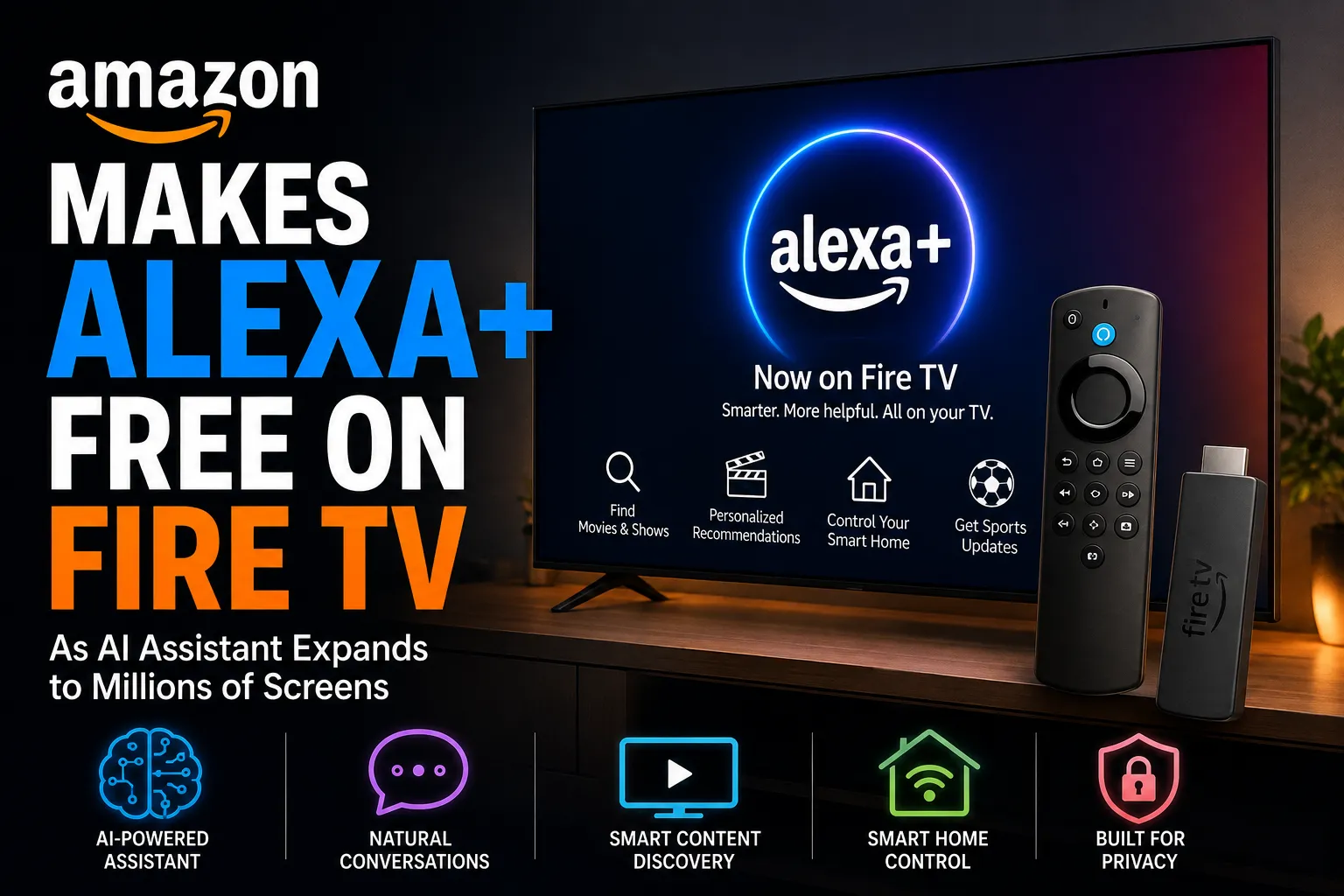
Amazon Makes Alexa+ Free on Fire TV as AI Assistant Expands to Millions of Screens
Amazon is making its next-generation Alexa+ assistant available at no additional cost on compatible Fire TV devices in the United States, expanding the reach of its generative AI technology beyond smart speakers and displays and directly into the living room. The company announced the change on August 20, saying Alexa+ is now included with compatible Fire TV devices rather than being limited by a separate Prime or Alexa+ subscription. (Amazon News)
The move represents another step in Amazon’s effort to turn Alexa into a more conversational, task-oriented AI assistant. With Fire TV, the company is putting those capabilities on one of the most frequently used screens in the home.
Alexa+ Comes to Fire TV at No Extra Cost
Amazon says Alexa+ is now available for free on compatible Fire TV devices in the U.S.
The rollout covers compatible:
- Fire TV Sticks
- Fire TV Cube devices
- Amazon Ember smart TVs
- Fire TV televisions from participating manufacturers, including Hisense and Panasonic
The company says the upgrade is automatic for eligible devices. (Amazon News)
That is significant because Amazon has already built a large installed base of Fire TV hardware. The company previously said customers had purchased more than 300 million Fire TV devices worldwide, including streaming players, Amazon televisions and Fire TV sets made by partners such as Hisense, Panasonic, TCL and Xiaomi. (Amazon News)
Rather than asking consumers to purchase new hardware, Amazon can therefore introduce AI capabilities to devices that many people already own.
What Alexa+ Can Do on a TV
Alexa+ is designed to move beyond traditional voice commands.
Instead of simply asking Alexa to play a particular title, users can have more conversational interactions about what they are watching or what they want to watch.
Amazon highlights capabilities such as:
- Finding movies and television shows through natural-language requests
- Getting personalized recommendations
- Asking questions about on-screen content
- Jumping directly to particular scenes
- Adding programs to a watchlist
- Getting information about sports
- Controlling compatible smart-home devices
- Adjusting lights
- Viewing connected security cameras
- Managing other compatible home devices
The assistant can also use information about a user’s preferences and context to make recommendations.
Amazon describes Alexa+ as a generative-AI-powered assistant capable of handling more complex conversations and tasks than traditional Alexa. (Amazon News)
The TV Is Becoming an AI Interface
Amazon’s move reflects a broader shift in consumer technology.
For years, televisions were primarily passive entertainment devices. Smart TV platforms changed that by adding apps, streaming services, voice controls and internet-connected features.
Generative AI could take that evolution further.
Instead of navigating through menus and applications manually, viewers can increasingly describe what they want in ordinary language.
A user might not know which streaming service carries a particular movie. Instead of opening several applications, they can ask the assistant to find it.
Likewise, someone watching a sports game could ask for information about a player without leaving the viewing experience.
The television effectively becomes a conversational interface.
Amazon Has Already Been Building Alexa+ Into Fire TV
The latest announcement is not Amazon’s first attempt to integrate Alexa+ into Fire TV.
The company introduced Alexa+ capabilities on Fire TV as part of a broader redesign of the platform. Amazon said users could ask Alexa+ what they were in the mood to watch, request recommendations based on actors or directors, add titles to watchlists, control smart-home devices and jump directly to scenes in movies. (Amazon News)
Amazon also redesigned the Fire TV interface in 2026 to make content discovery faster and more personalized.
The company said the redesigned experience was intended to reduce the amount of time viewers spend searching for something to watch.
Why Making Alexa+ Free Matters
Making Alexa+ available without an additional charge could significantly increase adoption.
Consumers are increasingly faced with multiple AI subscriptions, from productivity assistants to entertainment services. Asking users to pay another monthly fee can create friction.
Amazon’s decision to make Alexa+ available on compatible Fire TV devices at no additional cost removes one of those barriers.
It also gives the company an opportunity to expose a much larger audience to its AI assistant.
The strategy could be particularly important because AI assistants become more useful as users interact with them regularly and connect them to other services.
Prime Members Already Have a Broader Alexa+ Benefit
Amazon has been positioning Alexa+ as a broader part of its Prime ecosystem.
The company’s current Alexa+ information describes the service as free with Prime, while Amazon has also expanded availability beyond Prime members in the United States. (Amazon News)
The Fire TV announcement changes the equation for compatible television users because the assistant can now be accessed on the big screen without an additional Alexa+ charge.
That could make Alexa+ more visible during everyday activities such as watching television, searching for content and controlling connected devices.
Fire TV Could Become a Central Hub for the Smart Home
One of the more interesting aspects of the move is that Alexa+ is not limited to entertainment.
Amazon says Alexa+ on Fire TV can interact with compatible smart-home products.
That means the television can potentially function as a central interface for:
- Smart lights
- Cameras
- Locks
- Other connected devices
A viewer could theoretically control multiple aspects of a home without switching between dedicated apps.
This fits with Amazon’s broader strategy of turning Alexa into an AI system capable of completing tasks rather than simply responding to isolated commands.
Conversational Search Could Change How People Find Content
Traditional television navigation depends heavily on menus.
Users scroll through rows of thumbnails, open different applications and type search terms with a remote.
Conversational AI offers a different approach.
Instead of searching for:
“Science fiction movies”
a viewer could ask for something more specific, such as:
“Find me a science-fiction movie with a suspenseful story that isn’t too long.”
The assistant can potentially interpret the request and produce recommendations.
Amazon’s Fire TV strategy is therefore not simply about adding another voice-control feature. It is about changing how viewers interact with large libraries of digital content.
The Battle for the Smart TV Experience Is Expanding
Amazon is not alone in trying to make televisions more intelligent.
Smart TV manufacturers and technology companies are increasingly incorporating AI into:
- Content recommendations
- Search
- Voice assistants
- Picture processing
- Accessibility
- Personalization
- Smart-home control
The competition is gradually shifting from simply building better screens toward building better software experiences around those screens.
This could make the operating system and assistant on a television nearly as important as the display hardware itself.
Amazon’s Large Fire TV Installed Base Gives It an Advantage
The scale of Fire TV is an important part of the strategy.
Amazon says more than 300 million Fire TV devices have been purchased globally. (Amazon News)
That means the company does not necessarily need consumers to replace their televisions to expand Alexa+.
Software updates can introduce new functionality to compatible hardware.
This is particularly valuable in the AI market, where companies are competing to put their assistants in front of as many users as possible.
An assistant that already has access to a large hardware ecosystem has a significant distribution advantage.
What This Means for Existing Fire TV Owners
For owners of compatible devices, the biggest change is straightforward: Alexa+ can become a more capable part of the existing Fire TV experience without requiring the purchase of a new television.
Amazon says the upgrade is automatic for eligible users in the U.S. (The Verge)
However, availability depends on device compatibility and geographic rollout.
Consumers should therefore check Amazon’s current support information if Alexa+ does not immediately appear on their particular Fire TV device.
AI Could Make Content Discovery More Personal
One of the biggest problems with modern streaming is not a lack of content.
It is having too much of it.
Viewers can have access to thousands of movies, television programs, live events and other forms of entertainment across numerous services.
The result is often a frustrating search process.
Amazon has previously cited research showing that U.S. consumers spend an average of about 12 minutes searching for something to watch, up from 10.5 minutes in 2023. (Amazon News)
AI-powered recommendations could reduce that friction by allowing viewers to explain what they want instead of manually searching through menus.
There Are Still Questions About AI on the TV
The expansion also raises questions that will become increasingly important as AI assistants move into more parts of the home.
Users will need to consider:
- What information the assistant can access
- How voice interactions are processed
- Which smart-home devices can be controlled
- How personalized recommendations are generated
- How accurately the assistant understands context
- How much control users have over AI features
These questions are particularly relevant when an assistant can interact with cameras, locks and other connected household equipment.
Convenience increases as more devices become connected, but so does the importance of security and privacy controls.
Amazon’s Larger Alexa Strategy
The Fire TV expansion is part of a much broader transformation of Alexa.
Amazon describes Alexa+ as an assistant designed to perform tasks, manage smart homes, help with reservations, facilitate shopping, discover music and provide personalized recommendations. (Amazon News)
The company has also introduced new Echo hardware designed specifically around Alexa+ capabilities, including devices using Amazon’s custom silicon and AI acceleration technology. (Amazon News)
Taken together, these developments suggest that Amazon sees Alexa less as a traditional voice assistant and more as an AI platform connecting different parts of a user’s digital and physical environment.
The Bigger Consumer Technology Shift
The important story here is not simply that Alexa+ has become free on Fire TV.
It is that AI assistants are moving from individual devices toward entire ecosystems.
A smart speaker can answer questions. A smartphone can run an AI chatbot. A television can recommend content. A smart-home system can control lights and cameras.
The next stage is connecting those capabilities so that users can interact with an assistant across multiple devices without having to think about which device is handling the request.
Amazon is particularly well positioned to pursue that strategy because it operates across retail, entertainment, smart-home hardware, cloud computing and consumer devices.
From Smart TV to Intelligent Home Interface
Amazon’s decision to make Alexa+ available at no additional cost on compatible Fire TV devices gives the company another way to put generative AI into people’s daily routines.
The immediate benefit for consumers is easier content discovery and more natural interaction with their televisions. The longer-term significance is broader: the TV could become another entry point into an AI-powered home where entertainment, information and smart-home controls are handled through conversation.
Amazon’s Fire TV installed base gives it a substantial audience with which to test that vision. If users find Alexa+ genuinely useful rather than simply novel, the television could become one of the most important places where consumers experience the next generation of AI assistants. (Amazon News)