Fairphone Launches in the US With a Repairable Smartphone Built to Last
The smartphone market has spent years moving in the opposite direction from repairability. Phones have become thinner, more tightly sealed and increasingly difficult for owners to open, with a damaged screen, worn-out battery or faulty charging port often pushing consumers toward professional repairs or an entirely new device.
Fairphone is betting that there is still a market for something different.
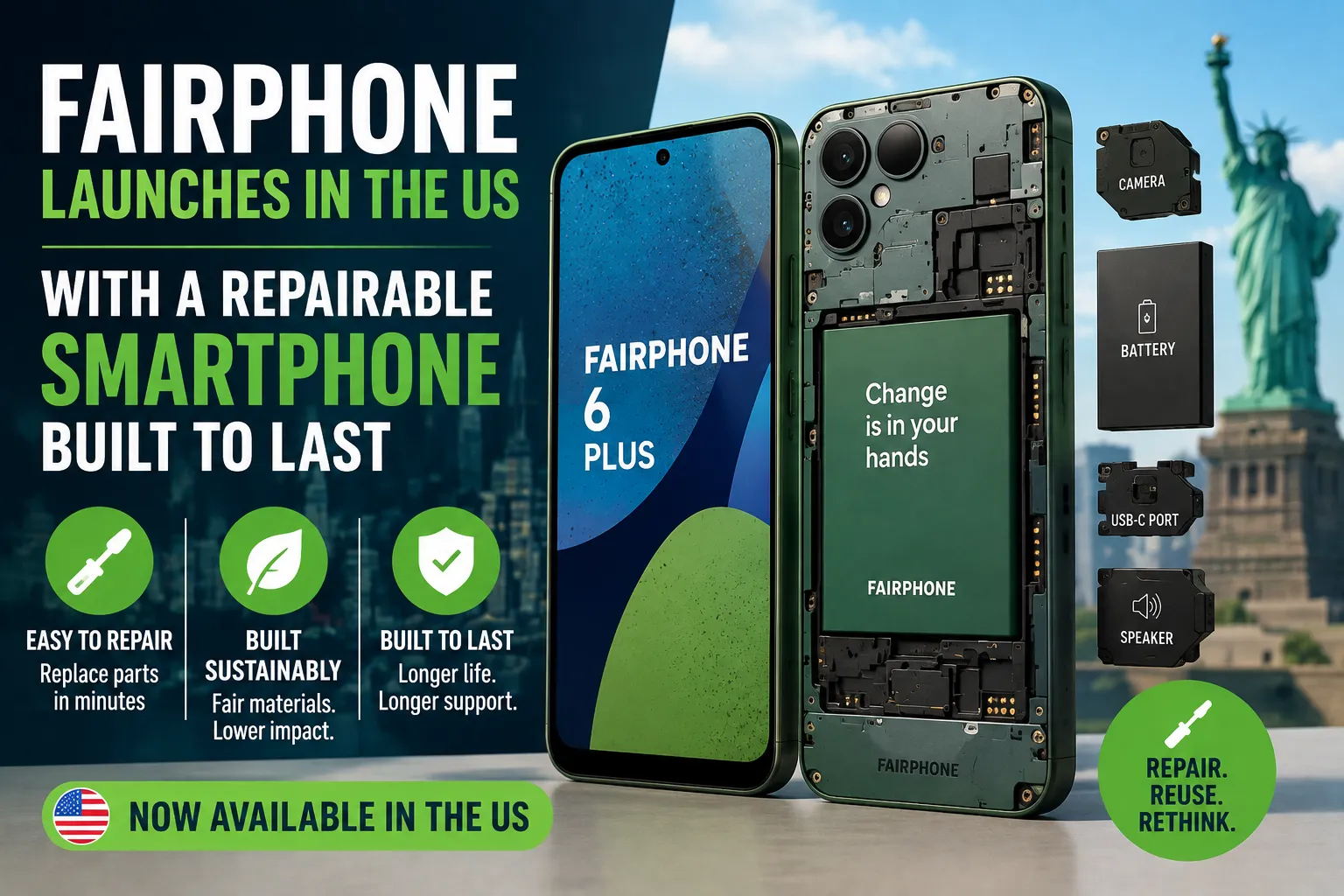
The Dutch smartphone maker has officially expanded its direct presence in the United States with the Fairphone 6 Plus, bringing its modular, repair-focused approach to a market dominated by Apple, Samsung and Google. The phone is priced at $649.99 and is being sold directly through Fairphone and Amazon, with support for major U.S. networks including AT&T and T-Mobile. (WIRED)
The launch gives American consumers another option at a time when repairability, software longevity and electronic waste are becoming increasingly important considerations when buying technology.
More importantly, Fairphone is trying to challenge a long-standing assumption in consumer electronics: that a smartphone should eventually be replaced simply because one component has worn out.
Fairphone’s Big Idea: Keep the Phone, Replace the Part
The central idea behind Fairphone’s latest smartphone is straightforward.
Instead of treating the entire phone as a single sealed product, Fairphone designs it as a collection of replaceable components.
The company’s latest generation uses a modular construction that allows users to replace individual parts rather than discard the entire device. Components such as the battery, display, USB-C port and cameras can be replaced when they fail or become damaged. (Fairphone)
That approach is particularly significant for the battery.
Smartphone batteries naturally lose capacity over time. On many conventional phones, replacing the battery can require specialized tools, professional service or extensive disassembly.
Fairphone takes a different approach. Its 4,415mAh battery can be removed and replaced by the owner, allowing the phone to continue operating long after the original battery has deteriorated. Fairphone says the battery can provide nearly two days of use under its stated testing conditions and can reach 50% charge in about 25 minutes with a compatible 30W charger. (Fairphone)
The philosophy is simple: a phone should not become obsolete because one part has reached the end of its useful life.
The Fairphone 6 Plus Brings the Concept to a Larger Market
Fairphone has promoted repairable smartphones for years, but the U.S. market represents a particularly important opportunity.
The company previously had limited availability in the United States through partnerships, but the new Fairphone 6 Plus represents its first direct U.S. smartphone launch, according to reporting from The Verge. (The Verge)
The $649.99 price puts the device in a competitive part of the American smartphone market.
It is not positioned as an ultra-cheap handset. Instead, Fairphone is asking consumers to consider the total lifespan of the device rather than focusing only on the initial purchase price.
If a phone can remain useful for many years and individual components can be replaced relatively inexpensively, the economics can look different from buying a new smartphone every few years.
What the Phone Offers Beyond Repairability
Fairphone is also trying to make sure longevity does not come at the expense of modern smartphone features.
The Fairphone 6 platform includes a 6.31-inch OLED display, 256GB of internal storage, dual rear cameras and a 4,415mAh replaceable battery. The U.S. Fairphone 6 Plus refresh also uses Qualcomm’s Snapdragon 7s Gen 4 processor and includes 12GB of RAM. (The Verge)
The phone is therefore not simply a sustainability statement.
It is designed to function as a conventional modern Android smartphone while adding features that are still unusual in the industry.
That distinction matters.
Consumers may support repairability in principle, but most still expect their smartphone to be fast, reliable, capable of running modern applications and supported with security updates.
Fairphone’s challenge is to prove that a repairable smartphone can compete on everyday usability as well as environmental and ethical considerations.
Software Support Could Be One of Its Biggest Advantages
Hardware repairability only solves part of the smartphone longevity problem.
A phone can remain physically functional while becoming increasingly difficult to use if its operating system stops receiving security updates or newer applications stop supporting it.
Fairphone has therefore placed considerable emphasis on software longevity.
The Fairphone 6 generation is backed by a five-year warranty and software support extending through 2033, with Fairphone promising at least seven Android version upgrades and at least eight years of security updates from its Android 15 launch. (Fairphone)
That could make software support one of the phone’s strongest selling points.
For consumers who normally replace phones because their existing devices no longer receive updates, a longer support window can potentially extend the useful life of the hardware substantially.
It also changes the way buyers can think about depreciation.
Instead of viewing a smartphone as a product intended to be replaced after a relatively short period, Fairphone wants customers to treat it more like a long-term device that can be maintained and upgraded.
Repairability Has a Direct Financial Benefit
The environmental argument for repairable electronics is well established, but there is also a practical financial argument.
Replacing a complete smartphone can cost hundreds of dollars.
Replacing a single component can be considerably cheaper.
Fairphone publishes repair prices for several replacement parts. For the Fairphone 6, its listed prices include approximately €39.95 for a replacement battery, €89.95 for the display and €19.95 for the USB-C port, excluding shipping. (Fairphone)
The exact economics for U.S. customers will depend on replacement-part availability, labor costs and the nature of the repair.
Still, the basic concept is attractive: repair the expensive device by replacing the relatively inexpensive component that failed.
That is particularly relevant for common smartphone problems such as cracked screens, worn batteries and damaged charging ports.
Fairphone Is Bringing Right-to-Repair Thinking Into Smartphones
The U.S. launch arrives as the right-to-repair movement continues to influence consumer technology.
Consumers, regulators and advocacy organizations have increasingly questioned why many electronic products are difficult to repair and why replacement can sometimes be easier than fixing a damaged component.
Smartphones are at the center of that debate because they are among the most frequently used personal electronic devices.
Fairphone’s design directly addresses the issue.
Its latest phone has 12 replaceable modules, and the company says owners can replace components using a single screwdriver. (Fairphone)
That is a radically different philosophy from sealed devices that are designed primarily around compactness and manufacturing efficiency.
It also gives consumers something that conventional smartphones often do not: greater physical ownership of the product after purchase.
A More Sustainable Approach to Smartphone Design
Fairphone’s argument extends beyond repair.
The company also focuses on the materials and manufacturing processes used to make its devices.
Fairphone says the latest generation contains more than 50% fair or recycled materials by weight, including recycled metals and plastics and materials sourced through fairer-mining initiatives. It also describes its devices as electronic-waste neutral. (Fairphone)
The underlying idea is that sustainability is not achieved simply by using recycled materials.
A smartphone that lasts longer can avoid the environmental impact associated with manufacturing an entirely new replacement device.
That makes longevity itself part of the sustainability strategy.
If a consumer keeps one phone for seven or eight years instead of replacing several phones during that period, the total number of devices manufactured, transported and eventually discarded can potentially be reduced.
The Environmental Case Depends on Longevity
There is an important qualification, however.
Repairability does not automatically make a smartphone environmentally friendly.
The environmental benefit depends heavily on whether consumers actually keep the device longer.
If a user buys a repairable phone and replaces it after two years even though it remains functional, the potential benefit of its modular design is reduced.
Fairphone’s strategy therefore depends on changing consumer behavior as much as changing hardware design.
The company wants buyers to see the phone as something they can maintain rather than something that must be replaced when a component fails.
That is a cultural shift as much as a technological one.
Fairphone Is Also Trying to Make Ethical Sourcing Part of the Product
The company’s sustainability message extends into its supply chain.
Fairphone has long emphasized responsible sourcing and working conditions alongside repairability.
Its materials program includes initiatives involving fair-trade and recycled materials, while the company says its devices are assembled in factories participating in programs aimed at improving working conditions and wages. (Fairphone)
This creates a broader definition of what Fairphone considers a sustainable smartphone.
The company is not simply asking whether a device can be repaired.
It is also asking where its materials come from, how workers are treated, how long the device remains useful and what happens when the device eventually reaches the end of its life.
That combination has become a defining part of the Fairphone brand.
Why the U.S. Market Is a Difficult Test
Breaking into the U.S. smartphone market will not be easy.
Consumers already have deeply established relationships with Apple, Samsung and Google. Those companies offer extensive carrier support, large retail networks, familiar software ecosystems and powerful marketing operations.
Fairphone is comparatively small.
That means the company cannot compete simply by matching the biggest manufacturers feature for feature.
Instead, it needs to persuade consumers that repairability and longevity are valuable enough to influence their purchasing decisions.
The U.S. market may nevertheless offer an opportunity because consumers are increasingly familiar with right-to-repair issues and concerns about electronic waste.
The question is whether that interest translates into enough smartphone purchases to establish Fairphone as a meaningful alternative.
The Phone’s Repairability Could Be Its Competitive Advantage
Fairphone does not necessarily need to beat Apple or Samsung at every specification.
Its competitive advantage is fundamentally different.
A consumer choosing between smartphones may ask which device has the fastest processor, best camera or brightest display.
Fairphone adds another question:
Which phone can I realistically keep for the longest time?
That question changes the comparison.
A smartphone that costs more initially but remains repairable and supported for many years can potentially become attractive to buyers who value long-term ownership.
This is particularly relevant for consumers who dislike frequent upgrades or who have experienced expensive repairs on conventional smartphones.
A Smartphone That Can Adapt to the Owner
Fairphone has also experimented with modular accessories as part of its broader approach.
The latest generation supports integrated accessories such as card holders and lanyards that attach through the phone’s modular back design. (Fairphone)
That is a small but interesting extension of the modular philosophy.
Instead of treating accessories as disposable additions, Fairphone is designing some of them as integrated parts of the device.
The result is a smartphone that can be adapted to different uses without necessarily requiring a bulky external case or entirely different device.
There Are Still Trade-Offs
Repairability does not eliminate the compromises involved in smartphone ownership.
Fairphone’s approach can require consumers to value longevity more highly than having the absolute latest flagship specifications.
The phone also enters a market where premium devices from larger manufacturers have enormous resources behind camera development, chip optimization, displays and artificial intelligence.
Consumers who prioritize the highest-end performance may therefore still prefer flagship devices from established competitors.
There is also a learning curve involved in changing the way people think about repairs.
Many smartphone owners have never opened a phone and may be uncomfortable performing even relatively straightforward component replacements.
Fairphone’s success will partly depend on making repair feel accessible rather than intimidating.
Fairphone’s U.S. Launch Is Bigger Than One Smartphone
The significance of the Fairphone 6 Plus extends beyond its specifications.
The launch represents a test of whether the repairable-electronics model can gain meaningful traction in one of the world’s largest consumer technology markets.
If enough American consumers respond positively, Fairphone could demonstrate that longevity itself can become a competitive feature.
That could encourage other manufacturers to reconsider how they approach repairability, replacement parts and software support.
The company has already spent more than a decade developing its philosophy. Its latest U.S. expansion puts that philosophy in front of a much larger audience.
The Long-Term Smartphone Question
The smartphone industry has traditionally encouraged consumers to think about what is new: a faster chip, better camera, brighter display, new AI feature or redesigned body.
Fairphone is asking consumers to consider something different.
How long can this phone remain useful?
That question could become increasingly important as smartphones mature and annual hardware upgrades become less dramatic for everyday users.
If consumers become less interested in replacing perfectly functional phones every few years, manufacturers may have to compete more heavily on durability, software support, repairability and long-term value.
Fairphone’s U.S. launch puts that idea directly into the mainstream smartphone conversation.
Whether the Fairphone 6 Plus becomes a major commercial success remains to be seen. But its arrival sends a clear message: a smartphone does not necessarily have to be disposable to be modern.