How Incident Response Handles Cybersecurity Events
Cybersecurity incidents can happen to organizations of almost any size. A stolen password, malicious email, exposed database, ransomware attack, or compromised employee account can quickly develop into a serious business problem.
What happens after an organization discovers an attack can be just as important as how the attack began.
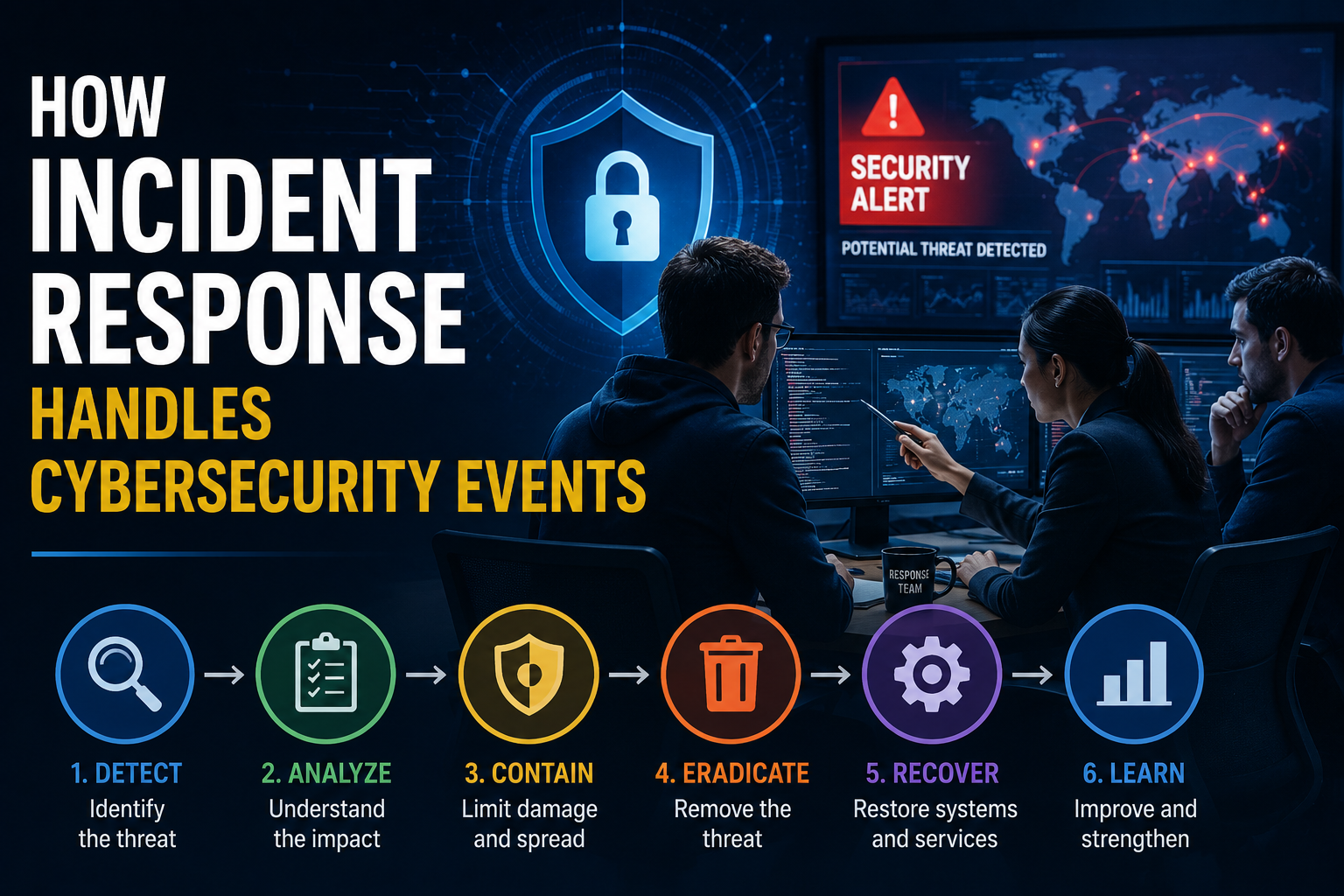
Incident response is the structured process organizations use to detect, investigate, contain, and recover from cybersecurity incidents. Instead of reacting to an attack with improvised decisions, an effective incident response program gives security teams a framework for determining what happened, limiting damage, and restoring normal operations.
Incident response is also closely connected to other areas of cybersecurity, including network protection, endpoint security, malware defense, vulnerability management, and security monitoring. It is therefore best understood as one component of a broader security strategy covered in our Ultimate Guide to Business Cybersecurity.
The process also produces valuable lessons that can help prevent similar incidents in the future.
What Is Incident Response?
Incident response is the coordinated approach an organization uses to manage a suspected or confirmed cybersecurity event.
The goal is not simply to stop an attacker. A complete response may involve:
- Detecting suspicious activity
- Determining whether an incident has occurred
- Investigating what happened
- Identifying affected systems and accounts
- Containing the threat
- Removing malicious activity
- Restoring systems
- Communicating with relevant stakeholders
- Documenting the incident
- Improving security controls afterward
An incident response team may include cybersecurity specialists, IT staff, legal professionals, communications teams, executives, and other employees depending on the nature of the incident.
The exact process varies between organizations, but the underlying objective remains the same: reduce the impact of a security incident while restoring safe and reliable operations as quickly as possible.
Not Every Security Alert Is an Incident
Modern organizations may receive thousands of security alerts.
A failed login attempt, unusual network connection, or suspicious email does not necessarily mean the organization has suffered a successful attack.
Incident response therefore begins with determining what the available evidence actually means.
Security teams may investigate questions such as:
- Is the alert legitimate?
- Is there evidence of unauthorized access?
- Which account or device is involved?
- Has any malicious activity occurred?
- Is the activity still happening?
- Are other systems potentially affected?
This process helps distinguish routine security events from incidents that require a coordinated response.
Effective detection often depends on continuous monitoring of endpoints, networks, applications, and cloud systems. Organizations can learn more about this defensive layer in our guide to how security operations teams monitor systems and detect cybersecurity threats.
Preparation Comes Before the Attack
Effective incident response starts long before an incident occurs.
Organizations need to prepare their people, technology, and procedures so that decisions can be made quickly when something goes wrong.
Preparation can include:
- Creating an incident response plan
- Assigning responsibilities
- Establishing communication procedures
- Maintaining accurate asset inventories
- Deploying security monitoring tools
- Maintaining reliable backups
- Establishing access controls
- Training employees
- Conducting simulations and exercises
- Establishing relationships with external specialists
Preparation is particularly important because cybersecurity incidents rarely occur at convenient times.
An organization may discover an attack overnight, during a holiday, or when key employees are unavailable. A documented process reduces dependence on improvisation.
Incident response preparation should also account for vulnerabilities that could make an attack possible. Organizations can strengthen this area through vulnerability management and the identification, prioritization, and reduction of security weaknesses.
Detection and Analysis
The next stage involves identifying potentially malicious activity and determining its significance.
Security monitoring systems may detect unusual behavior such as repeated authentication failures, unexpected administrative activity, suspicious software execution, or unusual transfers of data.
Employees can also play an important role in detection.
Someone might notice an unexpected password-reset message, a suspicious attachment, a strange computer notification, or unusual account activity and report it to the security team.
Once an alert is received, responders analyze available evidence to determine whether it represents a genuine security incident.
The investigation may involve examining:
- Authentication records
- Network activity
- Endpoint information
- Security alerts
- Application logs
- Cloud activity
- Email records
- System changes
- File activity
The objective is to develop an accurate picture of what happened rather than immediately making assumptions.
Establishing the Scope of an Incident
One of the most important questions during an investigation is how far the incident has spread.
A compromised employee account might initially appear to affect only one user. Further investigation could reveal that the same credentials were used to access additional services.
Similarly, malware discovered on one computer could potentially have affected other systems.
Security teams therefore attempt to establish the scope of the incident.
They may determine:
- Which devices are affected
- Which accounts are involved
- What information may have been accessed
- When suspicious activity began
- Whether the attacker still has access
- Which systems communicate with affected devices
- Whether the incident has spread beyond the original environment
Understanding scope helps organizations prioritize their response.
Containment Limits the Damage
Once an organization determines that an incident is occurring, responders typically work to contain it.
Containment aims to prevent the situation from becoming worse while investigators continue gathering information.
Depending on the incident, containment could involve:
- Isolating affected devices
- Disabling compromised accounts
- Revoking active sessions
- Blocking suspicious connections
- Restricting access to certain systems
- Temporarily disabling affected services
- Separating compromised infrastructure from unaffected systems
The appropriate action depends heavily on the circumstances.
For example, immediately shutting down a critical business system could prevent further malicious activity but could also disrupt essential services or destroy valuable evidence.
This is why containment decisions require careful coordination.
Eradication Removes the Cause
After containing an incident, security teams work to remove the underlying threat.
This may involve eliminating malicious software, closing exploited vulnerabilities, removing unauthorized accounts, or correcting compromised configurations.
Simply deleting an obvious malicious file may not be sufficient.
If an attacker obtained persistent access through another mechanism, removing one visible component could leave the organization vulnerable to continued compromise.
Responders therefore need to understand how the attacker gained access and whether additional unauthorized access mechanisms remain.
Recovery Restores Normal Operations
Once the threat has been removed, organizations can begin restoring affected systems.
Recovery may involve:
- Restoring systems from trusted backups
- Rebuilding compromised devices
- Resetting credentials
- Reconnecting systems to networks
- Monitoring restored infrastructure
- Verifying that security controls are working
- Gradually returning services to normal operation
Recovery should not simply mean turning everything back on.
Security teams need confidence that the underlying problem has been addressed. Otherwise, an attacker could regain access soon after systems are restored.
For particularly serious incidents, organizations may restore systems in stages while continuing to monitor for suspicious activity.
Communication Is Part of Incident Response
Cybersecurity incidents are technical events, but their consequences can extend across the entire organization.
Employees, customers, business partners, executives, regulators, and other stakeholders may need accurate information.
Communication therefore needs to be part of the incident response process.
Organizations should establish in advance:
- Who is authorized to communicate externally
- Who communicates with employees
- How executives are informed
- How customers are notified when appropriate
- When legal teams become involved
- How regulatory obligations are assessed
- Where official incident information is maintained
Poor communication can make an already difficult situation worse.
Unclear or contradictory messages can create confusion, while premature statements can spread inaccurate information.
The best approach is generally to communicate clearly while distinguishing confirmed facts from information that is still being investigated.
Evidence and Documentation Matter
Incident responders need to document what they discover and what actions they take.
Documentation can help answer important questions later:
- When was the incident discovered?
- Who identified it?
- Which systems were affected?
- What actions were taken?
- When were systems isolated?
- What evidence was collected?
- What information may have been exposed?
- When was normal operation restored?
Good documentation can also support legal, regulatory, insurance, and internal review processes.
It provides an organizational record that can be used to improve future security decisions.
Protecting Evidence During an Investigation
Cybersecurity investigations can involve valuable digital evidence.
Logs, system images, authentication records, and other information may help establish what happened and when.
Responders therefore need to consider evidence preservation while containing the incident.
Careless actions can sometimes destroy useful information.
For example, immediately wiping a compromised device might remove malware but also eliminate evidence that could help investigators understand the attack.
The appropriate balance depends on the circumstances, which is why serious incidents may involve specialized forensic professionals.
Ransomware Requires Difficult Decisions
Ransomware is a particularly disruptive type of cybersecurity incident because attackers may encrypt systems or threaten to release stolen information.
Organizations facing ransomware may have to address several problems simultaneously.
They may need to:
- Isolate affected systems
- Determine whether the attacker still has access
- Protect unaffected infrastructure
- Assess whether information was stolen
- Restore systems
- Investigate the initial intrusion
- Communicate with employees and stakeholders
- Evaluate legal and regulatory obligations
Organizations also need to be cautious about assuming that paying a ransom will solve the problem.
Payment does not necessarily guarantee that systems will be restored or that stolen information will not be disclosed. The decision can also involve legal, financial, and ethical considerations.
A strong backup and recovery strategy can significantly improve an organization’s ability to respond to ransomware without depending entirely on an attacker’s promises.
Organizations should also understand the malware involved in an incident. Our Complete Guide to Malware and Malicious Software explains how malware can spread, what different malware categories do, and how organizations can reduce their exposure.
Account Compromise Can Spread Quickly
Compromised accounts are another common incident-response challenge.
An attacker who gains access to an employee’s account may attempt to access email, cloud applications, internal systems, or sensitive information.
The response may therefore involve more than changing one password.
Security teams may need to:
- Disable the compromised account
- Reset credentials
- Revoke active sessions
- Review authentication activity
- Examine account permissions
- Check for unauthorized changes
- Investigate related accounts
- Determine whether data was accessed
Multi-factor authentication can also reduce the risk associated with stolen passwords, although organizations should recognize that attackers can use other techniques to target authentication systems.
Data Breaches Require Careful Investigation
When sensitive information may have been exposed, incident response becomes particularly complex.
Organizations need to determine what information was involved and whether unauthorized individuals actually accessed or acquired it.
Potentially affected information could include:
- Customer information
- Employee records
- Financial information
- Authentication credentials
- Intellectual property
- Business documents
- Personal information
The organization may need to involve legal and privacy specialists to determine its obligations.
Not every security incident becomes a reportable data breach, and determining the difference requires careful analysis of the facts and applicable requirements.
Third-Party Incidents Can Affect Your Organization
Businesses increasingly depend on cloud providers, software vendors, contractors, and other external partners.
That interconnectedness creates additional cybersecurity risk.
An incident at a supplier can potentially affect an organization even if its own systems were not directly compromised.
Incident response plans should therefore consider third-party scenarios.
Organizations may need to determine:
- Which suppliers have access to sensitive systems
- How vendors report security incidents
- Who should be contacted during an incident
- What information suppliers are required to provide
- Which services can be temporarily disconnected
- How business operations can continue if a supplier becomes unavailable
Third-party risk management is therefore closely connected to incident response planning.
Incident Response Teams Need Clear Roles
A successful response can become chaotic if nobody knows who is responsible for making decisions.
Organizations should establish roles before an incident occurs.
Depending on the organization’s size, responsibilities may include:
Incident commander: Coordinates the overall response.
Security team: Investigates technical activity and identifies threats.
IT team: Helps isolate, repair, and restore systems.
Legal team: Evaluates legal and regulatory considerations.
Communications team: Coordinates internal and external messaging.
Executive leadership: Makes high-level business decisions.
Human resources: May become involved when employee accounts or insider activity are relevant.
Clear responsibilities reduce delays and prevent multiple teams from making conflicting decisions.
Testing the Plan Is Essential
An incident response plan that exists only in a document may not work as expected during a real emergency.
Organizations should periodically test their plans through exercises and simulations.
A tabletop exercise, for example, can present a hypothetical scenario and ask participants what they would do at each stage.
A scenario might involve:
An employee’s credentials have been compromised, sensitive files may have been accessed, and unusual activity is continuing across the company’s cloud environment.
Participants can then work through questions about detection, escalation, containment, communication, and recovery.
These exercises often reveal gaps that are difficult to identify from written procedures alone.
The Recovery Period Should Include Monitoring
Restoring systems does not necessarily mean the incident is over.
Organizations should continue monitoring after recovery to make sure suspicious activity does not return.
This can involve reviewing authentication events, endpoint alerts, network activity, and other security signals.
Additional monitoring can be especially important after a serious compromise because organizations may not initially know whether every unauthorized access mechanism has been removed.
The recovery phase should therefore include a period of heightened awareness rather than an immediate return to business as usual.
Learning From the Incident
One of the most valuable parts of incident response happens after the immediate crisis has ended.
Organizations should conduct a post-incident review to determine what worked, what failed, and what needs to change.
Questions might include:
- How did the incident begin?
- Why was it possible?
- How quickly was it detected?
- Which controls worked?
- Which controls failed?
- Was communication effective?
- Were responsibilities clear?
- Did backups work as expected?
- What information was missing?
- What should be changed before the next incident?
The purpose is not simply to assign blame.
A useful review identifies weaknesses in technology, processes, and decision-making so the organization can become more resilient.
Prevention and Incident Response Work Together
Incident response is sometimes treated as something that happens only after security defenses fail.
In reality, incident response and prevention are closely connected.
An incident can reveal that:
- A particular system needs stronger authentication
- Sensitive information is stored unnecessarily
- Security monitoring needs improvement
- Employees need additional training
- Network segmentation is inadequate
- Backups are not sufficiently protected
- A vendor has excessive access
- Security patches are not being applied quickly enough
Each lesson can become an opportunity to strengthen the organization’s overall security posture.
This is why incident response should not be isolated from the rest of an organization’s cybersecurity program. It should operate alongside network security, endpoint protection, vulnerability management, access controls, data security, and other defensive capabilities.
Incident Response and Network Security
Network infrastructure can play an important role during both attack detection and containment.
Security teams may use network information to identify unusual connections, unexpected data transfers, suspicious destinations, or communication between compromised systems.
During an incident, network controls may also help restrict communication between affected and unaffected systems.
Organizations looking to strengthen this layer can explore the Complete Guide to Network Security, which covers the broader role of network protection in cybersecurity.
Incident Response Is About Resilience
No organization can assume that cybersecurity defenses will prevent every incident.
Attack techniques change, vulnerabilities are discovered, credentials can be stolen, and human mistakes happen.
The objective of incident response is therefore not to create a world in which incidents never occur.
It is to make organizations better prepared to detect problems, limit damage, and recover when something does go wrong.
A mature incident response capability combines preparation, monitoring, investigation, containment, recovery, and continuous improvement. It gives employees clear responsibilities and gives leadership a framework for making difficult decisions under pressure.
For businesses, that resilience can make the difference between a security incident that is contained and one that becomes a prolonged operational, financial, and reputational crisis.
Turning a Security Incident Into a Stronger Defense
Every cybersecurity incident carries the potential for disruption, but it can also provide valuable information about where an organization’s defenses need improvement.
The most resilient organizations do not treat incident response as a document that sits unused until an emergency. They practice their procedures, maintain reliable backups, understand their critical systems, train employees, and continually refine their security controls.
When an incident eventually occurs, those preparations can help transform an unpredictable crisis into a structured response.
Incident response is therefore not simply about reacting after something goes wrong. It is an ongoing part of building a stronger cybersecurity program.
Organizations that combine preparation, detection, containment, recovery, and post-incident learning are better positioned to reduce the consequences of future attacks.
The ultimate measure of incident response is not simply how quickly an organization stops an attack. It is how effectively it contains the damage, restores trust, and uses what it learned to make the next incident harder to succeed.