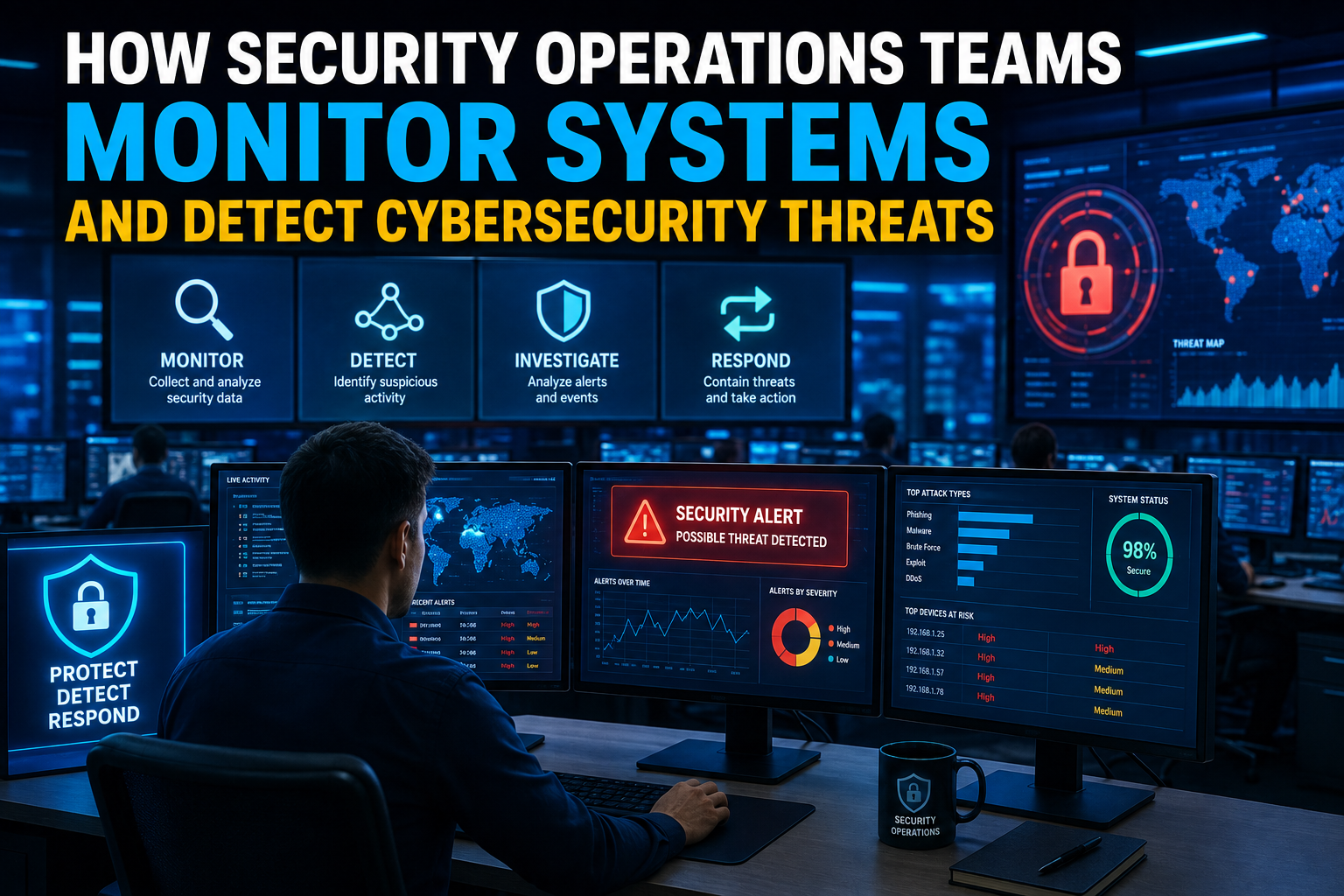
How Security Operations Teams Monitor Systems and Detect Cybersecurity Threats
Modern organizations generate enormous amounts of digital activity every day. Employees sign in to applications, servers exchange data, customers access websites, cloud services process requests, and connected devices communicate across networks.
Most of this activity is legitimate. Hidden among it, however, may be signs of phishing, malware, unauthorized access, data theft, account compromise, or other attacks.
Security operations teams are responsible for finding those warning signs and helping organizations respond before a security event causes serious damage.
A Security Operations Center (SOC) is often at the heart of this effort. Whether the SOC is operated internally, outsourced to a security provider, or managed through a combination of both, its purpose is broadly the same: monitor an organization’s digital environment, identify suspicious activity, investigate potential threats, and coordinate an appropriate response.
Security operations therefore sit at the intersection of prevention, detection, investigation, and incident response.
For a broader introduction to the threats these teams are designed to identify, see our Complete Guide to Malware and Malicious Software.
What Is a Security Operations Team?
A security operations team is a group of cybersecurity professionals responsible for monitoring and protecting an organization’s technology environment.
Depending on the organization, the team may include:
- Security analysts
- Incident responders
- Threat hunters
- Security engineers
- Detection engineers
- SOC managers
- Digital forensics specialists
- Malware analysts
- Security architects
Smaller organizations may combine several of these responsibilities into a few roles, while large enterprises may have specialized teams dedicated to individual areas of security.
The team typically works continuously because cyberattacks can occur at any time.
Security operations is therefore not simply about watching a dashboard. It involves collecting information, determining what matters, investigating suspicious behavior, coordinating responses, and continuously improving the organization’s ability to detect threats.
What Does a Security Operations Center Do?
A SOC provides a centralized function for monitoring cybersecurity events.
Its responsibilities commonly include:
- Collecting security data
- Monitoring systems and networks
- Detecting suspicious activity
- Investigating alerts
- Responding to incidents
- Containing threats
- Documenting security events
- Improving detection capabilities
The SOC does not necessarily prevent every attack from occurring.
Instead, it provides an organization’s ability to see, understand, and respond to suspicious activity quickly.
That makes security operations an important part of a broader cybersecurity strategy.
Why Continuous Monitoring Matters
Cybersecurity threats rarely announce themselves clearly.
An attacker might gain access using stolen credentials and remain quiet for days before attempting to access sensitive information.
A single login may look normal.
A single file download may look normal.
A single connection to an external server may also look normal.
But when these events are viewed together, they may reveal a much more concerning pattern.
Continuous monitoring allows security teams to connect individual events and identify activity that would otherwise be difficult to notice.
This is particularly important because modern attacks can involve several stages. An attacker might initially compromise an account, establish access, explore available systems, obtain additional privileges, and eventually attempt to steal or disrupt information.
Security monitoring can provide evidence throughout that sequence.
What Security Operations Teams Monitor
A SOC can monitor many different parts of an organization’s technology environment.
Network Traffic
Security teams examine network connections for unusual communication patterns, unauthorized connections, suspicious destinations, and unexpected transfers of information.
Network visibility can help analysts identify communication between compromised systems and external infrastructure as well as unusual activity occurring inside an organization’s environment.
Servers
Servers generate logs containing information about authentication attempts, processes, system changes, errors, and other activity.
Because servers may host important applications and data, unusual server behavior can warrant immediate investigation.
Endpoints
Laptops, desktops, and mobile devices can provide information about applications, processes, files, and user activity.
Endpoint visibility is particularly important when an attacker begins with a compromised employee device.
Our related article, How Computer and Mobile Device Security Protects Endpoints, explains how security controls protect these devices directly.
Cloud Services
Cloud platforms generate extensive logs covering authentication, configuration changes, API activity, resource access, and administrative actions.
As organizations increasingly depend on cloud infrastructure, monitoring these events has become an important part of security operations.
Applications
Application logs can reveal unusual requests, authentication failures, errors, and potential exploitation attempts.
Application-level visibility can help security teams understand what happened after an attacker reached a particular service.
Identity Systems
Identity and access systems provide valuable information about logins, password changes, multifactor authentication events, privilege changes, and access to resources.
This information has become increasingly important because attackers can sometimes operate using legitimate credentials rather than obvious malware.
Security Devices
Firewalls, intrusion-detection systems, email security tools, and endpoint security platforms can all generate alerts for the SOC.
The more comprehensive the visibility, the easier it becomes to investigate complex incidents.
What Are Security Logs?
A log is a record of activity generated by a system, application, or device.
A log might record:
- Who performed an action
- What happened
- When it happened
- Where the activity originated
- Which system was involved
- Whether the action succeeded or failed
For example, an authentication log could show that a user account successfully logged in at a particular time.
A single log entry may not be particularly meaningful.
Thousands or millions of log entries, however, can provide a detailed picture of what is happening across an organization’s environment.
Logs can therefore become one of the most important sources of evidence available to security analysts.
Why Logs Are Important for Cybersecurity
Logs provide evidence.
If an organization suspects that an account has been compromised, analysts can examine authentication records to determine:
- Where the account was used
- When unusual logins occurred
- What systems were accessed
- Whether authentication failures preceded the successful login
- Whether the account performed unusual actions afterward
Logs can therefore help answer both “What is happening?” and “What happened?”
They are also valuable for incident investigations and forensic analysis.
When a security event becomes a confirmed incident, investigators may need to reconstruct the sequence of events. That is where well-maintained logs can become particularly valuable.
For a deeper look at the broader response process, see How Incident Response Handles Cybersecurity Events.
How SIEM Systems Help Security Teams
One of the most important technologies used by many SOCs is a Security Information and Event Management (SIEM) platform.
A SIEM collects security-related data from many sources and brings it together for analysis.
Instead of requiring analysts to manually examine separate systems, a SIEM can provide a centralized view of security events.
Typical data sources can include:
- Firewalls
- Servers
- Endpoint security software
- Identity systems
- Cloud platforms
- Applications
- Network devices
- Email security systems
The SIEM can then normalize, search, correlate, and analyze the collected information.
This gives analysts a way to investigate relationships between events that might otherwise remain separated across different systems.
What Is Security Event Correlation?
Correlation means examining multiple events together to determine whether they form a meaningful pattern.
Imagine that the following events occur:
- An employee’s account experiences multiple failed login attempts.
- A successful login occurs from an unusual location.
- The account accesses a sensitive application.
- Large numbers of files are accessed shortly afterward.
Individually, some of these events might not be enough to trigger a serious investigation.
Together, they could indicate account compromise.
Correlation helps security teams identify those relationships.
This illustrates one of the central ideas behind modern security operations: context matters.
How Security Alerts Are Created
Security tools use detection rules, behavioral analysis, threat intelligence, and other methods to identify potentially suspicious activity.
A detection might trigger when:
- A user signs in from an unusual location
- A privileged account performs an unexpected action
- Malware-like behavior appears on an endpoint
- A large amount of data is transferred unexpectedly
- A known malicious indicator appears
- Security controls are disabled
- Multiple failed authentication attempts occur
- An unusual process starts on a server
When a detection condition is met, the system can generate an alert.
The alert is then evaluated by security personnel or automated processes.
Not every alert represents a successful attack, however.
Not Every Alert Is a Cyberattack
One of the biggest challenges facing security operations teams is false positives.
A false positive occurs when a security system identifies activity as suspicious even though it is legitimate.
For example, an employee traveling internationally might suddenly log in from another country.
A security system could consider that unusual.
But if the employee is legitimately traveling, there may be no attack at all.
If a SOC receives too many unnecessary alerts, analysts can become overwhelmed.
This is sometimes called alert fatigue.
Effective security operations therefore require more than generating large numbers of alerts. Detection systems need to produce useful signals that analysts can investigate.
How Analysts Prioritize Alerts
Security teams generally prioritize alerts based on factors such as:
- Severity
- Confidence
- Affected systems
- User privileges
- Sensitivity of the data
- Potential business impact
- Evidence of active exploitation
- Whether similar activity is occurring elsewhere
An alert involving an ordinary workstation may receive a different priority from an alert involving a highly privileged administrator account.
The objective is to direct human attention toward the events most likely to represent serious threats.
The Role of Endpoint Detection and Response
Endpoint Detection and Response (EDR) tools monitor computers and other endpoints for suspicious activity.
Unlike traditional antivirus software, modern endpoint security systems can provide broader visibility into what happens on a device.
They may monitor:
- Processes
- Files
- Network connections
- User activity
- System changes
- Persistence mechanisms
- Security configuration changes
If suspicious behavior is detected, security personnel may be able to investigate the activity and isolate the affected device.
This makes EDR particularly useful when security teams need to understand what happened on an individual computer.
Why Endpoint Visibility Matters
An attacker may attempt to move through an organization after gaining access to one computer.
Endpoint monitoring can provide clues about:
- How the initial compromise occurred
- What programs were executed
- Which accounts were used
- What systems were contacted
- Whether additional devices may be affected
This information can help responders determine the scope of an incident.
Endpoint visibility is therefore closely connected to both threat detection and incident response.
Network Monitoring and Threat Detection
Network monitoring provides another important layer of visibility.
Security teams can examine network traffic for unusual patterns.
Examples include:
- Unexpected connections
- Large outbound transfers
- Communication with suspicious infrastructure
- Unusual internal traffic
- Unexpected protocols
- Abnormal connection volumes
Network monitoring is especially useful when attackers attempt to communicate with external infrastructure or move between systems inside an organization.
What Is Network Detection and Response?
Network Detection and Response (NDR) focuses on identifying suspicious behavior within network traffic.
Rather than relying only on known malicious signatures, modern systems may also look for unusual patterns.
This can help identify previously unknown or modified threats.
NDR and EDR can complement one another by providing visibility into different parts of an organization’s environment.
Identity Monitoring Is Increasingly Important
Modern cybersecurity increasingly revolves around identity.
Organizations rely heavily on cloud applications, remote access, and centralized authentication systems.
An attacker who obtains legitimate credentials may be able to access systems without deploying traditional malware.
Security teams therefore monitor identity-related events closely.
They may look for:
- Impossible or unusual travel patterns
- Multiple authentication failures
- Unexpected privilege changes
- New authentication methods
- Suspicious account behavior
- Unusual access to sensitive resources
The goal is to determine whether an apparently legitimate account is being used in an illegitimate way.
This is one reason strong authentication and endpoint security need to work alongside security monitoring rather than operate as isolated controls.
Threat Intelligence Adds Context
Security teams often use threat intelligence to understand potential threats.
Threat intelligence can include information about:
- Known malicious infrastructure
- Malware families
- Attacker techniques
- Exploited vulnerabilities
- Campaigns targeting particular industries
- Indicators associated with known threats
Suppose an organization’s monitoring system detects communication with a particular internet address.
On its own, the connection may be difficult to interpret.
If threat intelligence identifies that address as associated with malicious activity, the security team has additional context for its investigation.
Threat intelligence can therefore help analysts determine which events deserve closer attention.
Indicators of Compromise
An indicator of compromise (IOC) is evidence that may suggest a security incident.
Examples can include:
- Malicious file hashes
- Suspicious domains
- Known malicious IP addresses
- Unusual registry changes
- Unexpected executable files
- Abnormal authentication activity
IOCs can help analysts identify known threats.
However, attackers can change infrastructure and modify malware, so security operations teams cannot rely exclusively on static indicators.
That is why behavioral analysis and threat hunting remain important.
Behavioral Detection Looks for Patterns
Behavioral detection focuses on what activity looks like, rather than only looking for known malicious files or addresses.
For example, a security system might flag a combination of actions that rarely occur during normal business operations.
This could include an ordinary employee account suddenly:
- Accessing large numbers of files
- Attempting privileged actions
- Connecting to unusual systems
- Creating unexpected accounts
- Transferring unusually large amounts of data
Behavioral detection can help identify threats that do not match previously known signatures.
Threat Hunting Goes Beyond Alerts
Security analysts do not always wait for automated systems to generate an alert.
Threat hunting involves proactively searching an organization’s environment for evidence of suspicious activity.
A threat hunter might investigate questions such as:
- Are there unusual authentication patterns?
- Are privileged accounts behaving differently?
- Are unexpected processes running?
- Are systems communicating with unusual destinations?
- Has a known vulnerability been exploited?
- Are there signs of lateral movement?
Threat hunting is especially valuable when attackers have managed to avoid conventional security controls.
Instead of waiting for a detection, analysts actively search for evidence that something may already be wrong.
How an Alert Becomes an Investigation
A typical security investigation may follow a sequence such as:
Alert → Triage → Investigation → Validation → Containment → Eradication → Recovery → Review
The process can vary depending on the organization and incident.
Step 1: Alert
A monitoring system identifies potentially suspicious activity.
Step 2: Triage
An analyst determines whether the alert appears legitimate and how serious it might be.
Step 3: Investigation
The analyst gathers additional evidence.
They may examine logs, endpoint data, network activity, and user behavior.
Step 4: Validation
The team determines whether the activity represents an actual security incident.
Step 5: Containment
If an attack is confirmed, responders attempt to limit its spread and impact.
Step 6: Eradication
The underlying cause of the compromise is addressed.
This could involve removing malicious software, disabling compromised accounts, or fixing exploited weaknesses.
Step 7: Recovery
Affected systems are restored to normal operation.
Step 8: Lessons Learned
The organization examines what happened and identifies improvements that could reduce the likelihood or impact of similar incidents.
This final stage connects security operations directly with the broader incident-response process.
Incident Response Requires Coordination
Cybersecurity incidents rarely involve only the SOC.
Depending on the severity, response may involve:
- IT teams
- Network administrators
- Cloud engineers
- Legal departments
- Compliance teams
- Executives
- Human resources
- Communications teams
- External security specialists
For serious incidents, coordination can be just as important as technical expertise.
An organization may have excellent detection technology but still struggle if nobody knows who has authority to isolate systems or communicate with customers.
That is why security monitoring should be integrated with a clearly defined incident response process.
Automation Helps Analysts Handle Volume
Modern organizations can produce enormous numbers of security events.
Human analysts cannot manually examine every event.
Automation therefore plays an increasingly important role.
Automated systems can:
- Enrich alerts with additional information
- Correlate related events
- Assign severity scores
- Block suspicious connections
- Disable compromised accounts
- Isolate endpoints
- Collect evidence
- Create incident tickets
Automation allows analysts to focus their time on investigations requiring judgment.
Security Orchestration and Response
Security Orchestration, Automation and Response (SOAR) platforms can connect security tools and automate predefined workflows.
For example, when a high-confidence threat is detected, an automated workflow might:
- Gather information about the affected device.
- Retrieve related security events.
- Check threat-intelligence sources.
- Create an incident record.
- Notify an analyst.
- Apply an approved containment action.
Automation must be carefully designed because an incorrect automated response can disrupt legitimate business operations.
Human approval may therefore remain appropriate for high-impact actions.
Artificial Intelligence in Security Operations
Artificial intelligence and machine learning are increasingly used to help security teams analyze large quantities of data.
AI-based systems can assist with:
- Detecting unusual behavior
- Grouping related alerts
- Identifying patterns
- Summarizing incidents
- Prioritizing investigations
- Analyzing large datasets
- Supporting security analysts
However, AI does not eliminate the need for human expertise.
Security environments contain ambiguity and context that automated systems may not fully understand.
A legitimate administrative action can resemble an attack, while a sophisticated attack can resemble ordinary activity.
Human analysts remain important for interpreting evidence and making high-impact decisions.
For broader context on how AI is changing technical work, see AI in Software Engineering.
Why Security Teams Need Baselines
A security system needs some understanding of what normal behavior looks like.
This is called establishing a baseline.
A baseline might describe:
- Normal login locations
- Typical network traffic
- Common applications
- Standard administrative activity
- Normal data-transfer volumes
- Typical working hours
Once normal patterns are understood, unusual behavior becomes easier to identify.
However, baselines must be maintained because organizations change.
Employees travel, businesses expand, applications are replaced, and working patterns evolve.
A detection system that treats every change as suspicious can create excessive alerts.
Vulnerability Management Supports Detection
Security operations and vulnerability management are closely connected.
A vulnerability is a weakness that could potentially be exploited.
Security teams need to know:
- Which systems are vulnerable
- Which vulnerabilities are actively being exploited
- Which systems are most important
- Whether suspicious activity targets known weaknesses
A vulnerability scanner may identify thousands of weaknesses, but not all have equal importance.
Combining vulnerability information with security monitoring helps organizations prioritize risks.
This can allow security teams to pay particular attention to systems where vulnerabilities and suspicious activity overlap.
Security Operations and Cloud Computing
Cloud environments create new monitoring challenges.
Organizations may use multiple cloud services, applications, and identity platforms.
Security teams therefore need visibility across:
- Cloud accounts
- Virtual machines
- Containers
- Storage systems
- APIs
- Identity services
- Cloud applications
- Network configurations
Cloud security monitoring also requires understanding the shared responsibility model, in which the cloud provider and customer have different security responsibilities.
Why Cloud Logs Matter
Cloud platforms can produce detailed audit logs.
These records may show:
- Who accessed a resource
- What action was performed
- When the action occurred
- Which account initiated it
- Where the request originated
Without appropriate logging and monitoring, suspicious cloud activity can be much harder to investigate.
Cloud logging is therefore an important component of security visibility for organizations that depend on cloud infrastructure.
Email Security Is Part of the SOC
Email remains a major avenue for cyberattacks.
Security teams may monitor email systems for:
- Phishing attempts
- Malicious attachments
- Suspicious links
- Impersonation
- Unusual sending behavior
- Compromised accounts
A successful phishing attack can become the starting point for a much larger incident.
SOC analysts therefore often investigate suspicious email reports from employees alongside automated email-security alerts.
This creates another connection between security operations and malware prevention: identifying the initial delivery mechanism can help prevent a larger compromise.
Human Reporting Still Matters
Not every threat is detected by software.
Employees can sometimes notice suspicious behavior before automated systems do.
For example, an employee might report:
- An unexpected password-reset message
- A suspicious email
- A strange login notification
- A computer behaving unusually
- An unexpected request for sensitive information
Organizations should make reporting easy and encourage employees to report suspicious activity without fear of punishment for honest mistakes.
Human observations can become valuable inputs for security investigations.
Measuring Security Operations Performance
Security teams need ways to evaluate whether their monitoring and response capabilities are effective.
Common measurements include:
Mean Time to Detect
How long it takes to identify a security incident.
Mean Time to Respond
How long it takes to begin responding after an incident is identified.
Mean Time to Contain
How long it takes to limit the incident’s impact.
Other metrics can examine:
- Alert volumes
- False-positive rates
- Investigation workloads
- Incident severity
- Response effectiveness
- Detection coverage
Metrics should be interpreted carefully.
A SOC receiving fewer alerts is not necessarily more effective if its detection capabilities have also become weaker.
Likewise, a high number of alerts does not automatically mean a security team is performing well.
Useful measurements should reflect meaningful security outcomes.
The Importance of Security Visibility
A security team cannot investigate what it cannot see.
This makes visibility one of the foundations of cybersecurity operations.
Organizations should understand which systems generate logs, which events are being monitored, and where important gaps exist.
Visibility should extend across:
- Endpoints
- Networks
- Identity
- Applications
- Cloud services
- Critical infrastructure
- Sensitive data environments
The goal is not necessarily to collect every possible piece of information.
It is to collect the information that provides meaningful security visibility.
Too little information makes investigation difficult. Too much poorly organized information can overwhelm analysts.
Effective monitoring therefore depends on collecting the right data and making it usable.
Security Operations Is a Continuous Process
Cybersecurity is not a project that can simply be completed.
Attackers change their methods. Organizations deploy new technology. Employees adopt new applications. Cloud environments evolve. New vulnerabilities appear.
Security operations teams therefore need to continuously improve:
- Detection rules
- Monitoring coverage
- Incident-response procedures
- Threat intelligence
- Automation
- Analyst skills
- Security controls
A detection strategy that works today may need to be updated tomorrow.
Continuous improvement is particularly important because attackers can adapt to defensive measures.
How Security Operations Fits Into a Broader Cybersecurity Strategy
Security operations is one part of a larger security ecosystem.
Endpoint protection helps secure individual computers and mobile devices.
Malware defenses help identify and prevent malicious software.
Identity controls help protect accounts.
Vulnerability management helps identify weaknesses.
Incident response provides a structured process for handling confirmed security events.
Security operations connects many of these capabilities by monitoring their signals and looking for relationships between them.
For example, a suspicious login might become more significant when analysts discover that the same account accessed a compromised endpoint and subsequently downloaded sensitive information.
The individual signals become much more useful when they can be investigated together.
Turning Digital Activity Into Security Intelligence
Security operations teams essentially transform enormous amounts of digital activity into information that organizations can act on.
Logs provide raw evidence. Monitoring systems identify unusual events. SIEM platforms correlate information. Endpoint and network tools add technical visibility. Threat intelligence supplies context, while analysts investigate whether suspicious behavior represents a genuine threat.
The most effective security operations programs do not depend on a single tool or a single detection method.
They combine technology, human expertise, clear procedures, reliable visibility, and continuous improvement.
As organizations become increasingly dependent on cloud services, connected devices, and digital identities, the ability to detect unusual activity quickly becomes just as important as preventing known threats.
A strong SOC gives organizations a way to see what is happening across their digital environment, investigate warning signs, and respond before a small security event becomes a much larger problem.
That makes security operations a natural bridge between everyday cybersecurity monitoring and full-scale incident response—helping organizations move from simply collecting security data to actually understanding and acting on it.