How to Choose the Right Camera Equipment
Choosing camera equipment can be surprisingly difficult. Walk into a camera store or browse an online marketplace and you can quickly encounter dozens of camera bodies, lenses, tripods, flashes, memory cards, bags and accessories.
The most expensive equipment is not automatically the best choice. In many cases, buying the wrong equipment can make photography more complicated without meaningfully improving your images.
The right approach is to start with what you want to photograph, how you plan to use your equipment and how much you are comfortable spending. From there, you can build a camera system that matches your needs rather than simply chasing specifications.
Start With the Type of Photography You Want to Do
Before comparing camera models, identify the kind of photography you are most interested in.
Different subjects place different demands on equipment.
For example:
- Travel photography benefits from portability and versatility.
- Portrait photography often benefits from lenses with wide apertures and flattering focal lengths.
- Wildlife photography usually requires long focal lengths and fast autofocus.
- Sports photography benefits from fast autofocus, rapid shooting and good low-light performance.
- Landscape photography often prioritizes image quality, dynamic range and wide-angle lenses.
- Street photography can benefit from compact cameras and discreet lenses.
- Video production requires attention to stabilization, autofocus, audio and recording capabilities.
- Product photography may place greater emphasis on lighting, macro capability and controlled shooting environments.
There is no single camera setup that is perfect for all of these situations.
Understanding your primary use case narrows the choices considerably.
Set a Realistic Budget
Camera equipment can become expensive quickly.
A camera body is only one part of the system. You may also need lenses, memory cards, batteries, a charger, a camera bag, a tripod and lighting equipment.
Instead of spending your entire budget on the camera body, consider the cost of the complete setup.
For example, a moderately priced camera paired with an excellent lens can be more useful than an expensive camera paired with a basic lens that does not suit your photography.
It can be helpful to divide your budget into priorities:
- Camera body
- Primary lens
- Memory and batteries
- Protection and carrying equipment
- Additional lens or lighting equipment
- Accessories
You do not need to purchase everything immediately.
Starting with a capable camera and one versatile lens can allow you to learn what you actually need before spending more money.
Decide Between Mirrorless and DSLR
For people buying interchangeable-lens cameras, one of the first decisions is whether to choose a mirrorless camera or a DSLR.
Mirrorless cameras use an electronic viewfinder or screen and do not require the traditional optical mirror system found in DSLRs.
They have become increasingly popular because they can offer:
- Compact designs
- Electronic viewfinders
- Advanced autofocus
- Real-time exposure previews
- Strong video capabilities
- Rapid continuous shooting
DSLRs use an optical viewfinder and a mirror mechanism.
They remain capable cameras and can be particularly attractive on the used market, where older models and lenses may offer excellent value.
For someone buying into a new system today, mirrorless cameras are often the more forward-looking choice. But a well-maintained DSLR can still produce excellent photographs.
The camera’s capabilities matter more than the label.
Sensor Size Matters, But It Is Not Everything
Camera specifications often emphasize sensor size.
Common formats include:
- Full frame
- APS-C
- Micro Four Thirds
- Smaller sensors found in compact cameras and smartphones
Larger sensors can provide advantages in areas such as low-light performance, depth of field and overall image quality under certain conditions.
However, larger does not automatically mean better for every photographer.
A smaller sensor can allow manufacturers to produce smaller, lighter lenses and camera bodies. This can be extremely valuable for travel, hiking and everyday photography.
A photographer who carries a lightweight camera everywhere may ultimately take more useful photographs than someone who owns a larger system that frequently stays at home.
Do Not Underestimate the Lens
For interchangeable-lens cameras, the lens can have an enormous effect on the shooting experience.
The camera body determines many technical capabilities, but the lens determines the perspective, field of view, maximum aperture, focusing behavior and physical characteristics of the image.
This is why buying the most expensive camera body available is not always the smartest strategy.
A good lens can remain useful across multiple camera generations.
When choosing a lens, consider:
- Focal length
- Maximum aperture
- Autofocus performance
- Image stabilization
- Size and weight
- Minimum focusing distance
- Weather resistance
- Compatibility with your camera system
Think about what you actually need rather than buying lenses simply because they have impressive specifications.
Understand Focal Length
Focal length determines how wide or narrow a lens’s field of view appears.
Broadly speaking:
- Wide-angle lenses are useful for landscapes, architecture and interiors.
- Standard lenses provide a perspective that can work well for everyday photography.
- Telephoto lenses are useful for distant subjects, sports and wildlife.
- Macro lenses are designed for close-up photography.
A versatile zoom lens can be an excellent starting point because it allows you to experiment with different focal lengths without carrying several lenses.
Prime lenses, which use a fixed focal length, can also be excellent choices. They often offer wide maximum apertures and can encourage photographers to think more carefully about composition.
Prime vs. Zoom Lenses
Both types have advantages.
Prime lenses
Prime lenses have a fixed focal length.
They are often:
- Compact
- Bright
- Optically strong
- Useful for low-light photography
- Excellent for portraits and creative work
Their limitation is that you cannot zoom in or out. You need to physically change your position or switch lenses.
Zoom lenses
Zoom lenses offer a range of focal lengths.
They are particularly convenient for:
- Travel
- Events
- Wildlife
- Sports
- Everyday photography
A zoom can replace several prime lenses and reduce the amount of equipment you need to carry.
For beginners, a good standard zoom can be an extremely practical starting point.
Pay Attention to Aperture
Aperture controls how much light enters the lens and influences depth of field.
A lens with a wide maximum aperture, such as f/1.8, can allow more light into the camera and make it easier to create a shallow depth of field.
This can be useful for portraits and low-light photography.
A lens with a narrower maximum aperture may be smaller, lighter and less expensive.
For example, an affordable zoom with a variable aperture may be perfectly adequate for outdoor travel photography where there is plenty of available light.
Do not assume that the widest possible aperture is always necessary.
Autofocus Can Make a Major Difference
Modern autofocus systems have become extremely sophisticated.
Depending on the camera, autofocus may be capable of detecting and tracking:
- People
- Faces
- Eyes
- Animals
- Vehicles
- Sports subjects
This can be particularly useful when subjects are moving unpredictably.
For landscapes and carefully composed still-life photographs, autofocus speed may be less important.
For children, sports, wildlife and events, however, reliable subject tracking can make a significant difference.
When comparing cameras, consider real-world autofocus performance rather than focusing exclusively on the number of autofocus points advertised.
Consider Image Stabilization
Image stabilization can reduce the effects of camera shake.
It can be especially useful when shooting handheld in low light or when using longer lenses.
Some cameras provide stabilization inside the camera body, while certain lenses include optical stabilization. Some systems combine both.
Stabilization does not freeze a moving subject. If a person is running through a dark scene, you may still need a fast shutter speed.
But it can help keep the camera itself steady when shooting at slower shutter speeds.
Think About Video if You Plan to Record It
Many people buy cameras primarily for photography and later discover that they want to produce video.
If video is part of your plans, look at features such as:
- Resolution
- Frame rates
- Autofocus during video
- Image stabilization
- Microphone inputs
- Headphone monitoring
- Recording limits
- Heat management
- File formats
- Log or flat picture profiles
A camera that is excellent for still photography is not automatically the best video camera.
If you regularly create content for websites, social media or YouTube, video capabilities may deserve a much higher place on your purchasing checklist.
Do Not Forget Audio
For video creators, audio quality can be just as important as image quality.
A high-quality external microphone can make a noticeable improvement over a camera’s built-in microphone.
Depending on the type of content you produce, you might consider:
- Shotgun microphones
- Wireless microphones
- Lavalier microphones
- Portable audio recorders
If you are recording interviews or presentations, prioritize reliable audio equipment rather than spending your entire budget on the camera body.
Choose the Right Memory Cards
Memory cards are easy to overlook when purchasing a camera.
However, the wrong card can cause problems, particularly when recording high-resolution video or capturing photographs at high continuous shooting speeds.
Check your camera manufacturer’s requirements and choose cards that provide sufficient:
- Capacity
- Write speed
- Read speed
- Reliability
It is often better to carry multiple reliable cards than to put an entire trip’s photographs on one card.
Regularly backing up your images is equally important.
Extra Batteries Can Be Worth It
Battery life varies considerably between cameras.
Electronic viewfinders, wireless connectivity, image stabilization and video recording can all consume power.
If you travel frequently or photograph events, an additional battery can be one of the most practical accessories you buy.
A spare battery is usually far more useful than a collection of inexpensive accessories that rarely leave your camera bag.
Buy a Tripod When Your Photography Requires One
A tripod is valuable for situations where camera stability is important.
It can help with:
- Landscape photography
- Night photography
- Long exposures
- Astrophotography
- Product photography
- Studio work
- Video recording
But not every photographer needs to carry one everywhere.
If you mainly photograph street scenes, family activities or travel experiences during the day, a tripod may add unnecessary weight.
Choose equipment based on your actual shooting conditions.
Lighting Can Transform Your Photographs
Many beginners spend most of their budget on cameras and lenses while overlooking lighting.
Good lighting can dramatically improve photographs.
For controlled photography, you might eventually invest in:
- Speedlights
- Studio strobes
- LED lights
- Softboxes
- Reflectors
- Light stands
- Diffusers
You do not need a complicated studio to begin learning about lighting.
Even a simple reflector or affordable continuous light can teach you how the direction and quality of light affect a subject.
Consider the Size and Weight of the Entire System
Camera specifications rarely communicate how heavy an entire kit will feel after several hours.
A professional camera combined with several large lenses may produce excellent results, but carrying that system through a city or along a hiking trail can become tiring.
Before purchasing, think about where you will use the equipment.
A lightweight system may be ideal for:
- Travel
- Hiking
- Street photography
- Family photography
- Everyday use
A larger professional system may make more sense for:
- Commercial photography
- Studio work
- Professional sports
- Wildlife
- High-end productions
The best equipment is often the equipment you are willing to carry and use consistently.
Check Ergonomics Before Buying
Two cameras with similar specifications can feel completely different in your hands.
Consider:
- Grip size
- Button placement
- Menu system
- Touchscreen responsiveness
- Viewfinder quality
- Screen articulation
- Control dials
- Weight distribution
If possible, physically hold a camera before purchasing it.
A camera that feels comfortable can encourage you to use manual controls and make adjustments more quickly.
Think About the Camera System, Not Just One Camera
An interchangeable-lens camera is part of a larger ecosystem.
Before choosing a brand, examine the available lenses and accessories.
Ask:
- Are the lenses I want available?
- Are third-party lenses supported?
- Are replacement batteries easy to find?
- Is the system affordable to expand?
- Are used lenses readily available?
- Does the manufacturer offer the features I may need later?
Your first camera may eventually be replaced, but your lenses and accessories can remain part of your system.
That makes the initial system decision more important than choosing between two individual camera bodies with similar specifications.
Buying Used Can Offer Excellent Value
Used camera equipment can provide significantly more capability for the money.
A previous-generation camera may still produce excellent images even after newer models have been released.
When buying used equipment, inspect:
- Sensor condition
- Lens glass
- Autofocus performance
- Shutter count where available
- Battery condition
- Ports and card slots
- Buttons and dials
- Signs of water or impact damage
Buy from reputable sellers when possible, and understand the return or warranty policy.
Older professional lenses can sometimes be particularly attractive because their optical quality may remain excellent even after newer camera bodies have appeared.
Avoid Buying Based Only on Specifications
Specifications are useful for comparison, but they do not tell the entire story.
A camera with a higher megapixel count is not automatically better.
A camera with more autofocus points is not necessarily easier to use.
A lens with a wider aperture is not automatically the right lens for your photography.
Instead, ask how each specification affects the photographs and situations you actually care about.
A camera should be evaluated as a tool rather than as a collection of numbers.
Accessories Worth Buying First
Once you have chosen your camera and primary lens, prioritize accessories that solve real problems.
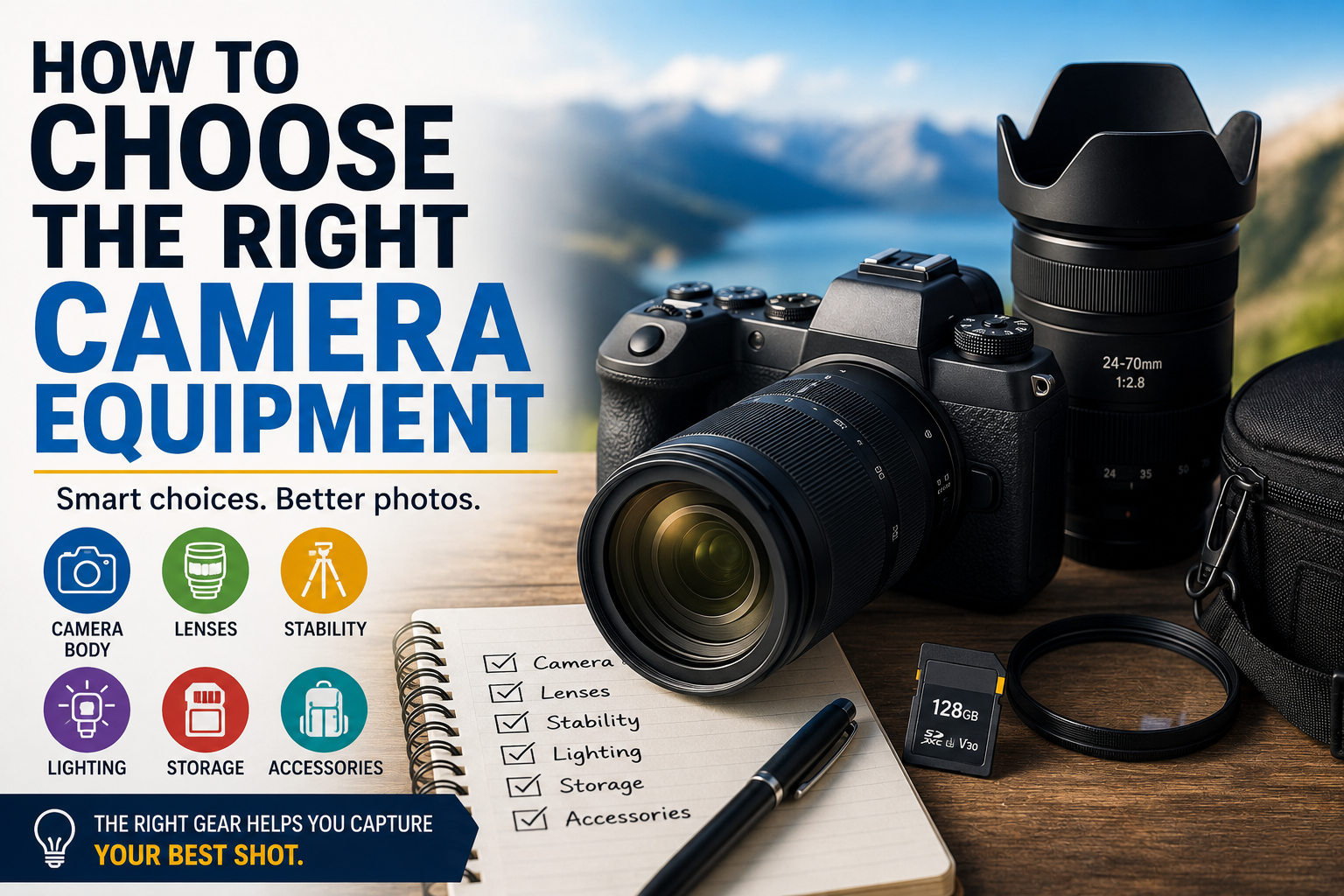
A practical starting kit might include:
- Extra battery
- Reliable memory card
- Comfortable camera strap
- Protective camera bag
- Lens-cleaning kit
- Basic tripod if needed
- External microphone for video
- Spare storage for backups
You can add specialized accessories as your photography develops.
There is little reason to purchase every available accessory on day one.
Learn Before You Upgrade
One of the most common mistakes new photographers make is upgrading equipment before understanding the limitations of what they already own.
If your photographs are not producing the results you want, determine why.
Is the problem:
- Composition?
- Lighting?
- Focus?
- Exposure?
- Camera shake?
- Lens selection?
- Subject movement?
- Editing?
Sometimes the solution is a new lens.
Sometimes it is a tripod.
Sometimes it is better lighting.
And sometimes the best solution is simply more practice.
Technical knowledge can often produce a larger improvement than another expensive piece of equipment.
Choose Equipment That Matches Your Photography
The right camera equipment should support the way you actually photograph.
A travel photographer may prioritize portability. A wildlife photographer may prioritize reach and autofocus. A portrait photographer may care more about lens characteristics and lighting. A filmmaker may place audio and video specifications at the top of the list.
There is no universally perfect camera.
The best buying decision starts by identifying your subjects, shooting conditions, budget and long-term goals. From there, choose a camera body that provides the capabilities you need, invest carefully in lenses and add accessories only when they solve a genuine problem.
Most importantly, remember that equipment is a means rather than the destination.
A more expensive camera cannot replace good composition, interesting subjects, thoughtful lighting and strong visual storytelling. The right equipment is the equipment that helps you spend less time worrying about your gear and more time creating photographs you are proud to keep.