How to Choose the Right Vacuum Cleaner
Choosing a vacuum cleaner can be surprisingly difficult. Walk into an appliance store or browse an online marketplace and you may find dozens of models that look similar but differ significantly in design, suction power, filtration, capacity, attachments and price.
The best vacuum cleaner is not necessarily the most expensive one or the model with the highest advertised power. The right choice depends on the type of floors in your home, the amount of cleaning required, whether you have pets, how much storage space you have and how much maintenance you are willing to handle.
Understanding the main types of vacuum cleaners and the features that actually matter can make the buying decision much easier.
Start With Your Cleaning Needs
Before comparing brands and specifications, consider what you actually need a vacuum cleaner to do.
Think about:
- The size of your home
- Carpeted versus hard floors
- Stairs and difficult-to-reach areas
- Pets and shedding
- Allergies or sensitivity to dust
- Children and frequent messes
- Available storage space
- How often you vacuum
- Whether you need to clean furniture or a car
- Your budget
A person living in a small apartment with mostly hard floors may have very different requirements from someone in a large house with thick carpets and several pets.
Starting with your cleaning habits prevents you from paying for features you will rarely use.
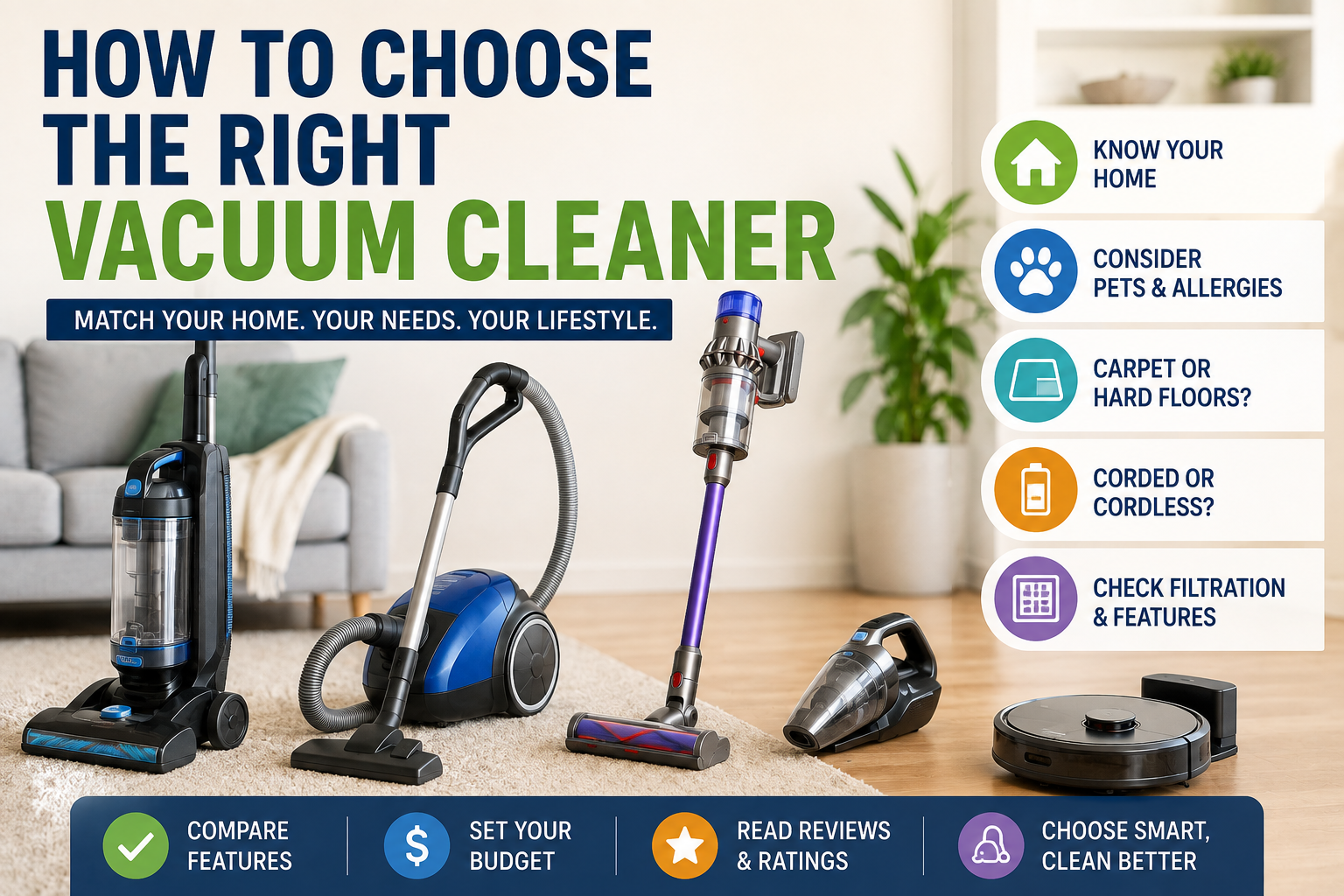
Upright Vacuum Cleaners
Upright vacuums are among the most recognizable designs.
They typically combine the motor, dust container and cleaning head into one upright unit. Many models are particularly effective on carpets because their powered brush heads can agitate dirt embedded in the fibers.
Advantages
- Strong carpet-cleaning performance
- Large dust capacity on many models
- Often easy to push across open floors
- Many models include multiple attachments
- Generally well suited to larger homes
Disadvantages
- Can be heavier than other designs
- May be awkward on stairs
- Takes up more storage space
- Some models can be relatively noisy
An upright vacuum can be a strong choice for homes with extensive carpeting and larger floor areas.
Canister Vacuum Cleaners
Canister vacuums separate the main motor and dust container from the cleaning head.
A flexible hose connects the canister to a wand and floor attachment. This design can make the vacuum easier to maneuver around furniture and into corners.
Advantages
- Flexible and maneuverable
- Often excellent on hard floors
- Useful for stairs
- Can reach underneath furniture
- Frequently supports a wide range of attachments
Disadvantages
- The canister must be pulled behind you
- Storage can be less convenient
- Hoses and accessories can become cumbersome
Canister models can be particularly useful for homes with multiple floor types and lots of furniture.
Stick Vacuum Cleaners
Stick vacuums are lightweight and generally designed for quick, convenient cleaning.
Cordless models have become especially popular because they eliminate the need to move a power cable between rooms.
They are useful for everyday messes and smaller living spaces.
Advantages
- Lightweight
- Easy to store
- Convenient for quick cleaning
- Cordless models offer freedom of movement
- Many can convert into handheld vacuums
Disadvantages
- Smaller dust containers
- Battery life can limit cleaning sessions
- Some models have less deep-cleaning capability than larger vacuums
- Battery replacement can eventually become a consideration
A stick vacuum can be ideal for someone who prefers frequent, quick cleaning rather than occasional intensive sessions.
Handheld Vacuums
Handheld vacuums are designed for small areas and quick jobs.
They can be useful for cleaning:
- Sofas
- Car interiors
- Stairs
- Shelves
- Kitchen surfaces
- Small spills
- Tight spaces
They generally should not be considered a replacement for a full-size vacuum when cleaning large floors.
Instead, they work well as a convenient secondary cleaning tool.
Robot Vacuum Cleaners
Robot vacuums have changed the way some households approach routine floor cleaning.
These devices can navigate rooms automatically, collect dust and return to a charging station. More advanced models may map rooms, avoid obstacles and integrate with smartphone applications.
Their biggest advantage is convenience.
A robot vacuum can perform routine cleaning while the occupants are working, sleeping or away from home.
However, robot vacuums have limitations.
They may struggle with stairs, thick carpets, tangled cables and cluttered rooms. They also generally require occasional human intervention to empty containers, clean brushes and deal with areas they cannot reach.
For many households, a robot vacuum works best as a complement to a conventional vacuum rather than a complete replacement.
Corded or Cordless?
One of the biggest decisions is whether to choose a corded or cordless model.
Corded Vacuums
Corded models draw continuous power from an electrical outlet.
Their major advantage is that you do not have to worry about battery life.
They can be particularly useful for larger homes or long cleaning sessions.
The downside is convenience. You have to manage the cable and move it between outlets.
Cordless Vacuums
Cordless models run on rechargeable batteries.
They are extremely convenient because there is no power cable to manage. You can quickly pick up the vacuum and start cleaning.
The main limitation is runtime.
Manufacturers often advertise maximum battery life under specific conditions, which may differ from real-world use. Using a motorized brush or high-power mode can reduce runtime considerably.
When comparing cordless models, look at usable cleaning time, charging time and whether the battery is replaceable.
Bagged Versus Bagless
Vacuum cleaners generally use either disposable bags or reusable dust containers.
Bagged Models
Bagged vacuums collect debris inside a replaceable bag.
Advantages can include:
- Hygienic disposal
- Less direct exposure to dust
- Large capacity on some models
- Potentially good choice for allergy-sensitive households
The main drawback is the ongoing cost and inconvenience of purchasing replacement bags.
Bagless Models
Bagless vacuums collect debris in a removable container.
Advantages include:
- No replacement bags
- Easy visibility of the collected dirt
- Convenient emptying
- No need to keep spare bags available
However, emptying a bagless container can release dust into the air, depending on the design.
The better option depends on your priorities and sensitivity to dust.
Suction Power Is Not the Whole Story
A common mistake is assuming that the vacuum with the highest advertised power must clean the best.
In reality, cleaning performance depends on multiple factors.
These can include:
- Airflow
- Suction efficiency
- Brush design
- Floor-head design
- Filtration
- Seal quality
- Motorized brush performance
- Ability to maintain suction as the container fills
A powerful motor does not automatically guarantee superior cleaning.
The design of the entire air path and cleaning head matters considerably.
Consider Your Flooring
The type of flooring in your home should strongly influence your choice.
Carpet
Carpets can trap dust, hair and debris deep within their fibers.
A vacuum with an effective powered brush roll can help loosen and remove embedded dirt.
If you have thick carpeting, look for a model designed specifically for carpet cleaning and one that allows you to adjust the brush height or cleaning mode.
Hard Floors
Hard surfaces such as tile, wood and laminate require a different approach.
A vacuum head designed for hard floors should pick up fine particles without unnecessarily scratching delicate surfaces.
Some models allow users to switch between hard-floor and carpet settings.
Mixed Flooring
If your home contains both carpets and hard floors, versatility becomes particularly important.
A vacuum with adjustable suction, interchangeable floor heads or automatic floor detection may be more convenient than a highly specialized model.
Pet Owners Have Different Requirements
Pets can dramatically increase cleaning demands.
Dogs and cats can leave behind hair, dander, dirt and other debris.
Pet-focused vacuum cleaners often include stronger brush systems and specialized tools designed to remove hair from carpets and upholstery.
When choosing a vacuum for a pet-friendly home, pay attention to the design of the brush roll.
Hair can become wrapped around a conventional brush, requiring frequent manual cleaning. Some newer models include anti-tangle systems designed to reduce this problem.
A crevice tool and upholstery attachment can also be valuable for cleaning sofas, stairs and other areas where pets spend time.
Filtration Matters
A vacuum cleaner does more than collect visible dirt. It also processes fine particles that can otherwise become airborne.
Good filtration helps prevent collected particles from simply being blown back into the room.
Some vacuum cleaners use multi-stage filtration systems, while others feature high-efficiency filters.
A high-efficiency filter can be particularly useful for households concerned about fine dust and airborne particles.
However, filtration performance depends on the entire vacuum design, not simply the presence of a particular filter label.
A good system needs to capture particles effectively while maintaining adequate airflow.
Look for a Well-Sealed System
A filter can only work effectively if air is forced through it properly.
If a vacuum has poorly sealed connections, air containing fine particles may escape through gaps rather than passing through the intended filtration system.
This is why the overall construction of the vacuum matters.
A well-designed sealed system can help ensure that air leaving the vacuum has passed through the appropriate filtration stages.
Check the Dustbin or Bag Capacity
Capacity determines how frequently you will need to empty the vacuum or replace its bag.
A small container may be perfectly adequate for a compact apartment, but it can become frustrating in a large home.
Pet owners may also benefit from a larger capacity because hair and debris accumulate quickly.
However, larger capacity can sometimes mean a larger and heavier vacuum.
The best balance depends on how much cleaning you typically do in one session.
Weight Can Make a Big Difference
A vacuum can look excellent on paper and still become unpleasant to use if it is too heavy.
This is particularly important if you need to clean:
- Multiple floors
- Stairs
- High shelves
- Curtains
- Furniture
- Ceilings
- Tight spaces
A lightweight model may be easier to use regularly.
For upright and canister vacuums, also consider how easily the machine moves. A heavier vacuum with excellent maneuverability can sometimes feel easier to use than a lighter model with poorly designed wheels.
Pay Attention to Ergonomics
Small design details can have a major impact on everyday use.
Check whether:
- The handle feels comfortable
- Controls are easy to reach
- The cleaning head turns easily
- The hose has sufficient reach
- Attachments are easy to change
- The dustbin is simple to remove
- The power cable is long enough
- The vacuum can stand or store easily
These features may not sound impressive in advertising, but they determine how convenient the vacuum is after months of regular use.
Consider the Attachments
Accessories can significantly expand what a vacuum cleaner can do.
Common attachments include:
Crevice Tool
Useful for narrow gaps between furniture, along baseboards and around other tight spaces.
Upholstery Tool
Designed for sofas, chairs and other fabric surfaces.
Dusting Brush
Useful for shelves, furniture and delicate surfaces.
Motorized Pet Tool
Designed to remove hair from upholstery, stairs and other surfaces.
Soft Brush or Hard-Floor Head
Useful for delicate flooring where an aggressive brush could cause damage.
The ideal accessory package depends on your home rather than the number of attachments included in the box.
Noise Levels Should Not Be Ignored
Some vacuum cleaners can be surprisingly loud.
Noise may be particularly important if you live in an apartment, have young children or pets that are frightened by loud appliances.
Manufacturers may provide noise specifications, but real-world noise can vary depending on the floor surface and cleaning mode.
If low noise is important, look for independent testing and reviews that discuss actual operating noise.
Maintenance Determines Long-Term Performance
A vacuum cleaner needs regular maintenance to perform properly.
Depending on the model, maintenance can include:
- Emptying the dust container
- Replacing bags
- Washing or replacing filters
- Cleaning the brush roll
- Removing tangled hair
- Checking hoses for blockages
- Cleaning sensors on robot vacuums
- Maintaining the charging system
Ignoring maintenance can reduce cleaning performance and place additional strain on the motor.
Before buying, consider how easy these tasks are to perform.
A machine that requires complicated maintenance may become frustrating even if its initial performance is excellent.
Replacement Parts Matter
A vacuum cleaner is a long-term appliance, so replacement parts can be more important than they initially appear.
Check whether the manufacturer sells replacement:
- Filters
- Batteries
- Brushes
- Hoses
- Belts
- Bags
- Cleaning heads
- Chargers
A vacuum may be inexpensive to purchase but expensive or difficult to maintain if essential parts are unavailable.
Long-term parts availability can be a strong indicator of whether a manufacturer expects its products to remain useful for years.
Think About the Total Cost
The purchase price is only one part of the cost of owning a vacuum cleaner.
Consider:
Initial price + consumables + replacement parts + maintenance + potential battery replacement
Bagged models require ongoing bags. Some cordless models may eventually need a replacement battery. Certain filters must be replaced periodically.
A slightly more expensive model with readily available parts and lower maintenance costs can sometimes offer better value over its lifetime.
Do Not Automatically Buy the Most Expensive Model
Premium vacuum cleaners can offer advanced features, better materials and stronger performance.
But expensive does not always mean appropriate.
A high-end model designed for large carpeted homes may be unnecessary for someone living in a small apartment with hard floors.
Similarly, paying extra for advanced mapping technology makes little sense if you have no interest in automated cleaning.
The best purchase is one that matches your actual needs.
Read Reviews Carefully
Customer reviews can provide useful information that manufacturers do not always emphasize.
Look for recurring comments about:
- Battery life
- Real-world suction
- Durability
- Noise
- Ease of emptying
- Hair tangling
- Filter maintenance
- Availability of replacement parts
- Customer support
However, avoid judging a vacuum based on a handful of extreme reviews.
A single negative experience may not represent the product as a whole. Patterns appearing across many independent reviews are generally more informative.
What to Prioritize on Different Budgets
Your priorities can change depending on how much you are willing to spend.
Budget Vacuums
Focus on:
- Basic cleaning performance
- Reliability
- Suitable floor-head design
- Easy maintenance
- Replacement-part availability
Mid-Range Vacuums
You may be able to add:
- Better filtration
- More powerful cleaning heads
- Larger capacity
- Improved maneuverability
- More accessories
- Better construction
Premium Vacuums
Higher-end models may offer:
- Advanced filtration
- Sophisticated sensors
- Automatic suction adjustment
- High-quality motorized heads
- Better battery systems
- Smart features
- Advanced robot navigation
The important thing is to identify which features provide genuine value for your household.
A Simple Vacuum Buying Checklist
Before purchasing, ask yourself:
- What type of flooring do I have?
- How large is my home?
- Do I have pets?
- Do I need to clean stairs?
- Would a cordless design make cleaning easier?
- Do I prefer bags or a reusable dust container?
- How important is filtration?
- How much weight am I comfortable handling?
- How much storage space do I have?
- How much maintenance am I willing to perform?
- Are replacement parts easily available?
- Does the price make sense for my cleaning needs?
Answering these questions can narrow down the choices considerably.
Choosing the Vacuum That Fits Your Home
There is no single vacuum cleaner that is perfect for every household.
A large upright may be the right choice for someone with wall-to-wall carpeting. A lightweight cordless stick can make more sense for a smaller home. A canister model can provide excellent flexibility across different surfaces, while a robot vacuum can reduce the amount of routine floor cleaning that needs to be done manually.
The most important thing is to look beyond marketing claims and focus on how the machine will actually fit into your daily routine.
A good vacuum cleaner is one you can comfortably use, maintain and rely on regularly. By matching the vacuum’s design, cleaning head, filtration, capacity and features to your home’s specific needs, you can spend less time comparing endless specifications and more time choosing a machine that genuinely makes cleaning easier.