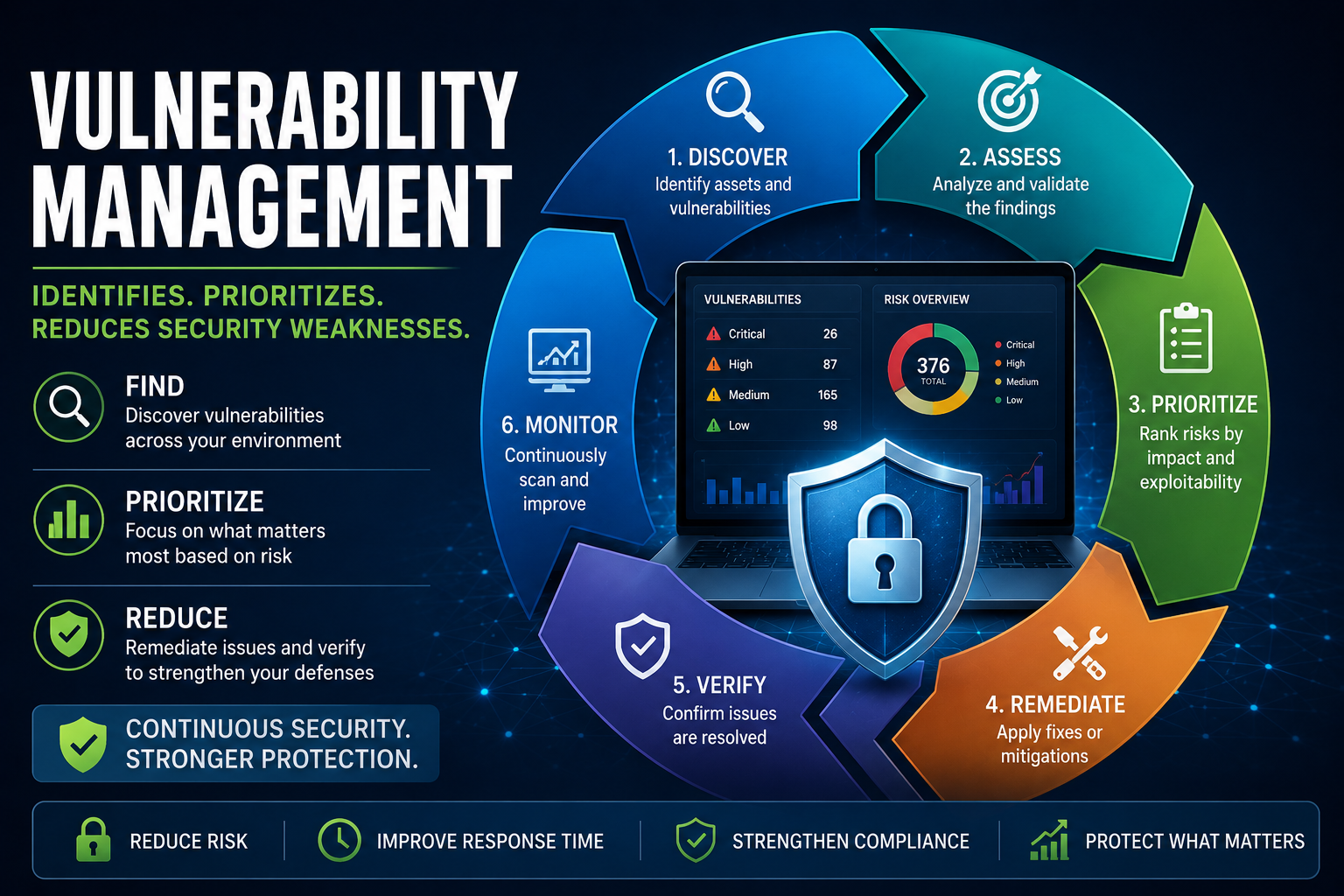
How Vulnerability Management Identifies, Prioritizes and Reduces Security Weaknesses
Cybersecurity teams face a difficult reality: no organization can completely eliminate security weaknesses.
Software changes constantly. New vulnerabilities are discovered every day. Employees add devices to networks, applications are updated, cloud environments expand and attackers continuously look for overlooked entry points.
The challenge is therefore not simply finding vulnerabilities. Organizations need to understand which weaknesses matter most, how exposed they are, what could happen if they are exploited and how quickly they should be addressed.
That is where vulnerability management comes in.
Vulnerability management is one of the important components of a broader business cybersecurity strategy. For a wider overview of how organizations protect systems, people, data and infrastructure, see The Ultimate Guide to Business Cybersecurity.
A mature vulnerability management program provides a continuous process for discovering security weaknesses, evaluating their risk, deciding what needs attention first and verifying that corrective measures actually worked.
What Is Vulnerability Management?
Vulnerability management is the ongoing process of identifying, assessing, prioritizing, remediating and monitoring security weaknesses across an organization’s technology environment.
Those weaknesses can exist in many places, including:
- Operating systems
- Applications
- Servers
- Network devices
- Cloud infrastructure
- Databases
- Endpoints
- Virtual machines
- Containers
- Web applications
- Internet-facing services
- Network configurations
- Identity and access systems
A vulnerability might be caused by outdated software, an insecure configuration, an exposed service, weak access controls or a flaw in an application.
The objective is not simply to produce a large list of vulnerabilities.
A useful program turns that list into actionable security decisions.
Why Finding Every Vulnerability Is Not Enough
A large organization can potentially discover thousands of vulnerabilities across its environment.
Trying to fix every vulnerability in exactly the same order would be inefficient.
A vulnerability affecting an isolated internal system may present considerably less immediate danger than a critical weakness on an internet-facing server containing sensitive information.
This creates a fundamental cybersecurity problem:
Which vulnerabilities should security teams address first?
Vulnerability management attempts to answer that question by combining technical severity with real-world context.
This risk-based approach fits into the broader security practices discussed in The Ultimate Guide to Business Cybersecurity, where vulnerability reduction forms part of a wider defense strategy rather than operating as an isolated security activity.
The Vulnerability Management Lifecycle
Although implementations differ between organizations, vulnerability management commonly follows a recurring cycle:
- Discover assets
- Identify vulnerabilities
- Assess and validate findings
- Prioritize risk
- Remediate weaknesses
- Verify the fixes
- Continuously monitor the environment
The process is designed to repeat.
A vulnerability that is fixed today may be replaced by another tomorrow. A new software update may introduce a configuration problem. An overlooked cloud asset may become publicly accessible.
Continuous monitoring is therefore essential.
Vulnerability management also connects closely with security operations. Security teams can use vulnerability information to understand which weaknesses may be targeted and where suspicious activity deserves greater attention. This is why vulnerability management works naturally alongside security operations teams and cybersecurity threat detection.
Step One: Discover What the Organization Owns
An organization cannot protect assets it does not know exist.
Asset discovery is therefore one of the foundations of vulnerability management.
Security teams need visibility into devices, applications, services and infrastructure operating within their environments.
An inventory might include:
- Employee laptops
- Desktop computers
- Servers
- Smartphones and tablets
- Routers and switches
- Firewalls
- Cloud resources
- Virtual machines
- Containers
- Databases
- Business applications
- Internet-facing systems
- Development environments
Asset inventories can become complicated as organizations adopt cloud computing, remote work and software-as-a-service platforms.
A system that was not present during the previous vulnerability scan may appear later, meaning asset discovery must be an ongoing activity rather than a one-time project.
Endpoint visibility is particularly important because employee computers and mobile devices can contain vulnerable software and provide potential entry points into organizational systems. A broader look at this layer is available in How Computer and Mobile Device Security Protects Endpoints.
Identifying Vulnerabilities
Once assets are understood, security teams can look for known and potential weaknesses.
Vulnerability scanners can examine systems for conditions associated with security problems.
Depending on the technology and scanning approach, tools may identify:
- Missing security updates
- Outdated software
- Known vulnerable versions
- Weak configurations
- Exposed services
- Insecure protocols
- Certificate problems
- Unnecessary open ports
- Default credentials
- Configuration errors
Vulnerability databases can help scanners determine whether a particular software version is associated with a publicly documented security issue.
However, automated scanning is not perfect.
A scanner may produce false positives, miss vulnerabilities or identify a technically vulnerable system that is not realistically exploitable in the organization’s environment.
That is why human analysis remains important.
Understanding CVEs and Vulnerability Severity
Many publicly disclosed software vulnerabilities receive a CVE, or Common Vulnerabilities and Exposures, identifier.
CVEs provide standardized references for known vulnerabilities.
Organizations also commonly use the Common Vulnerability Scoring System, or CVSS, to help evaluate technical severity.
CVSS considers characteristics such as:
- Attack complexity
- Required privileges
- User interaction
- Attack vector
- Confidentiality impact
- Integrity impact
- Availability impact
A high CVSS score can indicate that a vulnerability deserves significant attention.
But CVSS should not automatically determine the remediation order.
Technical severity is only one part of risk.
Why Context Changes Vulnerability Priority
Consider two vulnerabilities with identical technical severity.
One exists on a public-facing payment system.
The other exists on an isolated laboratory computer with no sensitive information and limited network access.
Treating both vulnerabilities as equally urgent would ignore important differences.
Security teams therefore consider additional factors such as:
- Is the asset exposed to the internet?
- What data does it contain?
- Is it business-critical?
- Can attackers reach it from other systems?
- Is exploitation known to be occurring?
- Is there a public exploit?
- How difficult would exploitation be?
- What security controls surround the system?
- How important is the system to business operations?
This approach moves vulnerability management away from simply asking, “How severe is this vulnerability?”
The better question is:
“How much risk does this vulnerability create in our environment?”
Exploitability Matters
Not every vulnerability is equally easy to exploit.
Some require an attacker to already have access to the network. Others can be exploited remotely without authentication.
Some attacks require a victim to click a link or open a malicious file. Others can be triggered automatically under the right conditions.
Understanding exploitability helps security teams distinguish between theoretical exposure and more immediate threats.
A vulnerability with moderate technical severity but a readily available exploit may deserve faster attention than a higher-scoring vulnerability that is extremely difficult to exploit.
Known Exploitation Can Change Everything
One of the strongest signals security teams can receive is evidence that attackers are actively exploiting a vulnerability.
When a vulnerability becomes part of real-world attacks, organizations may need to accelerate remediation significantly.
Security teams can monitor threat intelligence sources for information about active exploitation, exploit availability and campaigns targeting particular vulnerabilities.
This helps connect vulnerability management with the broader threat landscape.
The question is no longer simply whether a weakness could be exploited.
It becomes whether attackers are already attempting to exploit it.
Prioritization Turns Thousands of Findings Into a Work Plan
The purpose of prioritization is to turn vulnerability data into a manageable remediation queue.
Organizations may categorize vulnerabilities into levels such as:
- Critical
- High
- Medium
- Low
But mature programs often go further by incorporating asset importance, exposure, exploitability and business impact.
For example, a vulnerability might receive greater priority if it affects an internet-facing application that processes customer information.
A similar vulnerability on a disposable test machine might receive a lower priority.
This allows security teams to focus limited time and resources where they can reduce the greatest amount of risk.
Risk-Based Vulnerability Management
This broader approach is often described as risk-based vulnerability management.
Rather than treating every vulnerability as an isolated technical problem, organizations evaluate vulnerabilities within the context of their environment.
Risk-based prioritization can incorporate:
Technical severity + exploitability + exposure + asset importance + business impact
The exact formula varies between organizations.
The underlying principle is simple: cybersecurity resources should be directed toward the weaknesses most likely to produce meaningful harm.
Remediation Does Not Always Mean Patching
Patching is one of the most common ways to address software vulnerabilities, but it is not the only option.
Depending on the situation, organizations may:
- Upgrade software
- Replace vulnerable applications
- Disable unnecessary services
- Change configurations
- Restrict network access
- Apply compensating security controls
- Remove an exposed system
- Increase monitoring
- Isolate an asset
- Change access permissions
Sometimes a vendor patch is unavailable.
In those situations, temporary controls may reduce exposure until a permanent fix becomes possible.
For example, a vulnerable service might be restricted from public access while an organization waits for an appropriate software update.
Patch Management and Vulnerability Management Are Different
The two concepts are closely related but should not be treated as identical.
Patch management focuses on acquiring, testing, deploying and maintaining software updates.
Vulnerability management is broader.
It identifies weaknesses, evaluates their risk, determines appropriate responses and verifies that risk has actually been reduced.
A vulnerability might require a software patch, but another might be addressed through a configuration change or network restriction.
This distinction becomes particularly important in complex environments where not every vulnerability can be patched immediately.
Testing Before Deploying Fixes
Organizations cannot always install patches instantly.
Critical business systems may support essential operations, and an update could potentially introduce compatibility problems.
Security and IT teams may therefore test patches in controlled environments before deploying them widely.
The process can involve:
- Reviewing the vendor update.
- Testing it in a non-production environment.
- Checking critical applications.
- Monitoring for compatibility problems.
- Scheduling deployment.
- Applying the update.
- Verifying system functionality.
The goal is to reduce security risk without creating unnecessary operational disruption.
Verification Is a Critical Step
A vulnerability should not be considered permanently resolved simply because someone says a patch was installed.
Security teams need evidence.
Verification may involve rescanning the affected system, checking software versions, reviewing configurations or conducting additional security testing.
This matters because remediation attempts can fail.
A patch might not have installed correctly. A vulnerable component might remain on another system. A configuration change might not have been applied consistently.
Verification closes the loop between “we intended to fix it” and “the vulnerability is no longer present or exposed.”
Vulnerability Scanning Has Limitations
Automated vulnerability scanning is valuable, but it cannot provide complete security visibility.
Scanners can struggle with:
- Complex applications
- Custom software
- Authentication requirements
- Cloud environments
- Rapidly changing assets
- Previously unknown vulnerabilities
- Business context
- Sophisticated attack paths
This is why vulnerability management often works alongside other security practices, including penetration testing, configuration assessments, threat intelligence and security monitoring.
Each provides a different perspective.
The Importance of External Attack Surface Management
Organizations increasingly need to understand what attackers can see from the outside.
An internet-facing domain might expose unexpected services, forgotten subdomains, cloud resources or applications that security teams did not realize were publicly accessible.
External attack surface management helps identify these assets and assess their exposure.
This can be particularly important for organizations with large digital footprints.
A forgotten development server may not appear in an internal asset inventory, but an attacker searching the internet could still discover it.
Cloud Computing Changes the Equation
Cloud environments introduce new challenges for vulnerability management.
Traditional infrastructure might have relatively stable servers and networks.
Cloud environments can change rapidly.
New virtual machines, containers, storage resources and services can be created automatically. Infrastructure can also disappear or change configuration without following the same processes used in traditional data centers.
This creates a need for continuous visibility.
Security teams increasingly integrate vulnerability information with cloud asset inventories and configuration monitoring so that newly created resources can be assessed quickly.
Containers and Software Dependencies Create New Risks
Modern applications often rely on hundreds or thousands of software components.
A development team may build a service using open-source libraries, frameworks and packages maintained by other organizations.
If one of those dependencies contains a vulnerability, the application may inherit the associated risk.
This is why organizations increasingly monitor software composition and dependency security.
The challenge is not only identifying vulnerable packages.
Security teams also need to determine whether a vulnerable component is actually used in a way that creates meaningful exposure.
Vulnerability Management and Zero-Day Vulnerabilities
A particularly difficult challenge occurs when a vulnerability is unknown or has not yet received an official patch.
These vulnerabilities are often referred to as zero-days when attackers can exploit them before an effective fix is available.
Traditional vulnerability scanners may not detect every zero-day.
Organizations therefore rely on multiple layers of defense, including endpoint security, network monitoring, application security, threat intelligence, access controls and behavioral detection.
Once a vendor releases a fix, vulnerability management processes can help identify affected systems and prioritize remediation.
Automation Can Improve Response Times
The volume of vulnerability data can overwhelm security teams if everything depends on manual processes.
Automation can help connect discovery, prioritization and remediation.
For example, an organization might automatically:
- Discover new assets
- Scan systems
- Match software versions against vulnerability databases
- Assign risk scores
- Create remediation tickets
- Notify system owners
- Track deadlines
- Trigger patching workflows
- Verify remediation
Automation does not eliminate the need for human judgment.
Instead, it allows security professionals to spend more time analyzing complex risks rather than manually processing repetitive tasks.
Security Teams Need Clear Remediation Ownership
A vulnerability scanner can identify a problem, but security teams are not always the people responsible for fixing it.
A vulnerability might exist in a server managed by an infrastructure team, an application owned by developers or a cloud service controlled by another department.
Successful programs therefore establish clear ownership.
Every important vulnerability should ideally have someone responsible for determining how and when it will be addressed.
Without ownership, vulnerability reports can become lists of unresolved technical problems that continue growing over time.
Setting Remediation Deadlines
Organizations can establish service-level expectations for addressing vulnerabilities based on their severity and risk.
For example, a company might require critical vulnerabilities with active exploitation to be addressed within a much shorter period than low-risk findings.
These deadlines should be realistic and aligned with business operations.
The purpose is not to create arbitrary administrative targets.
The purpose is to make sure serious security weaknesses do not remain indefinitely unresolved.
Metrics Can Show Whether the Program Works
Security leaders need to know whether vulnerability management is actually reducing risk.
Useful metrics can include:
- Number of critical vulnerabilities
- Average remediation time
- Percentage of vulnerabilities fixed within policy
- Number of internet-facing vulnerabilities
- Vulnerability recurrence rates
- Age of unresolved vulnerabilities
- Percentage of assets covered by scanning
- Number of vulnerabilities actively exploited
- Remediation backlog
Metrics become more useful when they demonstrate trends rather than simply presenting large numbers.
A declining remediation time and shrinking backlog may indicate that processes are improving.
Conversely, a growing number of long-standing critical vulnerabilities could signal that the organization needs more resources or better remediation processes.
Vulnerability Management Is a Continuous Process
Technology environments never remain static.
New applications are deployed. Employees receive new devices. Vendors release updates. Attackers discover new techniques. Previously unknown vulnerabilities become public.
That means vulnerability management cannot be treated as an annual security audit.
A system that was secure last month may have a newly discovered vulnerability today.
Continuous discovery, prioritization, remediation and verification provide a more realistic approach to managing this changing environment.
Vulnerability management should also connect with incident response. If attackers exploit a vulnerability before it is fixed, the organization needs a structured process for containing the compromise, investigating what happened and restoring affected systems. Learn more in How Incident Response Handles Cybersecurity Events.
Turning Vulnerability Data Into Lower Risk
The real value of vulnerability management is not the number of vulnerabilities an organization can find.
It is the organization’s ability to reduce meaningful security exposure.
A mature program begins with visibility. It identifies the systems that matter, discovers weaknesses, evaluates their technical and business context, prioritizes the most dangerous exposures and assigns them to people who can take action.
It then verifies that those actions actually worked.
That cycle turns vulnerability management from a collection of scanning reports into an active risk-reduction strategy.
For organizations facing increasingly complex technology environments, the goal is not to promise that every vulnerability will disappear. That is rarely realistic.
The goal is to make sure that the weaknesses most likely to harm the organization are discovered quickly, understood accurately and addressed before attackers can turn them into security incidents.
Ultimately, vulnerability management is one part of a much larger business cybersecurity framework. Organizations need to understand how vulnerabilities, endpoints, security monitoring, identity, incident response and other controls work together. For that broader framework, return to The Ultimate Guide to Business Cybersecurity.