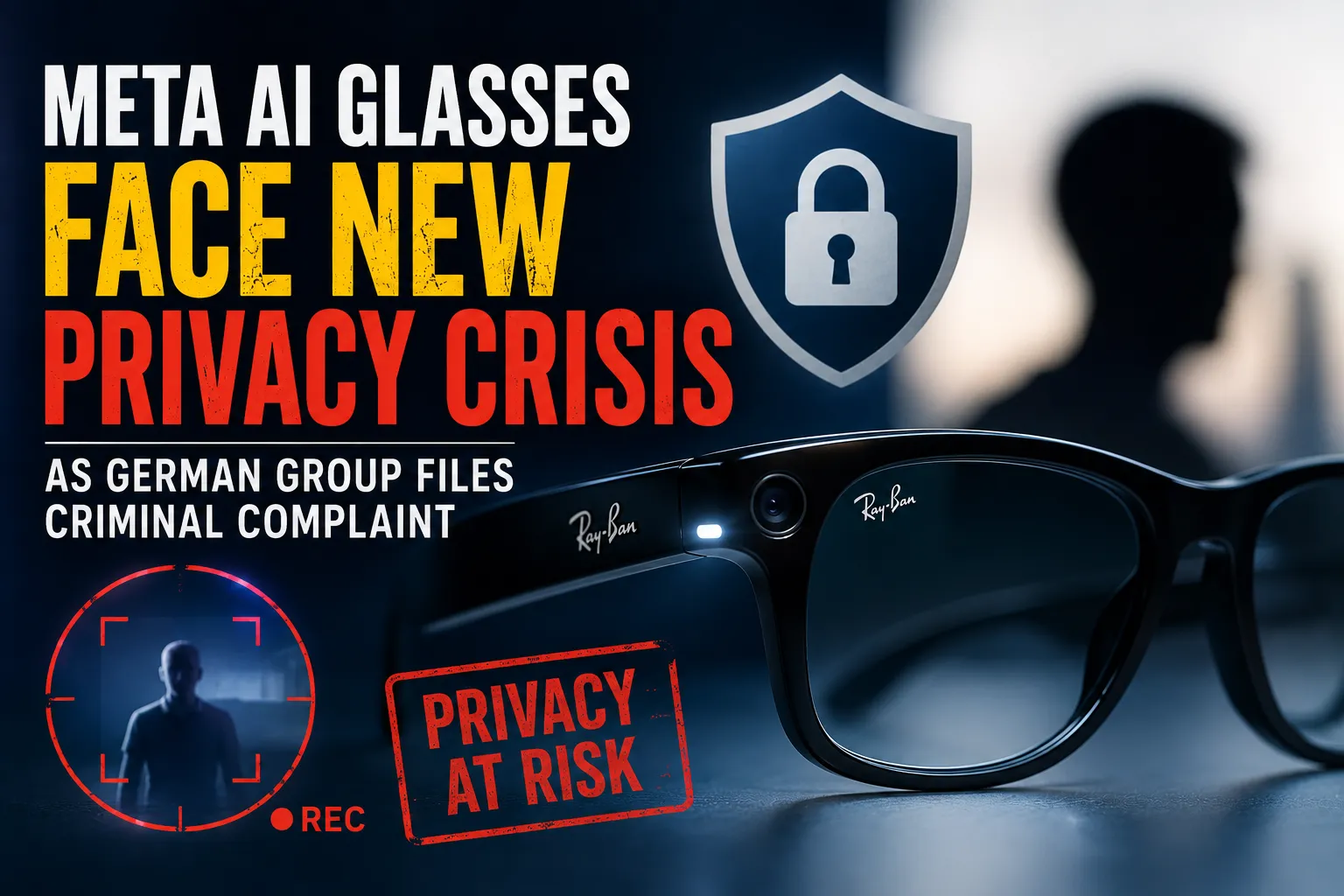
Meta AI Glasses Face New Privacy Crisis as German Group Files Criminal Complaint
Meta’s push to turn ordinary-looking eyewear into an always-available AI assistant is facing a fresh privacy challenge in Germany.
Digital rights organization HateAid has filed a criminal complaint against Meta and several companies involved in selling its AI-enabled smart glasses in Germany, arguing that the devices could violate German privacy rules by making it possible to record people without their knowledge. The complaint specifically focuses on the Ray-Ban Meta Wayfarer and names Meta, eyewear maker EssilorLuxottica and several German retailers.
The case comes at a particularly sensitive moment for Meta’s wearable ambitions. The company has been aggressively expanding its AI glasses lineup and says millions of people now use its glasses for hands-free photography, video, music and AI assistance. Meta also recently launched a new line of Meta Glasses with EssilorLuxottica, starting at $299.
The German complaint highlights a difficult question for the entire smart-glasses industry: Can a camera hidden inside an ordinary-looking pair of glasses ever provide enough transparency for people nearby to know when they are being recorded?
What Is Behind the German Complaint?
HateAid, a German organization focused on digital rights and online violence, submitted the complaint to Frankfurt’s digital crime prosecution unit, known as ZIT.
The organization argues that Meta’s glasses create a particular privacy risk because their cameras can be used while the wearer appears to be doing something completely ordinary.
The complaint names Meta, EssilorLuxottica and retailers including Fielmann, Apollo-Optik, Mister Spex and MediaMarkt. ZIT confirmed that it had received the complaint and said it would conduct a preliminary assessment to determine whether there are grounds for a deeper investigation. ()
This is an allegation, not a finding of criminal wrongdoing. The complaint itself does not establish that Meta or the named companies have violated German law.
That distinction is important as the legal process develops.
Why Germany Is Taking the Issue Seriously
Germany has particularly strong rules concerning devices that can be used for covert recording.
The country’s Federal Network Agency, the Bundesnetzagentur, has previously warned that networked devices capable of secretly recording audio or video can be prohibited. Its guidance says particular caution is needed with products that look like ordinary objects but can transmit recordings without the people being recorded knowing about it.
The agency has historically investigated products such as hidden cameras, microphones and even glasses equipped with cameras or microphones capable of transmitting information.
However, the legal question surrounding modern AI glasses is more complicated than simply asking whether they contain a camera.
The Bundesnetzagentur told that smart glasses are not automatically banned in Germany. The agency said ownership, import and sale can be permitted when the recording function is clearly visible—for example, through an optical signal. It also said it was monitoring the smart-glasses market but was not formally investigating violations at that point. ()
That visible signal is at the heart of the debate.
Meta’s Defense: The Recording Light
Meta has anticipated concerns about people being recorded without realizing it.
Its current AI glasses include a white capture LED on the front of the frame. Meta says the light blinks whenever content is being captured for the wearer’s gallery. For photographs, the light flashes briefly; for video, it continues blinking during recording.
Meta says the LED cannot simply be switched off.
More importantly, the company says newer generations of its glasses are designed to disable the camera if the system detects that the capture LED has been covered or physically tampered with. Meta has also said it is taking action against services and listings that promote methods for disabling or destroying the indicator.
From Meta’s perspective, these measures are intended to create a visible distinction between AI glasses and conventional eyewear.
But privacy advocates argue that the existence of an indicator does not necessarily mean people will notice it.
The Problem With a Tiny Light
A smartphone camera is generally obvious.
Someone holding a phone at eye level and pointing it toward another person is easy to notice.
Smart glasses are different.
The camera is built into the frame, and the wearer can look around naturally without obviously pointing a recording device at anyone.
The glasses can therefore change the social dynamics of recording.
A person sitting across from you at a restaurant, walking past you on the street or standing beside you on public transport could potentially capture images without making the action as obvious as it would be with a smartphone.
Meta’s blinking LED is designed to address that problem. But critics question whether a small light on the side of a pair of glasses provides meaningful consent for everyone who might appear in the camera’s field of view.
That is the larger issue Germany’s complaint could force regulators and courts to examine.
AI Makes the Privacy Question Bigger
Traditional cameras already raise privacy concerns.
AI cameras introduce another layer.
The glasses are not simply capable of recording. They can also use AI to understand what the wearer is seeing and respond to questions about the surrounding environment.
Meta markets its AI glasses as hands-free assistants that can help users understand what is around them, access information, communicate and capture content. The company has also emphasized their accessibility applications, including helping blind and low-vision users navigate and understand their surroundings.
That creates significant potential benefits.
It also means the technology is designed to look at and interpret the physical world.
A conventional camera captures an image.
An AI-enabled wearable can potentially analyze what that image contains.
That difference matters when the scene includes strangers, documents, computer screens, conversations, children or other sensitive information.
The Privacy Debate Goes Beyond Germany
Germany is not the only place where smart glasses are facing scrutiny.
Concerns over recording and surveillance have been appearing in different countries and settings as AI glasses become more widespread.
In England and Wales, courts have moved to prohibit Meta smart glasses from court buildings, with the devices subject to confiscation at entry because of concerns about unauthorized recording.
The controversy is also being driven by real-world incidents involving people who say they were recorded without their knowledge.
As smart glasses become more common, restaurants, workplaces, gyms, schools, courts and other private or sensitive environments are having to decide whether ordinary rules governing cameras are sufficient for wearable AI devices.
Why Smart Glasses Are Different From Smartphones
The distinction between smartphones and smart glasses is important.
A smartphone is usually removed from a pocket or bag before someone deliberately records.
Smart glasses can remain on the user’s face throughout the day.
That creates what privacy researchers sometimes describe as an ambient recording problem.
The wearer does not necessarily have to make a conscious decision to pull out a camera every time they want information. The device is already there.
Meta’s newer glasses are designed around this hands-free concept. The company describes glasses as an ideal platform for an all-day AI assistant that understands the world from the user’s perspective.
That is precisely what makes them useful.
It is also what makes privacy regulation difficult.
The Accessibility Benefits Are Real
The privacy debate should not obscure why people are interested in these devices in the first place.
AI glasses can offer genuine benefits, particularly for people with disabilities.
Meta has highlighted examples of blind and low-vision users using its glasses to identify objects, read menus, navigate airports and better understand their surroundings. Its partnership with Be My Eyes also allows some users to connect with visual assistance through the glasses.
For someone who cannot easily use a smartphone while walking through an unfamiliar environment, hands-free visual assistance can be transformative.
The same technology that makes privacy advocates uncomfortable can also make everyday tasks substantially easier for someone with limited vision or mobility.
That makes an outright rejection of the technology more complicated.
The challenge is to preserve these benefits without normalizing invisible surveillance.
The Risk of Image-Based Abuse
HateAid’s complaint also comes against the backdrop of growing concerns about image-based digital violence.
The organization says it has increasingly registered cases involving image-based abuse, particularly affecting women, and argues that smart glasses could make surveillance easier to disguise as an ordinary everyday object.
This is one of the most difficult aspects of the debate.
Technology does not have to be designed for abuse to become useful to people who want to misuse it.
A camera designed for travel memories can be used for harassment.
A microphone designed for hands-free calls can be used to record conversations.
An AI assistant designed to understand surroundings can potentially process information the people nearby never intended to share.
The industry therefore has to think about misuse at the design stage rather than treating it solely as a user-behavior problem.
The Data Question Is Just as Important
There is another privacy issue beyond whether someone notices the camera.
It concerns what happens to captured information after it is recorded.
Meta says photos and videos captured for a user’s gallery are stored privately on the glasses until the user chooses to import them to a phone. The company says users control whether they subsequently share that content or use it with Meta AI.
However, AI features can involve processing information from the user’s surroundings.
That raises broader questions about data retention, cloud processing, AI training, third-party access and how long information remains available.
These questions are not unique to Meta. They apply to any company developing wearable devices that continuously interact with cameras, microphones and AI systems.
As the technology becomes more capable, privacy policies will need to become understandable enough for ordinary consumers to make informed decisions.
Could Germany Force Changes to AI Glasses?
The immediate outcome of the complaint is uncertain.
ZIT has acknowledged receiving the complaint and is conducting a preliminary assessment. The process could lead to further investigation, but there is no guarantee that it will result in criminal charges or restrictions on the products.
Still, the case could have significance beyond Germany.
If regulators determine that existing privacy rules do not adequately address AI glasses, lawmakers may face pressure to clarify what constitutes sufficiently visible recording technology.
That could affect manufacturers across Europe.
It could also influence how future wearable devices are designed.
What Manufacturers May Need to Change
The controversy suggests that a tiny recording light may not be enough for the next generation of wearable AI.
Manufacturers could eventually need to consider stronger privacy signals, clearer user controls and more visible indicators that distinguish AI-enabled devices from ordinary glasses.
Possible approaches could include:
- More prominent recording indicators
- Clearer audio or visual warnings
- Stronger restrictions in sensitive environments
- Better controls for bystanders
- Automatic privacy modes in certain locations
- Improved transparency about AI processing
- More aggressive anti-tampering systems
- Clearer rules for third-party applications
The challenge is making these protections practical.
A privacy feature that is technically present but almost impossible for an ordinary person to notice may have limited real-world value.
The Industry Is Moving Faster Than Social Norms
One reason smart glasses are generating so much debate is that technology has advanced faster than social expectations.
People understand the social meaning of someone holding up a phone.
They are still learning what it means when someone walks into a room wearing glasses that contain cameras, microphones and an AI assistant.
Should you ask whether they are recording?
Should businesses ban them?
Should users remove them during private conversations?
Should schools or hospitals create specific rules?
Should a person be allowed to wear them everywhere a smartphone is permitted?
There are no universally accepted answers yet.
That uncertainty is itself a sign that society is still adapting.
The Bigger Question: Who Gets to Control the Camera?
The German complaint ultimately raises a question that goes beyond one product.
When a camera becomes part of something people wear all day, who gets to decide when it is appropriate to record?
The wearer may believe the recording is harmless.
The person being recorded may strongly disagree.
The law has traditionally dealt with cameras as objects people can see and recognize. AI glasses challenge that assumption by making cameras smaller, more integrated and increasingly capable of interpreting what they capture.
Meta is clearly aware of the problem. Its investment in capture indicators, tamper detection and privacy messaging shows that the company knows public trust is essential to the success of wearable AI.
But technology companies cannot answer every privacy question through product design alone.
Regulators, businesses, schools, courts and ordinary users will all have to establish new norms.
What the German Case Could Mean for Consumers
For consumers, the immediate lesson is not that every person wearing AI glasses is secretly recording people.
It is that wearable AI requires a new level of awareness.
Anyone considering these devices should understand exactly when cameras and microphones operate, what the recording indicators mean, what information is processed locally or remotely and how the device handles captured data.
People around users of these devices also have legitimate reasons to ask questions, particularly in private or sensitive environments.
And businesses may increasingly decide to establish their own rules.
The emerging debate is therefore less about whether AI glasses should exist and more about where, when and under what conditions they should be used.
A Privacy Test for the Wearable AI Era
Meta’s AI glasses represent an important step in consumer technology because they bring AI closer to the physical world.
They can help users communicate, capture memories, access information and, in some cases, navigate their surroundings more independently. Meta says millions of people already use its AI glasses, while its newest products are expanding the category further.
But the German criminal complaint demonstrates the uncomfortable side of that progress.
The more invisible technology becomes, the more important visible trust mechanisms become.
A smartphone makes its camera obvious. Smart glasses make the camera part of the person.
That may ultimately be the industry’s biggest privacy challenge: not convincing people that AI glasses are useful, but convincing everyone around the wearer that they remain in control of their own privacy.
The outcome of the German case could help determine where that line is drawn.