Meta Smart Glasses Face New Privacy Backlash After Courts Ban Them in England and Wales
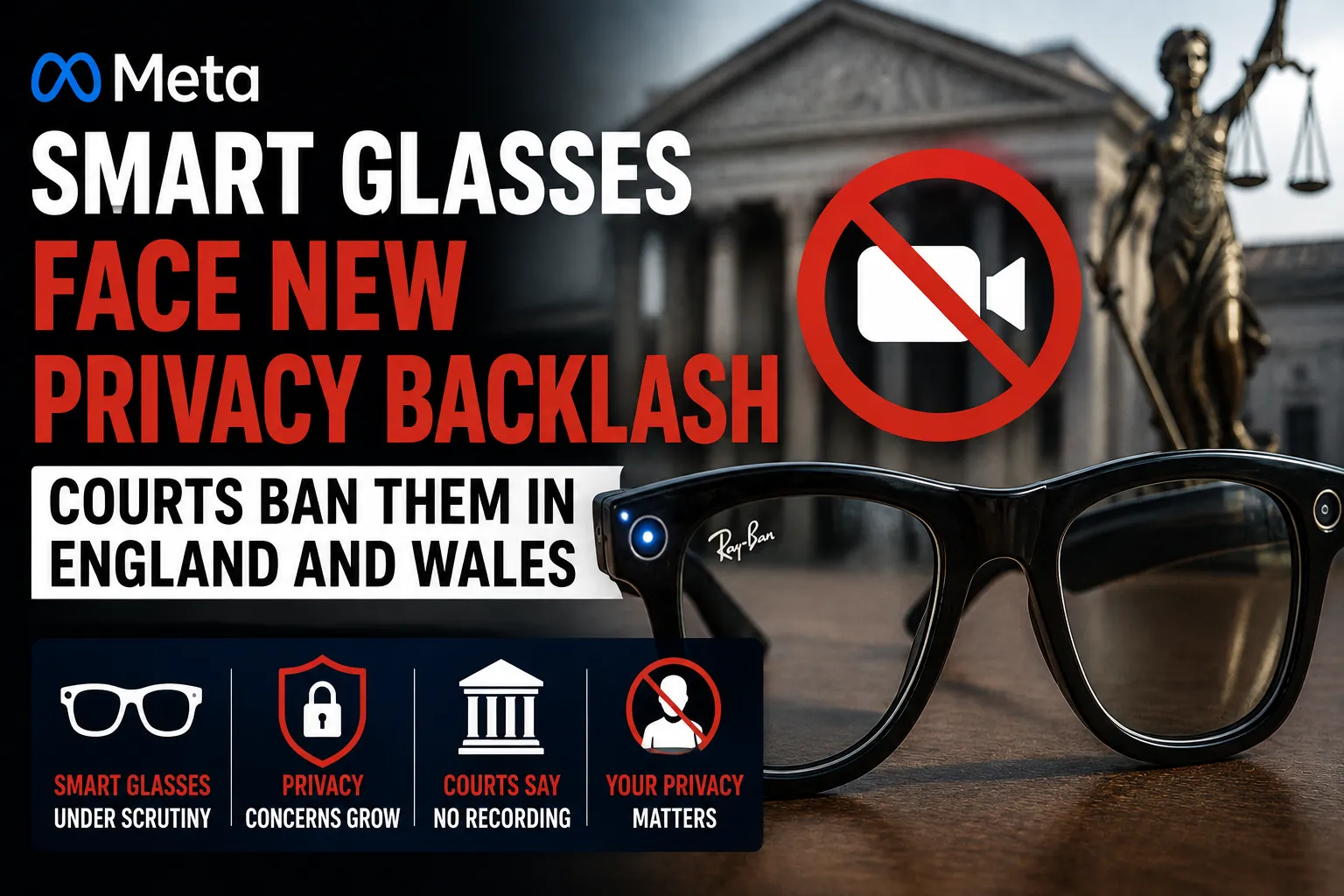
Meta’s smart glasses are facing renewed scrutiny after His Majesty’s Courts and Tribunals Service (HMCTS) confirmed that Meta’s camera-equipped glasses are prohibited inside courts and tribunals in England and Wales.
The decision comes as smart glasses become increasingly popular and capable. The devices can take photos and video, make calls, play audio and interact with Meta AI, but their discreet camera design has raised concerns about whether people nearby can reliably know when they are being recorded.
The court restrictions highlight a much larger question for consumer technology: how should society balance the convenience of wearable AI with people’s right not to be recorded without their knowledge?
Why Meta Smart Glasses Are Being Restricted in Courts
The immediate issue is straightforward.
HMCTS has confirmed that Meta smart glasses are prohibited in its court and tribunal buildings because there are already clear restrictions on taking images and videos within courts. According to reporting on the decision, the glasses can be confiscated when people enter court buildings and returned when they leave.
The restriction applies to the device, rather than representing a general ban on Meta smart glasses across England and Wales.
That distinction matters.
People can still legally own and use smart glasses in many ordinary circumstances. The UK government said in June that it had no current plans to introduce specific legislation banning camera-enabled smart glasses from public spaces, noting that existing offences can apply to harmful recording and that it would continue monitoring the issue.
Courts are different because recording proceedings is subject to specific restrictions designed to protect the integrity and privacy of judicial proceedings.
What Makes Smart Glasses Different From a Phone?
At first glance, the privacy concerns surrounding smart glasses may seem similar to those involving smartphones.
Both can contain cameras.
Both can record video.
Both can potentially upload content to the internet.
But smart glasses introduce an important difference: the camera is integrated into something that looks like ordinary eyewear.
A person wearing glasses can potentially look directly at another individual without appearing to hold a recording device.
That changes the social dynamics of recording.
With a smartphone, people can generally see the device being raised and pointed toward them. With glasses, the distinction between normal behavior and recording can be considerably less obvious.
That is one reason privacy concerns have followed Meta’s glasses as adoption has increased.
Meta Says Its Glasses Have Built-In Privacy Safeguards
Meta has defended the design of its AI glasses by pointing to a dedicated capture indicator.
The company says every pair of its AI glasses has a white capture LED that flashes when the device is capturing photos or video for the wearer’s gallery. For video, the light continues blinking while recording. Meta says the light cannot be switched off.
Meta also says the camera is designed to disable itself if the capture light is covered or otherwise blocked.
For second-generation glasses, the company says the system can detect attempts to physically tamper with or destroy the LED and disable the camera in response.
The company’s argument is essentially that people should be able to recognize when the glasses are actively recording.
But critics argue that the existence of a privacy light does not necessarily mean everyone nearby will notice or understand it.
The Privacy Debate Goes Beyond the LED
The controversy is not simply about whether the recording light works.
It is about whether people’s expectations of privacy can keep up with wearable technology.
Imagine someone sitting in a café, attending a meeting or walking through a crowded public space.
A person wearing smart glasses could potentially take photographs or record video without physically reaching for a phone.
Even if a recording indicator is technically visible, a person being filmed may never notice it.
That creates a gap between:
“The device provides an indication that recording is taking place.”
and:
“The person being recorded actually knows that they are being recorded.”
Those are not necessarily the same thing.
A Court Case Has Already Raised Questions About Smart Glasses
The debate has become particularly sensitive because of concerns about their use during legal proceedings.
Earlier in 2026, a claimant involved in a High Court case was accused of receiving coaching through smart glasses while giving evidence. The claimant denied the allegation.
Regardless of the outcome of that particular allegation, the incident illustrates why courts may take a conservative approach toward wearable recording technology.
Courtrooms require participants to follow strict procedures.
Unauthorized recording can interfere with the administration of justice, expose sensitive information and potentially affect witnesses or other participants.
A device capable of recording or providing AI assistance while appearing to be an ordinary pair of glasses introduces another layer of complexity.
Why Courts Are Especially Sensitive to Recording Technology
Courts in England and Wales are generally open to the public, reflecting the principle of open justice. However, being permitted to attend a hearing does not mean a visitor can freely record whatever happens inside.
HMCTS guidance explains that court hearings are generally public but also sets out restrictions concerning what people can and cannot do.
This creates an important distinction:
Public access does not equal unrestricted recording.
The same principle applies to many other environments.
A person may be allowed to enter a location while still being prohibited from making recordings, photographing certain people or using specific equipment.
Smart glasses make enforcement more complicated because the recording hardware is built into a device that can be worn continuously.
Smart Glasses Are Becoming More Than Cameras
The privacy debate is becoming more important because modern smart glasses are no longer simply wearable cameras.
Meta’s AI glasses can be used for:
- Taking photos
- Recording video
- Making phone calls
- Listening to music
- Sending messages
- Interacting with Meta AI
- Translating speech
- Receiving information hands-free
- Identifying objects and surroundings
Meta has also highlighted accessibility applications, including helping blind and low-vision users identify objects, read information and navigate their surroundings.
This makes blanket restrictions more complicated.
For some users, the technology is primarily entertainment.
For others, it can function as an assistive device.
That difference is important when policymakers consider where and how smart glasses should be restricted.
The Accessibility Argument
Smart glasses are not simply a privacy story.
They can provide genuine benefits.
Meta has promoted its AI glasses as accessibility tools for people who are blind or have low vision. The company says users can use them to identify surroundings, read labels and navigate unfamiliar environments while keeping their hands free.
The company has also described programs designed to provide AI glasses to blind veterans in the United States.
For these users, the camera and AI capabilities can have practical value that goes far beyond taking pictures.
That creates a difficult policy question:
How do regulators protect bystanders without unnecessarily restricting people who rely on wearable AI for accessibility?
The UK Has Not Announced a General Smart Glasses Ban
The court restriction should not be interpreted as evidence that the UK has banned Meta smart glasses generally.
In a June 2026 parliamentary response, the UK government said it had no current plans for specific legislation governing the use of camera-enabled smart glasses for filming in public spaces. It pointed to existing criminal offences covering certain harmful conduct, including harassment, stalking and voyeurism, while also noting protections under the UK GDPR and Online Safety Act.
That means the current approach is closer to:
existing laws + location-specific restrictions + continued monitoring
rather than a nationwide prohibition.
Privacy Concerns Are Growing Alongside Sales
Meta says its AI glasses have sold millions of units.
In a July 2026 explanation of the technology, Meta described its AI glasses as one of the fastest-growing consumer products in its history and said millions of people use them daily.
The company’s expansion also continues internationally.
Meta announced that its second-generation Ray-Ban Meta glasses and Oakley Meta glasses were launching in Japan in 2026, describing the products as part of a broader expansion of AI-powered wearable technology.
More users means more real-world encounters between people who own the devices and people who do not.
That is where the privacy debate becomes harder to ignore.
Smart Glasses Are Already Facing Restrictions Elsewhere
The concerns are not limited to England and Wales.
New York courts have reportedly introduced similar restrictions, while other organizations and venues have also moved to restrict camera-equipped smart glasses in privacy-sensitive environments.
Some restrictions are aimed at preventing:
- Unauthorized recording
- Cheating
- Confidential information being captured
- Disruption of proceedings
- Privacy violations
This suggests that smart glasses may increasingly be treated differently depending on where they are used, rather than simply being classified as ordinary consumer electronics.
Why Smart Glasses Could Be Difficult to Regulate
Traditional cameras are relatively easy to identify.
A smartphone is visibly a smartphone.
A professional camera is usually obvious.
Smart glasses are different.
As wearable technology becomes smaller and more fashionable, distinguishing between:
ordinary eyewear
and
a connected recording device
may become increasingly difficult.
That raises questions about how venues should enforce no-recording policies.
Should they:
- Ban all camera-equipped glasses?
- Require devices to be placed in secure storage?
- Require visible identification?
- Create technology-based detection systems?
- Rely on existing privacy laws?
- Allow them except during sensitive activities?
There is no universally accepted answer yet.
The Problem With Treating Smart Glasses Like Smartphones
One possible response is to say that smart glasses should simply be governed under the same rules as smartphones.
But there is a practical difference.
A smartphone user normally has to perform a deliberate physical action to record: taking the phone out, opening the camera and pointing it.
Smart glasses can potentially be operated hands-free.
That makes them particularly useful—but also potentially more discreet.
The more invisible the technology becomes, the harder it becomes for social norms developed around traditional cameras to apply.
Meta’s Privacy Controls Are Becoming More Important
Meta appears to recognize that privacy concerns could affect the long-term acceptance of wearable AI.
The company has publicly emphasized the capture LED and other safeguards.
It has also updated its technology to make attempts to circumvent the recording indicator harder. Meta says newer devices can disable the camera when tampering with the capture LED is detected.
These features are important because trust could become one of the biggest barriers to widespread adoption.
Consumers may enjoy the convenience of AI glasses, but people around them also need confidence that they are not being secretly recorded.
The Privacy Debate Could Shape the Next Generation of Wearables
The controversy is bigger than Meta.
Apple, Google, Samsung, Snap and other technology companies have all explored different forms of wearable computing, while startups continue experimenting with AI-powered glasses and other devices.
If smart glasses become a major consumer category, privacy safeguards could become an industry standard rather than a company-specific feature.
Future devices could potentially include:
- More visible recording indicators
- Stronger anti-tampering systems
- Automatic restrictions in sensitive locations
- Improved notification systems
- Better controls for bystanders
- Privacy-preserving AI processing
- Clearer recording status indicators
The challenge will be making those protections effective without destroying the convenience that makes wearable AI attractive in the first place.
What Smart Glasses Mean for Everyday Privacy
The bigger cultural question is whether society is comfortable with always-available cameras.
People have already adapted to smartphones, security cameras, doorbells and body cameras.
Smart glasses introduce another category: technology that can accompany a person throughout almost every part of the day.
That creates new questions.
Should someone ask permission before recording a conversation?
What happens when a person unknowingly appears in an AI-generated video?
Can someone record inside a workplace?
What about schools, hospitals, gyms or restaurants?
And who is responsible when recorded material is uploaded online?
The answers may differ depending on the location and circumstances, but the questions are becoming increasingly difficult to ignore.
What Users Should Know Before Wearing Meta Smart Glasses
Anyone using camera-equipped smart glasses should understand that having the technical ability to record does not mean recording is appropriate or lawful in every situation.
Before recording, users should consider:
- Whether recording is permitted in the location
- Whether other people have a reasonable expectation of privacy
- Whether consent is appropriate
- Whether the recording could expose sensitive information
- Whether the content could cause harm if shared
- Whether the venue has its own restrictions
Users should also understand the device’s recording indicators and privacy controls.
The safest approach is to treat smart glasses with the same respect for privacy expected from any other recording device—and to be particularly cautious in sensitive environments.
What Happens Next for Meta Smart Glasses?
The court restrictions in England and Wales are unlikely to end the smart-glasses debate.
If anything, they may accelerate it.
As more people adopt AI glasses, regulators, businesses and consumers will have to determine where the technology fits within existing rules.
The UK government’s current position suggests that it is not pursuing a blanket public-space ban, instead relying on existing legal protections while monitoring developments.
At the same time, individual institutions can impose stricter rules where privacy, security or the integrity of proceedings demands it.
That could lead to a future where smart glasses are perfectly acceptable in one environment but prohibited in another.
The Bigger Question Is Trust
The controversy surrounding Meta’s smart glasses is ultimately about more than whether a tiny white light is bright enough.
It is about trust.
Wearable AI promises to make technology less intrusive for the person wearing it: no phone to hold, no screen to stare at and no device to take out for every task.
But making technology less visible to its user can make it more difficult for everyone else to understand what the device is doing.
That tension will become increasingly important as AI moves from smartphones and computers into everyday objects.
For Meta, the court restrictions in England and Wales are a reminder that technological capability is only one part of successful consumer adoption. If smart glasses are going to become as ordinary as smartphones, the industry will need to convince not only the people wearing them, but also everyone around them, that privacy has not been left behind.