Sony Xperia 10 VIII Launch Brings a New Midrange Smartphone Into Focus
Sony is preparing to put another Xperia smartphone in the spotlight, with the Xperia 10 VIII expected to make its debut as the company’s next midrange handset.
The timing is significant. Sony has already introduced its premium Xperia 1 VIII this year, and the new Xperia 10 model would extend the company’s 2026 smartphone lineup into a more accessible segment.
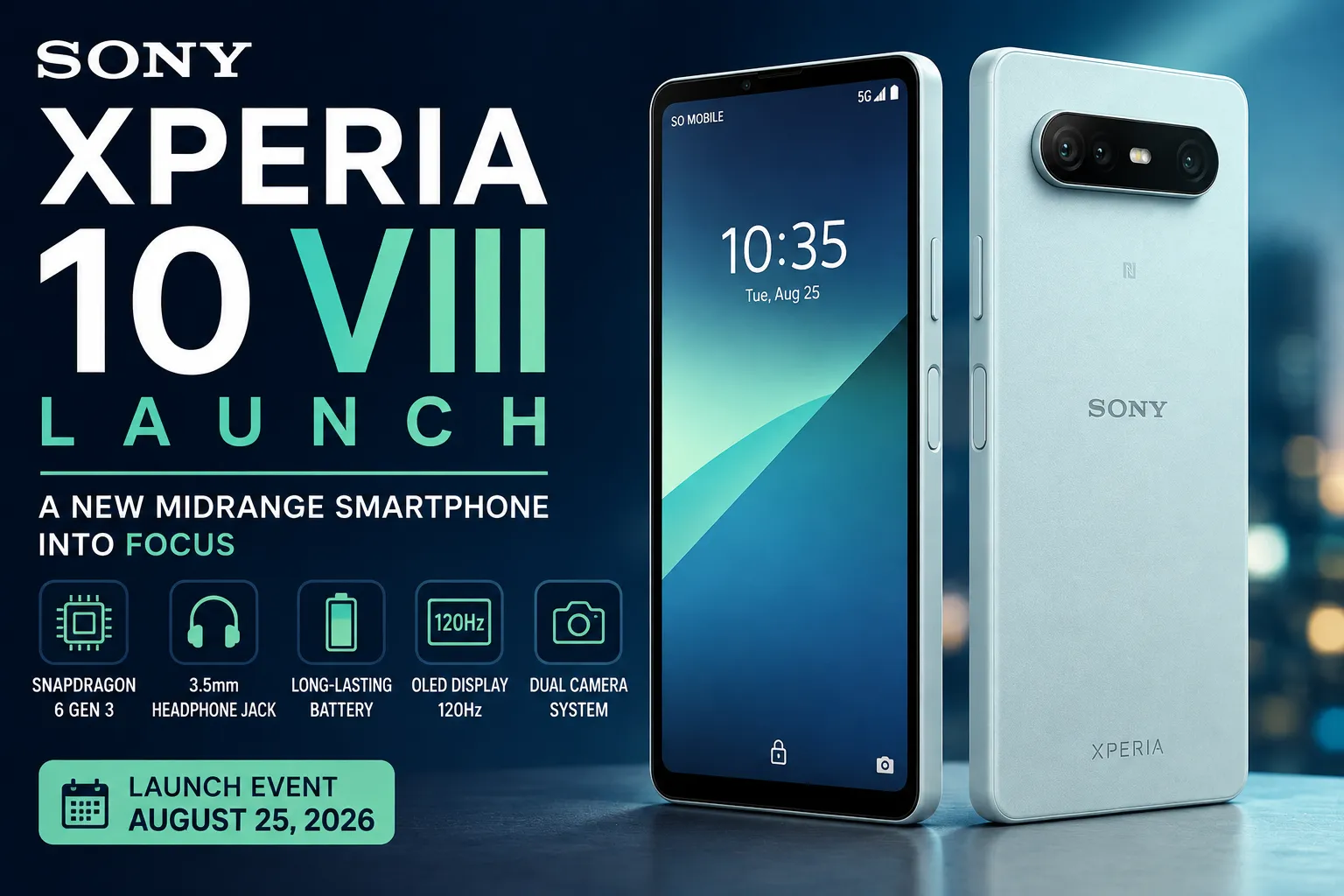
Sony has scheduled a new Xperia product announcement for August 25, 2026, at 11 a.m. Japan Standard Time. The company has not officially named the device in its announcement, but recent regulatory filings, benchmark results and leaks strongly point toward the Xperia 10 VIII. (Android Authority)
That means some of the most important details—including the official price, release markets and final specifications—are still expected to be confirmed at the launch.
Sony Is Keeping the New Xperia Under Wraps
Unlike many smartphone launches, Sony has provided relatively little information about the upcoming device.
The company has confirmed that a new Xperia product is coming, but it has not publicly detailed the phone’s specifications or pricing. That has left much of the pre-launch picture to regulatory databases, benchmark listings and leaked images.
The evidence is nevertheless becoming increasingly difficult to ignore.
The Xperia 10 VIII has appeared in an FCC filing, while a Geekbench listing has reportedly identified the device as model XQ-GH54. Recent leaks have also provided an early look at its exterior design. (Android Authority)
Until Sony takes the stage, however, leaked specifications should be treated as indications rather than confirmed facts.
A Familiar Xperia Design Appears to Be Returning
Leaked images suggest Sony is taking a relatively conservative approach to the Xperia 10 VIII’s design.
The handset appears to retain a flat-sided body and a horizontal rear camera bar, giving it a close visual relationship with the Xperia 10 VII. The leaked device has also been shown in a light mint-like finish. (SoyaCincau)
The approach is notably different from the more dramatic redesign Sony introduced with the flagship Xperia 1 VIII.
That could be intentional.
The Xperia 10 line has traditionally occupied a more affordable position within Sony’s smartphone portfolio, meaning the company may be prioritizing familiarity, practicality and manufacturing efficiency rather than introducing an expensive visual overhaul.
For existing Xperia users, that could be a positive.
For consumers looking for a visibly different phone, however, the lack of major exterior changes could make the new model feel less exciting.
The Snapdragon 6 Gen 3 Is the Biggest Question Mark
One of the most closely watched details is the processor.
A Geekbench listing attributed to the Xperia 10 VIII points to Qualcomm’s Snapdragon 6 Gen 3, paired with 8GB of RAM. The reported benchmark scores are 871 in single-core performance and 3,028 in multi-core performance. (Gizmochina)
The bigger story is that the same Snapdragon 6 Gen 3 platform was used by the Xperia 10 VII.
That means Sony may be choosing not to make a major generational performance leap with this model.
For everyday tasks such as messaging, web browsing, streaming, photography and social media, the existing platform may still provide adequate performance. The larger question is whether competitors will offer newer processors at similar prices.
Processor performance has become an increasingly important differentiator in the midrange smartphone market, where manufacturers compete aggressively on speed, battery efficiency and long-term software support.
Sony will therefore need to show that the Xperia 10 VIII offers enough value elsewhere.
8GB of RAM Could Keep Multitasking Comfortable
The reported 8GB RAM configuration would give the Xperia 10 VIII a solid foundation for everyday multitasking.
Modern Android applications can consume significant amounts of memory, particularly when users switch between browsers, social networks, streaming services, messaging apps and games.
Having sufficient RAM can help reduce the frequency with which applications need to reload.
However, RAM alone does not determine smartphone performance.
Software optimization, processor efficiency, storage speed and thermal management all contribute to how responsive a device feels.
That makes Sony’s implementation of Android just as important as the headline memory specification.
The Headphone Jack Refuses to Disappear
One feature that appears particularly noteworthy is something many flagship smartphones have abandoned: the 3.5mm headphone jack.
The Xperia 10 VIII’s FCC documentation indicates that Sony is retaining the wired audio connection for another generation. (Android Authority)
For consumers who still use wired headphones, this is more than a nostalgic feature.
A physical headphone jack eliminates the need for a USB-C adapter and allows users to connect traditional headphones, wired microphones and other audio equipment directly to the phone.
Sony has long maintained a reputation for catering to audio enthusiasts, and retaining the jack helps distinguish the Xperia 10 line from many competing devices.
It could also appeal to consumers who prefer not to depend entirely on wireless accessories.
Wi-Fi 6 Is Reportedly Included
The FCC filing also points to Wi-Fi 6 support.
Wi-Fi 6 remains a capable standard for everyday wireless connectivity and can provide improvements in efficiency and performance compared with older Wi-Fi generations.
However, reports indicate that the Xperia 10 VIII is not expected to move to Wi-Fi 7. (Android Authority)
For most smartphone users, this may not be a major issue.
The benefits of newer wireless standards depend heavily on the capabilities of the router, network environment and internet connection. A midrange phone does not necessarily need the newest connectivity technology to deliver a good everyday experience.
Still, it is another example of Sony appearing to prioritize practical specifications rather than chasing every newest standard.
5G Support Remains an Area to Watch
The FCC documentation has generated some uncertainty around 5G connectivity.
The filing reportedly identifies several LTE bands but does not clearly list 5G support. That has prompted speculation about regional connectivity configurations and whether some markets could receive different versions of the device. (Android Authority)
This is particularly important because 5G availability varies significantly between countries and carriers.
Consumers should therefore avoid assuming that a phone sold in one market will support exactly the same network bands elsewhere.
Until Sony publishes official regional specifications, buyers should check the model number and supported bands for their specific market.
The Display Could Remain One of Xperia’s Strengths
Although the Xperia 10 VIII’s final display specifications have not been officially confirmed, the previous Xperia 10 VII provides some context.
The Xperia 10 VII features a 6.1-inch Full HD+ OLED display with a 120Hz refresh rate, according to reports on the previous model. (Lowyat.NET)
If Sony retains a similar panel for the new generation, the phone could continue to offer an attractive display experience in the midrange segment.
OLED technology provides deep blacks and strong contrast, while a 120Hz refresh rate can make scrolling and compatible animations appear smoother.
The challenge for Sony will be balancing display quality with battery life and overall pricing.
Camera Upgrades Could Define the New Model
Camera hardware remains one of the biggest unknowns surrounding the Xperia 10 VIII.
Leaked images suggest the phone will retain a dual-camera arrangement within its horizontal rear camera bar, but detailed sensor specifications have not yet been confirmed. (SoyaCincau)
That leaves Sony with an opportunity to make photography one of the phone’s key selling points.
The Xperia brand has traditionally emphasized photography and video capabilities, particularly among enthusiasts who appreciate manual controls and Sony’s broader camera technology.
But the midrange market has changed considerably.
Competitors increasingly use computational photography and AI-powered image processing to produce impressive results from relatively modest hardware.
Sony therefore has to compete not only on sensors and lenses but also on image processing and software.
Battery Life Will Be Closely Watched
Battery capacity is another specification that remains unconfirmed for the Xperia 10 VIII.
The previous Xperia 10 VII used a 5,000mAh battery, giving the new model a useful benchmark if Sony maintains a similar capacity. (iNews Zoombangla)
Battery endurance will depend on much more than capacity, however.
The processor, display refresh rate, software optimization, network connectivity and background activity all influence how long a phone lasts between charges.
If Sony combines a large battery with efficient hardware and restrained software, the Xperia 10 VIII could become particularly attractive to users who prioritize endurance over maximum performance.
Android 16 Gives the Phone a Modern Software Foundation
The Xperia 10 VIII is expected to ship with Android 16, based on benchmark-related reports. (Lowyat.NET)
Sony’s approach to software is generally less aggressive than some manufacturers that heavily customize Android.
That can be appealing to consumers who prefer a relatively clean interface.
Software support will be equally important.
Buyers increasingly expect smartphones to remain secure and useful for several years, particularly as phones become more expensive and consumers keep them longer.
Sony’s current support documentation shows that the company’s 2025 Xperia 10 VII began with Android 15 and has a listed security-update end date of August 1, 2031. (Sony UK)
The official support commitment for the Xperia 10 VIII should therefore be an important detail to watch when Sony announces the phone.
Where the Xperia 10 VIII Could Fit in the Market
The midrange smartphone market is arguably one of the most competitive parts of the industry.
Consumers can choose from devices offering increasingly powerful processors, large batteries, high-refresh-rate displays and advanced cameras without paying flagship prices.
Sony’s strategy is somewhat different.
The Xperia 10 series has traditionally emphasized features that appeal to a particular type of user, including a slim design, expandable storage on previous models and the headphone jack.
That gives Sony a potential advantage among consumers who value features that have become less common elsewhere.
But the company must also keep the price competitive.
A familiar design and unchanged processor could be difficult to justify if the Xperia 10 VIII enters the market at a significantly higher price than its predecessor.
The Launch Price Could Tell the Real Story
Specifications alone will not determine whether the Xperia 10 VIII is a compelling midrange smartphone.
Pricing will be crucial.
If Sony manages to position the device competitively, retaining features such as the headphone jack and potentially strong display and battery characteristics could make the phone appealing.
If the price rises too far, consumers may instead choose rivals offering newer chipsets, faster charging or more advanced camera systems.
That makes the launch announcement particularly important.
The Xperia 10 VIII does not necessarily need to win every specification battle. It needs to offer a combination of features that makes sense for its target audience.
Sony’s Midrange Strategy Comes Into Focus
The expected Xperia 10 VIII launch arrives at an interesting point for Sony’s smartphone business.
The company’s flagship Xperia 1 VIII has already introduced a major redesign and premium hardware, while the Xperia 10 VIII appears to be taking a more measured approach. (The Verge)
That creates a clear division within the lineup.
The flagship can chase high-end performance and advanced camera technology, while the midrange model can focus on practicality and value.
The success of that strategy will depend on execution.
Sony needs to demonstrate that a familiar design and potentially unchanged processor are deliberate choices rather than signs that the midrange line has been left behind.
What to Watch When Sony Reveals the Phone
The August 25 announcement should answer the biggest remaining questions surrounding the Xperia 10 VIII.
Consumers will want to know:
- The official price
- Release date
- Countries and regions where it will be sold
- Display specifications
- Camera sensors and features
- Battery capacity
- Charging speeds
- Storage configurations
- 5G compatibility
- microSD support
- Software-update policy
- Available colors
Those details will determine whether the Xperia 10 VIII can stand out in a crowded midrange market.
For now, the evidence points toward a phone that prioritizes continuity rather than reinvention.
A Familiar Xperia Could Still Find Its Audience
The Xperia 10 VIII is shaping up to be an interesting test of Sony’s approach to midrange smartphones.
The leaked specifications suggest a device built around familiar hardware, including the Snapdragon 6 Gen 3 and 8GB of RAM, while regulatory documents point to features such as a 3.5mm headphone jack and Wi-Fi 6. (Gizmochina)
That may not sound revolutionary.
But smartphones do not always need to introduce dramatic changes to be useful. A reliable OLED display, long battery life, clean software, expandable or flexible storage options, wired audio and a practical camera system can still appeal to buyers who value everyday usability over benchmark records.
The decisive factor will be whether Sony gets the balance right.
With the Xperia 10 VIII expected to be formally unveiled on August 25, 2026, the remaining pieces—including price, availability and final hardware—should soon determine whether Sony’s familiar midrange formula remains competitive or needs a more substantial rethink. (Android Authority)