What Is the Difference Between Cybersecurity and Information Security?
The terms cybersecurity and information security are often used interchangeably. Both are concerned with protecting valuable information and reducing the risk of unauthorized access, theft, disruption, or destruction. However, they are not exactly the same thing.
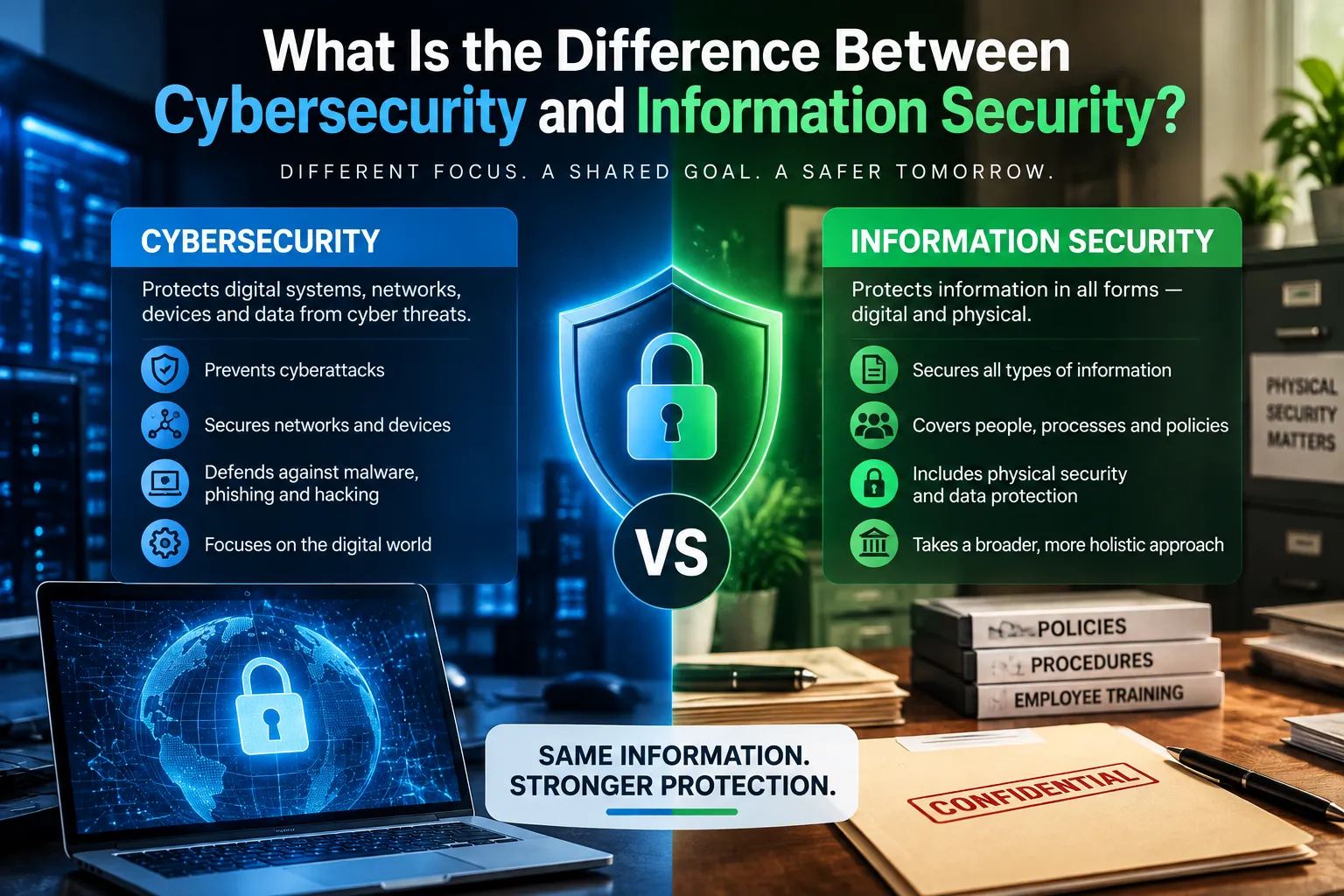
The simplest way to understand the difference is this: information security protects information in all forms, while cybersecurity focuses primarily on protecting digital systems, networks, devices, applications, and data from cyber threats.
That distinction becomes increasingly important as businesses move more of their operations online. Customer records, financial information, intellectual property, employee data, cloud applications, and internal communications may all depend on digital infrastructure. At the same time, organizations still have to protect information that exists outside computers, including printed documents, physical records, and conversations.
Understanding where cybersecurity ends and information security begins can help individuals and organizations build stronger protection strategies.
What Is Information Security?
Information security, often abbreviated as InfoSec, is the broader discipline of protecting information against unauthorized access, use, disclosure, alteration, disruption, or destruction.
The information being protected does not necessarily have to be digital.
For example, an organization might need to protect:
- Digital customer databases
- Paper contracts
- Printed financial statements
- Employee records
- Business plans
- Intellectual property
- Passwords and credentials
- Emails and electronic communications
- Physical documents stored in filing cabinets
- Confidential conversations
Information security therefore takes a comprehensive view of information throughout its entire lifecycle.
A company may have excellent technical security but still have an information security problem if an employee leaves confidential documents on a desk, sends sensitive information to the wrong person, or throws private records into an unsecured trash bin.
This is one reason information security extends beyond technology.
What Is Cybersecurity?
Cybersecurity is the practice of protecting digital systems, networks, devices, applications, and electronically stored information from cyber threats.
Cybersecurity deals heavily with attacks carried out through computers, networks, software, and connected devices.
Common cybersecurity threats include:
- Malware
- Ransomware
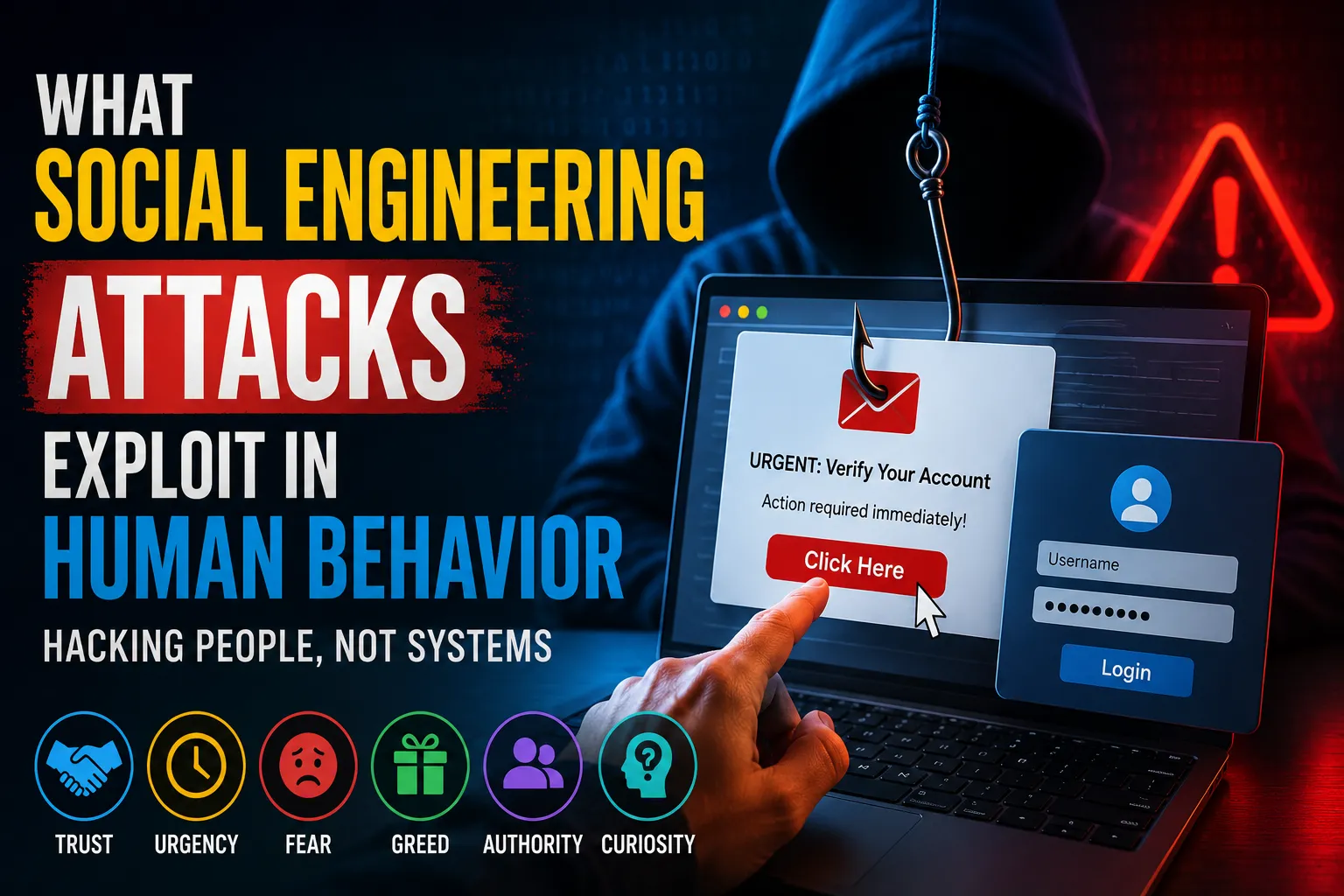
- Phishing
- Credential theft
- Account takeover
- Distributed denial-of-service attacks
- Exploitation of software vulnerabilities
- Social engineering
- Data breaches
- Malicious insiders
- Supply-chain attacks
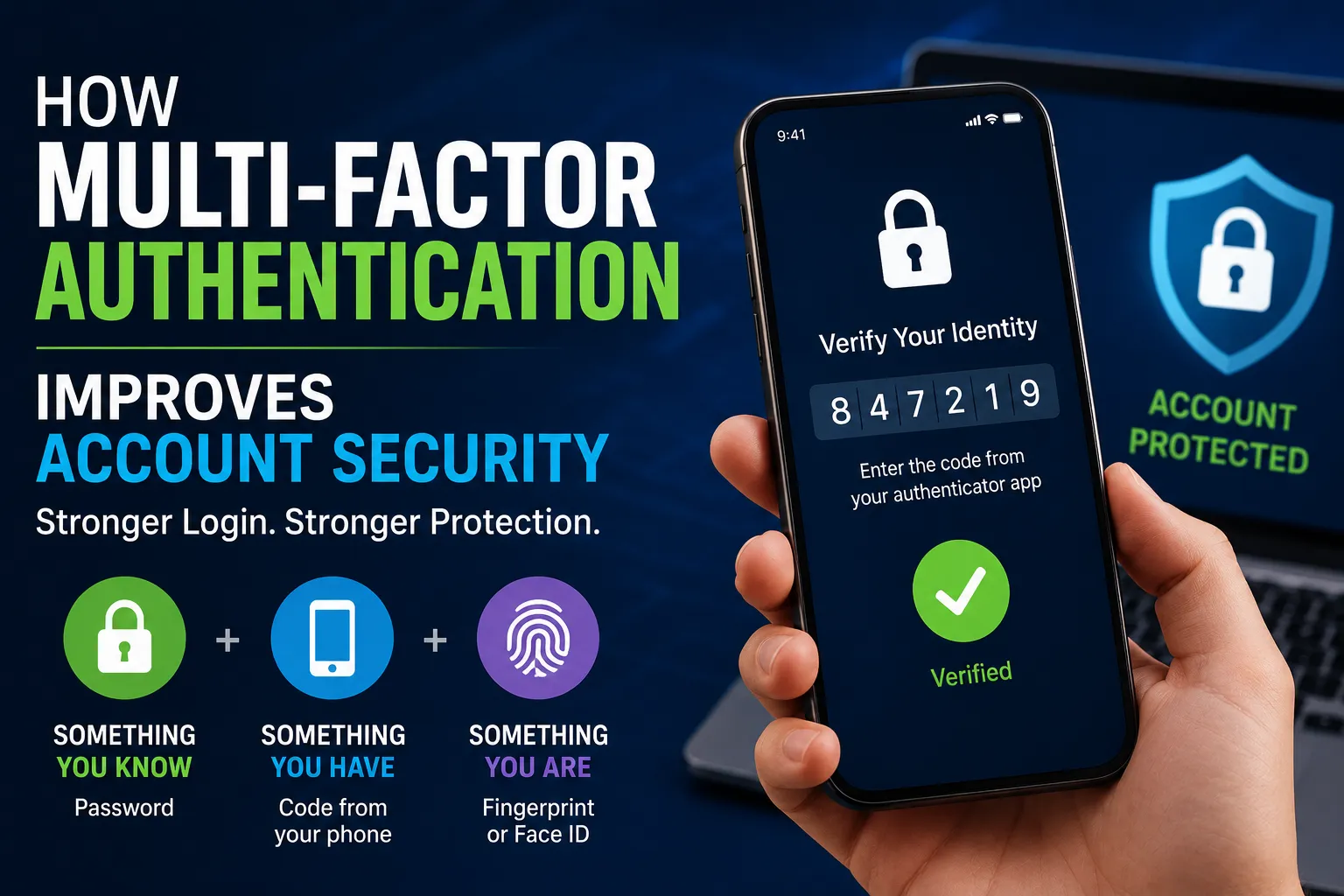
Cybersecurity also involves defensive technologies and practices such as firewalls, endpoint protection, encryption, multi-factor authentication, vulnerability management, security monitoring, and incident response.
As organizations become increasingly dependent on digital infrastructure, cybersecurity has become a major component of overall information protection.
Cybersecurity vs. Information Security at a Glance
The relationship becomes easier to understand when the two disciplines are compared directly.
| Cybersecurity | Information Security |
|---|---|
| Primarily focuses on digital environments | Covers information in both digital and physical forms |
| Concentrates heavily on cyber threats | Addresses a broader range of information risks |
| Protects networks, devices, systems, and applications | Protects information regardless of its format |
| Includes malware, hacking, phishing, and cyberattacks | Includes cyber threats, physical theft, unauthorized disclosure, and improper handling |
| Relies heavily on technical controls | Uses technical, administrative, physical, and organizational controls |
| Is generally considered part of the broader information security discipline | Encompasses cybersecurity as one component |
In other words, cybersecurity can be viewed as a specialized area within the larger field of information security.
The Relationship Between Cybersecurity and Information Security
Imagine a company has a confidential customer database stored on a cloud server.
Cybersecurity might focus on protecting that database from:
- Hackers
- Malware
- Exploited vulnerabilities
- Stolen passwords
- Unauthorized network access
Information security takes a wider perspective.
It may also ask:
- Who is allowed to access the customer information?
- How should employees handle customer records?
- How long should the company retain the information?
- What happens when the information is no longer needed?
- Where are backups stored?
- Are printed copies properly secured?
- What policies govern the sharing of customer information?
- What happens if an employee accidentally sends the information to the wrong recipient?
Cybersecurity provides important technical defenses, but information security considers the entire information environment.
The CIA Triad Applies to Both
One of the foundational concepts in information security is the CIA triad.
CIA stands for:
- Confidentiality
- Integrity
- Availability
These three principles provide a useful framework for understanding what security programs are trying to accomplish.
Confidentiality
Confidentiality means ensuring that information is only accessible to people or systems authorized to access it.
Examples include:
- Password-protected accounts
- Access controls
- Encryption
- Secure document storage
- Multi-factor authentication
A data breach that exposes private customer records is primarily a confidentiality failure.
Integrity
Integrity means ensuring that information remains accurate, trustworthy, and protected from unauthorized modification.
For example, a business needs confidence that:
- Financial records have not been altered
- Customer information has not been manipulated
- Software has not been modified maliciously
- Reports accurately represent underlying data
Cyberattacks can threaten integrity when attackers modify databases, websites, files, or other systems.
Availability
Availability means ensuring that authorized users can access information and systems when they need them.
A ransomware attack can threaten availability by preventing an organization from accessing its own files.
Similarly, a denial-of-service attack can make a website or online service unavailable.
The CIA triad therefore provides a common foundation for both cybersecurity and broader information security.
Where Cybersecurity Fits Into Information Security
Information security encompasses multiple areas of protection.
Cybersecurity is one of them.
A broader information security program can include:
Cybersecurity
Protecting digital infrastructure from cyber threats.
Physical Security
Protecting facilities, computers, servers, documents, and other physical assets from theft, damage, or unauthorized access.
Data Security
Protecting information from unauthorized access, alteration, disclosure, or destruction.
For a deeper look at this particular area, what data security is and how digital information can be protected provides a useful foundation.
Access Management
Determining who can access specific information and systems.
Security Policies
Establishing rules governing how information is created, accessed, stored, shared, and destroyed.
Risk Management
Identifying threats, evaluating their potential impact, and deciding how those risks should be addressed.
Organizations looking to strengthen this area can explore understanding cybersecurity risk management as part of a broader security strategy.
Examples That Show the Difference
Real-world scenarios make the distinction clearer.
Example 1: A Phishing Attack
An employee receives a fake email that attempts to steal their login credentials.
Protecting the employee from the phishing attack is primarily a cybersecurity concern.
But information security also becomes relevant because the stolen credentials could provide access to confidential business information.
Example 2: A Stolen Laptop
An employee leaves a company laptop in a public location and it is stolen.
Cybersecurity controls such as full-disk encryption and remote device management may help protect the data.
Information security, however, also encompasses the organization’s policies regarding physical devices, employee responsibilities, access permissions, and sensitive information.
Example 3: A Confidential Document Left on a Desk
An employee leaves a confidential contract on their desk overnight.
There may be no hacking, malware, or network attack involved.
Nevertheless, the organization has experienced an information security risk because unauthorized people could potentially access the information.
Example 4: A Database Breach
An attacker exploits a vulnerable application and gains access to a company’s customer database.
This is clearly a cybersecurity incident.
It is also an information security incident because confidential information has been exposed.
This overlap is why the terms can sometimes appear interchangeable.
Cybersecurity Is Becoming More Complex
Modern cybersecurity is no longer limited to protecting desktop computers and office networks.
Organizations now depend on:
- Cloud platforms
- Smartphones
- Internet-connected devices
- Remote work systems
- Artificial intelligence
- Software-as-a-service applications
- Digital payment systems
- APIs
- Online collaboration platforms
- Automated business processes
Every additional technology can introduce new security considerations.
Artificial intelligence is also changing the security landscape. AI can help defenders identify unusual behavior, automate analysis, detect threats, and respond more quickly. At the same time, attackers can use AI to improve phishing campaigns, automate reconnaissance, generate malicious content, and scale attacks.
Businesses trying to understand this changing environment can explore cybersecurity in the AI era to see how artificial intelligence is reshaping both threats and defenses.
Why Businesses Need Both
A business cannot protect its information effectively by focusing exclusively on cybersecurity technology.
Installing a firewall does not prevent an employee from accidentally sharing a confidential spreadsheet.
Encryption does not stop someone from taking a photograph of a sensitive document.
Antivirus software does not establish appropriate rules for retaining customer records.
Likewise, strong information security policies are not enough if an organization leaves its internet-facing systems vulnerable to attackers.
Effective protection requires both approaches.
A business needs technical safeguards and policies, processes, employee awareness, physical controls, and risk management.
For organizations developing a broader security strategy, The Ultimate Guide to Business Cybersecurity offers a useful starting point for understanding the major components of protecting a modern business.
People Are Part of the Security Equation
Technology receives much of the attention in cybersecurity discussions, but people remain a critical part of information security.
An employee can unintentionally create a security problem by:
- Reusing passwords
- Clicking a malicious link
- Sending information to the wrong recipient
- Sharing credentials
- Losing a device
- Using unauthorized software
- Mishandling confidential documents
- Ignoring security procedures
This does not mean employees are necessarily the weakest link. It means security systems must account for how people actually work.
Effective organizations combine technology with:
- Security awareness training
- Clear policies
- Simple procedures
- Strong authentication
- Appropriate access controls
- Regular security assessments
- Well-defined incident reporting
The goal is not simply to tell employees what they should never do. It is to create an environment where secure behavior is practical and understandable.
The Importance of Access Control
Access control is another area where cybersecurity and information security overlap.
Organizations should avoid giving every employee unrestricted access to every system and document.
Instead, access should generally reflect a person’s responsibilities.
This concept is often described as least privilege.
For example, an employee working in marketing may need access to campaign materials but have no reason to access payroll records.
Similarly, a contractor working on a specific application may need access to development resources without needing access to the company’s entire internal network.
Good access management can reduce the potential damage caused by both accidental mistakes and compromised accounts.
Security Is About Risk, Not Just Technology
No organization can eliminate every security risk.
The practical objective is to identify important risks and reduce them to an acceptable level.
That requires organizations to consider questions such as:
- What information is most valuable?
- Where is it stored?
- Who can access it?
- What threats could affect it?
- How likely are those threats?
- What would happen if the information were compromised?
- Which controls would reduce the risk?
- How much would those controls cost?
- How quickly could the organization recover from an incident?
This is where cybersecurity and information security become closely connected with risk management.
A company might decide that protecting its most sensitive customer information deserves stronger controls than protecting publicly available marketing material.
Security decisions should therefore be based on the organization’s actual risks rather than simply purchasing as many security products as possible.
Information Security Goes Beyond Preventing Attacks
One important misconception is that security is only about stopping attackers.
Protection also involves preparing for accidents, mistakes, technical failures, natural disasters, and other disruptions.
Consider a company’s financial database.
Even if nobody attempts to hack it, the organization could still lose access because of:
- Hardware failure
- Software errors
- Accidental deletion
- Power outages
- Damaged infrastructure
- Failed updates
- Human mistakes
Backups, disaster recovery plans, redundancy, and business continuity procedures can therefore be important parts of information security.
Cybersecurity helps defend against malicious digital activity, while information security considers the wider set of circumstances that could threaten information.
Which One Should a Business Focus On?
The answer is both, but the balance depends on the organization.
A small business that stores most of its information online may need to prioritize areas such as:
- Multi-factor authentication
- Secure cloud configuration
- Endpoint protection
- Software updates
- Backups
- Phishing awareness
- Access controls
A larger organization may need a much broader information security program covering:
- Cybersecurity
- Physical security
- Data classification
- Privacy
- Identity management
- Vendor security
- Incident response
- Business continuity
- Security governance
- Regulatory requirements
The important point is that cybersecurity should not be treated as an isolated technical department. It should support the organization’s broader information protection objectives.
Cybersecurity and Information Security in the Future
The distinction between cybersecurity and information security will remain important as businesses become increasingly digital.
More information is moving into cloud environments. Connected devices are becoming more common. Remote and hybrid work continue to expand digital access points. Artificial intelligence is becoming integrated into business processes, software development, customer service, and decision-making.
These developments create opportunities, but they also create new security considerations.
Future security programs will increasingly need to account for the entire information lifecycle—from creation and collection to storage, access, transmission, backup, and eventual destruction.
Organizations that focus only on defending their networks may overlook risks involving people, physical information, third-party providers, data handling, or business processes.
The Key Difference Comes Down to Scope
Cybersecurity and information security share many goals, technologies, and practices, which is why the terms are often confused.
The clearest distinction is scope.
Information security is the broader discipline concerned with protecting information in every form. Cybersecurity is more specifically focused on protecting digital systems, networks, devices, applications, and data from cyber threats.
That means cybersecurity is an essential part of information security, but information security extends beyond cybersecurity.
Understanding this relationship helps businesses build security programs that address more than just hackers and malware. Strong protection requires attention to technology, people, processes, physical environments, data, and risk.
As the amount of information organizations create and depend on continues to grow, that broader perspective will become increasingly important.