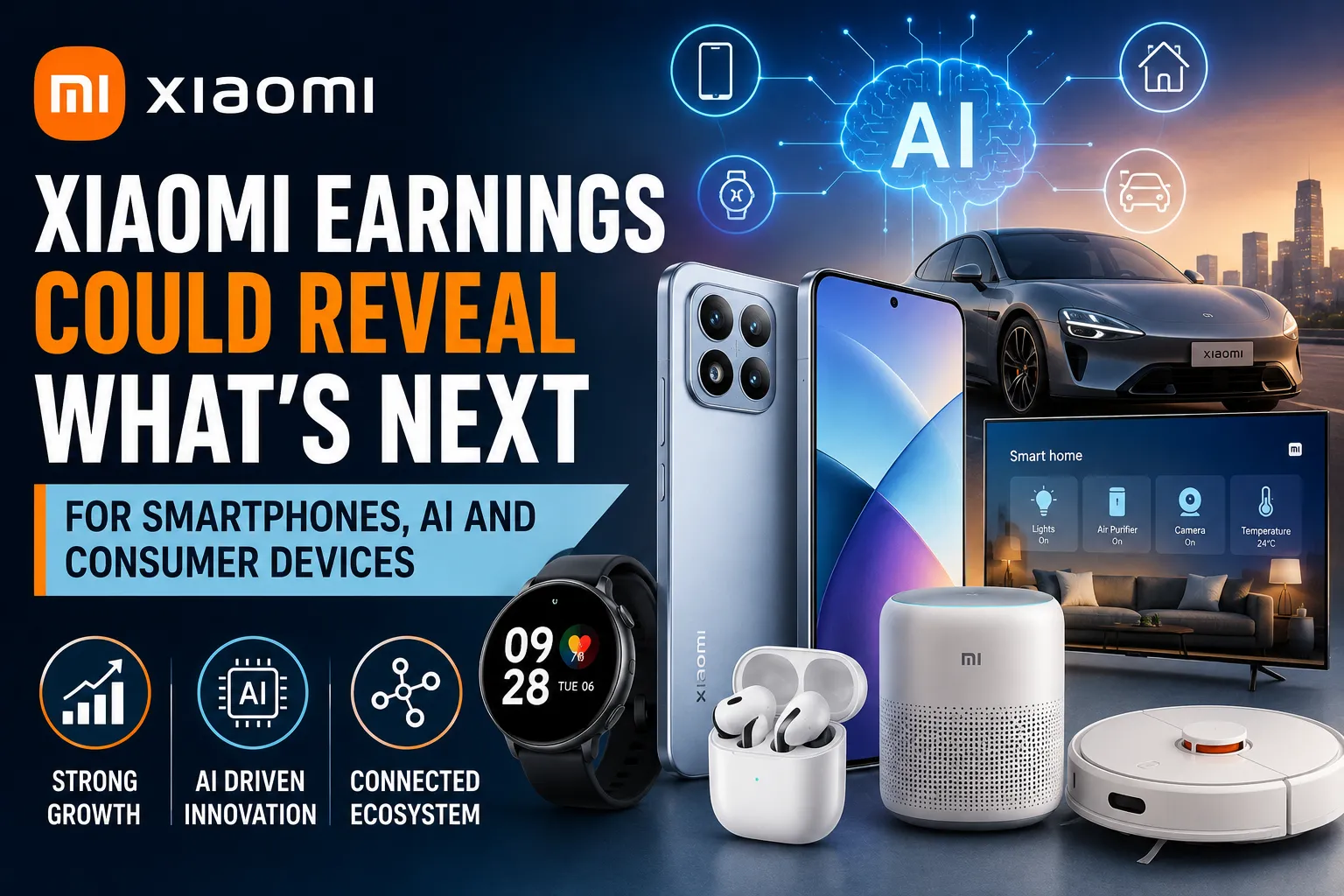
Xiaomi Earnings Could Reveal What’s Next for Smartphones, AI and Consumer Devices
The latest results from Xiaomi Corporation offer a useful snapshot of where the consumer technology industry may be heading next.
The company remains a major smartphone maker, but its business is increasingly broader than phones. Xiaomi now connects smartphones, tablets, wearables, home appliances, connected devices, artificial intelligence and electric vehicles through an expanding technology ecosystem.
Its first-quarter 2026 results showed both sides of that transformation. Xiaomi reported RMB 99.1 billion in quarterly revenue and RMB 6.1 billion in adjusted net profit, while its smartphone business faced weaker shipments and higher component costs. At the same time, its IoT business, overseas operations, AI investments and newer businesses continued to shape the company’s long-term strategy. (HKEXnews)
That combination makes Xiaomi’s earnings more significant than a simple scorecard for one smartphone manufacturer. They provide clues about the pressures facing device makers—and about how companies may try to make money from AI and connected hardware in the years ahead.
Xiaomi’s Smartphone Business Faces a More Difficult Environment
Smartphones remain central to Xiaomi’s business, but the latest numbers highlight how challenging the market can be.
The company shipped approximately 33.8 million smartphones in the first quarter of 2026, maintaining a top-three global position, according to company data citing Omdia. Smartphone revenue was about RMB 44.3 billion, while smartphone gross margin was 10.1%. (HKEXnews)
One of the biggest challenges has been rising component costs, particularly memory.
Higher memory prices can create a difficult equation for smartphone manufacturers. They can absorb some of the additional cost, raise retail prices, reduce specifications, adjust product mixes or try to increase sales of higher-margin models.
Xiaomi has indicated that it has been adjusting its product and channel strategy rather than simply competing on the lowest possible price. Its smartphone average selling price reached approximately RMB 1,310, up 8.2% year over year, according to management’s earnings presentation and call. (EarningsCalls.dev)
That could signal an important shift in the smartphone market.
The Smartphone Market May Be Moving Further Upmarket
For years, Xiaomi built much of its reputation around offering strong hardware at competitive prices.
But the economics of smartphones increasingly reward companies that can sell more premium devices and generate revenue beyond hardware.
Xiaomi’s earnings suggest that the company is continuing to push in that direction.
Premium smartphones can provide greater revenue per device and potentially create stronger opportunities for services, accessories and ecosystem products.
The company’s challenge is balancing that strategy with its historical strength in value-oriented devices.
If consumers become less willing to replace phones frequently, manufacturers need stronger reasons to persuade customers to upgrade.
Better cameras, displays and processors have traditionally provided those reasons. Increasingly, AI capabilities could become another major upgrade driver.
AI Could Change What Consumers Expect From Smartphones
Artificial intelligence is gradually moving from an abstract technology concept into everyday consumer products.
For smartphones, AI can potentially improve:
- Photo and video editing
- Voice assistants
- Translation
- Search
- Writing and summarization
- Personal organization
- Accessibility
- On-device recommendations
- Image generation
- Device automation
The important question for manufacturers is whether these features are genuinely useful enough to influence purchasing decisions.
Consumers are unlikely to pay significantly more simply because a phone has an “AI” label. The technology needs to solve problems that people encounter regularly.
That makes software integration increasingly important.
Xiaomi Is Building AI Into a Larger Ecosystem
Xiaomi’s strategy goes beyond putting AI features inside individual smartphones.
The company describes its broader direction around a “Human × Car × Home” ecosystem, connecting devices and services across different categories. Its first-quarter results also highlighted continued investment in AI capabilities and core technologies. (HKEXnews)
This approach could become one of the most important parts of Xiaomi’s long-term strategy.
Instead of thinking about a smartphone as an isolated product, Xiaomi can treat it as one interface within a larger network.
A user’s phone could interact with smart appliances, earbuds, tablets, wearables, vehicles and other connected devices.
The more useful those connections become, the more valuable the ecosystem may be.
Xiaomi’s IoT Business Is Becoming More Important
The company’s connected-device business provides an important counterweight to pressure in smartphones.
In the first quarter, Xiaomi reported RMB 24.7 billion in revenue from IoT and lifestyle products, with a gross margin of 25.2%. Management said overseas IoT revenue achieved double-digit year-over-year growth and reached a record level. (EarningsCalls.dev)
This matters because connected devices can diversify a technology company’s revenue.
Products such as:
- Wireless earbuds
- Smartwatches
- Fitness bands
- Tablets
- Smart televisions
- Home appliances
- Smart-home equipment
can all contribute to a broader ecosystem.
They can also create additional opportunities to keep customers within the same technology platform.
The Connected Home Could Become More Intelligent
The long-term opportunity for AI may not be limited to smartphones.
Imagine a home where connected devices understand context rather than simply responding to isolated commands.
A television, speaker, refrigerator, lighting system, security camera and smartphone could potentially work together more intelligently.
AI could help coordinate these devices, understand user preferences and automate routine activities.
This is one reason Xiaomi’s large connected-device base is strategically important.
The company said its AIoT platform had more than 1.1 billion connected IoT devices by the end of the first quarter of 2026, excluding smartphones, tablets and laptops. (Ijiwei)
The scale of that network could provide Xiaomi with a substantial foundation for expanding AI-powered experiences across hardware.
AI Spending Is Becoming a Long-Term Investment
Building competitive AI systems is expensive.
Companies need investment in:
- Research and development
- Computing infrastructure
- AI models
- Software engineering
- Data processing
- Semiconductor technology
- Product integration
- Talent
Xiaomi reported RMB 9.0 billion in research and development spending during the first quarter, representing a 33.4% year-over-year increase. (WebWire)
That investment reflects a broader shift across the technology industry.
AI is increasingly being treated as infrastructure rather than merely a feature.
The companies that succeed may be those capable of integrating AI into products while maintaining reasonable costs and compelling consumer experiences.
Why Xiaomi’s AI Strategy Matters for Consumers
For consumers, the important issue is not how much a company spends on AI.
It is what that spending produces.
An AI system that makes devices easier to use could be valuable. One that simply adds another chatbot to a smartphone may be less compelling.
The most meaningful developments could come from AI operating quietly in the background.
For example, an assistant could potentially coordinate information across devices, understand natural-language requests, anticipate routine tasks and personalize experiences.
That would make AI less like a separate application and more like an underlying layer of the consumer technology ecosystem.
Rising Memory Costs Could Affect Device Prices
Xiaomi’s results also highlight an issue that could extend beyond the company itself.
Memory is an important component in modern electronics, and increasingly sophisticated AI applications can require more memory.
Smartphones, tablets and computers are all competing for components that may also be required by data centers and other technology applications.
If component costs remain elevated, manufacturers may face difficult choices.
Consumers could see:
- Higher device prices
- Fewer low-cost models
- Smaller discounts
- Greater emphasis on premium products
- Changes in memory configurations
The impact will vary by product and market, but component costs can eventually influence the retail products consumers see.
Xiaomi Is Becoming More Than a Smartphone Company
One of the clearest themes from the earnings results is diversification.
Xiaomi describes itself as a consumer electronics and smart-manufacturing company with smartphones and smart hardware connected through an IoT platform. (Xiaomi Corporation)
That description is increasingly important.
The company’s businesses now span smartphones, connected devices, internet services, electric vehicles and AI-related initiatives.
This diversification creates both opportunities and risks.
More businesses can reduce dependence on smartphone sales, but they also require substantial investment and management attention.
Electric Vehicles Add Another Layer to the Strategy
Xiaomi’s move into electric vehicles has made its ecosystem strategy more ambitious.
In the first quarter of 2026, its smart electric vehicle, AI and other new initiatives segment generated approximately RMB 19.9 billion in revenue. The company delivered 80,856 vehicles during the quarter. (EarningsCalls.dev)
The significance for consumer technology extends beyond vehicle sales.
Cars are increasingly becoming software-driven technology platforms.
A vehicle can incorporate:
- AI assistants
- Navigation
- Connected services
- Smartphone integration
- Voice controls
- Entertainment
- Driver-assistance technologies
- Smart-home connections
That creates another environment in which Xiaomi can potentially extend its ecosystem.
The “Human × Car × Home” Idea Could Become a Major Differentiator
The most interesting part of Xiaomi’s strategy may be the connection between categories.
A consumer who owns a Xiaomi phone, smartwatch, earbuds, television and smart-home products already participates in an ecosystem.
Adding a connected vehicle expands that ecosystem into another major part of daily life.
The strategic goal is straightforward: make the products work better together than they would separately.
If Xiaomi succeeds, the competitive advantage may not come from a single device.
It could come from the relationship between devices.
Overseas Growth Could Become Increasingly Important
Xiaomi is also looking beyond its domestic market.
The company reported strong overseas performance in parts of its IoT business, while continuing to expand retail and distribution networks internationally. Its first-quarter filing said overseas new retail stores exceeded 520, covering regions including Southeast Asia, Europe, East Asia, Latin America, the Middle East and Africa. (HKEX News)
International expansion could provide additional growth opportunities as smartphone markets mature.
But it also brings challenges, including:
- Different consumer preferences
- Local competitors
- Regulatory requirements
- Currency fluctuations
- Distribution costs
- Brand positioning
- Software and service differences
How successfully Xiaomi manages those issues will influence the next stage of its global expansion.
What Xiaomi’s Results Could Mean for Smartphone Buyers
Consumers should not assume that one company’s earnings report will immediately change the smartphone market.
However, several broader trends are worth watching.
Premium Devices May Become More Important
Higher component costs and slower unit growth could encourage manufacturers to prioritize more profitable devices.
AI Features Will Need to Become More Useful
Consumers may increasingly expect AI capabilities to be integrated into everyday functions rather than marketed as standalone features.
Ecosystems Could Matter More
Companies that connect phones, wearables, home products and other devices may have more opportunities to retain customers.
Hardware Costs Could Remain Important
Memory and other component prices can influence device specifications and retail prices.
Smart Devices May Become More Connected
The next phase of consumer technology could involve fewer isolated gadgets and more coordinated systems.
The Bigger Question Is Whether AI Can Create Real Consumer Value
Xiaomi’s earnings highlight a broader transition taking place across consumer technology.
The smartphone remains one of the industry’s most important products, but the industry is searching for its next source of growth.
AI is one candidate.
Connected ecosystems are another.
Vehicles, smart homes, wearables and other devices provide additional opportunities.
But none of these automatically guarantees success.
Consumers ultimately decide whether a technology is worth paying for.
The companies that benefit most from the AI era may therefore be those that can combine sophisticated technology with simple, practical experiences.
Xiaomi’s Next Chapter Will Be About More Than Phones
Xiaomi’s first-quarter 2026 results reveal a company navigating a difficult smartphone environment while continuing to invest heavily in AI, connected devices and newer businesses.
The numbers show pressure in smartphones, but they also show why Xiaomi is trying to build something larger than a handset business. Its IoT platform, international expansion, AI investments and electric-vehicle ambitions are all pieces of a broader ecosystem strategy. (HKEXnews)
For consumers, the most important development to watch is not simply whether Xiaomi sells more phones.
It is whether the company’s different products begin to work together in ways that genuinely make everyday technology more useful.
If Xiaomi can turn AI from a marketing feature into an intelligent layer connecting phones, homes, wearables and vehicles, its earnings could eventually tell a much bigger story: the smartphone may be evolving from the center of the consumer technology world into the gateway to an entire connected ecosystem.