How AI Is Transforming Software Engineering
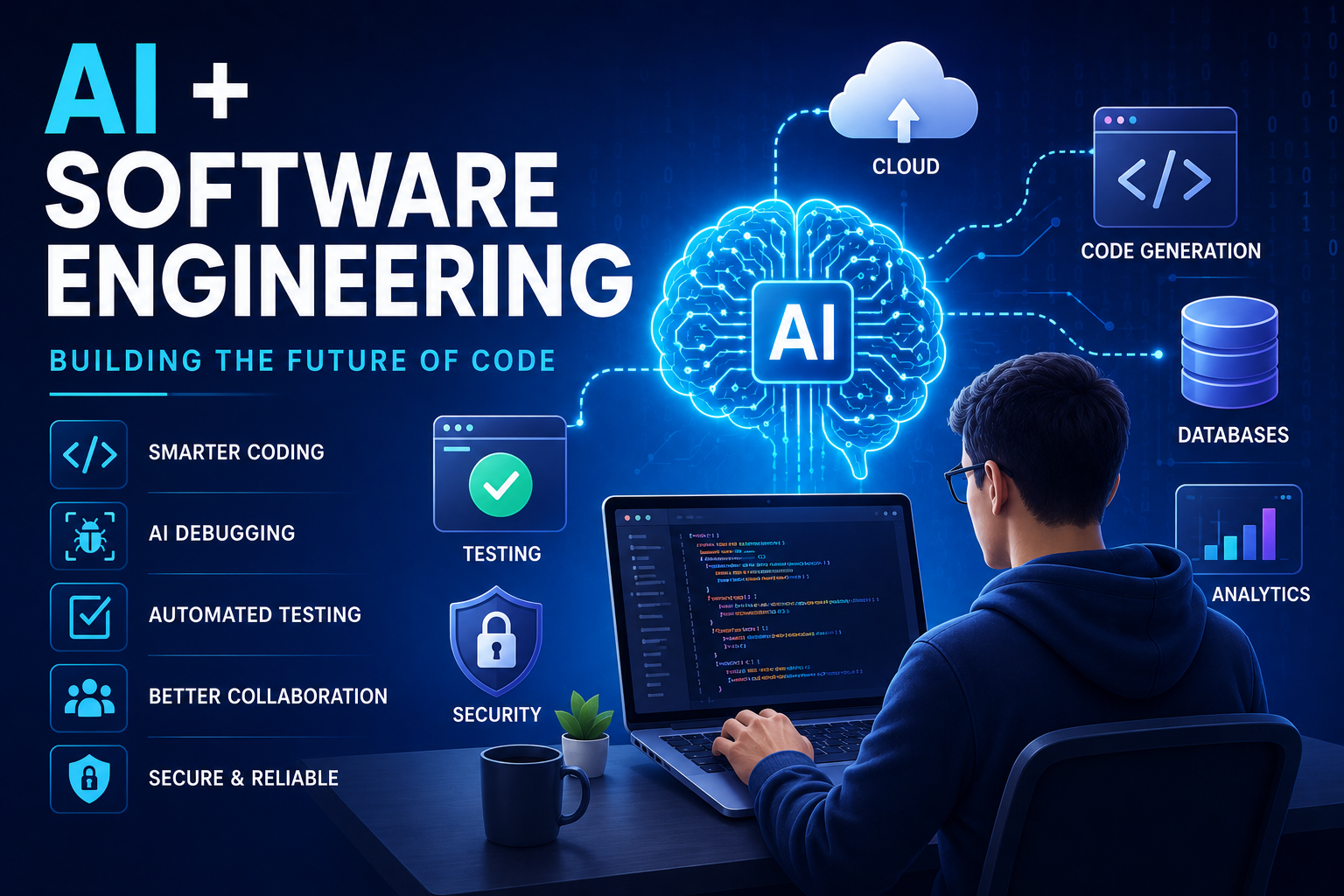
Artificial intelligence is rapidly changing the way software is designed, built, tested, deployed, and maintained. What once required hours of manual coding and debugging can now be accelerated with AI-powered tools capable of generating code, identifying bugs, writing documentation, and even suggesting architectural improvements. Rather than replacing software engineers, AI is becoming a powerful collaborator that helps developers work faster, solve complex problems, and focus on higher-value tasks.
From startups building their first applications to global technology companies managing millions of lines of code, AI has become an integral part of modern software development. As large language models, intelligent coding assistants, AI agents and automated testing platforms continue to evolve, software engineering is entering a new era where human creativity and artificial intelligence work side by side.
This guide explores how AI is transforming software engineering, its benefits and challenges, and what developers can expect in the future.
Related reading: The Rise of AI Agents: How Autonomous AI Could Change Work, Business, and Daily Life
What Is AI in Software Engineering?
AI in software engineering refers to the use of artificial intelligence and machine learning technologies to assist with designing, developing, testing, deploying, maintaining, and improving software applications.
Rather than replacing developers, AI automates repetitive tasks, provides intelligent recommendations, and helps engineers write better code more efficiently.
Modern AI tools can:
- Generate code
- Detect bugs
- Review pull requests
- Explain unfamiliar code
- Create documentation
- Suggest optimizations
- Generate unit tests
- Improve software security
These capabilities are part of a much broader transition from AI systems that simply provide information to systems that can increasingly perform multi-step work. For a broader explanation of this transition, see AI Agents Are Taking Over More Tasks: What the Next Generation of AI Can Actually Do.
Why AI Matters for Developers
Software projects have become increasingly complex.
Modern applications often include:
- Cloud infrastructure
- APIs
- Databases
- Mobile apps
- AI services
- Microservices
- Security layers
- Third-party integrations
Managing this complexity requires tools that improve productivity while maintaining software quality.
AI helps developers by:
- Reducing repetitive work
- Improving code quality
- Accelerating development
- Supporting learning
- Enhancing collaboration
The significance of this change becomes clearer when AI is viewed not simply as a coding assistant but as part of the wider rise of agentic AI and autonomous software systems.
How AI Works in Software Development
Most AI coding assistants are powered by large language models (LLMs) trained on vast collections of publicly available code, documentation, programming concepts, and technical literature.
When developers write code, AI can:
- Analyze the surrounding context.
- Predict the developer’s intent.
- Suggest complete functions or classes.
- Recommend best practices.
- Identify possible errors.
- Explain unfamiliar code.
Developers remain responsible for reviewing, testing, and validating AI-generated suggestions.
This distinction is especially important as coding systems become more autonomous. Modern AI agents can increasingly move beyond suggesting individual lines of code and work through larger software-development objectives.
AI-Powered Code Generation
One of AI’s most significant contributions is code generation.
Instead of writing every line manually, developers can describe what they want in plain language.
Examples include:
- Creating REST APIs
- Building user interfaces
- Database queries
- Authentication systems
- Configuration files
- Data models
- Utility functions
This dramatically reduces development time for routine tasks.
The next stage of this development is increasingly agentic: instead of asking AI to generate one function, developers can give an AI system a larger objective and allow it to work through multiple coding tasks.
Intelligent Code Completion
Modern AI-powered editors provide context-aware suggestions beyond traditional autocomplete.
AI can complete:
- Entire functions
- Loops
- Error handling
- SQL queries
- API calls
- Test cases
- Documentation comments
Developers spend less time typing repetitive code and more time solving business problems.
As these tools become more capable, the boundary between a traditional coding assistant and an AI agent becomes increasingly difficult to define.
AI for Debugging
Debugging often consumes a significant portion of development time.
AI assists by:
- Explaining error messages
- Finding likely root causes
- Suggesting fixes
- Identifying logical mistakes
- Detecting unused variables
- Highlighting performance issues
Rather than replacing debugging skills, AI accelerates troubleshooting.
However, developers should not assume that an AI-generated fix is automatically correct. A plausible-looking solution can introduce new bugs, security vulnerabilities, or unexpected behavior.
Automated Code Reviews
Code reviews help maintain software quality.
AI can automatically check for:
- Coding standards
- Security vulnerabilities
- Performance issues
- Duplicate code
- Complexity
- Naming consistency
- Potential bugs
Human reviewers still make final decisions while AI reduces repetitive review work.
This human-review requirement becomes particularly important when AI systems are given permission to make changes directly to repositories or development environments.
AI in Software Testing
Testing is another area benefiting significantly from AI.
AI helps generate:
- Unit tests
- Integration tests
- Edge-case scenarios
- Mock data
- Test documentation
AI-powered testing tools can also identify portions of code requiring additional test coverage.
As AI becomes more involved in software development, automated testing becomes even more important because developers must verify not only manually written code but also code produced by AI systems.
Improving Software Documentation
Documentation is essential but often neglected.
AI can automatically generate:
- API documentation
- README files
- Function descriptions
- Architecture summaries
- Inline comments
- User guides
Developers can then refine the generated content for accuracy.
This can significantly reduce the administrative burden associated with maintaining documentation, particularly on large projects where code and system architecture change frequently.
AI and DevOps
AI is becoming increasingly valuable throughout DevOps workflows.
Applications include:
- Infrastructure monitoring
- Log analysis
- Deployment recommendations
- Incident detection
- Performance optimization
- Capacity planning
AI helps operations teams identify problems before they affect users.
More advanced systems could eventually connect development, testing, deployment, monitoring, and remediation into longer-running automated workflows.
That is another example of the broader movement toward AI systems that can execute work rather than simply provide recommendations.
AI in Cybersecurity
Software security is another area transformed by AI.
AI tools can:
- Detect vulnerable code
- Identify exposed secrets
- Recommend secure coding practices
- Scan dependencies
- Monitor suspicious behavior
- Predict attack patterns
Developers still need security expertise, but AI provides valuable assistance.
The relationship between artificial intelligence and cybersecurity is becoming increasingly important because more capable AI systems can also gain access to sensitive software environments, repositories, credentials, and infrastructure.
For a broader look at this issue, see Cybersecurity in the AI Era.
Benefits of AI in Software Engineering
Faster Development
Routine coding tasks can often be completed in minutes instead of hours.
Increased Productivity
Developers spend more time solving business problems and less time writing boilerplate code.
Better Learning
AI explains unfamiliar programming concepts, frameworks, and libraries, helping beginners learn more quickly.
Improved Code Quality
Automated suggestions encourage cleaner, more consistent code.
Reduced Repetitive Work
Documentation, testing, formatting, and simple refactoring can often be partially automated.
The combination of these benefits explains why software development has become one of the most important early applications of AI agents and other forms of agentic automation.
Challenges of AI-Assisted Development
Despite its advantages, AI is not perfect.
Developers should be aware of:
Incorrect Code
AI occasionally produces code containing logical or security errors.
Hallucinations
AI may confidently generate APIs or functions that do not actually exist.
Security Risks
Generated code should always be reviewed for vulnerabilities.
Copyright Questions
Organizations should understand the licensing implications of AI-generated code.
Overreliance
Developers still need strong programming fundamentals to evaluate AI suggestions effectively.
These limitations become even more significant when AI is allowed to execute actions rather than merely suggest them. Greater autonomy means that mistakes can potentially affect production systems, data, repositories, and other digital resources.
Skills That Still Matter
AI changes software engineering, but it does not eliminate the need for experienced developers.
Critical skills include:
- Problem solving
- System architecture
- Algorithms
- Database design
- Security
- Performance optimization
- Communication
- Product thinking
Human judgment remains essential.
In fact, as AI becomes better at producing code, understanding why a system should be built a certain way may become more important than manually writing every line.
The Future of Software Engineering
AI is expected to become an increasingly capable development partner.
Future capabilities may include:
- Autonomous bug fixing
- Intelligent architecture recommendations
- Self-optimizing applications
- Automated software maintenance
- Natural language programming
- AI-powered project planning
- Predictive code quality analysis
- Smarter developer collaboration
The evolution of AI coding systems is already creating intense competition among major technology companies. For more on this development, see The AI Coding Race Intensifies as Meta Challenges OpenAI and Anthropic.
Developers who learn to work effectively with AI will likely gain significant productivity advantages.
Best Practices for Using AI in Development
To get the most value from AI:
- Verify all generated code.
- Write comprehensive tests.
- Understand the code before deploying it.
- Avoid sharing sensitive data with AI tools.
- Use AI as an assistant, not a replacement for engineering judgment.
- Continue learning programming fundamentals.
Responsible use leads to better outcomes.
Developers should also consider the permissions given to increasingly autonomous systems. An AI agent with access to a code repository, deployment environment, databases, or production infrastructure should not automatically receive unrestricted authority.
Common Myths About AI in Software Engineering
| Myth | Reality |
|---|---|
| AI will replace software engineers. | AI automates tasks but still requires human oversight, creativity, and decision-making. |
| AI-generated code is always correct. | Developers must review, test, and validate every suggestion. |
| Beginners no longer need to learn programming. | Understanding programming concepts remains essential for using AI effectively. |
| AI only helps experienced developers. | Developers of all skill levels can benefit from AI-powered tools. |
| AI eliminates debugging. | AI assists debugging but cannot replace human reasoning for complex issues. |
Frequently Asked Questions
Will AI replace software engineers?
AI is more likely to change how software engineers work rather than replace them. Human expertise remains essential for designing systems, solving complex problems, and making architectural decisions.
Can AI write complete applications?
AI can generate significant portions of an application, but developers still need to integrate components, test functionality, ensure security, and maintain the software.
As AI agents become more capable, they may handle increasingly large portions of application development, but human oversight remains important.
Is AI-generated code safe?
Not always. Developers should review AI-generated code carefully, perform security testing, and validate functionality before deployment.
Which parts of software development benefit most from AI?
Code generation, debugging, testing, documentation, code reviews, and automation are among the areas seeing the greatest productivity improvements.
Should new developers learn programming if AI writes code?
Yes. Understanding programming fundamentals is essential for evaluating AI-generated code, debugging issues, and designing reliable software.
What is the future of AI in software engineering?
AI is expected to become a collaborative development partner that automates routine work while allowing engineers to focus on architecture, innovation, and solving complex business challenges.
As development agents become more autonomous, software engineers may increasingly shift from manually performing every development task toward defining objectives, supervising AI systems, reviewing their work, and making higher-level technical decisions.
Conclusion
Artificial intelligence is reshaping software engineering by making development faster, more efficient, and increasingly accessible. From generating code and automating testing to improving security and simplifying documentation, AI is transforming nearly every stage of the software development lifecycle.
However, AI is best viewed as an intelligent assistant rather than a replacement for skilled engineers. The most successful developers will be those who combine strong programming knowledge with the ability to leverage AI responsibly and effectively. As software systems continue to grow in complexity, the partnership between human creativity and artificial intelligence will define the next generation of software engineering.