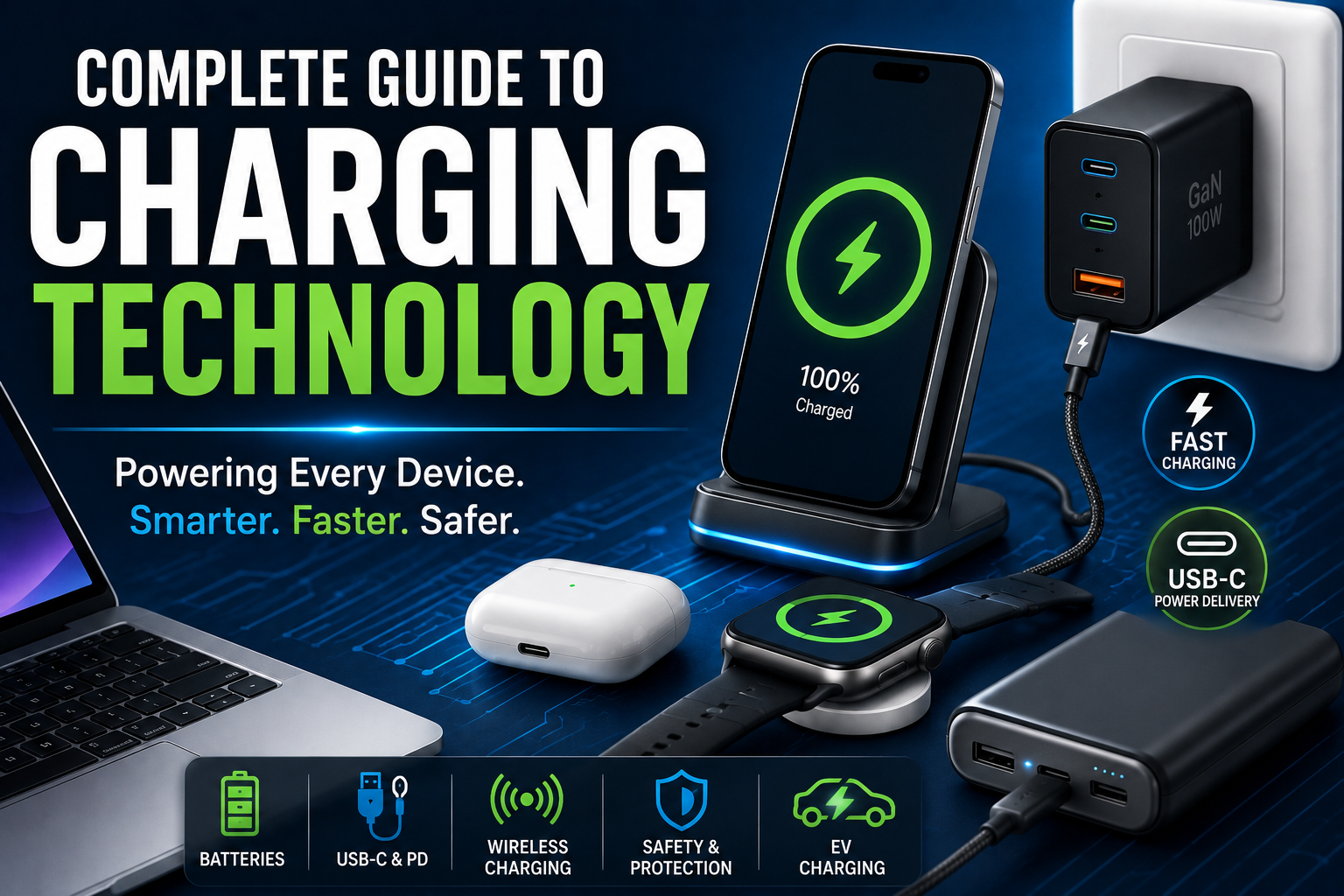
Complete Guide to Charging Technology
Charging technology has become one of the most important parts of modern consumer electronics.
Smartphones, laptops, tablets, smartwatches, wireless earbuds, electric vehicles and countless other devices depend on charging systems to keep their batteries operating. Yet charging is often treated as a simple matter of plugging in a cable.
Behind that everyday action is a complex combination of batteries, power supplies, charging protocols, connectors, wireless technologies, thermal management and software.
Modern charging systems are also becoming faster and more intelligent. USB-C has become increasingly common across devices, fast-charging technologies can deliver substantial amounts of power in relatively short periods, and wireless charging has evolved from a convenience feature into a more capable charging option.
This complete guide to charging technology explains how charging works, the major charging standards, wired and wireless charging, fast charging, USB-C, charging safety, batteries, chargers, power banks and the technologies shaping the future of charging. For a broader look at how these technologies fit into the wider consumer electronics ecosystem, see What Are Consumer Gadgets and How Do Modern Gadgets Work?.
What Is Charging Technology?
Charging technology refers to the hardware, software, electrical standards and protocols used to transfer energy into a rechargeable battery.
A complete charging system can include:
-
Power source
-
Wall charger or adapter
-
Charging cable
-
Connector
-
Charging protocol
-
Power-management circuitry
-
Battery-management system
-
Rechargeable battery
-
Device software
These components work together to determine how quickly and safely a device can receive energy.
Charging isn’t simply about supplying as much electricity as possible.
The device and charger must communicate and regulate power according to the battery’s condition, temperature and electrical characteristics.
How Battery Charging Works
Rechargeable batteries store electrical energy through electrochemical processes.
When a device is being used, stored chemical energy is converted into electrical energy.
During charging, electrical energy is supplied to the battery, reversing the relevant electrochemical process and restoring some of its stored energy.
A simplified charging chain looks like this:
Power Source
↓
Charger / Power Adapter
↓
Charging Protocol
↓
Device Power Management
↓
Battery
↓
Stored Energy
The exact process depends on the battery chemistry and device design.
What Happens When You Plug In a Device?
When you connect a device to a charger, several things can happen almost immediately.
The device may determine:
-
Whether the charger is compatible
-
How much power is available
-
What voltage is supported
-
What current can be drawn
-
Whether fast charging is available
-
Whether the battery is too hot or cold
-
How much charging power should be applied
The charging system then regulates the energy entering the battery.
This is why plugging a powerful laptop charger into a smartphone doesn’t necessarily mean the phone receives the charger’s maximum output.
The device determines how much power it can safely accept.
Understanding Voltage, Current and Power
Three electrical concepts are particularly important when discussing charging:
-
Voltage
-
Current
-
Power
Power can be expressed as:
Power = Voltage × Current
So, for example:
20 volts × 3 amps = 60 watts
This is why higher-power charging can be achieved by increasing voltage, current or both.
However, real charging systems involve additional factors such as efficiency, heat and conversion losses.
What Does Wattage Mean?
Watts (W) measure power.
A charger rated at 65W can potentially deliver up to 65 watts under supported conditions.
But a 65W charger doesn’t force 65W into every connected device.
The actual power depends on:
-
Charger capability
-
Device capability
-
Cable capability
-
Charging protocol
-
Battery condition
-
Temperature
-
Other system constraints
A 100W charger connected to a device that supports only 25W won’t automatically make that device charge at 100W.
What Is USB Charging?
USB, or Universal Serial Bus, was originally developed primarily for connecting computers and peripherals.
Over time, USB evolved into an important power-delivery system.
Modern USB standards can support substantially more power than the early USB implementations.
USB charging is now used across:
-
Smartphones
-
Tablets
-
Laptops
-
Cameras
-
Headphones
-
Gaming accessories
-
Portable devices
-
Displays
-
Other electronics
Understanding USB-C
USB-C refers primarily to a connector design.
It is important to distinguish the physical USB-C connector from the various USB and charging standards that can operate through it.
A USB-C port may support different capabilities depending on the device.
These can include:
-
Data transfer
-
Charging
-
Video output
-
High-speed networking
-
Alternate modes
Therefore, two USB-C ports can look identical while offering very different capabilities.
USB-C Does Not Automatically Mean Fast Charging
This is one of the most common misconceptions about modern charging.
A USB-C connector does not guarantee:
-
A particular charging speed
-
A specific USB data speed
-
High-wattage power delivery
-
Video support
The capabilities depend on the implementation.
When buying a cable or charger, users should therefore examine its supported specifications rather than relying solely on the shape of the connector.
What Is USB Power Delivery?
USB Power Delivery (USB PD) is a power-delivery technology designed to negotiate power between compatible devices and chargers.
It can support significantly higher power levels than older USB charging implementations.
USB PD can be used with many types of devices, including:
-
Phones
-
Tablets
-
Laptops
-
Monitors
-
Portable gaming devices
-
Accessories
The charger and device negotiate an appropriate power level rather than simply delivering maximum available power without coordination.
Why Charging Protocols Matter
Different manufacturers and devices can use different charging technologies.
A charger may support several standards, while a device may support only certain ones.
If the necessary protocol isn’t supported, the device may still charge but at a lower speed.
This explains why a charger advertised as “fast” doesn’t necessarily fast-charge every device.
What Is Fast Charging?
Fast charging refers to charging technologies designed to deliver energy to a battery more quickly than conventional charging systems.
Fast charging can involve:
-
Higher power
-
Improved power-management circuitry
-
Specialized charging protocols
-
Better thermal management
-
Optimized battery chemistry
-
Software-controlled charging
The exact charging speed varies throughout the charging cycle.
Why Charging Slows Down Near Full Capacity
A battery generally doesn’t charge at its maximum rate from empty to full.
Charging often occurs in different stages.
A simplified lithium-ion charging process can be described as:
-
Initial charging
-
Constant-current phase
-
Constant-voltage phase
-
Reduced current
-
Charging completion
As the battery approaches full capacity, the charging system generally reduces the amount of current entering the battery.
This helps manage battery stress and safety.
Why 80% Can Charge Faster Than 100%
The last portion of a battery’s charging cycle often takes disproportionately longer than the first portion.
For this reason, a device might reach a high percentage relatively quickly but take considerably longer to reach 100%.
Some manufacturers also provide battery-protection features that deliberately slow charging or pause around a certain level.
What Is Battery Health?
Battery health refers broadly to the condition and remaining capacity of a rechargeable battery compared with when it was new.
Lithium-ion batteries gradually degrade through:
-
Charge cycles
-
Time
-
Heat
-
High operating temperatures
-
Prolonged high charge levels
-
Other chemical and electrical stresses
Battery degradation is normal.
The goal of good charging technology is not to prevent degradation entirely but to manage factors that can accelerate it.
How Heat Affects Charging
Heat is one of the most important considerations in battery charging.
Charging produces some heat naturally.
High charging power can increase thermal demands, especially when a device has limited space for cooling.
Excessive temperatures can accelerate battery degradation and may cause charging systems to reduce power.
Modern devices may monitor temperature continuously and adjust charging behavior accordingly.
Why Fast Charging Creates More Heat
Higher power means more energy is transferred over a shorter period.
Although modern charging systems are designed to operate efficiently, electrical resistance and power conversion can still produce heat.
Engineers therefore need to balance:
Charging speed + efficiency + temperature + battery longevity
Increasing charging power indefinitely isn’t practical.
What Is Adaptive Charging?
Adaptive charging uses software and device intelligence to adjust charging behavior according to usage patterns or battery conditions.
For example, a device might learn when it is normally unplugged and delay reaching full charge until closer to that time.
The objective is to reduce the amount of time the battery spends at very high charge levels.
What Is Battery Protection Charging?
Many modern devices include charging controls intended to reduce long-term battery wear.
Features can include:
-
Charge limits
-
Optimized charging
-
Temperature protection
-
Slow charging at high percentages
-
Overnight charging management
These features vary between manufacturers.
Wireless Charging Explained
Wireless charging transfers electrical energy without requiring a conventional wired connection between the charger and device.
Most consumer wireless charging systems use electromagnetic induction.
A charging pad contains a transmitting coil.
The compatible device contains a receiving coil.
Energy is transferred through an electromagnetic field over a short distance.
How Wireless Charging Works
A simplified wireless charging system looks like this:
Wall Charger
↓
Charging Pad
↓
Transmitter Coil
↓
Electromagnetic Field
↓
Receiver Coil
↓
Device Battery
The process eliminates the need to plug a cable directly into the device.
What Is Qi Wireless Charging?
Qi is a widely used wireless charging standard developed by the Wireless Power Consortium.
Qi-compatible products can use standardized wireless charging technologies designed for interoperability.
The Qi ecosystem has helped make wireless charging common across smartphones and accessories.
Wireless Charging Advantages
Wireless charging can provide several benefits.
Convenience
Simply placing a compatible device on a charging surface can begin charging.
Reduced Connector Wear
The device’s charging port may experience less physical wear.
Easy Placement
Charging pads can be useful on desks, bedside tables and vehicles.
Cleaner Workspaces
Wireless charging can reduce cable clutter.
Wireless Charging Disadvantages
Wireless charging isn’t perfect.
Potential disadvantages include:
-
Lower efficiency
-
More heat
-
Alignment requirements
-
Slower charging in some situations
-
Higher accessory costs
-
Energy losses
For maximum charging efficiency and speed, wired charging can still be preferable in many circumstances.
Why Wireless Charging Can Generate More Heat
Wireless power transfer isn’t perfectly efficient.
Some energy is lost during transmission and conversion.
That energy can become heat.
Poor alignment between charging coils can also reduce efficiency.
Modern wireless charging systems therefore use various controls to manage power and temperature.
What Is Magnetic Wireless Charging?
Some charging systems use magnets to help align a device with a charging coil.
Magnetic alignment can make wireless charging more convenient because the device is guided into an appropriate position.
This approach can also improve alignment compared with simply placing a phone on a flat charging pad.
Wireless Charging in Cars
Wireless charging has become increasingly common in vehicles.
A built-in charging area can allow compatible smartphones to charge while driving.
However, vehicle wireless charging can be affected by:
-
Phone positioning
-
Case thickness
-
Heat inside the vehicle
-
Charging-pad design
-
Device compatibility
Vehicle interiors can also become hot, making thermal management particularly important.
What Is Reverse Wireless Charging?
Some smartphones can act as wireless charging sources for compatible accessories.
This feature is often called reverse wireless charging.
A phone can potentially transfer energy to:
-
Wireless earbuds
-
Smartwatches
-
Another compatible phone
The feature is useful when another device needs a small amount of emergency power.
Wired Charging Versus Wireless Charging
| Feature | Wired Charging | Wireless Charging |
|---|---|---|
| Efficiency | Generally higher | Generally lower |
| Maximum speed | Often higher | Depends on standard |
| Convenience | Requires cable | Cable-free device connection |
| Heat | Usually easier to manage | Can be higher |
| Port wear | Possible | Reduced |
| Alignment | Not required | May matter |
| Travel convenience | Requires cable | Requires charging pad |
| Compatibility | Depends on connector/protocol | Depends on wireless standard |
The best choice depends on the situation.
What Is a Charging Cable?
A charging cable connects a power source to a device.
However, modern cables can do much more than carry basic electrical power.
Depending on their design and certification, cables may support:
-
Different power levels
-
High-speed data
-
Video
-
Alternate modes
-
Device communication
This means cables should not be treated as interchangeable.
Why Some USB-C Cables Charge Faster Than Others
USB-C cables can differ significantly.
Some support only relatively modest power levels and data speeds.
Others are designed for substantially higher power and faster data transmission.
A cable’s physical appearance doesn’t necessarily reveal its capabilities.
When purchasing a high-power charger, the cable should also be capable of handling the intended power level.
What Is a GaN Charger?
Gallium nitride (GaN) is a semiconductor material increasingly used in power electronics.
GaN chargers can offer advantages such as:
-
Smaller size
-
Higher power density
-
Efficient operation
-
Reduced heat in certain designs
This has made GaN technology particularly popular in compact high-power chargers.
Why GaN Chargers Are Smaller
Traditional power adapters often require relatively large components to handle power conversion and heat.
GaN technology can enable switching at higher frequencies and support more compact designs.
Manufacturers can therefore build smaller chargers capable of delivering substantial amounts of power.
Multi-Port Charging Technology
Modern chargers increasingly provide multiple USB ports.
A single charger might power:
-
Smartphone
-
Laptop
-
Tablet
-
Headphones
However, total output is often shared between ports.
For example, a charger advertised as 100W may not deliver 100W simultaneously to every connected device.
The actual power distribution depends on the charger design and connected devices.
What Is a Power Bank?
A power bank is a portable battery system designed to recharge electronic devices away from a wall outlet.
It typically contains:
-
Rechargeable battery cells
-
Charging circuitry
-
USB ports
-
Power-management electronics
-
Protective circuitry
Power banks vary considerably in capacity and output capability.
Understanding Power Bank Capacity
Power-bank capacity is commonly expressed in milliamp-hours (mAh) or watt-hours.
A larger nominal capacity generally means more stored energy.
However, the energy available to a connected device is lower than the battery’s nominal rating because energy is lost during voltage conversion and charging.
For comparing devices with different voltages, watt-hours can provide a more useful measure of stored energy.
What Is Pass-Through Charging?
Some power banks support pass-through charging, allowing the power bank to charge while simultaneously supplying power to another device.
This can be convenient, but users should check manufacturer specifications because not every power bank supports the feature.
Charging Technology for Laptops
Laptops have traditionally used proprietary power adapters, but USB-C charging has become increasingly common.
Modern USB-C power delivery can provide enough power for many laptops.
However, laptop charging requirements vary.
A lightweight laptop may require relatively little power, while a powerful workstation or gaming laptop can require considerably more. Understanding those hardware differences is also useful when choosing the right technology devices.
Charging Technology for Tablets
Tablets generally sit between smartphones and laptops in terms of power requirements.
Many modern tablets use USB-C.
Some support advanced charging protocols that can significantly reduce charging time compared with older adapters.
The exact charging speed depends on the device and charger combination.
Charging Technology for Smartwatches
Smartwatches typically use specialized charging systems because their compact size leaves little room for conventional connectors.
Charging methods can include:
-
Magnetic charging
-
Proprietary connectors
-
Wireless charging systems
-
Charging docks
Because smartwatch batteries are relatively small, charging efficiency and thermal control remain important.
Charging Technology for Wireless Earbuds
Wireless earbuds usually charge through a case.
The case contains a battery that stores energy.
When earbuds are placed inside, electrical contacts or wireless mechanisms transfer power from the case to the earbuds.
The case itself is then recharged through:
-
USB
-
Wireless charging
-
Other manufacturer-specific systems
Charging Electric Vehicles
Electric vehicle charging is fundamentally different in scale from smartphone charging, but many of the same principles apply.
EV charging systems can be broadly divided into:
-
AC charging
-
DC fast charging
For a broader understanding of how electric vehicles combine batteries, electric powertrains, charging infrastructure and software, see Electric Vehicles Explained.
AC Electric Vehicle Charging
With AC charging, alternating current from the electrical supply is converted by the vehicle’s onboard charging equipment into the appropriate form for the battery.
AC charging is commonly used:
-
At home
-
At workplaces
-
At destinations
Charging speeds depend on the vehicle, electrical supply and charging equipment.
DC Fast Charging
DC fast charging delivers direct current to the vehicle’s battery system through specialized charging infrastructure.
Because the conversion is handled differently, much higher charging power can be delivered in suitable systems.
DC fast charging is particularly useful for:
-
Long-distance travel
-
Highway charging
-
Rapid turnaround
Why EV Charging Slows Down
Like smartphones, electric vehicles generally don’t charge at maximum power throughout the entire charging cycle.
Charging power can decline as the battery approaches a high state of charge.
This helps manage:
-
Battery temperature
-
Electrical limits
-
Battery health
-
Charging safety
For long journeys, charging only to the level needed to continue the trip can sometimes be more time-efficient than waiting for a full charge.
Charging Standards for Electric Vehicles
EV charging ecosystems use different connector and communication standards depending on region, vehicle manufacturer and charging network.
Important considerations include:
-
Connector type
-
AC charging capability
-
DC charging capability
-
Charging-network compatibility
-
Vehicle charging limits
EV buyers should consider charging compatibility alongside battery capacity and driving range.
Solar Charging Technology
Solar charging systems use photovoltaic panels to generate electricity that can be used to recharge batteries or devices.
Applications include:
-
Outdoor electronics
-
Portable power stations
-
Remote equipment
-
Off-grid systems
-
Electric vehicles
-
Residential energy storage
Solar charging depends heavily on:
-
Sunlight
-
Panel efficiency
-
Battery capacity
-
Power electronics
-
Weather conditions
Portable Solar Chargers
Portable solar chargers can be useful for outdoor activities and remote locations.
However, advertised solar output may not represent the power available under real-world conditions.
Cloud cover, panel angle, temperature and shading can substantially affect output.
Charging Safety
Charging technology involves electrical energy and rechargeable batteries, so safety matters.
Good practices include:
-
Use compatible chargers
-
Use appropriate cables
-
Avoid damaged cables
-
Keep charging equipment ventilated
-
Avoid exposing batteries to extreme heat
-
Follow manufacturer instructions
-
Stop using visibly damaged batteries
-
Use reputable charging accessories
Uncertified or poorly manufactured charging equipment can create unnecessary risks.
Why Damaged Cables Should Be Replaced
A damaged cable can expose conductors or compromise insulation.
Potential problems include:
-
Electrical faults
-
Short circuits
-
Overheating
-
Intermittent charging
-
Device damage
If a cable is visibly damaged, replacing it is generally safer than continuing to use it.
Why You Should Avoid Extreme Heat While Charging
High temperatures can accelerate battery degradation and can trigger protective charging behavior.
Avoid placing a charging device:
-
Under pillows
-
Inside tightly enclosed spaces
-
Against heat-producing equipment
-
In direct intense sunlight
Devices need adequate airflow to dissipate heat.
Are Overnight Charging Practices Safe?
Modern devices generally incorporate charging-management systems designed to prevent uncontrolled overcharging.
However, battery temperature, charger quality, cable condition and device design still matter.
Many newer devices also include optimized charging features designed to reduce the time a battery remains at a very high state of charge.
Users should follow the manufacturer’s recommendations.
Does Fast Charging Damage Batteries?
Fast charging does not automatically mean a battery will become unsafe or fail quickly.
Modern devices are engineered with charging controls that regulate power based on battery conditions.
However, factors such as:
-
Heat
-
Charging frequency
-
Battery chemistry
-
High charge levels
-
Device design
can influence long-term battery degradation.
A fast-charging system designed by the manufacturer is generally preferable to using an incompatible or poorly designed charging solution.
Does Using a Higher-Wattage Charger Hurt a Device?
A higher-wattage compatible charger does not necessarily force maximum power into a device.
The device and charger negotiate an appropriate power level when the relevant charging technology supports it.
However, compatibility matters.
Users should choose reputable chargers that support the required standards and voltage profiles.
Why Devices Sometimes Charge Slowly
Slow charging can have many causes.
Possible explanations include:
-
Low-power charger
-
Incompatible charging protocol
-
Poor-quality cable
-
Damaged cable
-
High device temperature
-
Battery nearing full capacity
-
Heavy device usage
-
Charging through a low-power port
-
Dirty or damaged connector
Before assuming the battery is defective, check the entire charging chain.
Charging While Using a Device
Using a device while charging can increase overall heat production.
For example, demanding activities such as:
-
Gaming
-
Video rendering
-
Navigation
-
High-resolution recording
can cause a device to consume significant power while it is simultaneously charging.
This may reduce net charging speed.
Some devices intelligently adjust charging behavior to manage the additional heat.
Charging and Battery Longevity
There is no single charging habit that guarantees maximum battery lifespan.
However, good practices generally involve avoiding unnecessary thermal stress and following the manufacturer’s charging recommendations.
Useful habits can include:
-
Keeping devices away from excessive heat
-
Using compatible charging equipment
-
Avoiding damaged batteries
-
Using optimized charging features
-
Avoiding unnecessary extreme charge conditions
Modern battery-management systems already handle many of these processes automatically.
Charging Technology and Sustainability
Charging technology also has an environmental dimension.
More efficient chargers can reduce energy losses.
Longer-lasting batteries can reduce the frequency with which devices need replacement.
Standardized connectors can reduce the number of different chargers consumers need.
Repairable devices can further extend product lifespans.
Sustainability therefore involves more than charging efficiency alone.
It also includes:
-
Product longevity
-
Battery replacement
-
Repairability
-
Recycling
-
Charger reuse
-
Manufacturing impacts
Universal Charging Standards
Standardization can make consumer electronics easier to use.
Instead of requiring a separate charger for every device, common charging standards allow one charger to serve multiple products.
USB-C is an important example of this trend.
A standardized ecosystem can potentially reduce:
-
Cable clutter
-
Electronic waste
-
Charger duplication
-
Consumer confusion
However, connector standardization doesn’t necessarily mean every device has identical charging capabilities.
The Future of Charging Technology
Charging technology continues to evolve in several directions.
Faster Charging
Manufacturers continue to improve charging speeds while attempting to control heat and battery degradation.
Smarter Charging
Software is becoming more involved in determining when and how quickly batteries should charge.
Better Wireless Charging
Wireless systems are becoming more efficient and more convenient.
Higher-Power USB Charging
USB-based power delivery continues to expand into laptops, displays and other high-power equipment.
Improved Battery Chemistry
Advances in battery materials could increase energy density, lifespan and charging performance.
More Efficient Power Electronics
Technologies such as GaN can help make chargers smaller and more efficient.
Wireless Charging From Greater Distances
Researchers and manufacturers continue to explore charging systems that can transfer energy over greater distances.
The challenge is balancing:
-
Efficiency
-
Safety
-
Alignment
-
Power
-
Heat
-
Regulatory requirements
Long-distance wireless charging could eventually make charging more ambient, but practical limitations remain significant.
Charging Multiple Devices Simultaneously
Future charging environments may increasingly be designed around multiple devices.
A single charging station could potentially coordinate power for:
-
Phone
-
Laptop
-
Earbuds
-
Watch
-
Tablet
Intelligent power management could dynamically allocate available energy based on device needs.
Smart Charging and Energy Grids
Charging technology is also becoming relevant to electricity grids.
Electric vehicles and large battery systems can consume substantial amounts of electricity.
Smart charging can potentially schedule charging according to:
-
Electricity demand
-
Energy prices
-
Renewable-energy availability
-
User requirements
-
Grid conditions
This could become increasingly important as electric transportation and renewable energy expand.
Smart, networked charging also reflects the wider development of connected devices and infrastructure. The principles behind this broader ecosystem are explained in The Internet of Things Explained.
Vehicle-to-Grid Charging
Some electric vehicle systems can potentially allow stored vehicle energy to flow back into an electrical grid.
This concept is commonly known as vehicle-to-grid (V2G).
A compatible EV could potentially function as a temporary energy-storage resource.
This requires appropriate:
-
Vehicle hardware
-
Charging infrastructure
-
Grid integration
-
Software
-
Utility policies
Charging Technology and AI
Artificial intelligence can also play a role in future charging systems.
AI and machine learning could help optimize:
-
Charging schedules
-
Battery temperature management
-
Energy consumption
-
Charging-station utilization
-
Battery health predictions
-
Grid demand
For large fleets of electric vehicles, intelligent charging management could become particularly valuable.
Common Charging Mistakes
Using Any Charger Because It Fits
Physical compatibility doesn’t guarantee optimal electrical compatibility.
Ignoring Cable Specifications
A cable may limit charging performance.
Covering a Device While Charging
Poor ventilation can increase heat.
Buying Extremely Cheap Unknown Chargers
Poor-quality electrical equipment can create unnecessary safety and reliability risks.
Assuming 100W Means Every Device Charges at 100W
The device determines how much power it can accept.
Replacing Only the Charger When Charging Is Slow
The cable, device temperature and charging protocol can also be responsible.
Leaving Damaged Cables in Use
Visible damage is a reason to replace the cable.
How to Choose a Charging Adapter
Before buying a charger, consider:
Power Output
Choose sufficient wattage for your devices.
Charging Standards
Check whether the charger supports the protocols your devices use.
Number of Ports
Consider how many devices you normally charge simultaneously.
Cable Compatibility
Make sure your cables can handle the intended charging performance.
Size
GaN chargers can be useful for travelers who want high power in a compact package.
Safety Features
Look for reputable manufacturers and appropriate safety certifications.
How to Choose a Power Bank
Consider:
-
Battery capacity
-
Output power
-
Number of ports
-
USB-C support
-
Fast-charging compatibility
-
Size
-
Weight
-
Recharge speed
-
Safety features
If you frequently travel with laptops, a high-capacity power bank with sufficient USB-C power output may be more useful than a compact smartphone-focused model.
How to Choose a Wireless Charger
Look at:
-
Supported wireless standard
-
Maximum charging power
-
Device compatibility
-
Alignment
-
Heat management
-
Stand or pad design
-
Cable and adapter requirements
A wireless charger should be evaluated as a complete system rather than by its maximum advertised wattage alone.
Charging Technology Frequently Asked Questions
What Is Fast Charging?
Fast charging is a technology that allows a compatible device to receive electrical power more quickly than conventional charging systems.
Is USB-C the Same as Fast Charging?
No. USB-C is a connector type. Charging speed depends on the device, charger, cable and supported power-delivery standards.
Is Wireless Charging Better Than Wired Charging?
Neither is universally better. Wired charging is generally more efficient and can offer higher power, while wireless charging provides greater convenience.
Can Any USB-C Charger Charge a Laptop?
Not necessarily. The charger must provide appropriate power and support the relevant charging standards required by the laptop.
Why Does My Phone Charge Slowly?
Possible causes include an incompatible charger, unsuitable cable, high temperature, heavy device usage, battery conditions or the device approaching a high state of charge.
Does Fast Charging Reduce Battery Life?
Charging speed is only one factor affecting battery longevity. Heat, battery chemistry, charging behavior and device design also influence degradation.
Why Does Charging Slow Down Near Full?
Battery-management systems generally reduce charging power as the battery approaches full capacity to manage voltage, temperature and battery stress.
What Is Wireless Charging?
Wireless charging transfers energy between a charging transmitter and a compatible device, typically using electromagnetic induction.
What Is Qi Charging?
Qi is a widely used wireless charging standard developed by the Wireless Power Consortium.
What Is GaN Charging?
GaN charging uses gallium nitride semiconductor technology in power electronics to enable compact and efficient charger designs.
What Is Reverse Wireless Charging?
Reverse wireless charging allows a compatible smartphone or other device to transfer wireless power to another supported device.
How to Build a Better Charging Setup
A good charging setup doesn’t necessarily require the most powerful charger available.
Instead, match the equipment to your actual devices.
A practical setup might include:
High-quality USB-C charger
↓
Compatible USB-C cables
↓
Phone + Laptop + Tablet
↓
Wireless charging pad
↓
Watch + Earbuds
↓
Portable power bank
For a household with multiple devices, reducing the number of chargers while maintaining compatibility can make charging simpler and more organized.
The Charging Ecosystem Is Becoming Smarter
Charging technology has moved far beyond the basic wall adapter.
Modern systems combine power electronics, battery chemistry, software, communication protocols and thermal management to determine how energy reaches a device.
USB-C and standardized power-delivery technologies are making charging more interoperable. Wireless charging is improving convenience. GaN is making high-power adapters smaller. Smart charging systems are helping manage battery health and energy consumption.
At the same time, electric vehicles are transforming charging from a personal electronics problem into a major infrastructure challenge.
From Plugging In to Intelligent Energy Management
The future of charging is unlikely to be defined by speed alone.
Faster charging is useful, but the bigger opportunity is smarter charging.
Future systems will increasingly need to balance charging speed with battery longevity, energy efficiency, heat management, electricity costs and grid demand. Phones and laptops can already make charging decisions based on battery conditions, while electric vehicles are beginning to interact more directly with energy infrastructure.
The result is a gradual shift from charging as a simple transfer of electricity to charging as an intelligent energy-management system.
For consumers, understanding the basics—power, protocols, cables, batteries, wireless standards and safety—makes it easier to choose compatible equipment and avoid unnecessary upgrades. This is particularly useful when evaluating devices as part of the broader consumer technology and devices ecosystem.
And as more of everyday life becomes battery-powered, knowing how charging technology works will become just as useful as knowing how to choose the devices being charged.