How Future Transportation Technology Could Change Travel
The way people travel has changed dramatically over the past century. Cars replaced many horse-drawn journeys, commercial aviation made long-distance travel accessible to millions, and high-speed rail transformed travel between major cities.
The next transformation could be even more significant.
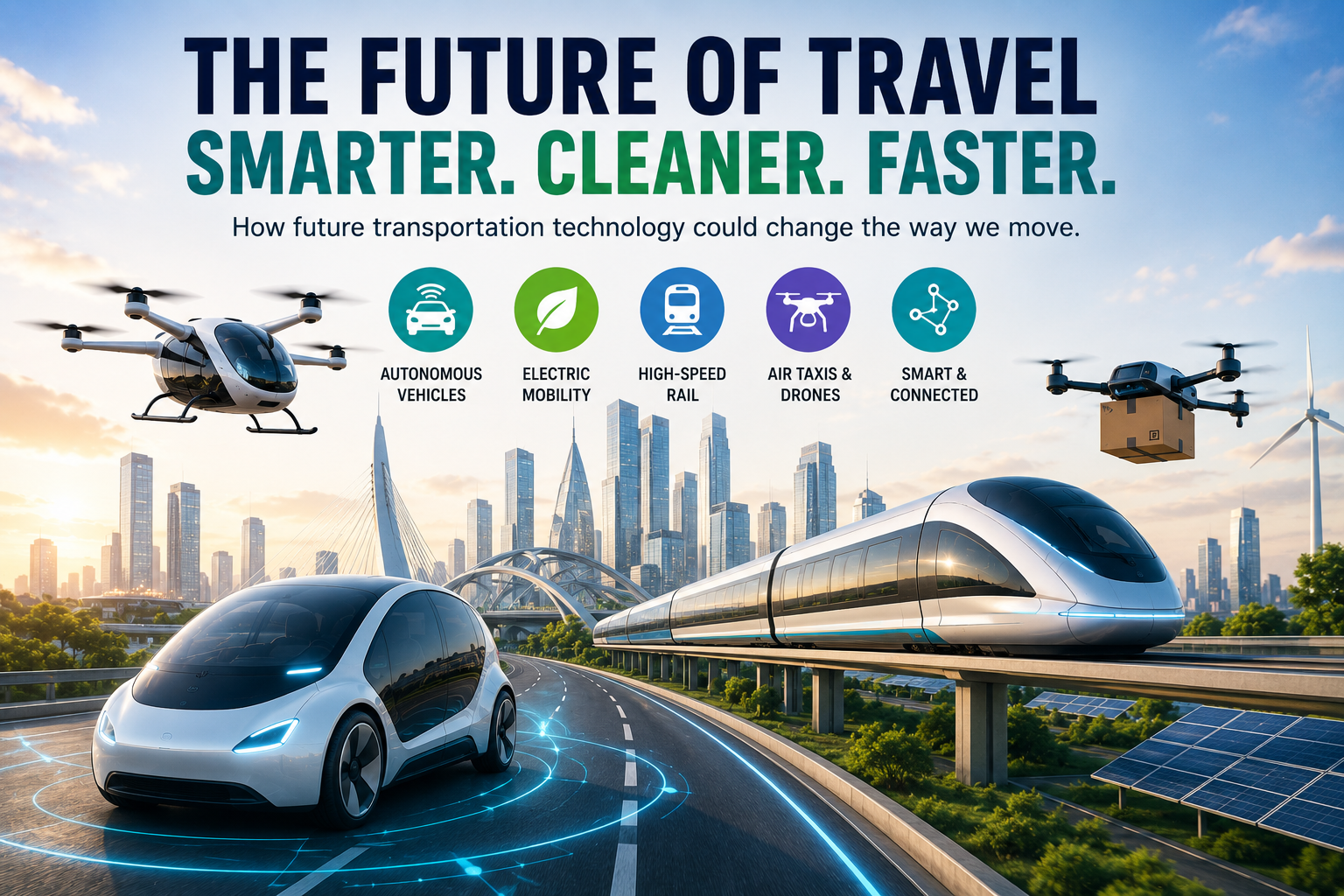
Advances in electric vehicles, autonomous driving, artificial intelligence, high-speed rail, electric aircraft, connected infrastructure and new forms of urban transportation could change not only how quickly people travel, but also where they live, how cities are designed and how frequently they move between places.
Some technologies are already entering everyday use, while others remain experimental. Together, they point toward a transportation system that could eventually be cleaner, more automated, more connected and potentially more convenient.
The technologies behind this transformation overlap heavily with robotics and intelligent machines. For a broader overview of how autonomous systems, sensors, artificial intelligence and machine control are coming together, see The Complete Guide to Robotics and Consumer Robots.
This broader shift is also closely connected to the development of electric transportation. For an overview of electric vehicles, their powertrains, batteries, charging systems and role in modern transportation, see Electric Vehicles Explained.
These technologies form part of the wider emerging technology and innovation landscape, where AI, robotics, connected infrastructure and advanced transportation systems increasingly overlap.
Electric Vehicles Could Become the Default
Electric vehicles are likely to play a central role in the future of road transportation.
Battery technology has improved considerably, allowing electric cars to travel longer distances while charging infrastructure continues to expand.
As battery costs, charging speeds and vehicle technology improve, electric vehicles could become increasingly practical for everyday drivers.
The transition would affect more than passenger cars.
Electric buses, delivery vans, trucks, motorcycles and other forms of transportation are also being developed with electric powertrains.
For travelers, widespread electrification could mean quieter roads, fewer tailpipe emissions and potentially lower operating costs.
The biggest challenges will include charging availability, electricity infrastructure, battery production and the environmental impact of manufacturing and disposing of batteries.
Autonomous Vehicles Could Change the Meaning of Driving
Self-driving technology could eventually transform the relationship between people and cars.
Today’s vehicles already contain systems that can assist with braking, steering, parking and maintaining distance from other vehicles. More advanced autonomous systems aim to perform increasingly complex driving tasks with less human intervention.
If fully autonomous vehicles become reliable and widely approved, passengers could potentially work, read, rest or communicate during journeys instead of concentrating on the road.
This could be particularly significant for people who cannot drive because of age, disability or other circumstances.
For a detailed explanation of the sensors, artificial intelligence, computer vision and control systems that make autonomous driving possible, see How Self-Driving Cars Work.
However, autonomous transportation still faces major technological, regulatory and ethical challenges. A vehicle must be able to deal with unpredictable pedestrians, weather, road conditions and unusual situations that are difficult to reproduce in testing environments.
Robotaxis Could Transform Urban Travel
One potential application of autonomous driving is the robotaxi.
Instead of owning a vehicle, passengers could use an app to request an autonomous car that arrives when needed.
A large-scale robotaxi network could change how people think about car ownership.
If autonomous rides become affordable and reliable, some households might decide that purchasing and maintaining a private vehicle is unnecessary.
Cities could also potentially redesign parking areas, since autonomous vehicles could spend more time transporting passengers instead of sitting unused.
But there is an important complication.
If autonomous rides are too cheap and convenient, they could encourage people to choose cars instead of walking, cycling or public transportation. That could increase congestion rather than reduce it.
The effect will depend heavily on how autonomous vehicles are integrated into wider transportation systems.
Electric Air Taxis Could Shorten Urban Journeys
One of the most futuristic developments in transportation is electric vertical takeoff and landing aircraft, commonly known as eVTOLs.
These aircraft are being developed for applications that could include air taxis, emergency services and regional transportation.
Instead of traveling through congested roads, passengers could potentially fly between designated landing locations.
For certain journeys, this could dramatically reduce travel time.
A trip that takes an hour by road might eventually take only a fraction of that time by air.
The technology still faces major obstacles, including battery limitations, aircraft certification, noise, airspace management, infrastructure and operating costs.
Whether air taxis become an everyday transportation option or remain a specialized service will depend on how successfully those challenges are addressed.
High-Speed Rail Could Make Short Flights Less Necessary
Future transportation will not necessarily mean putting more vehicles into the sky.
Improved rail networks could provide a faster and more efficient alternative for journeys between cities.
High-speed rail can already connect major population centers in parts of the world at speeds that make it competitive with short-haul flights.
Future improvements could involve faster trains, automated operations, better signaling and more integrated stations.
For travelers, the biggest advantage is not simply speed.
Rail stations are often located closer to city centers than airports, potentially reducing the time spent traveling to and from the transportation hub.
Maglev Could Push Train Speeds Even Higher
Magnetic levitation, or maglev, trains use magnetic forces to lift and propel trains rather than relying on conventional wheels and rails in the same way as traditional rail systems.
The technology can reduce certain forms of mechanical friction and potentially support very high speeds.
If large-scale maglev networks become economically viable, they could significantly reduce travel times between major cities.
However, constructing entirely new rail infrastructure is enormously expensive.
The technology therefore faces a practical question: can the time savings justify the cost of building specialized infrastructure?
In densely populated corridors with heavy travel demand, the answer could be more favorable.
Hyperloop Concepts Aim to Rethink Rail Travel
Another transportation concept involves moving passenger or cargo vehicles through low-pressure tubes at extremely high speeds.
Often described using the term hyperloop, these systems aim to reduce air resistance and potentially allow very rapid ground transportation.
The concept has attracted significant attention, but large-scale commercial deployment faces substantial engineering, financial and regulatory challenges.
Unlike conventional rail, which has decades of established infrastructure and operating experience, tube-based high-speed transportation would require entirely new systems.
For now, it remains an emerging concept rather than a mainstream form of transportation.
Artificial Intelligence Could Coordinate Transportation
AI may have an important role even when it is not physically powering a vehicle.
Future transportation networks could use AI to analyze enormous amounts of information about traffic, weather, passenger demand and vehicle availability.
For example, an intelligent transportation system could adjust traffic signals according to real-time congestion rather than using fixed schedules.
Ride-sharing services could dynamically match passengers and vehicles.
Public transportation systems could adjust capacity according to demand.
Airports could optimize passenger flows and baggage handling.
The result could be a transportation network that responds continuously to changing conditions.
Smart Roads Could Communicate With Vehicles
The roads themselves could become more intelligent.
Connected infrastructure could provide vehicles with information about traffic conditions, road closures, hazards, weather and construction.
Vehicles could communicate with traffic systems and potentially with other vehicles.
This could help improve coordination at intersections and reduce some forms of congestion.
Connected infrastructure could also help autonomous vehicles navigate environments where road markings or visibility are poor.
The broader idea is to move from transportation systems in which vehicles operate largely independently toward networks where vehicles, roads and infrastructure exchange information continuously.
This is closely related to the principles behind connected devices and infrastructure. The Internet of Things Explained provides a broader look at how networked devices can communicate and exchange information.
Travel Could Become More Personalized
Future transportation could become increasingly responsive to individual preferences.
Imagine planning a trip and having a digital system automatically compare different options based on price, travel time, environmental impact, comfort and accessibility.
Instead of separately checking trains, buses, flights and ride-hailing services, travelers could receive an integrated itinerary.
A single journey might combine several modes:
Walk → autonomous shuttle → high-speed train → electric taxi.
The traveler would not necessarily need to manage each stage independently.
This concept is sometimes described as mobility as a service, where transportation is treated as an integrated network rather than a collection of disconnected services.
Autonomous Public Transportation Could Expand Access
Self-driving technology could also influence buses and shuttles.
Autonomous vehicles could potentially operate fixed routes, on-demand services or smaller neighborhood transportation networks.
This could be particularly useful in areas where traditional bus routes are expensive to operate because passenger demand varies throughout the day.
Smaller autonomous shuttles could connect residential areas with major transportation hubs.
However, public transportation is not only about technology. Affordability, accessibility, coverage and reliability will remain critical considerations.
Battery Technology Could Determine How Far Electric Travel Goes
The future of electric transportation depends heavily on batteries.
Cars can operate with relatively large battery packs, but aviation presents a much more difficult challenge because aircraft must carry their energy source while minimizing weight.
Advances in battery energy density could therefore determine how far electric aircraft can realistically travel.
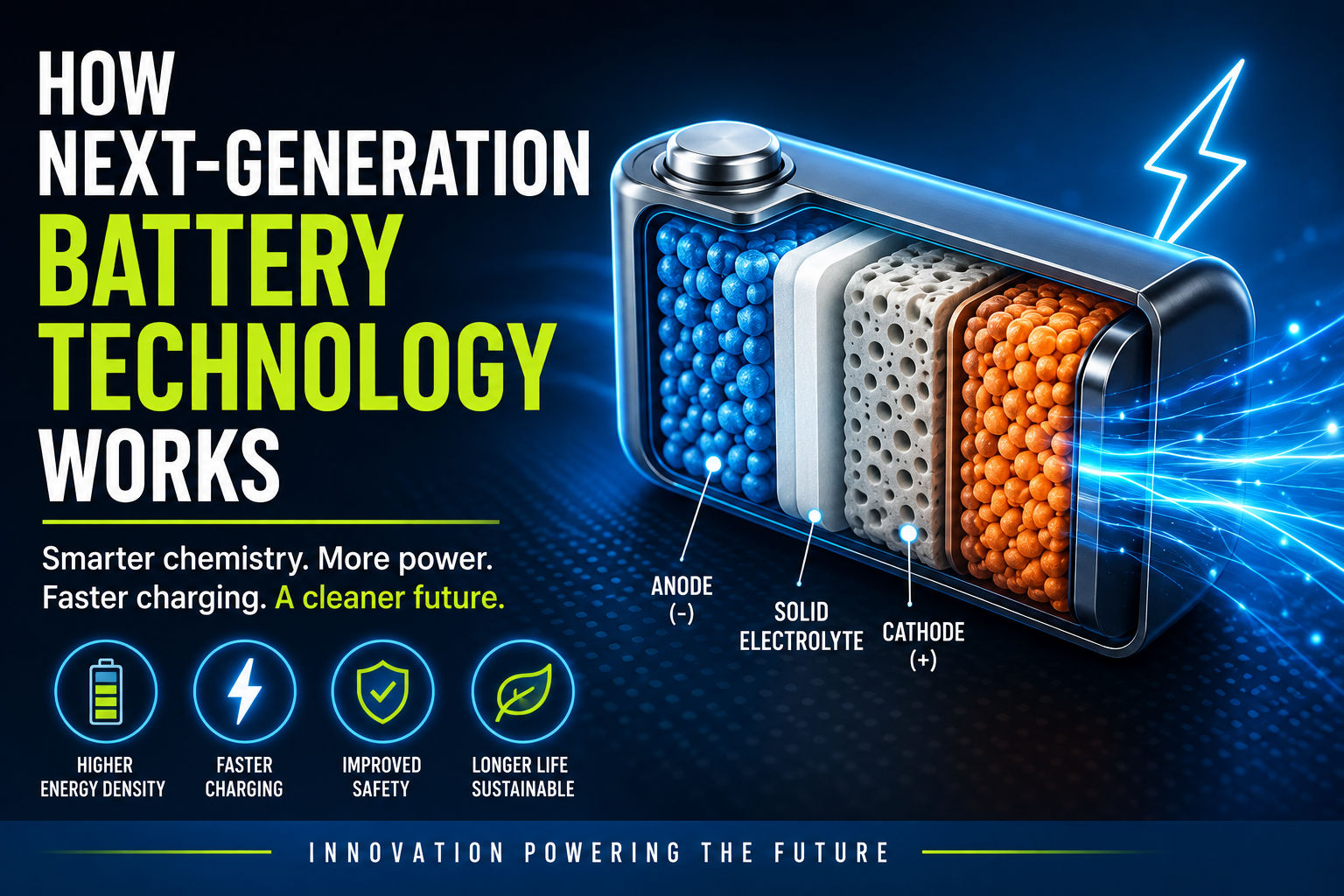
For a deeper explanation of emerging battery technologies and how they could affect electric transportation, see How Next-Generation Battery Technology Works.
Other technologies, including hydrogen-based systems and alternative fuels, may also play roles in future aviation.
Rather than one technology replacing every other option, transportation could develop into a mixture of solutions optimized for different distances and applications.
Airports Could Become More Automated
Air travel itself could change even if conventional aircraft remain in use.
Artificial intelligence, biometric systems, robotics and automated baggage handling could reduce the amount of time passengers spend moving through airports.
Automated check-in, security processes and boarding systems could potentially make airport journeys more seamless.
Aircraft maintenance could also become increasingly data-driven.
Sensors can monitor aircraft systems and provide information that helps maintenance teams identify potential problems before they become serious.
This could improve reliability while reducing unnecessary downtime.
Drones Could Transform More Than Delivery
Drones are often associated with small package deliveries, but their potential applications are broader.
Autonomous or remotely operated aircraft could support surveying, infrastructure inspection, emergency response, agriculture and medical logistics.
In some regions, drones could eventually help deliver essential goods to locations that are difficult to reach by conventional transportation.
For a closer look at how these unmanned aircraft combine sensors, flight controllers, navigation and autonomous technologies, see Drones Explained.
Passenger drones represent a much more complex challenge, requiring sophisticated safety systems and extensive regulatory oversight.
Nevertheless, the broader expansion of autonomous aerial technology could reshape how certain goods and services move.
Roads Could Become More Energy Efficient
Future transportation infrastructure may also incorporate energy-generation and energy-management technologies.
Electric vehicle charging could become faster and more widely distributed.
Smart charging systems could determine when vehicles should charge based on electricity demand and grid conditions.
In some cases, vehicles could potentially return electricity to the grid, creating a more interactive relationship between transportation and energy systems.
This could become increasingly important as millions of electric vehicles connect to electricity networks.
For a broader explanation of charging systems and the technologies that support modern electric transportation, see the Complete Guide to Charging Technology.
Transportation Could Become More Accessible
Technology has the potential to improve mobility for people who face transportation barriers.
Autonomous vehicles could eventually provide greater independence to some people who cannot drive.
Accessible vehicle designs can accommodate wheelchairs and other mobility requirements.
Real-time travel information can help passengers identify accessible routes and transportation services.
AI-powered navigation could also provide personalized assistance based on an individual’s needs.
The challenge will be ensuring that these technologies are affordable and available beyond wealthy neighborhoods and major cities.
Faster Travel Could Change Where People Live
Transportation technology can influence geography.
When travel between two cities becomes significantly faster, the practical distance between them effectively shrinks.
High-speed rail has already demonstrated how improved transportation can connect urban areas into larger economic regions.
Autonomous vehicles could make long commutes less burdensome if passengers no longer have to drive.
Remote work may also combine with improved transportation to make it easier for people to live farther from traditional employment centers.
Over time, these changes could influence housing markets, urban development and the distribution of economic activity.
Cities May Need Less Space for Parking
Autonomous and shared transportation could potentially reduce demand for privately owned vehicles.
If fewer people own cars, cities might need less land dedicated to parking.
Parking lots and garages could potentially be converted into housing, parks, businesses or public spaces.
However, this outcome is not guaranteed.
If autonomous vehicles simply replace privately driven vehicles while continuing to make car travel inexpensive and convenient, cities could still experience significant traffic and land-use pressures.
Urban planning will therefore determine whether transportation technology produces more efficient cities or simply creates new forms of congestion.
Environmental Benefits Will Depend on How Technology Is Used
Future transportation technologies are often presented as inherently cleaner.
Electric vehicles can eliminate tailpipe emissions, but their overall environmental impact depends partly on how electricity is generated and how batteries are manufactured.
Similarly, replacing private vehicles with shared autonomous transportation could reduce the number of vehicles needed—but only if those systems are actually shared efficiently.
The environmental outcome will depend on the entire transportation system, including energy production, manufacturing, infrastructure and travel behavior.
Technology creates possibilities, but policy and consumer choices determine how those possibilities are used.
Cybersecurity Will Become More Important
Connected transportation also creates new cybersecurity challenges.
A modern vehicle can contain numerous computers and communication systems. Future autonomous vehicles could depend even more heavily on software and connectivity.
Transportation networks will therefore need strong protections against unauthorized access, malicious software and data theft.
The consequences of a cyberattack could be more serious when transportation systems become increasingly automated.
Security will need to be built into vehicles and infrastructure from the beginning rather than treated as an afterthought.
Privacy Could Become Another Major Issue
Connected transportation systems may collect substantial amounts of information.
A vehicle could potentially know where someone travels, when they leave home, which destinations they visit and how frequently they use particular transportation services.
This information can improve services, but it also raises privacy questions.
Who owns the data?
Who can access it?
How long is it stored?
Can it be sold or shared?
Future transportation policy will need to address these questions as mobility becomes increasingly digital.
Not Every Futuristic Idea Will Become Reality
Transportation history is filled with technologies that promised to revolutionize travel but never achieved widespread adoption.
Cost, infrastructure requirements, regulation, safety concerns and consumer preferences can all determine whether a promising technology becomes commercially viable.
Some concepts may remain useful only in specialized applications.
Others could become unexpectedly important.
The technologies that ultimately succeed will probably be those that solve real transportation problems at a reasonable cost rather than simply offering impressive specifications.
The Future May Be a Combination of Technologies
There is unlikely to be a single technology that defines the future of transportation.
Instead, different systems will probably complement one another.
Electric cars could dominate everyday road travel. Autonomous shuttles could connect neighborhoods. High-speed trains could link major cities. Electric aircraft could serve shorter regional routes. Drones could handle specialized deliveries. AI could coordinate the entire network.
The traveler may eventually care less about the individual vehicle and more about how easily all of these systems work together.
A More Connected Way to Move
Future transportation technology could fundamentally change the experience of travel.
The biggest transformation may not be that cars become electric or trains become faster. It may be that transportation becomes more integrated.
A journey could be planned automatically, vehicles could communicate with infrastructure, payments could happen seamlessly and different forms of transportation could coordinate around the passenger’s needs.
That could make travel faster and potentially more convenient while creating new challenges involving affordability, privacy, cybersecurity, infrastructure and environmental sustainability.
The most successful transportation systems of the future will likely be those that combine technological innovation with thoughtful planning. The objective is not simply to move people faster, but to create safer, cleaner, more accessible and better-connected ways to move through the world.