How Next-Generation Battery Technology Works
Batteries are becoming one of the most important technologies in the transition toward a more electrified world.
Electric vehicles, smartphones, laptops, renewable-energy systems, drones and increasingly powerful consumer devices all depend on batteries that can store and deliver energy efficiently. As these technologies become more demanding, conventional lithium-ion batteries are approaching some of their practical limits.
Researchers and manufacturers are therefore developing a new generation of battery technologies designed to store more energy, charge faster, last longer, operate more safely and potentially reduce reliance on expensive or difficult-to-source materials.
Next-generation batteries do not refer to one single invention. The term covers several approaches, including solid-state batteries, lithium-metal batteries, sodium-ion batteries, lithium-sulfur systems and improved versions of conventional lithium-ion cells.
These developments are part of the wider shift toward emerging technologies that are changing transportation, energy storage, electronics, robotics, and other industries. The Complete Guide to Emerging Technology and Innovation explores how advances across these fields are contributing to the next generation of technology.
Understanding how these technologies work starts with understanding what happens inside an ordinary battery.
How a Conventional Battery Works
A rechargeable battery stores chemical energy and converts it into electrical energy when a device needs power.
A typical lithium-ion battery contains several key components:
-
Cathode: The positive electrode during discharge.
-
Anode: The negative electrode during discharge.
-
Electrolyte: A material that allows ions to move between the electrodes.
-
Separator: A thin layer that keeps the electrodes apart while allowing ions to pass through.
-
Current collectors: Conductive materials that move electrons into and out of the battery.
When the battery powers a device, lithium ions move through the electrolyte from the anode toward the cathode.
Electrons cannot pass through the electrolyte in the same way. Instead, they travel through the external electrical circuit, creating the electric current used by the device.
When the battery is recharged, an external power source reverses the process and drives the lithium ions back toward the anode.
This basic mechanism has powered portable electronics and electric vehicles for decades.
Why Batteries Need to Improve
Conventional lithium-ion technology has improved considerably, but it faces several competing demands.
Consumers want smartphones that run longer without becoming larger. Electric-vehicle drivers want greater range without carrying an enormous battery pack. Renewable-energy operators need storage systems capable of holding electricity for longer periods.
At the same time, batteries need to remain affordable, durable and safe.
Improving one characteristic can sometimes make another more difficult to achieve.
For example, increasing energy density can introduce additional safety or material challenges. Faster charging can increase heat generation and accelerate degradation if the battery is not carefully engineered.
Next-generation battery research is therefore about finding better combinations of materials and designs.
What Energy Density Means
One of the most important battery measurements is energy density.
Energy density describes how much energy a battery can store relative to its size or weight.
Higher energy density can allow a device to operate longer without increasing the size of its battery.
For electric vehicles, this can translate into greater driving range or a smaller battery pack for the same range.
Improving energy density is one reason researchers are exploring new electrode materials and battery architectures.
The importance of better batteries is particularly clear in electric transportation, where battery capacity directly influences range, weight and vehicle efficiency. Electric Vehicles Explained provides a broader look at how battery technology fits into the design and operation of electric vehicles.
Solid-State Batteries Replace the Liquid Electrolyte
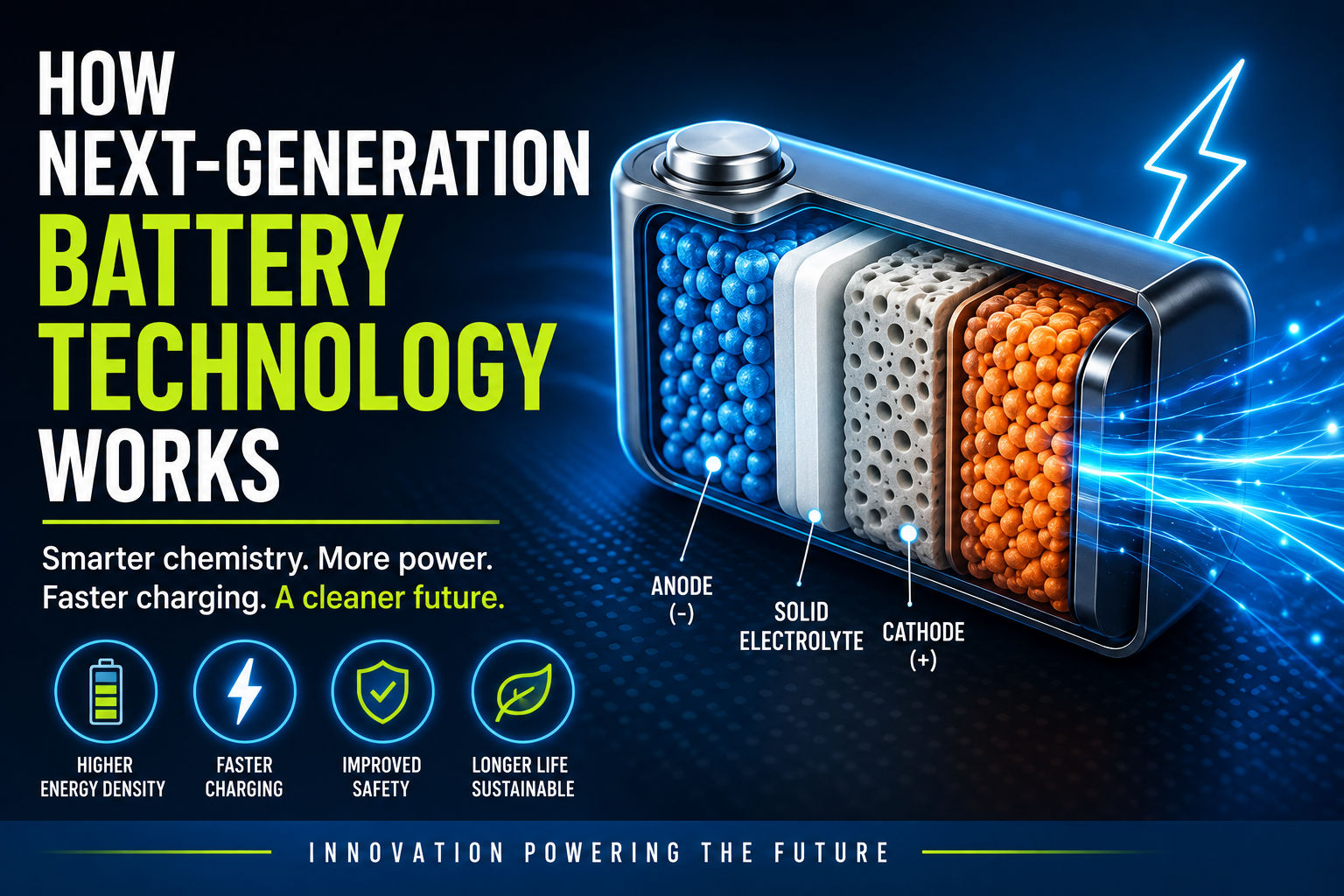
One of the most closely watched next-generation technologies is the solid-state battery.
Traditional lithium-ion batteries generally use a liquid or gel electrolyte. Solid-state designs replace this with a solid electrolyte.
The basic idea is straightforward: lithium ions still need to move between the electrodes, but they travel through a solid material instead of a conventional liquid electrolyte.
Potential advantages include:
-
Higher energy density
-
Improved thermal stability
-
Reduced risk of certain types of leakage
-
Potentially faster charging
-
Compatibility with lithium-metal anodes
Solid electrolytes can be made from different classes of materials, including ceramics, polymers and other engineered compounds.
The challenge is making these materials conduct ions efficiently while maintaining good physical contact with the electrodes.
Why Solid-State Batteries Are Difficult to Manufacture
A promising laboratory result does not automatically translate into a commercially successful battery.
Solid-state batteries face manufacturing challenges involving interfaces, materials processing, durability and production consistency.
The boundary between a solid electrolyte and an electrode needs to remain effective as the battery repeatedly charges and discharges.
Small imperfections can become significant problems when thousands of cells are manufactured for vehicles or other large-scale applications.
Manufacturers therefore need production processes that can deliver consistent performance at industrial scale.
Lithium-Metal Batteries Could Store More Energy
Another important direction is the lithium-metal battery.
Many conventional lithium-ion batteries use graphite as the anode. Lithium-metal designs instead use metallic lithium.
Because lithium metal can store a large amount of charge relative to its weight, replacing graphite with lithium metal has the potential to increase energy density.
However, lithium metal introduces difficult engineering problems.
During charging, lithium can sometimes form structures known as dendrites. These needle-like formations can potentially cross the separator and create an internal short circuit.
Researchers are investigating electrolytes, coatings, separators and battery structures that can reduce this problem.
Solid-state technology is also frequently discussed alongside lithium-metal batteries because certain solid electrolytes may help enable lithium-metal anodes.
Sodium-Ion Batteries Take a Different Approach
Not every next-generation battery is designed around lithium.
Sodium-ion batteries replace lithium ions with sodium ions.
Sodium is abundant and widely distributed, which can offer potential advantages in terms of material availability and supply-chain diversity.
Sodium-ion technology generally has lower energy density than the highest-performing lithium-ion systems, but that does not make it unsuitable for every application.
For uses where weight and volume are less critical, sodium-ion batteries could provide an attractive alternative.
Potential applications include stationary energy storage, lower-cost electric vehicles and other systems where affordability and material availability are especially important.
Lithium-Sulfur Batteries Use a Different Chemistry
Lithium-sulfur batteries are another technology receiving significant research attention.
Instead of using conventional cathode materials based on metal oxides, lithium-sulfur batteries use sulfur.
Sulfur is relatively abundant and inexpensive compared with some materials used in conventional high-performance batteries.
The chemistry also has the theoretical potential for very high energy density.
However, lithium-sulfur batteries face problems such as capacity degradation and chemical reactions that can cause active materials to migrate within the cell.
Researchers are working on electrode structures, electrolytes and protective layers designed to control these reactions.
If these challenges can be solved economically, lithium-sulfur technology could be particularly interesting for applications where low weight is important.
Silicon Could Transform the Anode
Next-generation battery technology does not always require replacing the entire battery chemistry.
Sometimes a major improvement can come from changing one component.
Silicon is one example.
Silicon can theoretically hold significantly more lithium than graphite, making it an attractive candidate for higher-capacity anodes.
The problem is that silicon expands substantially when it absorbs lithium and contracts again when the battery is discharged.
Repeated expansion and contraction can damage the electrode and cause capacity to decline.
Researchers are therefore developing silicon-carbon composites, engineered particles, protective coatings and other structures designed to accommodate the material’s movement.
Some modern batteries already incorporate silicon in their anodes, while research continues toward greater silicon content.
New Battery Designs Can Improve Fast Charging
Charging speed depends on much more than the amount of electricity entering a battery.
Fast charging requires lithium ions to move efficiently through the electrolyte and electrodes without creating excessive heat, unwanted chemical reactions or damaging structural changes.
Battery engineers can improve charging performance through:
-
Electrode design
-
Electrolyte chemistry
-
Particle size
-
Thermal management
-
Charging algorithms
-
Battery architecture
The battery-management system is particularly important because charging has to be controlled according to temperature, state of charge and other operating conditions.
A battery that can technically accept a large amount of power is not necessarily capable of doing so safely under every condition.
Understanding the wider charging ecosystem is also important for electric transportation and other battery-powered systems. The Complete Guide to Charging Technology explains the technologies and principles behind modern charging systems.
Battery Management Systems Are Becoming Smarter
A modern battery is more than a collection of electrochemical cells.
It also includes a battery-management system, or BMS.
The BMS monitors conditions such as voltage, temperature and state of charge. It can control charging and discharging to help protect the battery.
More advanced systems can use data and algorithms to estimate battery health and predict how much usable capacity remains.
As batteries become more sophisticated, software is becoming an increasingly important part of battery performance.
Thermal Management Is Critical
Heat is one of the major challenges in battery engineering.
High temperatures can accelerate degradation and, under certain circumstances, contribute to dangerous failures.
Electric vehicles therefore use thermal-management systems to keep battery packs within appropriate operating ranges.
Depending on the design, these systems can use air, liquid cooling, heat exchangers or other approaches.
Next-generation batteries may improve inherent thermal stability, but thermal management will remain important because energy is being stored and released at increasingly high power levels.
Battery Architecture Matters Too
Battery performance is determined not only by chemistry but also by how cells are constructed.
A battery pack can contain hundreds or thousands of individual cells, depending on its design.
Engineers are developing new approaches to reduce unnecessary packaging, improve cooling and make better use of the available space.
One approach is to integrate cells more directly into the battery pack structure.
Reducing the amount of material that does not directly store energy can increase the proportion of the total pack devoted to useful energy storage.
Batteries for Renewable Energy Need Different Characteristics
The best battery for an electric car is not necessarily the best battery for a solar or wind farm.
Electric vehicles place a premium on energy density, weight, power and charging performance.
Stationary storage can prioritize other characteristics, including cost, lifespan, safety and the availability of raw materials.
This is why researchers are exploring many different battery chemistries rather than searching for one universal solution.
Large-scale energy storage could eventually include a mixture of lithium-ion, sodium-ion, flow batteries and other technologies.
What Makes a Battery Last Longer?
Battery lifespan depends on how the battery is designed and how it is used.
Repeated charging and discharging causes chemical and structural changes inside the cell.
Factors that can influence degradation include:
-
Temperature
-
Charging speed
-
Depth of discharge
-
Time spent at high charge levels
-
Operating conditions
-
Electrode materials
-
Electrolyte chemistry
Battery manufacturers can use chemistry and software to manage these factors.
For consumers, avoiding excessive heat and following manufacturer charging guidance can help preserve battery performance.
Sustainability Is Becoming a Major Design Goal
Battery development is increasingly concerned with more than performance.
Researchers and manufacturers are also considering the environmental impact of extracting, processing, manufacturing, using and recycling battery materials.
Next-generation batteries could improve sustainability by reducing reliance on scarce materials, increasing energy efficiency or making recycling easier.
Sodium-ion technology, for example, has attracted attention partly because sodium is abundant.
Other research focuses on reducing the amount of critical minerals required in battery production and improving methods for recovering valuable materials from used cells.
Battery Recycling Could Become More Important
As the number of electric vehicles, renewable-energy systems and electronic devices grows, so will the number of batteries reaching the end of their useful lives.
Recycling can recover materials that would otherwise require additional mining and processing.
Modern battery recycling approaches can target materials such as lithium, nickel, cobalt, copper and other components, depending on the battery chemistry.
The challenge is making recycling economically viable while safely handling batteries with different designs and chemical compositions.
Designing batteries with recycling in mind could make the entire lifecycle more sustainable.
Why There Will Probably Not Be One Winning Battery
Battery technology is sometimes presented as a race in which one chemistry will eventually replace everything else.
The reality is likely to be more complicated.
Different applications have different requirements.
A lightweight drone may prioritize energy density. A city bus may emphasize durability and fast charging. A home-energy system may prioritize cost and longevity. A smartphone may need a combination of compact size, energy density and rapid charging.
Aerial systems are another example of applications where battery performance directly affects what is possible. The Complete Guide to Drones explores how battery capacity, weight and energy efficiency influence modern drone technology.
That creates room for multiple battery technologies to succeed simultaneously.
The Role of Manufacturing
Battery innovation ultimately depends on manufacturing.
A technology can demonstrate excellent performance in a laboratory and still fail commercially if it is too expensive, difficult to manufacture or unreliable at large scale.
Manufacturers need to produce enormous numbers of consistent cells while maintaining tight tolerances.
This means successful next-generation batteries will have to demonstrate more than impressive laboratory measurements.
They will need to prove that they can be produced economically, safely and reliably.
What the Future of Batteries Could Look Like
The next generation of batteries is likely to emerge gradually rather than through one dramatic replacement of existing technology.
Improved lithium-ion batteries are likely to remain important while new chemistries and architectures move from laboratories into specialized commercial applications.
Solid-state batteries could eventually offer higher energy density and new safety characteristics. Silicon-based anodes can increase the capacity of lithium-ion cells. Sodium-ion batteries may provide a lower-cost option for applications where maximum energy density is less important. Lithium-sulfur and other emerging chemistries could open additional possibilities if their technical challenges are overcome.
The result could be a much more diverse battery industry.
From Longer Phone Life to Longer-Range Electric Cars
Better batteries have consequences far beyond the battery itself.
A smartphone with greater energy density can become thinner or last longer between charges. An electric vehicle with a more capable battery can potentially travel farther without adding as much weight.
For renewable energy, improved storage can help electricity generated by solar and wind systems remain available when production falls.
For portable electronics, robotics, aviation and other emerging technologies, batteries can determine what is technically and economically practical.
That is why battery development has become such an important part of the broader technology industry.
The Battery Race Is Really an Efficiency Race
Next-generation battery technology is not simply about putting more energy into a smaller package.
The most successful batteries will need to balance energy density, charging speed, lifespan, safety, cost, material availability and environmental impact.
Researchers are approaching that challenge from multiple directions, changing electrode materials, replacing electrolytes, developing new chemistries and redesigning the physical structure of battery cells and packs.
Some technologies will likely remain experimental, while others will gradually become commercially important.
What is already clear is that better batteries could unlock technologies that are currently limited by energy storage. As researchers solve more of the chemistry and manufacturing challenges, batteries are likely to become smaller, more capable, longer-lasting and more adaptable to the needs of the next generation of devices and energy systems.