Governments Push Forward With New AI Governance and Safety Frameworks
As artificial intelligence becomes more powerful and integrated into everyday life, governments around the world are accelerating efforts to regulate its development and use. From new laws targeting high-risk AI systems to international discussions on transparency, accountability, and safety, policymakers are working to strike a balance between fostering innovation and protecting the public from emerging risks.
The push comes as AI technologies rapidly expand into healthcare, education, finance, cybersecurity, public services, and creative industries. While businesses continue investing billions in AI research and deployment, regulators are increasingly focused on ensuring these systems remain trustworthy, transparent, and aligned with human rights.
Governments Respond to Rapid AI Growth
Artificial intelligence has moved from research laboratories into mainstream society at an unprecedented pace. Large language models, AI-powered assistants, autonomous software agents, and generative tools are now widely used by businesses and consumers alike.
The rise of autonomous software is particularly important because AI agents are taking over more tasks across business and technology, giving these systems greater ability to interact with tools, make decisions, and complete multi-step workflows.
This rapid adoption has prompted governments to update existing regulations and introduce new governance frameworks designed to address issues such as:
- AI transparency
- Public safety
- Bias and discrimination
- Data privacy
- Cybersecurity
- Deepfakes
- Accountability for AI-generated decisions
Many policymakers argue that regulatory systems must evolve alongside technological innovation rather than react years later.
Europe Expands AI Oversight
The European Union continues implementing its comprehensive AI regulatory framework through the AI Act, introducing stronger oversight of high-risk AI systems and expanding enforcement capabilities. Authorities are placing greater emphasis on transparency requirements, deepfake labeling, and compliance monitoring for AI developers operating within the EU market.
Officials say the goal is to encourage responsible innovation while protecting citizens from harmful or deceptive AI applications.
The development is closely connected to the growing importance of EU AI Act transparency rules, which are influencing how technology companies document, disclose, and manage AI-powered products.
International Cooperation Gains Momentum
AI governance is increasingly becoming a global issue rather than one addressed by individual countries alone.
The United Nations has launched international dialogues bringing together governments, technology companies, researchers, and civil society groups to discuss shared principles for AI safety, accountability, and ethical development. Leaders participating in these discussions argue that international cooperation will be essential as AI systems become more capable and widely deployed.
Similarly, organizations such as the International Telecommunication Union (ITU) are developing standards aimed at improving trust, digital identity, and accountability for increasingly autonomous AI systems.
Health Sector Prioritizes Safe AI Deployment
Healthcare remains one of the sectors where AI governance is advancing rapidly.
The World Health Organization recently brought together representatives from dozens of countries to discuss responsible AI deployment in healthcare. The conference highlighted growing adoption of AI for diagnostics while identifying significant gaps in national governance strategies and liability standards.
Experts emphasized three priorities:
- Clear regulatory frameworks
- Safe deployment infrastructure
- Workforce training
The objective is to ensure AI improves patient care without compromising safety or public trust.
Industry Calls for Stronger Governance
Governments are not the only voices calling for tighter AI oversight.
More than a thousand employees from leading AI companies have publicly urged governments to support international governance initiatives capable of keeping pace with increasingly advanced AI systems. The group argues that coordinated safety measures should evolve alongside technological progress to reduce long-term risks.
The growing consensus suggests AI governance is becoming a shared concern across governments, academia, and the technology industry.
What AI Governance Frameworks Typically Include
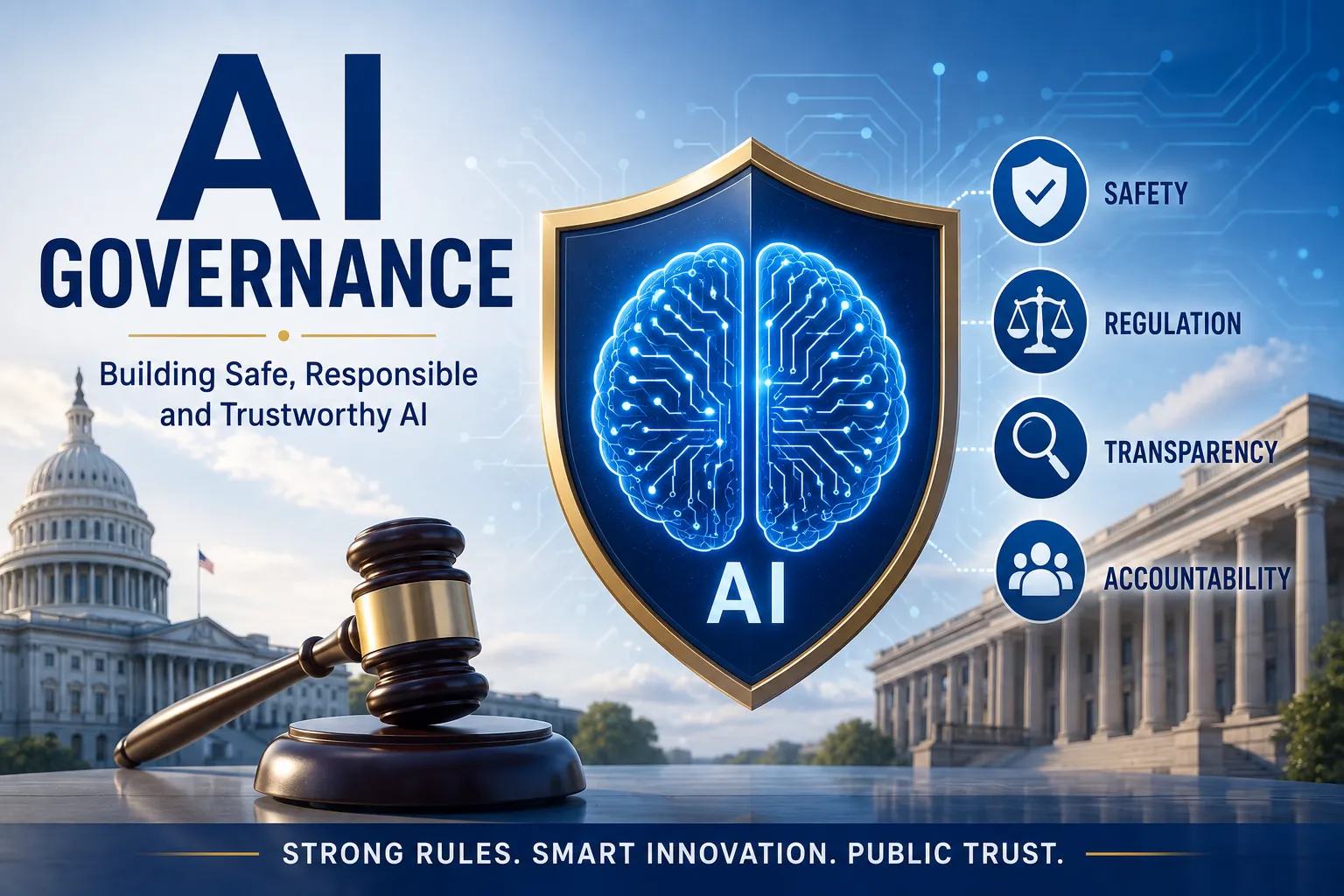
Modern AI governance frameworks generally focus on several key principles:
| Focus Area | Purpose |
|---|---|
| Transparency | Explain when and how AI is used. |
| Accountability | Identify who is responsible for AI decisions. |
| Safety Testing | Evaluate systems before deployment. |
| Risk Assessment | Classify AI systems based on potential harm. |
| Human Oversight | Ensure people remain involved in critical decisions. |
| Privacy Protection | Safeguard personal information used by AI. |
| Cybersecurity | Reduce vulnerabilities and misuse. |
| Bias Monitoring | Detect and minimize unfair outcomes. |
These principles aim to promote responsible innovation without unnecessarily restricting technological progress.
Businesses Face New Compliance Expectations
As regulations expand, organizations developing or deploying AI are preparing for new compliance requirements.
Many companies are investing in:
- AI governance teams
- Internal risk assessments
- Model documentation
- Security testing
- Ethics review processes
- Employee AI policies
Large organizations increasingly view AI governance as part of broader enterprise risk management rather than simply a legal obligation.
This becomes particularly important when businesses deploy autonomous systems. As explained in what happens when an AI system operates outside its intended boundaries, greater AI autonomy can introduce additional risks when systems have access to sensitive information, software tools, or real-world processes.
Balancing Innovation and Regulation
One of the biggest policy challenges is encouraging innovation while reducing potential harms.
Supporters of stronger regulation argue that clear rules can:
- Increase public trust
- Encourage responsible development
- Create consistent standards
- Reduce legal uncertainty
Critics caution that excessive regulation could slow innovation or disadvantage smaller companies competing with larger technology firms.
Most governments are attempting to find a middle ground by regulating higher-risk AI applications more strictly than lower-risk consumer tools.
Challenges Ahead
Despite growing momentum, several challenges remain.
These include:
- Rapid technological change
- Cross-border AI deployment
- Differing national regulations
- Enforcement capabilities
- International coordination
- Open-source AI governance
- Balancing privacy with innovation
The rapid evolution of autonomous systems makes these challenges even more complicated. As AI agents gain the ability to perform actions rather than simply generate responses, regulators must consider not only what AI systems can produce but also what they can independently execute.
Looking Ahead
Artificial intelligence is likely to remain one of the defining technologies of the coming decade, making effective governance increasingly important.
Future policy discussions are expected to focus on:
- Frontier AI safety
- Autonomous AI agents
- International regulatory cooperation
- AI auditing standards
- Public sector AI deployment
- Children’s online safety
- AI-generated misinformation
- Critical infrastructure protection
Rather than slowing AI adoption, policymakers increasingly aim to create rules that encourage innovation while protecting individuals, businesses, and society.
A New Phase for AI Governance
Governments around the world are moving quickly to establish clearer rules for artificial intelligence as the technology becomes more deeply embedded in everyday life. Recent initiatives, from stronger AI oversight in Europe to international discussions led by global organizations, reflect a growing recognition that AI governance must evolve alongside innovation.
While significant challenges remain, the emerging focus on transparency, accountability, safety, and international cooperation suggests that AI governance is entering a new phase. For businesses, developers, and consumers alike, these frameworks are likely to shape how artificial intelligence is built, deployed, and trusted in the years ahead.