How Internet of Things Devices Collect, Exchange and Process Data
The modern world is filled with devices that can sense, communicate and respond to information.
A smart thermostat can detect the temperature inside a home. A fitness tracker can monitor movement and heart rate. A connected security camera can identify activity around a property. Industrial sensors can monitor machinery, while connected vehicles can collect information about speed, location and operating conditions.
These devices are part of the Internet of Things (IoT), a broad network of physical objects equipped with sensors, software, connectivity and computing capabilities.
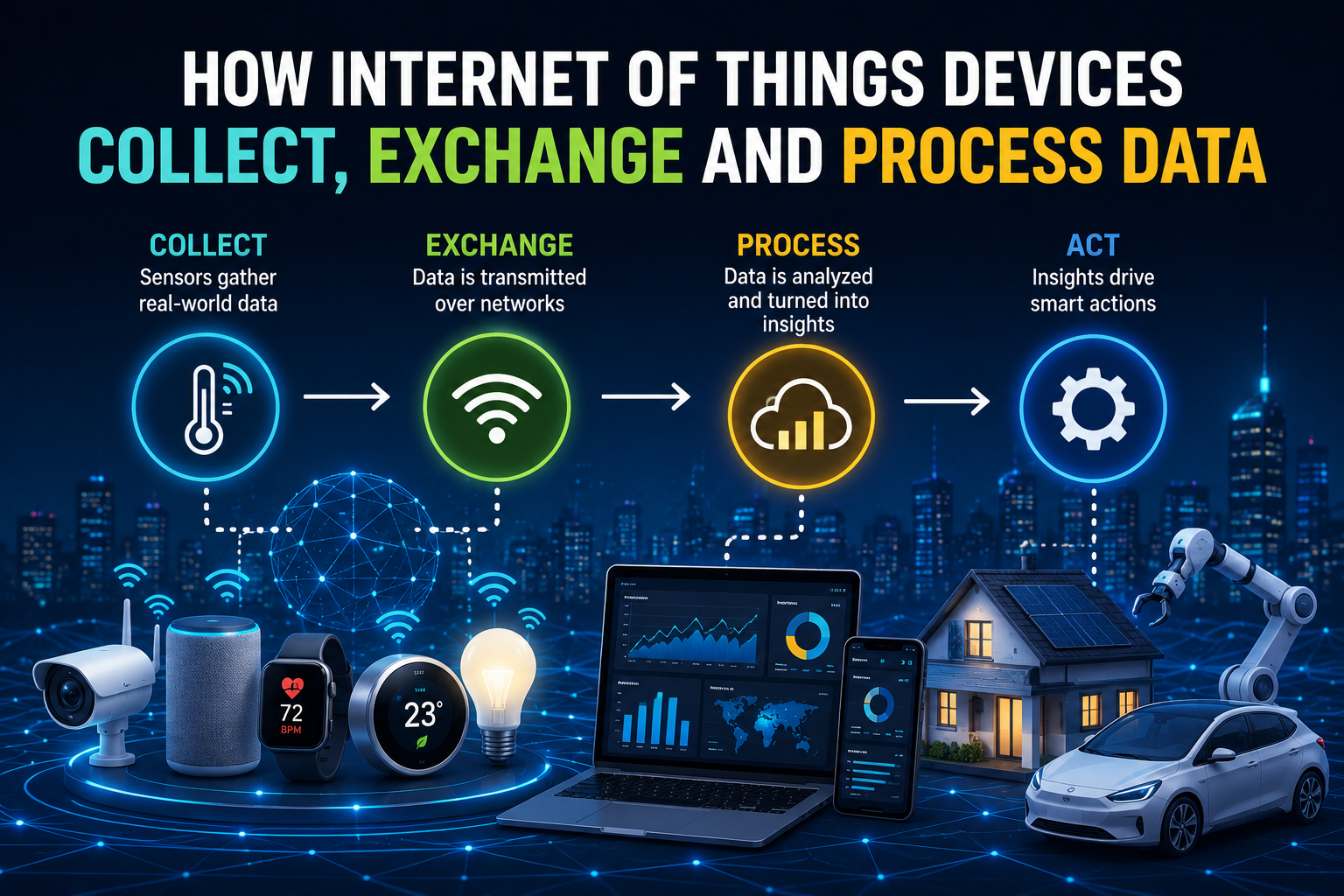
What makes IoT particularly powerful is not simply that devices can connect to the internet. It is that they can collect data from the physical world, exchange that information with other systems and process it to produce useful actions or insights.
Understanding how this happens provides a clearer picture of how smart homes, connected cars, industrial automation and other forms of future technology work.
For a broader introduction to connected devices and the technologies behind them, see The Internet of Things Explained.
For a broader look at how connected devices fit into modern homes, networks and automation, see The Complete Guide to Building an Intelligent Home.
What Is the Internet of Things?
The Internet of Things refers to physical devices that can collect and exchange data through communication networks.
An IoT device can be something relatively simple, such as a temperature sensor, or something highly sophisticated, such as an autonomous industrial machine.
Common IoT devices include:
- Smart thermostats
- Fitness trackers
- Smart watches
- Connected appliances
- Security cameras
- Smart lighting
- Connected vehicles
- Industrial sensors
- Agricultural monitoring systems
- Medical monitoring equipment
- Smart energy meters
- Environmental sensors
The devices differ greatly, but most IoT systems involve three fundamental activities:
Sensing → Communication → Processing
A device first gathers information from its surroundings. It then communicates that information to another device, local system or cloud platform. Finally, the data is processed to produce an insight, decision or action.
How IoT Devices Collect Data
The first stage of an IoT system is data collection.
IoT devices use sensors to detect physical conditions.
A sensor is a component capable of measuring something in the environment.
Depending on the device, sensors can measure:
- Temperature
- Humidity
- Pressure
- Movement
- Light
- Sound
- Location
- Acceleration
- Rotation
- Air quality
- Proximity
- Electrical activity
A smart thermostat, for example, may use a temperature sensor to determine whether a room is becoming too hot or cold.
A fitness tracker may combine motion sensors with other sensors to estimate activity levels.
An agricultural IoT system could measure soil moisture to help determine when crops require water.
Sensors Turn Physical Conditions Into Data
The physical world does not naturally exist as digital information.
Temperature is a physical condition. Movement is a physical event. Pressure is a physical force.
Sensors convert these conditions into measurable signals that electronic systems can interpret.
For example, a temperature sensor might detect that a room is approximately 24 degrees Celsius.
The device can represent that measurement digitally and associate it with information such as:
- Time
- Device identification
- Location
- Measurement type
The resulting data can then be processed locally or transmitted elsewhere.
IoT Devices Collect More Than One Type of Data
Many connected devices use multiple sensors at the same time.
A modern smartphone is a good example.
It may contain sensors for:
- Acceleration
- Rotation
- Location
- Light
- Proximity
- Magnetic fields
- Cameras
- Microphones
The device can combine information from these different components to understand what is happening.
A smartphone might use accelerometer and gyroscope data to determine whether the device is being rotated.
A connected vehicle can similarly combine information from many sensors to understand its speed, position, engine conditions and surroundings.
Sampling Determines How Often Data Is Collected
An IoT device does not necessarily need to measure its environment continuously.
Instead, it may collect data at specific intervals.
A weather sensor could take a temperature reading every minute.
A smart electricity meter might record consumption at regular intervals.
A fitness tracker may continuously monitor certain measurements while using lower-power sampling strategies for others.
The appropriate sampling rate depends on the application.
Collecting data more frequently can provide greater detail, but it can also increase energy consumption, storage requirements and network traffic.
Data Is Often Cleaned Before It Is Used
Raw sensor readings are not always perfect.
Sensors can produce noise, temporary errors or unusual measurements.
An IoT system may therefore process data before sending or using it.
For example, if a temperature sensor suddenly reports a dramatic reading that is inconsistent with previous measurements, the system may flag it as potentially unreliable.
Filtering and validation techniques can help prevent poor-quality data from producing incorrect decisions.
How IoT Devices Exchange Data
Once an IoT device has collected information, it needs a way to communicate.
IoT devices can use a variety of communication technologies depending on their purpose.
These include:
- Wi-Fi
- Bluetooth
- Bluetooth Low Energy
- Cellular networks
- Ethernet
- Zigbee
- Z-Wave
- LoRaWAN
- Near-field communication
- Satellite connections
The choice depends on factors such as range, power consumption, bandwidth, cost and environmental conditions.
A smart home sensor may need only a small amount of data and can prioritize low power consumption.
An industrial camera transmitting high-resolution video requires much more bandwidth.
For a deeper look at the networking technologies used by connected devices, see the Complete Guide to Wireless Connectivity.
Wi-Fi Is Common in Connected Homes
Wi-Fi is widely used by consumer IoT devices because it provides relatively high data rates and is already available in many homes and businesses.
Smart televisions, security cameras, appliances and speakers can connect directly to a wireless network.
The advantage is convenience.
The disadvantage is that Wi-Fi-connected devices can consume more power than some low-energy communication technologies.
This matters particularly for small battery-powered sensors.
Bluetooth Works Well for Nearby Devices
Bluetooth is designed for relatively short-range communication.
It is particularly useful for devices such as:
- Fitness trackers
- Smart watches
- Wireless sensors
- Headphones
- Health-monitoring devices
Bluetooth Low Energy (BLE) is especially important for IoT because it is designed to reduce power consumption.
A small sensor can potentially operate for a long period using a small battery while communicating periodically with a nearby smartphone or gateway.
Cellular Networks Enable Wide-Area Connectivity
Some IoT devices need to communicate over long distances without relying on a local Wi-Fi network.
Cellular connectivity can provide that capability.
Connected vehicles, tracking devices and certain industrial systems can use cellular networks to transmit information from locations far from conventional internet connections.
Specialized cellular technologies designed for IoT can also prioritize characteristics such as low power consumption and broad coverage.
Low-Power Networks Support Small Sensors
Some IoT applications involve sensors that transmit very small amounts of information over long distances.
Agriculture, environmental monitoring and smart-city applications can benefit from technologies designed specifically for low-power, wide-area communication.
Instead of sending large amounts of information continuously, these sensors might transmit small packets of data at regular intervals.
This allows battery-powered devices to remain operational for long periods.
Gateways Connect IoT Devices to Larger Networks
Not every IoT device needs to connect directly to the internet.
Many systems use an IoT gateway.
A gateway acts as an intermediary between local devices and a wider network.
For example:
Sensor → Gateway → Internet → Cloud platform
The gateway can collect information from multiple nearby devices and forward it to a central system.
It may also perform local processing, security functions or protocol conversion.
This architecture can reduce the complexity of connecting large numbers of sensors directly to the internet.
Devices Can Communicate With Each Other
IoT does not always mean that every device sends information to a distant cloud server.
Devices can sometimes communicate directly with one another.
For example, a motion sensor could communicate with smart lighting.
When movement is detected, the sensor sends a message that causes the lights to turn on.
In this situation, the system can operate without requiring every step to pass through a remote server.
This type of local interaction can reduce delays and improve reliability.
What Happens to IoT Data After It Is Collected?
Once data has been transmitted, it needs to be processed.
Processing can happen in several locations:
- On the device itself.
- On a nearby gateway.
- On an edge-computing system.
- In a cloud data center.
- Across several of these layers.
Where processing occurs can have a major effect on performance, cost and privacy.
Edge Computing Processes Data Closer to the Device
Edge computing involves processing information close to where it is generated rather than sending everything to a distant cloud server.
This can be valuable when an IoT system needs a rapid response.
Consider an industrial machine that detects a dangerous operating condition.
It may be better for a nearby computer to analyze the sensor data and stop the machine immediately than to send the information across the internet and wait for a remote server to respond.
Edge computing can therefore reduce latency.
Cloud Computing Provides Large-Scale Processing
Cloud platforms can provide enormous amounts of computing and storage capacity.
IoT systems can send data to cloud servers where it can be:
- Stored
- Analyzed
- Visualized
- Compared with historical information
- Combined with other datasets
- Used to train machine-learning models
This is particularly useful when an organization operates thousands or millions of connected devices.
Instead of maintaining separate computing systems for every location, organizations can centralize much of their processing infrastructure.
For a deeper explanation of the infrastructure behind these cloud-based systems, see Cloud Computing Explained.
IoT Data Often Becomes More Valuable Over Time
A single sensor reading may not reveal much.
A long-term collection of readings can reveal patterns.
Imagine a machine that reports vibration levels every minute.
One reading might not mean much.
But if vibration gradually increases over several weeks, the pattern could indicate that the machine is developing a mechanical problem.
This is one of the major advantages of IoT.
Connected devices can continuously generate information that allows organizations to analyze changes over time.
Data Analytics Turns Measurements Into Insights
Raw IoT data becomes useful when analytical systems can identify meaningful patterns.
For example, an energy-management system could analyze electricity consumption and identify periods of unusually high demand.
A smart agriculture system could compare soil moisture, weather information and crop conditions.
A logistics company could analyze vehicle location and fuel consumption.
Analytics can help answer questions such as:
- What is happening?
- When is it happening?
- Where is it happening?
- How often does it happen?
- What factors appear to be associated with it?
- What might happen next?
Businesses can explore the broader role of data analytics in turning large collections of information into useful business insights.
IoT Can Support Automated Decisions
One of the most important characteristics of IoT is that data does not always need to be reviewed by a person before something happens.
An IoT system can be designed to trigger an automated response.
For example:
Temperature rises → sensor detects change → system analyzes reading → air conditioning activates
Or:
Water level rises → sensor detects threshold → controller activates pump
Or:
Machine vibration increases → system detects abnormal pattern → maintenance alert is generated
Automation turns IoT from a monitoring system into an operational system.
Smart Homes Demonstrate IoT in Everyday Life
The smart home is one of the most familiar examples of IoT.
A household may contain connected:
- Lights
- Thermostats
- Door locks
- Cameras
- Doorbells
- Appliances
- Speakers
- Smoke detectors
- Energy monitors
These devices can collect information and communicate with central applications or home hubs.
A smart thermostat can monitor temperature and adjust heating or cooling.
A smart doorbell can detect activity near an entrance and send an alert to a smartphone.
Smart lights can respond to schedules, motion or commands.
The individual devices are useful, but their ability to work together is what makes the system more powerful.
For a complete look at how connected devices, automation, AI and home networks can work together, see The Complete Guide to Building an Intelligent Home.
IoT products are also part of the broader consumer technology ecosystem, where sensors, connectivity, software and computing capabilities are built into everyday devices. What Are Consumer Gadgets and How Do Modern Gadgets Work? provides a broader explanation of how these technologies come together in consumer electronics.
Smart Homes Depend on Rules and Automation
IoT systems can use predefined rules to determine how devices respond.
A simple rule might be:
If motion is detected after 10 p.m., turn on the hallway light.
A more sophisticated system could consider several factors simultaneously.
For example:
If nobody is home, the temperature is above a certain level and electricity prices are high, adjust the cooling system.
These rules can reduce the need for constant human intervention.
Connected Cars Generate Huge Amounts of Data
Vehicles are becoming increasingly connected.
Modern vehicles can collect information about:
- Speed
- Location
- Fuel or battery levels
- Tire pressure
- Engine performance
- Driving behavior
- Road conditions
- Charging activity
Some vehicles can transmit information to manufacturers, navigation services or other platforms.
This data can support navigation, vehicle maintenance, emergency assistance and other connected services.
As advanced driver-assistance systems become more sophisticated, vehicles are also relying on increasingly complex sensor systems to understand their surroundings.
These connected and autonomous transportation systems illustrate how IoT can interact with robotics, artificial intelligence and machine perception. The Future of Robotics explores how intelligent machines are becoming increasingly capable of sensing and responding to their environments.
Industrial IoT Changes Manufacturing
The Industrial Internet of Things, often called IIoT, applies connected sensors and systems to industrial environments.
Factories can use sensors to monitor:
- Machine temperature
- Vibration
- Pressure
- Production rates
- Energy consumption
- Equipment performance
- Product quality
The resulting information can help companies identify inefficiencies and potential equipment failures.
This can support a shift from repairing machines after they fail toward maintaining them based on their actual condition.
Predictive Maintenance Uses IoT Data
Predictive maintenance is one of the most important industrial applications of IoT.
Instead of servicing a machine only after it breaks or according to a fixed calendar, a business can monitor its condition.
Suppose a machine normally produces a particular vibration pattern.
If sensors detect a gradual change, an analytics system may determine that the machine requires inspection.
Maintenance can then potentially be scheduled before a major failure occurs.
This can reduce downtime and avoid some costly emergency repairs.
Agriculture Is Becoming More Connected
IoT is also changing agriculture.
Farmers can deploy sensors that measure:
- Soil moisture
- Temperature
- Humidity
- Weather conditions
- Water levels
- Crop conditions
The information can help farmers make more informed decisions about irrigation, fertilization and other activities.
Instead of treating an entire field identically, connected systems can potentially identify areas with different conditions.
This can make agricultural resource use more precise.
Smart Cities Use IoT at Large Scale
Cities can also deploy connected sensors.
Applications include:
- Traffic monitoring
- Street lighting
- Waste management
- Parking systems
- Air-quality monitoring
- Water management
- Public transportation
- Infrastructure monitoring
A smart-city system might use sensors to determine which roads are experiencing heavy traffic.
Another system could monitor waste containers and schedule collection when they approach capacity.
The objective is to use real-world data to make public services more efficient.
IoT Data Can Be Combined With Other Information
IoT data becomes even more useful when combined with external information.
For example, an agricultural system could combine soil sensors with weather forecasts.
A logistics system could combine vehicle location with traffic information.
An energy system could combine electricity consumption with weather conditions and energy prices.
Combining datasets allows systems to understand situations from multiple perspectives.
Machine Learning Adds Another Layer of Intelligence
Machine learning can help IoT systems identify patterns that may be difficult to define manually.
An industrial system might analyze historical sensor data to learn what normal machine behavior looks like.
If new data differs significantly from that pattern, the system could flag it for investigation.
Similarly, smart buildings can analyze occupancy and energy-use patterns to improve heating, cooling and lighting.
The combination of IoT and machine learning can therefore create systems that become increasingly capable of interpreting large streams of information.
IoT Devices Do Not Always Need to Send Everything
Sending every piece of sensor data to the cloud can be inefficient.
A device may collect thousands of measurements but only need to transmit important changes.
For example, a temperature sensor might measure conditions continuously but send an update only when the temperature changes significantly.
Local processing can therefore reduce:
- Network traffic
- Cloud-storage costs
- Energy consumption
- Response times
This is another reason edge computing is becoming important in IoT architecture.
Security Is a Major IoT Challenge
Connecting physical devices to networks creates new security risks.
An IoT device can become another potential entry point into a network.
Security concerns can involve:
- Weak passwords
- Outdated software
- Poorly configured devices
- Unencrypted communications
- Insecure application interfaces
- Unauthorized access
- Compromised cloud accounts
A connected camera or smart appliance may appear relatively harmless, but if poorly secured, it could potentially expose information or provide an attacker with access to other systems.
Organizations deploying connected devices should therefore consider the broader principles covered in the Complete Guide to Network Security.
Software Updates Matter
IoT devices need software just like computers and smartphones.
Manufacturers may release updates to fix vulnerabilities, improve performance or add functionality.
However, some low-cost devices receive limited support after purchase.
This creates a long-term security challenge.
A device installed today may remain physically operational for years while its software becomes outdated.
Manufacturers and users therefore have an important role in maintaining connected devices securely.
Encryption Helps Protect Data
IoT systems often transmit information across networks.
Encryption can help protect that information by making it difficult for unauthorized parties to understand intercepted communications.
Secure authentication can also help ensure that devices are communicating with legitimate systems.
Security should ideally be considered during the design of an IoT system rather than added only after deployment.
Privacy Is Another Important Concern
Some IoT devices collect information about people’s behavior.
Smart cameras can observe physical activity.
Wearable devices can record health and activity information.
Connected vehicles can generate location and driving data.
Smart home devices can potentially reveal patterns about when people are home and how they use their living spaces.
This creates legitimate privacy questions.
Organizations operating IoT services need to consider what information they collect, why they collect it, how long they retain it and who can access it.
Users should also understand the privacy settings associated with their connected devices.
The Challenge of Managing Millions of Devices
IoT becomes particularly complicated at large scale.
A company with ten sensors can manage them relatively easily.
A company with hundreds of thousands of devices has a much larger challenge.
Large IoT deployments need systems for:
- Device registration
- Authentication
- Monitoring
- Configuration
- Software updates
- Fault detection
- Data management
- Security
- Decommissioning
This is known as device management.
Without centralized management, maintaining a large IoT network can become extremely difficult.
Interoperability Remains a Challenge
Not every IoT device uses the same technology or communication protocol.
One manufacturer may use one system, while another uses something completely different.
This can make it difficult for devices from different manufacturers to work together.
Industry standards and common protocols can help address this problem.
Greater interoperability could make IoT ecosystems more flexible by allowing consumers and businesses to combine devices from different vendors.
Reliability Matters When Devices Control Physical Systems
A failed smart speaker is inconvenient.
A failed industrial control system can be much more serious.
IoT systems that interact with physical infrastructure need to be designed for reliability.
This may involve:
- Redundant systems
- Local fallback controls
- Reliable network connections
- Fail-safe mechanisms
- Continuous monitoring
- Regular maintenance
The more important the physical process, the more carefully the IoT architecture needs to be designed.
IoT Is Creating a Feedback Loop Between the Physical and Digital Worlds
The most important idea behind IoT is the connection between physical events and digital systems.
A sensor observes the physical world.
The device converts that observation into data.
A network transfers the data.
A computer analyzes it.
The system then sends an instruction back to a physical device.
The cycle can look like this:
Physical world → Sensor → Data → Network → Processing → Decision → Action → Physical world
That feedback loop is what allows connected systems to respond intelligently.
The Future of IoT Will Be More Autonomous
As sensors, networks, edge computing and artificial intelligence improve, IoT systems are becoming less dependent on human intervention.
Future systems could increasingly detect conditions, interpret them and respond automatically.
A building could dynamically manage its energy consumption.
A factory could identify equipment problems before production is interrupted.
A vehicle could adapt to changing road conditions.
An agricultural system could adjust irrigation based on soil conditions and weather forecasts.
The important shift is from connected devices to connected systems capable of making context-aware decisions.
IoT is also part of a much broader technology landscape involving artificial intelligence, robotics, connected vehicles, smart devices and automation. The Complete Guide to Emerging Technology and Innovation provides a wider view of how these technologies are developing and increasingly converging.
Making Sense of a More Connected World
The Internet of Things is ultimately about turning physical activity into usable digital information.
Sensors provide the first step by observing the environment. Communication networks allow devices and systems to exchange information. Edge and cloud computing provide the processing power needed to analyze that data. Analytics and artificial intelligence can then turn measurements into predictions, alerts and automated decisions.
The technology already touches homes, factories, vehicles, farms and cities, and its role is likely to expand as connectivity becomes more widespread.
But the future of IoT will depend on more than simply connecting as many devices as possible. Security, privacy, interoperability, reliability and responsible data management will determine whether increasingly connected systems deliver their full potential.
The most useful IoT devices will not be those that merely collect enormous amounts of information. They will be the ones that can collect the right data, communicate it securely, understand what it means and use it to produce a useful result.