How Product Lifespan Affects Value
When people compare products, price is often the first number they notice.
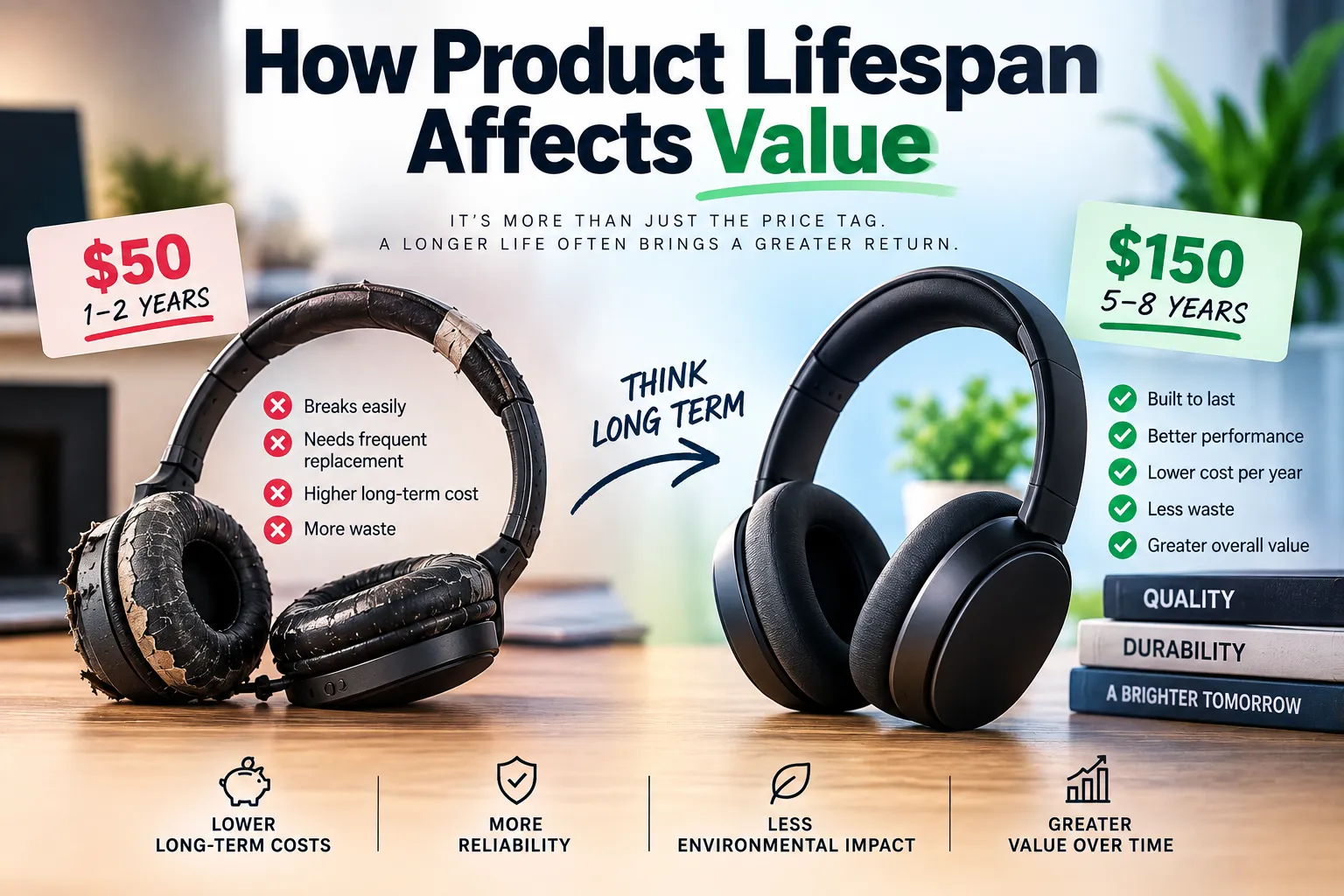
A $500 product may appear more expensive than a $300 alternative. But purchase price tells only part of the story. If the $500 product lasts eight years while the $300 product needs to be replaced after three years, the cheaper option may not actually provide better value.
This is why product lifespan is an important part of evaluating value.
Lifespan affects how long a product can serve its intended purpose, how frequently it needs to be replaced, how much money is spent over time, and how much waste is generated. It can also influence convenience, reliability, repair costs, resale value, and the overall ownership experience.
Understanding the relationship between lifespan and value can help shoppers move beyond the question of “How much does it cost?” and instead ask a more useful question:
“What am I getting for the money over the product’s useful life?”
What Is Product Lifespan?
Product lifespan refers to the period during which a product remains usable for its intended purpose.
The exact meaning of “usable” can vary considerably between products.
A smartphone might technically continue functioning for many years while its battery capacity declines and software support ends. A refrigerator may continue operating for a decade or more but eventually become less efficient or increasingly expensive to repair.
Lifespan can therefore involve several different concepts:
- Physical lifespan: How long the product remains physically functional.
- Functional lifespan: How long it continues to perform its intended job effectively.
- Supported lifespan: How long the manufacturer provides software, security updates, parts, or other support.
- Practical lifespan: How long the product remains useful to the owner.
- Economic lifespan: How long keeping the product makes financial sense compared with replacing it.
These forms of lifespan do not always end at the same time.
Why Lifespan Matters When Measuring Value
A product’s value is closely connected to the benefits it provides relative to what the owner spends.
A durable product can spread its initial cost across many years of use.
For example, consider two hypothetical appliances:
| Product | Purchase Price | Useful Life | Approximate Purchase Cost Per Year |
|---|---|---|---|
| Product A | $300 | 3 years | $100 |
| Product B | $500 | 8 years | $62.50 |
Product B requires a larger payment upfront, but its purchase cost is lower when spread across its useful life.
This does not automatically make Product B the better purchase. Maintenance, energy consumption, repairs, performance, and other factors also matter.
Nevertheless, the example demonstrates why purchase price alone can provide an incomplete picture of value.
For a broader framework for evaluating products, The Complete Guide to Choosing the Right Products provides useful context for looking beyond the initial price.
The Difference Between Price and Value
Price is the amount paid to acquire something.
Value is the overall benefit received relative to the costs involved.
A product can be inexpensive but offer poor value if it:
- Breaks frequently
- Performs poorly
- Requires expensive repairs
- Needs frequent replacement
- Has high operating costs
- Becomes obsolete quickly
Conversely, a more expensive product can offer strong value if it:
- Performs reliably
- Lasts considerably longer
- Costs little to maintain
- Remains useful for many years
- Holds reasonable resale value
- Continues receiving important support
This is why shoppers should avoid automatically assuming that cheaper means better value.
Cost Per Year Can Reveal Hidden Differences
One simple way to incorporate lifespan into a buying decision is to calculate the approximate cost per year.
The basic formula is:
Cost per year = Purchase price ÷ Useful lifespan
Suppose a laptop costs $1,000 and remains useful for five years.
Its basic purchase cost works out to:
$1,000 ÷ 5 = $200 per year
Another laptop costs $700 but remains useful for only three years:
$700 ÷ 3 ≈ $233 per year
The more expensive laptop has a lower annual purchase cost under these assumptions.
However, this calculation should be treated as a starting point rather than a complete measure of value.
It does not include repairs, accessories, electricity, subscriptions, financing costs, insurance, or resale value.
Total Cost of Ownership Matters Too
Lifespan is particularly important because it interacts with total cost of ownership.
The true cost of owning a product may include:
- Purchase price
- Delivery costs
- Installation
- Accessories
- Maintenance
- Repairs
- Replacement parts
- Energy consumption
- Software subscriptions
- Insurance
- Financing costs
- Disposal or recycling
A product that lasts longer may reduce some of these expenses by delaying the need to purchase a replacement.
For a deeper examination of these expenses, Product Ownership Costs: Complete Guide to True Cost explores the costs that can accumulate after the initial purchase.
A Longer Lifespan Does Not Always Mean Better Value
It is tempting to assume that the product that lasts the longest automatically provides the best value.
That is not necessarily true.
Imagine a $2,000 appliance that lasts 15 years but consumes substantially more energy than newer alternatives.
A $1,200 appliance might last 10 years while using significantly less electricity.
The newer product could potentially provide greater overall value depending on energy prices, usage patterns, maintenance requirements, and other factors.
Similarly, a professional-grade tool might last decades but be unnecessary for someone who uses it once a year.
The best value depends on how well the product’s lifespan matches the owner’s needs.
Product Lifespan Should Be Compared With Usage
A product’s value is influenced by how frequently it is used.
Consider two consumers purchasing the same pair of headphones.
One person uses them every day for several hours. Another uses them occasionally while traveling.
The first person may benefit substantially from paying more for a durable model because the product receives heavy use.
For the occasional user, spending significantly more for extreme durability may provide fewer practical benefits.
This principle applies across many categories.
Products used heavily may justify greater investment in:
- Durability
- Build quality
- Repairability
- Reliability
- Warranty coverage
- Replacement parts
Products used infrequently may place greater emphasis on affordability and basic functionality.
Reliability and Lifespan Are Closely Connected
A long expected lifespan is valuable only if the product can reliably perform during that period.
A product that lasts ten years but frequently breaks down may be less useful than one that operates consistently for seven years.
Reliability considers how consistently a product performs without failures.
Important factors can include:
- Failure rates
- Build quality
- Component quality
- Manufacturing consistency
- Maintenance requirements
- Warranty claims
- Customer experiences
- Availability of replacement parts
Before buying, shoppers can benefit from learning how to evaluate product reliability before buying rather than relying solely on marketing claims about durability.
Repairability Can Extend Product Lifespan
A product does not necessarily become worthless when one component fails.
If the failed component can be repaired or replaced affordably, the product may continue providing value for years.
Repairability therefore has an important relationship with lifespan.
Examples include:
- Replaceable batteries
- Replaceable appliance components
- Repairable mechanical parts
- Standardized fasteners
- Accessible internal components
- Availability of replacement parts
- Manufacturer repair programs
- Third-party repair options
A product designed to be discarded after a minor failure may have a much shorter practical lifespan than a product that can be repaired.
Software Support Can Determine Lifespan
Physical durability is increasingly only one part of product longevity.
Many modern products depend on software.
Smartphones, computers, vehicles, televisions, home appliances, cameras, watches, and other connected devices can rely on software updates for functionality and security.
A device may remain physically operational while becoming less useful because:
- Security updates stop
- Applications stop supporting the operating system
- Online services are discontinued
- New features require newer hardware
- Compatibility declines
- Cloud services change
For technology products, shoppers should therefore distinguish between how long something can physically work and how long it remains practically supported and useful.
Batteries Can Affect Practical Lifespan
Battery-powered products provide a particularly clear example of the difference between physical and practical lifespan.
Rechargeable batteries naturally lose capacity over time.
A smartphone, laptop, electric vehicle, wireless vacuum, or cordless tool may continue functioning while delivering progressively shorter operating times.
If the battery can be replaced affordably, the product’s useful lifespan may be extended.
If the battery is difficult or expensive to replace, declining battery performance may effectively shorten the product’s practical life.
Battery replacement costs should therefore be considered when comparing products that depend heavily on rechargeable power.
Warranty Length Can Provide Useful Information
A warranty does not guarantee that a product will last for the duration of the warranty, but it can provide useful information about the manufacturer’s support commitment.
When comparing products, shoppers can examine:
- Warranty duration
- What components are covered
- What types of failures are covered
- Labor coverage
- Replacement policies
- Repair procedures
- Warranty exclusions
A longer warranty can reduce financial risk during the early part of ownership.
However, warranty length should not be treated as a direct measurement of lifespan.
A product with a two-year warranty could last ten years, while another product with a five-year warranty might experience problems shortly after coverage ends.
Materials and Build Quality Matter
The materials used to construct a product can influence how well it withstands long-term use.
Depending on the category, shoppers may evaluate:
- Frame materials
- Seams and joints
- Fasteners
- Hinges
- Buttons
- Connectors
- Screens
- Internal components
- Protective coatings
- Moving parts
Higher-quality materials can sometimes improve durability, although material quality alone does not guarantee reliability.
Product design, manufacturing quality, maintenance, and usage conditions all contribute to how long something lasts.
How Obsolescence Changes Value
A product can become obsolete before it physically fails.
This is particularly common with technology.
A computer might continue powering on for many years, but newer software may demand more processing power. A smartphone might still function but no longer receive security updates. A television may work perfectly while newer streaming standards change the viewing experience.
This creates a distinction between durability and relevance.
A durable product provides little practical value if it no longer meets the owner’s needs.
When evaluating lifespan, shoppers should therefore ask:
How long is this product likely to remain useful, not merely functional?
That question can produce a much more realistic estimate of value.
Resale Value Can Extend Economic Value
Some products retain significant value after years of ownership.
A product with strong resale demand can reduce the effective cost of ownership because the owner may recover part of the original purchase price when selling it.
For example:
- A phone purchased for $1,000 may later sell for $300.
- A laptop purchased for $1,500 may later sell for $500.
- A camera purchased for $2,000 may retain substantial value if demand remains strong.
Resale value depends on many factors, including brand reputation, condition, age, demand, specifications, and availability of newer alternatives.
It can therefore be useful when comparing products with different depreciation patterns.
Product Lifespan and Environmental Impact
Longer-lasting products can also influence environmental impact.
Replacing products frequently can require additional:
- Raw materials
- Manufacturing
- Packaging
- Transportation
- Energy
- Electronic components
Frequent disposal can also increase waste.
This does not mean every long-lasting product is automatically environmentally superior. Manufacturing processes, energy efficiency, repairability, recycling, and transportation all matter.
Still, extending the useful life of a product can reduce the frequency with which a replacement needs to be manufactured and purchased.
For environmentally conscious consumers, lifespan can therefore be both a financial consideration and a sustainability consideration.
The Importance of Maintenance
Even a well-built product can have a shorter lifespan if it is poorly maintained.
Maintenance requirements vary by product.
They might include:
- Cleaning
- Lubrication
- Software updates
- Battery care
- Filter replacement
- Calibration
- Firmware updates
- Inspection
- Proper storage
Regular maintenance can prevent minor problems from becoming major failures.
When comparing products, shoppers should consider not only how long the manufacturer says a product can last, but also what the owner must do to achieve that lifespan.
Lifestyle Changes Can Shorten a Product’s Practical Lifespan
Sometimes a product is replaced even though it still works.
This can happen because the owner’s circumstances change.
For example:
- A family grows and needs a larger refrigerator.
- A remote worker needs a more capable computer.
- A photographer moves from casual photography to professional work.
- A homeowner moves into a larger property.
- A person changes from occasional travel to frequent international travel.
In these cases, the product’s physical lifespan may continue, but its practical lifespan has ended for that particular user.
This is another reason why lifespan should not be evaluated independently from individual needs.
How to Calculate a More Complete Value
A more realistic approach considers several costs and benefits.
A simplified calculation might look like:
Effective annual ownership cost = (Purchase price + ownership costs − resale value) ÷ useful years
For example, suppose a product has:
- Purchase price: $800
- Maintenance and other ownership costs: $200
- Resale value: $150
- Useful life: 5 years
The approximate effective cost is:
($800 + $200 − $150) ÷ 5 = $170 per year
This provides a more useful comparison than looking only at the $800 purchase price.
It is still an estimate, but it helps reveal the financial impact of longevity.
Compare Products Based on the Right Lifespan
Different product categories require different approaches.
Smartphones
Consider:
- Software support
- Battery replacement
- Hardware durability
- Repairability
- Performance over time
- Resale value
Laptops
Consider:
- Upgradeability
- Battery replacement
- Build quality
- Software support
- Repairability
- Performance requirements
Appliances
Consider:
- Expected service life
- Energy consumption
- Repair costs
- Replacement parts
- Warranty
- Maintenance
Furniture
Consider:
- Materials
- Construction
- Repairability
- Usage intensity
- Style longevity
- Resale potential
Tools
Consider:
- Frequency of use
- Motor or mechanical quality
- Replaceable components
- Battery ecosystem
- Warranty
- Parts availability
The right definition of value changes depending on the product.
Don’t Confuse Premium Pricing With Durability
A higher price does not automatically indicate a longer lifespan.
Premium products can offer better materials, engineering, support, or reliability, but price alone is not proof.
Shoppers should look for evidence such as:
- Independent testing
- Long-term user experiences
- Repair information
- Warranty terms
- Replacement-part availability
- Product specifications
- Reliability history
The goal is to determine whether the additional cost actually provides additional useful life or meaningful benefits.
How Product Lifespan Should Influence Buying Decisions
When evaluating a purchase, consider asking these questions:
1. How long do I realistically expect to use it?
Your expected ownership period may differ from the manufacturer’s estimated lifespan.
2. How heavily will I use it?
Heavy usage may justify investing in greater durability.
3. Can it be repaired?
Repairability can significantly extend practical lifespan.
4. Are replacement parts available?
A product can become difficult to maintain if critical parts disappear from the market.
5. How long will software support last?
This is especially important for connected and technology products.
6. What will it cost to operate?
Energy, subscriptions, consumables, and maintenance can significantly affect long-term value.
7. What might it be worth later?
Resale value can reduce the effective cost of ownership.
8. Will my needs change?
A product may physically last for many years but become unsuitable as your requirements evolve.
A Better Definition of Value
The relationship between lifespan and value can be summarized simply:
A product’s value is not determined solely by what you pay for it. It is influenced by how much useful benefit you receive over the period you own it and the costs required to keep it useful.
That means a product costing $1,000 can provide better value than a $500 alternative if it delivers substantially more useful years at reasonable ownership costs.
But the opposite can also be true.
Paying more for durability that you never need, features you rarely use, or a lifespan that exceeds your practical requirements may not be the most efficient use of your money.
The objective is not to buy the product that lasts the longest at any price.
It is to find the product whose price, lifespan, performance, reliability, ownership costs, and usefulness make sense for your particular situation.
Why Lifespan Belongs in Every Buying Decision
Price is easy to compare because it is printed on the product page.
Lifespan requires more thought.
Yet it can be one of the most important factors separating a genuinely good purchase from one that only looks inexpensive at checkout.
A product that lasts longer can reduce replacement costs, spread its purchase price over more years, preserve convenience, and potentially reduce waste. When combined with reasonable maintenance, repairability, software support, reliability, and resale value, longevity can become a major contributor to overall product value.
The smartest purchasing decision is therefore rarely about finding the lowest price.
It is about finding the right balance between what a product costs today and what it can realistically deliver over the years that follow.