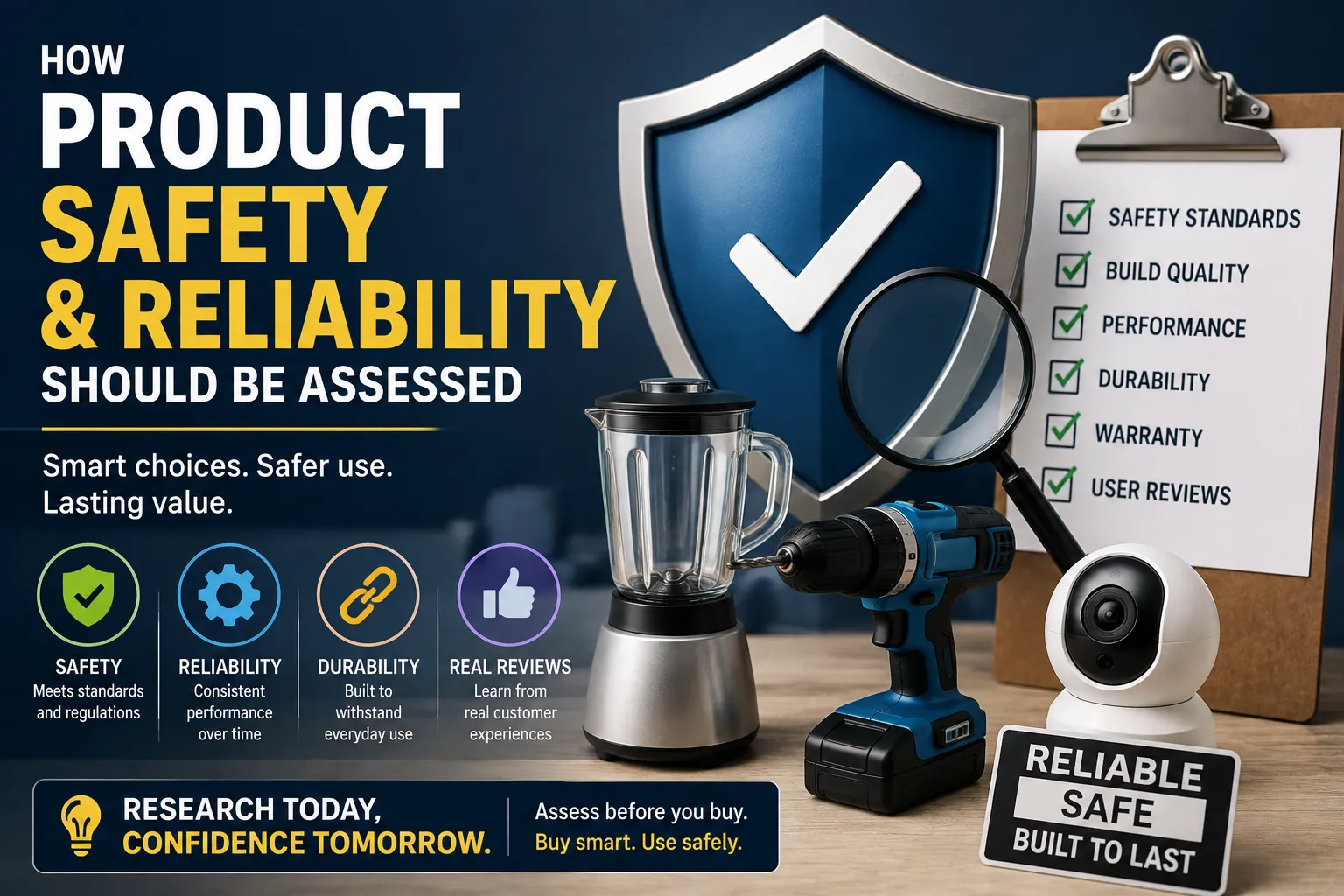
How Product Safety and Reliability Should Be Assessed
Buying a product is often presented as a simple decision: compare prices, read a few reviews and choose the option that appears to offer the best value.
But price and features do not tell the whole story.
A product can look impressive on paper while having poor durability, inadequate safety protections or a history of recurring problems. Another product may cost more initially but prove to be a better long-term investment because it lasts longer, performs consistently and is supported by a manufacturer that stands behind it.
That is why **product safety and reliability should be evaluated alongside price, performance and features**. Understanding how these factors fit into the broader buying process is an important part of The Complete Guide to Choosing the Right Products.
Whether someone is buying an appliance, electronic device, vehicle accessory, tool, piece of furniture or another consumer product, understanding how to assess safety and reliability can lead to better purchasing decisions and fewer unpleasant surprises.
**What Product Safety Really Means**
Product safety refers to the extent to which a product can be used as intended without creating unreasonable risks of injury, property damage or other harm.
Safety can involve many different factors depending on the product.
For an electrical appliance, it may involve insulation, overheating protection, electrical connections and construction quality.
For a child’s product, safety could involve materials, small parts, structural stability and age-appropriate design.
For a vehicle-related product, it could include structural integrity, compatibility and performance under demanding conditions.
Safety is therefore not a single specification.
It is a combination of design, manufacturing, materials, testing, instructions and appropriate use.
**Reliability Is Different From Safety**
Safety and reliability are closely connected, but they are not identical.
**Safety** concerns whether a product can be used without creating unacceptable hazards.
**Reliability** concerns whether the product consistently performs its intended function over time.
A product could theoretically be safe but unreliable.
For example, a device might have strong electrical protections but frequently stop working.
Conversely, a product could appear reliable during everyday use while still containing a potentially dangerous design flaw.
A good buying decision considers both.
**Start With the Intended Use**
The first step in assessing a product is understanding what it is actually designed to do.
Consumers sometimes judge products without considering the conditions in which they will be used.
A product intended for occasional household use may not be designed for commercial environments. A device designed for indoor use may not be suitable outdoors. A tool designed for light tasks may perform poorly under continuous heavy workloads.
Before evaluating reliability, ask:
-
What is the product designed to do?
-
How frequently will it be used?
-
Under what environmental conditions?
-
What level of performance is required?
-
What loads or stresses will it experience?
-
Is the product being used within its stated limits?
A product should be assessed against its intended purpose rather than unrealistic expectations.
**Look Beyond Marketing Claims**
Product descriptions are designed to persuade.
Manufacturers may emphasize words such as “premium,” “professional,” “advanced,” “durable” or “long-lasting.”
Those terms can be useful for positioning a product, but they are not necessarily evidence.
Consumers should look for measurable information.
Instead of simply asking whether a product is described as durable, consider:
-
What materials are used?
-
What testing has been performed?
-
Is there a stated operating life?
-
What warranty is provided?
-
Are replacement parts available?
-
What do long-term owners report?
-
Does the manufacturer publish technical specifications?
Evidence is generally more useful than marketing language.
**Check Applicable Safety Standards**
Safety standards can provide an important reference point.
Depending on the product and country, manufacturers may need to meet specific regulatory requirements or industry standards.
These standards can address issues such as electrical safety, mechanical strength, fire resistance, chemical exposure, materials or performance.
However, consumers should be careful when interpreting certification claims.
A product displaying a certification or compliance mark does not necessarily mean it is superior in every respect.
The relevant question is what the certification actually covers.
A safety standard may address one particular risk without evaluating durability, usability or overall product quality.
**Understand Product Recalls**
Product recalls can provide valuable information about safety problems.
A recall generally occurs when a manufacturer or regulator determines that a product presents a safety issue or does not meet applicable requirements.
Before purchasing certain categories of products, particularly those involving significant safety risks, consumers may benefit from checking whether the model has been subject to recalls.
A recall does not necessarily mean the manufacturer is unreliable.
Companies sometimes identify problems and voluntarily issue recalls to protect customers.
What matters is how the company responds.
A manufacturer that communicates clearly, provides an effective remedy and learns from the problem may demonstrate responsible safety practices.
**Examine the Warranty**
A warranty can provide clues about how a manufacturer stands behind its product.
It is not a guarantee of quality, but it can reduce financial risk when something goes wrong.
When comparing warranties, look beyond the headline duration.
Check:
-
What components are covered?
-
How long does coverage last?
-
Are labor costs included?
-
Is shipping covered?
-
What exclusions apply?
-
Does the warranty require registration?
-
Are repairs or replacements provided?
-
Are there different warranty periods for different components?
A five-year warranty with extensive exclusions may be less valuable than a shorter warranty with broader coverage.
**Warranty Length Is Not Proof of Reliability**
A long warranty can be reassuring, but it should not automatically be interpreted as evidence that a product will last longer.
Some manufacturers may offer extended warranties as a marketing strategy.
Reliability should instead be evaluated using multiple sources of evidence.
Warranty terms are one piece of the puzzle.
Long-term owner experiences, independent testing, repair information, failure patterns and manufacturer reputation can provide additional context.
**Read Reviews With a Critical Eye**
Online reviews can be extremely useful, but they need to be interpreted carefully.
A product with thousands of positive reviews may appear highly reliable, but star ratings alone rarely tell the complete story.
Look for recurring patterns.
If multiple independent buyers report the same problem, that may be more meaningful than one extremely negative review.
Pay particular attention to comments mentioning:
-
Repeated failures
-
Problems shortly after purchase
-
Premature wear
-
Battery degradation
-
Overheating
-
Difficult repairs
-
Missing parts
-
Poor customer support
-
Performance declining over time
Also distinguish between legitimate product problems and dissatisfaction caused by unrealistic expectations.
For a more systematic approach, see How to Read Product Reviews Like an Expert.
**Review Quality Matters More Than Review Quantity**
One detailed review based on two years of ownership can provide more useful reliability information than dozens of comments written immediately after purchase.
New owners can assess first impressions.
Long-term owners can assess durability.
For reliability research, look for reviews that explain:
-
How long the product has been used
-
How frequently it is used
-
Under what conditions it operates
-
What maintenance has been performed
-
Whether performance has changed
-
Whether repairs were necessary
This provides much more context than a simple five-star rating.
**Look for Patterns Across Multiple Sources**
No single review should determine a purchasing decision.
Instead, compare information from several sources.
These might include:
-
Independent product reviews
-
Consumer reports
-
Manufacturer documentation
-
Regulatory information
-
Long-term owner experiences
-
Professional testing
-
Repair communities
-
Retailer feedback
-
Technical publications
When different sources independently identify the same strength or weakness, confidence in that finding increases.
This is particularly important for expensive products.
**Consider Materials and Build Quality**
Physical construction can influence both reliability and safety.
Look at the materials used in components that experience significant stress or wear.
For an appliance, this might include hinges, switches, motors and heating elements.
For electronics, it could involve connectors, buttons, charging ports, screens and batteries.
For furniture, structural joints, fasteners and load-bearing components may matter most.
The goal is not necessarily to identify the most expensive materials.
Good design can allow relatively simple materials to perform extremely well.
The important question is whether the materials and construction are appropriate for the product’s intended use.
**Pay Attention to Known Failure Points**
Almost every product category has components that tend to fail more frequently than others.
Research can reveal whether a particular model has recurring weaknesses.
For example, users may repeatedly report a specific component breaking after a certain period.
That does not necessarily mean every unit will fail.
But a recurring pattern can signal an area worth investigating before buying.
Understanding failure points also helps consumers assess repairability.
If a commonly failing component is inexpensive and easy to replace, the problem may be manageable.
If the same failure requires replacing the entire product, it becomes much more significant.
**Repairability Matters to Long-Term Reliability**
A product that can be repaired may provide greater long-term value than one that must be replaced after a relatively minor failure.
Repairability depends on factors such as:
-
Availability of replacement parts
-
Access to service manuals
-
Standardized components
-
Ease of disassembly
-
Availability of qualified technicians
-
Manufacturer support
Some products are deliberately designed to make repairs easier, while others use sealed or proprietary components that can make repairs difficult.
For consumers who intend to keep products for many years, repairability can be an important part of the buying decision.
**Replacement Parts Can Make or Break a Product**
A durable product is less useful if essential replacement parts disappear after a few years.
Before purchasing expensive equipment, consider whether the manufacturer provides replacement components and how long those parts are expected to remain available.
Common examples include:
-
Batteries
-
Filters
-
Belts
-
Chargers
-
Power adapters
-
Seals
-
Cables
-
Blades
-
Handles
-
Switches
A product with readily available parts can remain useful long after its original warranty expires.
**Software Reliability Matters Too**
For connected products, reliability is no longer purely physical.
Smartphones, computers, cameras, smart appliances, vehicles and other connected devices increasingly depend on software.
A product may work perfectly when purchased but become less useful if software support ends prematurely.
When evaluating connected products, consider:
-
How long security updates are provided
-
How frequently software updates are released
-
Whether essential features depend on cloud services
-
Whether the manufacturer can shut down services remotely
-
Whether the product continues functioning without internet access
-
Whether older devices remain compatible with newer software
A product’s useful life can sometimes depend as much on software support as hardware durability.
**Battery Longevity Deserves Special Attention**
Battery-powered products require another layer of reliability assessment.
Rechargeable batteries naturally lose capacity over time.
Consumers should therefore investigate:
-
Expected battery lifespan
-
Replacement availability
-
Charging behavior
-
Charging speed
-
Thermal management
-
Whether the battery is replaceable
-
Cost of replacement
A device with excellent battery performance when new may become significantly less useful if its battery cannot be replaced and loses substantial capacity after a few years.
**Safety Features Should Be Easy to Understand**
Good safety features are valuable, but consumers also need to understand how they work.
Safety instructions should clearly explain:
-
Proper operation
-
Important warnings
-
Installation requirements
-
Maintenance procedures
-
Environmental limitations
-
Actions to take if something goes wrong
Instructions that are unclear or difficult to follow can create risks even when the underlying product is well designed.
This is particularly important for products involving heat, electricity, pressure, chemicals, sharp components or moving machinery.
**User Error Should Be Considered**
Not every product failure indicates poor manufacturing.
Sometimes a product is used outside its intended conditions.
This is why reliability assessments should distinguish between:
**Design or manufacturing failures** and **misuse or improper maintenance**.
If a product consistently fails when operated within its stated specifications, that is more concerning than a product failing because it was repeatedly used outside those limits.
Understanding the manufacturer’s requirements helps make this distinction.
**Maintenance Can Affect Reliability**
Many products require routine maintenance to operate safely and reliably.
Examples include:
-
Cleaning filters
-
Lubricating moving parts
-
Replacing consumable components
-
Updating software
-
Inspecting cables
-
Checking fasteners
-
Cleaning ventilation areas
-
Replacing batteries
A product may be highly reliable when maintained correctly but perform poorly when maintenance is ignored.
Consumers should therefore consider not only whether maintenance is required but also how easy and affordable it is.
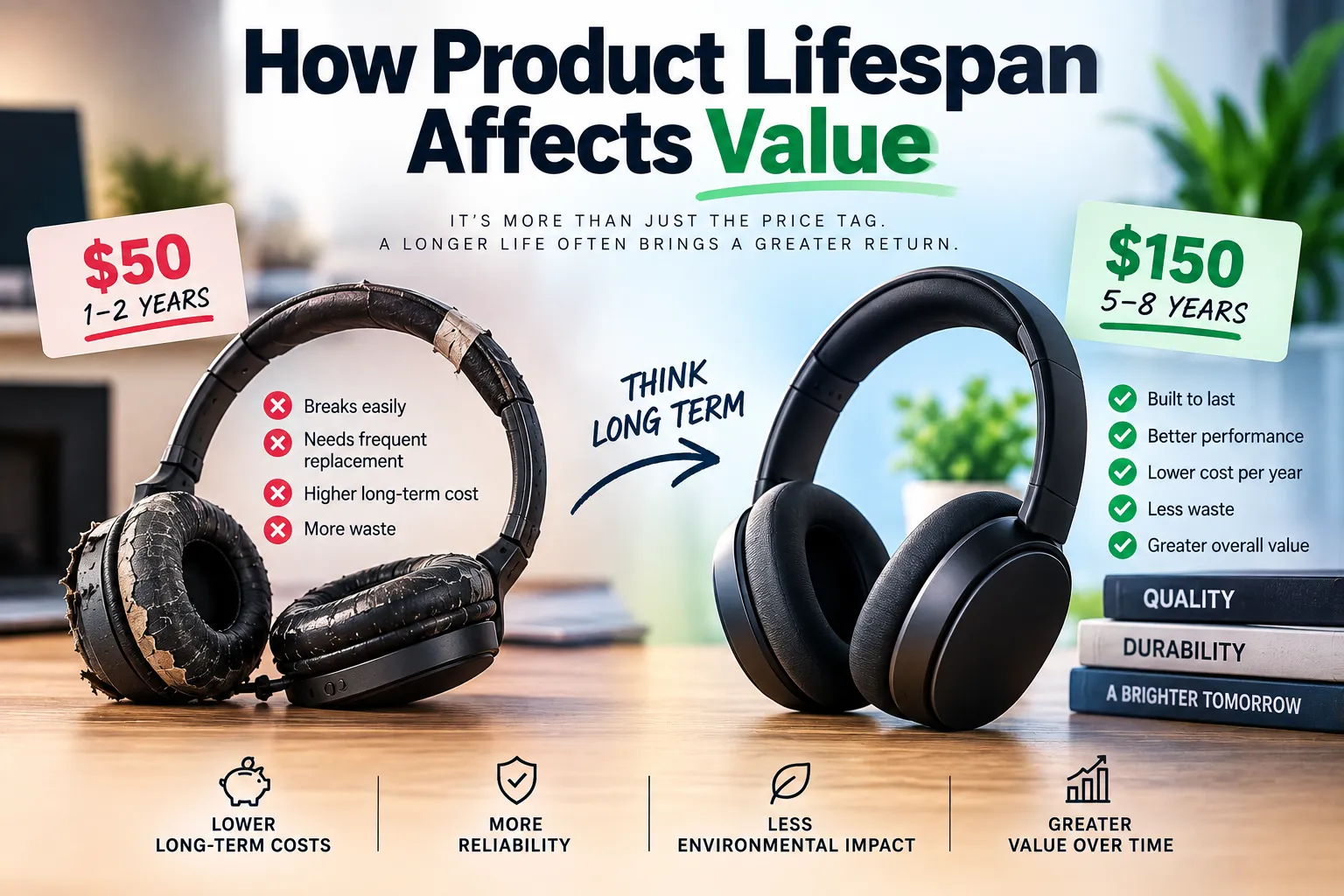
**Total Cost of Ownership Is More Useful Than Purchase Price**
The cheapest product is not necessarily the least expensive option.
A better comparison considers the **total cost of ownership**. A deeper look at these costs can be found in Product Ownership Costs: Complete Guide to True Cost.
That can include:
**Purchase price + energy costs + maintenance + consumables + repairs + replacement parts − resale value**
For example, a cheaper appliance that consumes substantially more electricity and requires frequent repairs may cost more over several years than a more expensive, efficient model.
The same principle applies to electronics, vehicles, tools and other durable goods.
**Reliability Should Be Evaluated Over Time**
A product can perform extremely well during its first few months.
That does not necessarily tell us how it will perform after three or five years.
Reliability is fundamentally a time-based characteristic.
When possible, look for long-term testing and ownership reports.
Questions worth asking include:
-
Does performance remain consistent?
-
Which components wear first?
-
Does the product become noisier?
-
Does battery life decline?
-
Are replacement parts still available?
-
Does software support continue?
-
How does the manufacturer handle failures?
These questions reveal much more about long-term ownership than launch-day specifications.
For a broader assessment of long-term product performance, How to Determine Whether a Product Is Durable and Reliable provides another useful perspective.
**Manufacturer Reputation Can Provide Context**
A manufacturer’s history can also be useful.
Companies that consistently provide replacement parts, honor warranties, issue recalls responsibly and support products for many years may offer greater confidence.
However, reputation should not replace product-specific research.
Even highly respected manufacturers can produce defective models.
Likewise, a less familiar brand may produce an excellent product.
The strongest assessment combines manufacturer history with evidence about the specific product.
Consumers can learn more about this factor in How to Evaluate Brand Reputation Before Buying a Product.
**Beware of Fake or Misleading Reviews**
Online shopping has made it easier to compare products, but it has also created opportunities for misleading information.
Some reviews may be incentivized, manipulated or generated without genuine ownership experience.
Warning signs can include:
-
Extremely generic language
-
Identical wording across multiple products
-
Large numbers of reviews appearing within a short period
-
Reviews that discuss features without actual usage
-
Excessively positive or negative claims without evidence
-
Ratings that differ dramatically between platforms
Consumers should not assume every review is authentic.
Looking across multiple independent sources can reduce the risk of making a decision based on distorted information. For a closer look at the issue, see How to Identify Biased Product Reviews.
**Safety Research Should Be Proportional to Risk**
Not every purchase requires the same level of investigation.
Buying a low-cost decorative item is different from buying a device that produces heat, stores energy, carries people or is intended for children.
The greater the potential consequences of failure, the more important it becomes to investigate safety carefully.
For higher-risk products, consumers should pay particular attention to applicable standards, recalls, manufacturer instructions, professional testing and documented safety history.
**A Practical Product Assessment Framework**
Before purchasing an important product, consumers can evaluate it across several categories.
**### **1. Safety****
Ask:
-
Are there known safety issues?
-
Has the product been recalled?
-
Does it meet relevant standards?
-
Are the safety instructions clear?
**### **2. Reliability****
Ask:
-
How often do owners report failures?
-
Are there recurring defects?
-
Does performance remain consistent over time?
**### **3. Durability****
Ask:
-
Are materials appropriate for the intended use?
-
Which parts experience the most wear?
-
Is the product designed for its expected workload?
**### **4. Repairability****
Ask:
-
Can damaged components be replaced?
-
Are parts available?
-
Can qualified technicians service it?
**### **5. Manufacturer Support****
Ask:
-
How long is the warranty?
-
What does it cover?
-
Is customer service responsive?
-
How long are software and parts supported?
**### **6. Total Cost****
Ask:
-
What will the product cost over its expected lifetime?
-
How much will maintenance and consumables cost?
-
What happens if it fails?
This framework can turn a vague impression of product quality into a more structured evaluation.
**Don’t Let Features Distract From Fundamentals**
Manufacturers compete heavily on specifications.
A product may advertise more storage, more processing power, additional modes, higher resolution or new smart features.
Those can be useful.
But consumers should first establish whether the fundamental product is safe, reliable and appropriate for their needs.
A long list of features cannot compensate for a product that frequently fails or becomes difficult to repair.
The best product is often not the one with the longest specification sheet.
It is the one that performs the tasks that matter reliably and safely for the length of time the buyer expects to own it.
**Making Better Buying Decisions**
Assessing product safety and reliability requires more than reading a specification sheet or looking at a star rating.
It involves examining how the product is designed, how it performs in real-world conditions, how it holds up over time and how the manufacturer responds when something goes wrong.
The most useful evidence comes from multiple sources: independent testing, long-term user experiences, safety records, warranties, repair information, technical documentation and regulatory resources.
Consumers should also consider their own circumstances.
A product that is reliable for occasional household use may not be suitable for demanding professional work. A device with excellent hardware may be a poor long-term purchase if its software support ends quickly. A low purchase price may lose its appeal when maintenance and replacement costs are included.
Ultimately, **good product research is about looking beyond what a product promises at the moment of purchase and asking how safely, consistently and economically it is likely to perform throughout its useful life**.
That shift—from comparing features to evaluating the entire ownership experience—can make buying decisions more informed and help consumers choose products that deliver value long after the initial excitement of the purchase has faded. For additional guidance on turning this research into a structured purchasing process, see How to Make Better Buying Decisions When Choosing Products.