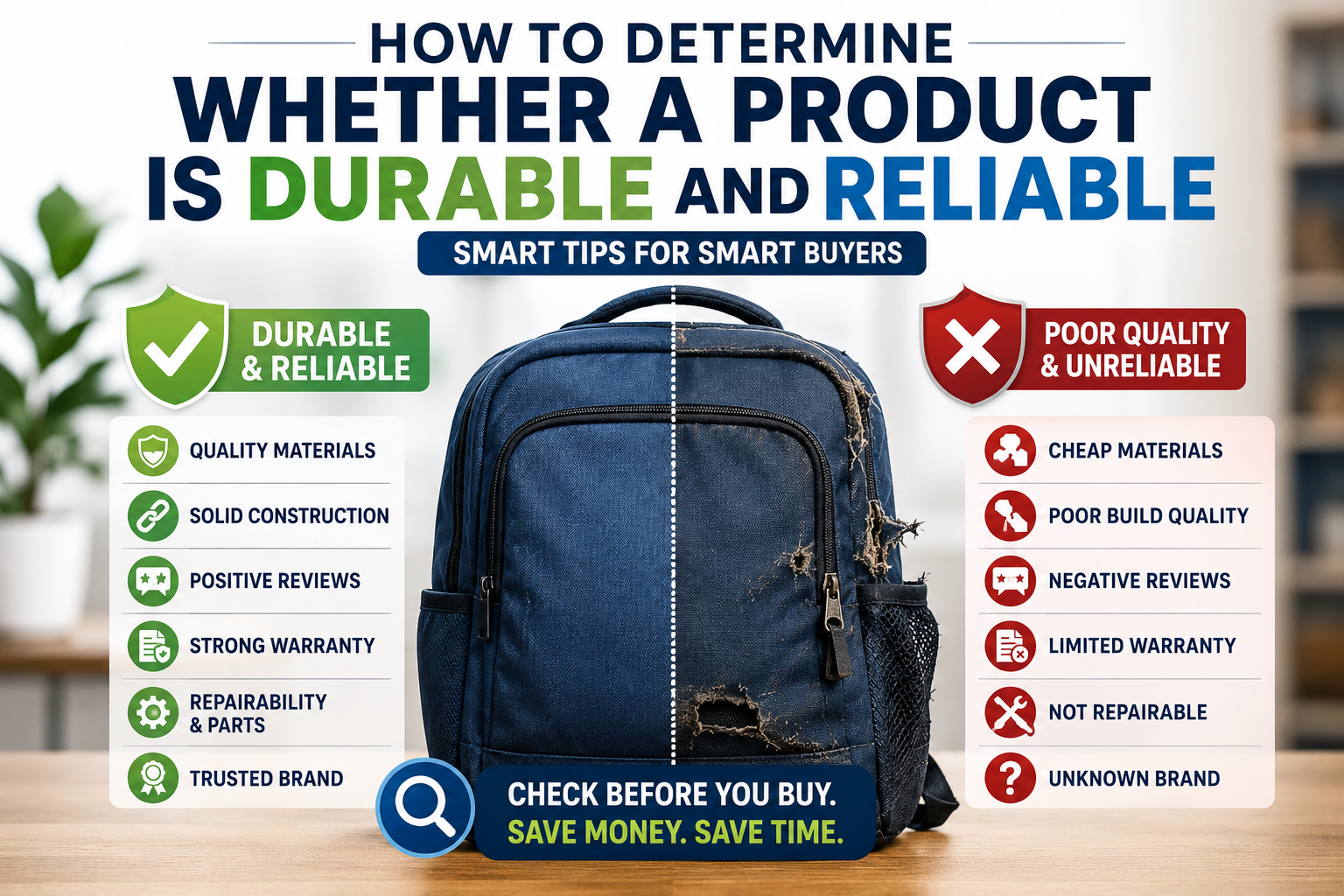
How to Determine Whether a Product Is Durable and Reliable
A product can look impressive on a store shelf, receive thousands of positive reviews and still disappoint after a few months of use. Conversely, a less flashy product may continue working reliably for years.
That difference comes down to more than brand reputation or appearance.
Durability describes how well a product withstands physical use, wear and environmental conditions over time. Reliability describes how consistently it performs its intended function without unexpected failures.
Understanding both concepts can help shoppers make better purchasing decisions, particularly when comparing products that look similar but differ significantly in construction, materials, warranty coverage and long-term performance. For a broader framework for evaluating products, see The Complete Guide to Choosing the Right Products.
## What Is Product Durability?
Product durability refers to a product’s ability to withstand use and remain functional over an extended period.
Durability can involve resistance to:
-
Physical impact
-
Repeated use
-
Friction and wear
-
Heat
-
Moisture
-
Dust
-
Corrosion
-
Vibration
-
Pressure
-
Environmental exposure
The relevant factors depend heavily on the type of product.
A smartphone, washing machine, pair of shoes and kitchen appliance face completely different forms of wear.
A durable product is therefore not necessarily the one made from the heaviest or most expensive materials. It is the one appropriately designed and constructed for the conditions in which it will be used.
## What Is Product Reliability?
Reliability focuses on consistency.
A reliable product should perform its intended function repeatedly and predictably under normal operating conditions.
For example, a reliable washing machine should complete its cycles consistently. A reliable laptop should start, run applications and maintain stable operation without frequent failures.
Durability and reliability often overlap, but they are not identical.
A product could be physically durable but unreliable because its electronics frequently malfunction. Another product could operate consistently but have components that wear out relatively quickly.
The strongest products tend to perform well in both areas.
## Start With the Product’s Intended Use
Before evaluating durability, determine what the product is actually designed to do.
Ask:
-
How frequently will it be used?
-
Where will it be used?
-
Will it be exposed to moisture or heat?
-
Will it be transported regularly?
-
Will it experience heavy loads?
-
Will multiple people use it?
-
Is it designed for professional or household use?
A product should be evaluated against its intended environment rather than against an unrealistic standard.
For example, a lightweight laptop designed for occasional home use should not necessarily be judged by the same expectations as a rugged business laptop intended for frequent travel.
## Examine the Materials
Materials provide useful clues about construction quality, but material names alone do not tell the whole story.
Look at:
-
What materials are used?
-
Where are stronger materials used?
-
Are joints reinforced?
-
Are moving parts robust?
-
Are exposed components protected?
-
Does the material suit the intended use?
A product made from metal is not automatically more durable than one made partly from high-quality engineered plastic.
Design, manufacturing quality and construction methods can be just as important as the raw material.
## Pay Attention to Construction Quality
Construction quality is often more revealing than appearance.
Look for signs such as:
-
Even seams
-
Secure fasteners
-
Strong joints
-
Consistent finishes
-
Properly fitted components
-
Minimal unnecessary movement
-
Smooth operation of moving parts
If possible, physically inspect the product before purchasing it.
Try switches, hinges, handles, buttons and adjustment mechanisms.
They should operate smoothly without excessive looseness, grinding or resistance.
## Examine Moving Parts Carefully
Moving components often experience more wear than stationary ones.
Products containing hinges, wheels, switches, gears, zippers, clasps or mechanical controls deserve particular attention.
Ask whether those components appear designed for repeated use.
For example, a laptop hinge that feels excessively loose when new could be worth investigating. A suitcase with fragile-looking wheels may be less suitable for frequent travel.
The more often a component moves, the more important its construction becomes.
## Look for Evidence of Testing
Manufacturers may perform testing designed to determine whether products can withstand particular conditions.
Depending on the product, testing may involve:
-
Drop tests
-
Cycle testing
-
Temperature testing
-
Water-resistance testing
-
Load testing
-
Battery testing
-
Vibration testing
-
Stress testing
When manufacturers provide specific testing information, it can be more useful than vague claims such as “premium quality” or “built to last.”
However, shoppers should distinguish between a clearly defined test and a marketing statement that provides no meaningful evidence.
## Understand Product Ratings and Standards
Some products are tested or certified according to recognized industry standards.
These standards can be particularly useful when evaluating products such as electrical equipment, protective equipment, building materials and appliances.
However, not every certification measures durability.
A certification may address safety, energy efficiency, environmental performance or another specific characteristic.
Read what the standard actually covers before assuming it guarantees long-term reliability.
## Read Reviews for Long-Term Evidence
Customer reviews can provide useful information, but the timing of a review matters.
A review written immediately after purchase may tell you about:
-
Packaging
-
Initial appearance
-
Setup
-
First impressions
-
Basic functionality
It may tell you very little about durability.
Look for reviews written after several months or longer.
Search specifically for comments about:
-
Long-term performance
-
Component failures
-
Battery degradation
-
Wear
-
Repairs
-
Customer support
-
Parts availability
-
Performance after repeated use
Long-term reviews can reveal problems that are invisible during the first few weeks. For a more detailed approach to interpreting this evidence, see How to Read Product Reviews Like an Expert.
## Look for Patterns Instead of Individual Complaints
One negative review does not necessarily mean a product is unreliable.
Manufacturing defects can happen even with well-designed products.
Instead, look for patterns.
If many independent reviewers report the same issue, it deserves attention.
For example, repeated reports of broken hinges, overheating, leaking seals or premature battery failure may indicate a systemic weakness.
Likewise, repeated reports that a product continues performing well after several years can provide useful evidence of reliability.
## Separate Product Problems From User Problems
Not every failure is caused by poor product quality.
Some products require proper installation, maintenance or operating conditions.
A product may perform poorly if:
-
It is overloaded
-
It is installed incorrectly
-
It is exposed to conditions beyond its specifications
-
It is not maintained
-
Incorrect accessories are used
-
It is handled improperly
Before concluding that a product is unreliable, consider whether it has been used according to the manufacturer’s instructions.
## Check the Warranty
A warranty can provide important information about how a manufacturer stands behind its product.
Examine:
-
Warranty length
-
What components are covered
-
What types of failures qualify
-
Labor coverage
-
Replacement policies
-
Repair procedures
-
Exclusions
-
Geographic limitations
A longer warranty does not automatically mean a product is more durable.
However, unusually limited coverage on an expensive product may be worth considering when comparing alternatives.
## Investigate Repairability
A product that can be repaired may remain useful for much longer than one that must be replaced after a minor component fails.
Consider whether:
-
Replacement parts are available
-
Batteries can be replaced
-
Common components can be repaired
-
The manufacturer provides service information
-
Authorized repair centers exist
-
Independent repair is practical
Repairability is particularly important for expensive electronics, appliances, tools and other products expected to remain in service for many years.
## Consider Parts Availability
A product may be well built but difficult to maintain if replacement parts become unavailable.
This is especially important for products containing components that naturally wear out.
Examples include:
-
Appliance filters
-
Batteries
-
Belts
-
Seals
-
Wheels
-
Blades
-
Cables
-
Mechanical components
Before making an expensive purchase, check whether replacement parts are sold separately.
## Research the Manufacturer’s Track Record
A company’s history can provide useful context.
Look at how long the manufacturer has produced similar products and whether previous generations have developed recurring problems.
You can also investigate:
-
Product recalls
-
Warranty complaints
-
Service reputation
-
Parts availability
-
Product support
-
Software-update policies for connected devices
A long operating history does not guarantee quality, but it can provide more evidence than a brand with little track record.
For a deeper look at this factor, see How to Evaluate Brand Reputation Before Buying a Product.
## Consider the Product’s Design Life
Some products are designed for relatively short periods of use, while others are intended to last for many years.
Manufacturers may provide expected service-life information for certain categories.
For example, appliances and industrial equipment may have estimated operating lifespans or duty cycles.
This information can be useful when comparing products with different prices.
A cheaper product that needs replacement twice as often may ultimately cost more than a more expensive product designed for a longer service life.
## Calculate the Total Cost of Ownership
Purchase price is only one part of the cost.
A better comparison considers:
Total cost of ownership = purchase price + maintenance + consumables + repairs + energy costs − resale or residual value
Not every product requires all these categories, but the principle is useful.
For example, an appliance with a higher upfront price might use less energy and require fewer repairs.
Likewise, a printer that is inexpensive to buy may have relatively high ongoing consumable costs.
Durability can therefore have a direct financial impact. For a broader breakdown of these expenses, see Product Ownership Costs: Complete Guide to True Cost.
## Check Maintenance Requirements
Some durable products require regular maintenance to remain reliable.
Ask:
-
How often does it need servicing?
-
Are filters easy to replace?
-
Does it require lubrication?
-
Are parts difficult to access?
-
Is professional servicing required?
-
How expensive is routine maintenance?
A product that is theoretically durable but impractical to maintain may not be the best choice for every user.
## Pay Attention to Environmental Resistance
If a product will be exposed to demanding conditions, check its environmental specifications.
Depending on the product, relevant characteristics may include resistance to:
-
Water
-
Dust
-
Heat
-
Cold
-
Humidity
-
Corrosion
-
UV exposure
-
Impact
Do not confuse marketing terms with formal ratings.
For electronics, for example, a clearly defined ingress-protection rating provides more useful information than simply describing a product as “water resistant.”
## Evaluate Batteries Separately
Battery-powered products require special consideration because batteries naturally experience chemical aging.
For products such as smartphones, laptops, cameras, power tools and electric devices, ask:
-
Can the battery be replaced?
-
Is replacement expensive?
-
How long is the battery warranty?
-
Is battery capacity documented?
-
Does the manufacturer provide replacement batteries?
-
How does the product perform when battery capacity declines?
A device can remain mechanically sound while its battery becomes the limiting factor.
## Software Reliability Matters Too
Modern products increasingly depend on software.
Smart televisions, smartphones, vehicles, appliances, cameras and other connected products may require software updates to maintain functionality and security.
When evaluating such products, consider:
-
How frequently updates are released
-
How long support is expected to continue
-
Whether essential functions depend on cloud services
-
What happens if the manufacturer ends support
-
Whether the product remains usable offline
A physically durable device may have a shorter practical life if critical software or cloud services are discontinued.
## Be Careful With Product Recalls
A recall does not necessarily mean that an entire product line is poorly designed.
Recalls can involve specific batches, components or safety issues.
However, they are important information when evaluating a purchase.
If a product has been recalled, determine:
-
What caused the recall
-
Which models are affected
-
Which production dates are involved
-
Whether the issue was corrected
-
Whether replacement or repair is available
Official recall information is generally more reliable than social media discussions about potential defects.
## Compare Products on the Same Criteria
When comparing two or more products, use consistent criteria.
A simple comparison framework might include:
| Factor | Product A | Product B | Product C |
| —– | —– | —– | —– |
| Construction quality | Strong | Moderate | Strong |
| Warranty | 3 years | 1 year | 2 years |
| Repairability | High | Low | Moderate |
| Parts availability | Good | Limited | Good |
| Long-term reviews | Positive | Mixed | Positive |
| Maintenance requirements | Low | Moderate | Low |
| Total ownership cost | Moderate | Low initially | Moderate |
The exact criteria should change according to the product category.
The purpose is to prevent price or branding from becoming the only deciding factor.
## Do Not Assume Expensive Means Durable
Price and durability are related in some products, but they are not interchangeable.
A higher price may reflect:
-
Better materials
-
More sophisticated technology
-
Brand positioning
-
Design costs
-
Marketing
-
Features
-
Distribution expenses
Similarly, an inexpensive product can sometimes be extremely durable because it has a simple design and fewer components that can fail.
Evaluate evidence rather than assuming price tells the whole story.
## Watch for Marketing Language
Words such as these can sound reassuring:
-
Premium
-
Professional
-
Heavy-duty
-
Industrial-grade
-
Rugged
-
Long-lasting
-
Military-inspired
-
Built to last
But marketing language should not replace evidence.
Ask what the claim actually means.
If a manufacturer says a device is “rugged,” look for specific information about drop resistance, environmental testing or relevant standards.
Specific claims are generally more useful than adjectives.
## Use a Product’s Failure Points as a Test
One useful way to evaluate reliability is to ask:
What is most likely to fail first?
For a laptop, it might be the battery, hinges, keyboard or cooling system.
For a washing machine, it could involve pumps, seals, bearings or electronic components.
For furniture, joints, hardware and moving mechanisms may deserve particular attention.
Identifying likely failure points helps shoppers investigate the components that matter most rather than spending too much time evaluating cosmetic features.
## Consider How Often You Will Use It
Durability requirements depend heavily on usage.
A product used once a month experiences very different demands from one used several times every day.
Consider the expected:
-
Frequency of use
-
Duration of use
-
Intensity of use
-
Number of users
-
Environmental exposure
A product designed for occasional household use may be perfectly adequate for a light-use customer but unsuitable for a busy commercial environment.
## Look Beyond the First-Year Experience
The first year is often not enough to judge a product’s full lifespan.
For long-term purchases, try to find information covering multiple years.
Look for evidence about:
-
Performance after two or three years
-
Common component failures
-
Availability of replacement parts
-
Software support
-
Warranty experiences
-
Repair costs
-
Resale value
Long-term ownership reports can be particularly valuable for expensive products.
## A Practical Durability and Reliability Checklist
Before buying an important product, ask these questions:
### Construction
-
Are the materials appropriate for the intended use?
-
Are joints and moving parts well constructed?
-
Does the product feel solid without unnecessary bulk?
### Performance
-
Does it perform its primary function consistently?
-
Are there recurring complaints about failures?
### Longevity
-
Are long-term reviews available?
-
Is the expected service life known?
### Maintenance
-
What routine maintenance is required?
-
Are replacement parts available?
### Support
-
How long is the warranty?
-
Is customer service accessible?
-
Are repairs available?
### Technology
-
Does the product depend on software or cloud services?
-
How long is software support expected to last?
### Value
-
What is the likely total cost of ownership?
-
Is paying more likely to reduce future replacement or repair costs?
## The Best Product Is Often the One That Fails Least Expensively
No product lasts forever.
Even well-designed products eventually experience wear, technological obsolescence or component failure.
The goal when shopping should therefore not be to find a product that can never fail. It is to identify a product whose expected performance, lifespan, repairability and ownership cost make sense for the way you intend to use it.
Durability provides one part of that picture. Reliability provides another. Warranty coverage, repairability, parts availability, manufacturer support and long-term user experiences complete the picture.
The most reliable buying decision comes from looking beyond the first impression and asking a more useful question: not simply “Is this product good?” but “How well is this product likely to perform after hundreds or thousands of hours of real-world use?”