How to Evaluate Brand Reputation Before Buying a Product
Buying a product is rarely just a decision about the product itself. The company behind it matters too.
Two products can have similar specifications and prices but deliver very different experiences because of differences in manufacturing quality, customer service, warranty support, reliability and business practices. A strong brand reputation does not guarantee that every product will be excellent, just as a poor reputation does not automatically mean that every product is bad.
The challenge is learning how to separate useful reputation signals from advertising, isolated complaints and online hype.
A thoughtful evaluation can help shoppers make more informed decisions before spending their money. This is also an important part of The Complete Guide to Choosing the Right Products.
What Is Brand Reputation?
Brand reputation is the overall perception people have of a company based on its products, services, customer experiences, communication and business behavior.
It can be influenced by:
-
Product quality
-
Reliability
-
Customer service
-
Warranty policies
-
Return experiences
-
Pricing
-
Transparency
-
Business practices
-
Product safety
-
Reviews
-
Public complaints
-
Company history
Reputation develops over time, but it can also change quickly.
A company that produced excellent products several years ago may have different quality standards today. Likewise, a company with a mixed reputation may improve its customer service or manufacturing processes.
This is why shoppers should evaluate current evidence, not rely entirely on a brand’s historical image.
Why Brand Reputation Matters
A product’s specifications tell only part of the story.
A laptop may have a powerful processor, but that does not tell you whether it will remain reliable after several years.
A washing machine may have impressive features, but those features matter less if replacement parts are difficult to find.
A smartphone may offer excellent hardware, but poor software support can shorten its useful life.
Brand reputation can provide clues about what happens after the initial purchase.
It can help shoppers assess:
-
Expected reliability
-
Quality consistency
-
Support after purchase
-
Warranty experiences
-
Availability of replacement parts
-
Software updates
-
Responsiveness to problems
Reputation Is Not the Same as Popularity
A popular brand is not automatically a trustworthy brand.
Popularity can result from:
-
Heavy advertising
-
Low prices
-
Strong distribution
-
Celebrity endorsements
-
Viral marketing
-
Attractive product design
A company can be highly visible without having consistently strong customer service or product reliability.
Likewise, a smaller brand may have an excellent reputation within a particular product category without being widely recognized.
The goal is therefore to evaluate evidence of performance, not simply name recognition.
Start With the Specific Product
One of the biggest mistakes shoppers make is judging a brand based on its reputation across every product category.
A company might make excellent televisions but mediocre headphones.
Another company might be known for reliable power tools but have a weaker reputation for appliances.
Before researching a brand, identify the specific product you are considering.
Ask:
-
What model is it?
-
How long has it been available?
-
What type of product is it?
-
Who typically buys it?
-
What alternatives compete with it?
-
Does the brand have experience making this type of product?
The reputation of the brand is useful, but the reputation of the specific product line is often more relevant.
Look for Independent Reviews
Independent reviews are among the most useful sources of information before making a purchase.
Look for reviewers who actually test products rather than simply repeating manufacturer specifications.
Useful reviews often discuss:
-
Build quality
-
Performance
-
Ease of use
-
Long-term reliability
-
Limitations
-
Maintenance
-
Software
-
Battery life
-
Noise
-
Comfort
-
Customer support
A good review should explain both strengths and weaknesses.
Be cautious when every product review reads like promotional material.
Look Beyond the Star Rating
A four-star rating does not tell the entire story.
Read the written reviews to understand why people gave the product that rating.
For example, a product might receive four stars because customers love its performance but frequently complain about its mobile application.
Another product could receive four stars because it is inexpensive and functional but has mediocre durability.
The same numerical rating can therefore describe very different products.
Look for Patterns in Customer Reviews
Individual complaints are not necessarily evidence of a widespread problem.
Almost every product will have unhappy customers.
The more useful question is:
Do the same complaints appear repeatedly?
Suppose hundreds of customers independently mention:
-
The same component failing
-
Poor battery life
-
Difficult warranty claims
-
Frequent software crashes
-
Fragile construction
That pattern deserves attention.
A single angry review is anecdotal.
A repeated pattern across many independent sources can be a much stronger signal.
Pay Attention to Verified Purchases
When available, verified-purchase indicators can provide additional context.
They suggest that the reviewer actually purchased the product through the platform.
However, verified status does not automatically make a review accurate.
A verified buyer can still misunderstand the product, have unusual expectations or provide an unfair assessment.
Treat verification as one signal among many, not as proof that a review is reliable.
Watch for Suspicious Review Patterns
Some review sections contain unusual patterns that should make shoppers cautious.
Warning signs can include:
-
Large numbers of nearly identical reviews
-
Sudden bursts of overwhelmingly positive ratings
-
Generic praise without product details
-
Reviews that appear unrelated to the product
-
Repetitive language
-
Many reviews posted within a very short period
-
Extremely positive reviews alongside a sudden increase in negative reports
These patterns do not automatically prove manipulation, but they justify looking for evidence elsewhere.
Compare Multiple Review Sources
No single review platform provides a complete picture.
A better approach is to compare information from:
-
Specialist reviewers
-
Retailer reviews
-
Consumer forums
-
Professional publications
-
Industry publications
-
Long-term user discussions
-
Manufacturer documentation
If several independent sources identify the same strengths or weaknesses, confidence in that finding increases.
Why Professional Reviews and Customer Reviews Differ
Professional reviewers typically spend more time testing features and comparing products.
Customers, on the other hand, provide real-world experiences after purchasing and using products in ordinary environments.
Both perspectives are valuable.
Professional reviews can tell you how a product performs under structured testing.
Customer reviews can reveal issues such as:
-
Packaging problems
-
Warranty experiences
-
Long-term durability
-
Installation difficulties
-
Replacement-part availability
-
Customer service quality
Combining both perspectives produces a more complete picture.
Investigate the Company’s Warranty
A warranty can reveal how a company stands behind its products.
Look at:
-
Warranty duration
-
What is covered
-
What is excluded
-
Who pays shipping
-
Whether labor is covered
-
Repair versus replacement policies
-
Warranty registration requirements
-
Geographic restrictions
A long warranty is not automatically better if the claims process is difficult.
The practical question is:
What happens if the product fails?
Research Warranty Experiences
The written warranty tells you what the company promises.
Customer experiences can reveal how those promises work in practice.
Search for discussions involving:
-
Warranty claims
-
Repair times
-
Replacement experiences
-
Customer-service responses
-
Parts availability
-
Refund disputes
A company with a strong written warranty but consistently poor implementation may deserve additional scrutiny.
Evaluate Customer Service
Customer service becomes important when something goes wrong.
Before buying an expensive product, check how the company handles customer questions and complaints.
Look for:
-
Multiple support channels
-
Published contact information
-
Reasonable response times
-
Knowledgeable representatives
-
Clear escalation procedures
-
Self-service documentation
Try contacting the company before purchasing if you have an important question.
The experience can provide a small preview of what support might be like later.
Check Return and Refund Policies
A generous return policy can reduce the risk of buying an unfamiliar product.
Review:
-
Return period
-
Restocking fees
-
Return shipping costs
-
Condition requirements
-
Refund timing
-
Exceptions
-
Final-sale restrictions
Also distinguish between the manufacturer’s policy and the retailer’s policy.
The retailer may handle returns even when the manufacturer handles warranty repairs.
Research Product Recalls
For products where safety matters, recall history deserves particular attention.
Search relevant government agencies and official safety databases for recalls involving the brand or specific model.
This is especially important for products such as:
-
Vehicles
-
Children’s products
-
Electrical equipment
-
Appliances
-
Batteries
-
Tools
-
Food-related products
-
Medical devices
A recall does not necessarily mean that a company is irresponsible.
Manufacturers sometimes discover problems and issue recalls precisely because their safety systems are working.
The more important questions are how the company responded, how quickly it addressed the problem and whether affected customers were properly informed.
Examine the Company’s Response to Problems
Every large manufacturer eventually encounters defective products, software problems or customer complaints.
The response can reveal more about a company’s reputation than the existence of the problem itself.
Look for evidence of whether the company:
-
Acknowledged the issue
-
Communicated clearly
-
Offered repairs or replacements
-
Issued refunds where appropriate
-
Released software fixes
-
Updated customers
-
Took responsibility
A company cannot realistically guarantee that nothing will ever go wrong.
What matters is how it behaves when something does.
Consider Software and Security Support
For connected products, brand reputation should include the company’s approach to software support.
This is particularly important for:
-
Smartphones
-
Computers
-
Smart TVs
-
Routers
-
Smart-home devices
-
Wearables
-
Security cameras
-
Connected appliances
Research:
-
How long software updates are provided
-
How frequently security updates are released
-
Whether older models remain supported
-
How the company handles security vulnerabilities
A product can remain physically functional while becoming less useful or secure if software support ends prematurely.
Look at Replacement Parts
For durable products, replacement parts can have a major effect on long-term ownership costs.
Research whether the company provides parts for:
-
Motors
-
Batteries
-
Filters
-
Belts
-
Chargers
-
Screens
-
Handles
-
Seals
-
Other common components
A cheap product may become expensive to own if a relatively minor failure requires replacing the entire device.
Repairability Matters
Repairability refers to how easily a product can be repaired rather than replaced.
Useful signals include:
-
Availability of spare parts
-
Repair documentation
-
Replaceable components
-
Standard fasteners
-
Battery replacement options
-
Authorized repair networks
For products expected to last several years, repairability can be an important part of brand reputation.
Consider How Long the Brand Has Been Around
A long operating history can provide useful evidence, but it should not be treated as a guarantee of quality.
An established company may have:
-
Extensive customer-service infrastructure
-
Large repair networks
-
Established suppliers
-
More product history
-
A documented record of recalls and improvements
A newer company may have fewer years of history but still produce excellent products.
The important factor is the amount and quality of evidence available.
Research the Company’s Manufacturing Practices
Where and how a product is manufactured can influence quality, but country of manufacture alone does not determine whether a product is good or bad.
Modern manufacturing is global.
A product might be:
-
Designed in one country
-
Manufactured in another
-
Assembled somewhere else
-
Sold worldwide
Instead of judging a product based solely on its manufacturing location, investigate the company’s quality-control processes and track record.
Supplier and Quality-Control Problems
A brand can experience quality problems when:
-
Suppliers change
-
Components are redesigned
-
Manufacturing is moved
-
Production volumes increase rapidly
-
Quality-control procedures weaken
If a company recently changed manufacturing arrangements, reviews of newer production batches can sometimes provide useful information.
Search for Long-Term Ownership Experiences
Short-term reviews tell you how a product performs when new.
Long-term ownership reports can reveal a different story.
Search for phrases related to:
-
One-year ownership
-
Two-year ownership
-
Long-term review
-
Reliability after several years
-
Common failures
-
Maintenance costs
-
Replacement parts
-
Battery degradation
These searches can uncover problems that may not appear during a two-week review period.
Compare Reputation With Price
Price can influence expectations.
A premium product should generally be evaluated against other products in its price range.
A budget product should be judged differently.
For example, a $100 product may not offer the same materials or features as a $500 alternative.
That does not automatically make it a poor purchase.
The important question is:
Does the product deliver reasonable quality and reliability for its price?
Value is often more useful than absolute quality.
For a broader approach to assessing what you actually receive for your money, see the Product Value Guide.
Consider the Cost of Ownership
The purchase price is only one part of the cost.
A product can also require:
-
Replacement batteries
-
Filters
-
Accessories
-
Software subscriptions
-
Maintenance
-
Repairs
-
Replacement parts
-
Consumables
A cheaper product with high recurring costs may ultimately be more expensive than a higher-priced alternative.
Brand reputation can help shoppers evaluate whether these additional costs are likely to be manageable.
Investigate Subscription Requirements
Some modern products depend heavily on subscriptions.
This is particularly common with:
-
Security cameras
-
Smart-home systems
-
Fitness devices
-
Software
-
Cloud-connected appliances
-
Digital services
Before buying, determine:
-
What features work without a subscription
-
What features require payment
-
Monthly or annual costs
-
Whether prices can change
-
What happens if the subscription ends
A product that appears inexpensive may become significantly more expensive over several years.
Research the Company’s Privacy Practices
For connected products, reputation should also include privacy.
A smart device may collect information about:
-
Usage patterns
-
Location
-
Voice interactions
-
Household activity
-
Device behavior
-
Personal preferences
Before buying, review the company’s privacy policy and determine what information is collected and how it is used.
Also consider whether the company has experienced significant security incidents or privacy controversies.
Security History Matters
For internet-connected products, investigate whether the company:
-
Releases security updates
-
Responds quickly to vulnerabilities
-
Communicates security incidents
-
Provides secure authentication
-
Supports modern encryption
-
Continues supporting older devices
A connected product should be evaluated as both a physical object and a piece of software.
Look at the Company’s Transparency
Transparency is another useful reputation signal.
Companies that clearly communicate about products, warranties, recalls, security issues and pricing can be easier for consumers to evaluate.
Warning signs may include:
-
Vague warranty language
-
Difficult-to-find support information
-
Unclear subscription terms
-
Hidden fees
-
Confusing return policies
-
Limited information about product specifications
Transparency does not guarantee quality, but a lack of transparency can increase purchasing risk.
Don’t Rely on Social Media Hype
Social media can be useful for discovering real-world experiences, but it is also heavily influenced by trends.
A product can go viral because of:
-
Influencers
-
Short-form videos
-
Celebrity endorsements
-
Promotional campaigns
-
Controversies
-
Memes
Virality does not necessarily indicate reliability.
Use social media to identify questions worth investigating, then verify important claims through more reliable sources.
Understand Influencer Reviews
Influencer content can be helpful when creators clearly disclose sponsorships and provide genuine testing.
However, viewers should consider:
-
Whether the product was provided for free
-
Whether the content is sponsored
-
Whether the creator earns commissions
-
How long the product was tested
-
Whether weaknesses were discussed
-
Whether competing products were compared
A polished video can demonstrate features effectively without providing enough evidence about long-term reliability.
Search for Complaints Before Buying
Searching specifically for complaints can provide a useful counterbalance to marketing material.
Try searches such as:
-
“[Brand] customer service problems”
-
“[Model] common problems”
-
“[Brand] warranty complaints”
-
“[Model] reliability issues”
-
“[Brand] software support”
-
“[Product] long-term review”
The objective is not to prove that the product is bad.
It is to discover potential risks before committing your money.
Don’t Confuse Complaints With Proof
Complaint websites and online forums can be valuable sources of information, but they require careful interpretation.
People are more likely to post when they are angry or disappointed than when everything works normally.
As a result, online complaints can exaggerate the frequency of problems.
Look for:
-
Repeated patterns
-
Specific descriptions
-
Independent reports
-
Dates
-
Model numbers
-
Company responses
-
Evidence of resolution
Avoid assuming that every complaint represents the typical customer experience.
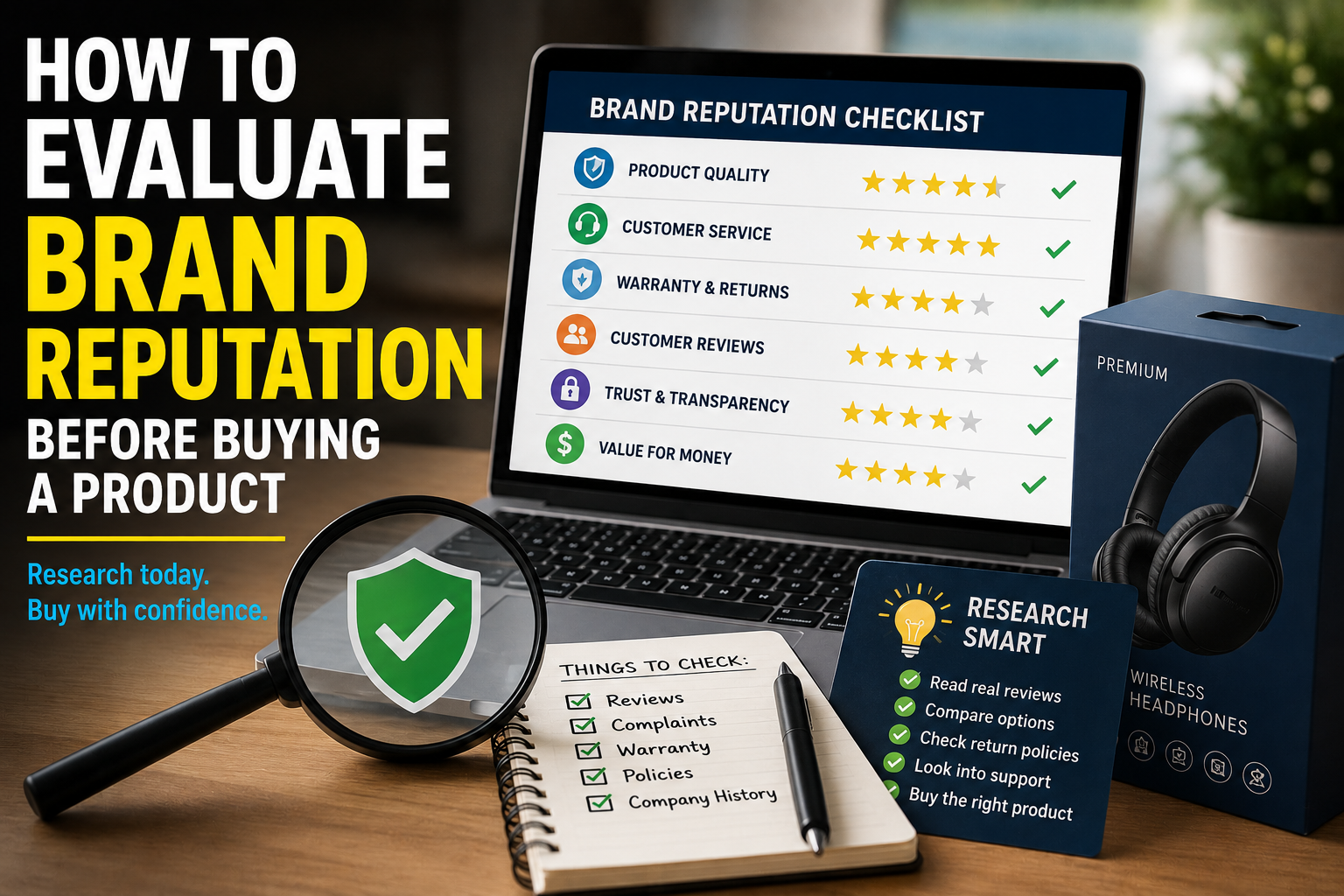
Use a Reputation Scorecard
A simple scorecard can make comparisons easier.
For example:
| Factor | Rating |
| —– | —– |
| Product reliability | ⭐⭐⭐⭐☆ |
| Customer service | ⭐⭐⭐⭐☆ |
| Warranty support | ⭐⭐⭐☆☆ |
| Return policy | ⭐⭐⭐⭐☆ |
| Software support | ⭐⭐⭐⭐⭐ |
| Parts availability | ⭐⭐⭐☆☆ |
| Privacy and security | ⭐⭐⭐⭐☆ |
| Long-term ownership | ⭐⭐⭐⭐☆ |
| Value for money | ⭐⭐⭐⭐☆ |
The ratings do not need to be mathematically precise.
The purpose is to force yourself to consider multiple dimensions rather than relying on brand recognition.
Compare Brands on the Same Criteria
Suppose you are choosing between three products.
Instead of asking:
“Which brand is best?”
ask:
“Which brand performs best on the factors that matter most to me?”
For example:
| Factor | Brand A | Brand B | Brand C |
| —– | —– | —– | —– |
| Reliability | High | Medium | High |
| Warranty | Medium | High | High |
| Customer support | High | Medium | Medium |
| Parts availability | High | Medium | Low |
| Price | Medium | Low | High |
| Software support | High | High | Medium |
This approach makes the decision more objective.
Weight the Factors That Matter Most
Not every factor deserves equal importance.
For an inexpensive kitchen appliance, customer support might matter less than price and reliability.
For a $2,000 laptop, warranty and software support may be much more important.
For a smart security camera, privacy and security could be among the highest priorities.
Think about what would cause the most frustration or financial loss if the product failed.
Then give those factors greater weight.
Check Whether the Brand Supports Your Region
A brand may have an excellent reputation in one market but limited support in another.
Before purchasing, check:
-
Local warranty coverage
-
Authorized service centers
-
Shipping availability
-
Replacement parts
-
Local customer support
-
Regional software support
-
Compatible power standards
-
Import or repair considerations
This is especially important when purchasing products from international sellers.
A product may be inexpensive to import but difficult to repair locally.
Beware of Counterfeit Products
A reputable brand does not guarantee that every product carrying its name is genuine.
Counterfeit products can appear on marketplaces and informal sales channels.
Warning signs include:
-
Unusually low prices
-
Poor packaging
-
Missing documentation
-
Suspicious seller information
-
Incorrect model numbers
-
Inconsistent branding
-
Unusual serial numbers
Buying through an authorized retailer can reduce the risk.
Consider the Retailer’s Reputation Too
The manufacturer is not the only company involved in your purchasing experience.
The retailer can influence:
-
Shipping
-
Product authenticity
-
Returns
-
Refunds
-
Warranty handling
-
Customer support
A reputable product sold by an unreliable seller can still result in a frustrating experience.
Evaluate both the brand and the seller.
Brand Reputation Can Change
One of the most important principles is that reputation is not permanent.
Companies change leadership, suppliers, products, pricing strategies and customer-service policies.
A brand that was highly regarded five years ago may have different strengths today.
Similarly, a company with a poor reputation can improve.
Pay attention to recent evidence rather than relying entirely on old reviews.
A Practical Brand-Reputation Checklist
Before buying an unfamiliar product, ask:
### Product Quality
-
Are independent reviews generally positive?
-
Are recurring defects reported?
-
Does the product perform as advertised?
### Reliability
-
How does it perform after one or two years?
-
Are there common failure points?
### Customer Service
-
Can customers easily reach support?
-
Are complaints resolved effectively?
### Warranty
-
How long is the warranty?
-
What does it actually cover?
-
Are claims straightforward?
### Repairs
-
Are replacement parts available?
-
Can the product be repaired?
### Software
-
How long are updates provided?
-
Are security patches available?
### Privacy
-
What data does the product collect?
-
How does the company protect it?
### Value
-
What is the total cost of ownership?
-
Are subscriptions or accessories required?
### Company History
-
Has the brand responded responsibly to past problems?
-
Does it communicate transparently?
If the answers are consistently positive, the brand is more likely to be a reasonable choice.
When a Poor Reputation Should Stop a Purchase
Not every negative reputation signal is equally serious.
A minor complaint about packaging may not matter much.
A repeated history of serious safety issues, deceptive pricing, unresolved warranty failures or poor security practices is considerably more concerning.
Consider walking away when several independent sources consistently identify serious problems and the company appears unwilling or unable to address them.
When a New or Unknown Brand Can Still Be Worth Considering
An unfamiliar brand is not automatically a bad choice.
New companies may offer innovative products, competitive prices and strong customer support.
The difficulty is that there may be less historical evidence available.
In that situation, reduce risk by checking:
-
Warranty terms
-
Return policy
-
Seller reputation
-
Independent testing
-
Customer reviews
-
Parts availability
-
Company contact information
-
Privacy and security practices
You may also decide that a lower-priced product from a new brand is worth the risk, while choosing a more established company for an expensive purchase.
Make the Brand Part of the Buying Decision
Evaluating brand reputation is ultimately about reducing uncertainty.
No amount of research can guarantee that a product will never fail or that a company will always provide excellent service. What research can do is reveal patterns that are easy to miss when a buying decision is based solely on price, specifications or advertising.
The strongest approach is to combine independent reviews, long-term ownership experiences, warranty information, customer-service history, product recalls, software support, privacy practices and total cost of ownership.
Most importantly, judge the brand in the context of the specific product you are buying. A company does not need to be perfect to be a good choice. It needs to provide enough evidence that its product quality, support and business practices match the money and expectations you are putting behind the purchase.