How to Evaluate Product Brands Before Buying Their Products
Choosing a product is often easier than choosing the brand behind it. Two products may appear similar on paper, yet differ significantly in quality, reliability, customer support, warranty coverage, and long-term value.
Brand evaluation is therefore an important part of making an informed purchase. A familiar logo does not automatically mean a product is worth buying, while a lesser-known brand is not necessarily a poor choice. The goal is to look beyond marketing claims and assess the evidence available before spending money.
Why Brand Evaluation Matters
A brand influences more than the appearance or specifications of a product. It can affect how consistently products are manufactured, how customer complaints are handled, whether replacement parts are available, and how long a product remains useful.
This becomes particularly important when buying expensive or frequently used products. A small difference in upfront price may become insignificant if one brand provides better durability, support, and warranty protection.
Understanding The Complete Guide to Choosing the Right Products can also help put brand research into perspective. The strongest purchasing decisions consider the product itself, the seller, the brand, and the buyer’s individual needs together.
Start With the Brand’s Reputation
The first step is to investigate how the brand is perceived by customers and the wider market.
Look for patterns rather than isolated opinions. A handful of enthusiastic comments does not establish a strong reputation, just as a few negative reviews do not necessarily prove that a company is unreliable.
Consider questions such as:
- How long has the brand been operating?
- What products is it known for?
- Does it have a consistent reputation for quality?
- Are customers generally satisfied after purchasing?
- Does the company respond to complaints?
- Has the brand developed a history of recurring quality problems?
- Does it provide clear information about its products?
For a more detailed approach, How to Evaluate Brand Reputation Before Buying a Product can help explain the factors that distinguish genuine reputation from effective marketing.
Examine Product Quality Across the Brand
One successful product does not necessarily mean every product from a brand is equally good.
Look at the company’s broader product range and determine whether quality appears consistent. If customers repeatedly report problems across several product categories, that may indicate a wider issue with manufacturing standards, quality control, or customer service.
At the same time, avoid judging an entire brand based on one defective item. Even reputable manufacturers can produce individual products with faults.
A useful approach is to compare multiple models from the same company and examine:
- Materials and construction
- Performance
- Reliability
- Design quality
- Ease of use
- Expected lifespan
- Software or firmware support where applicable
- Availability of replacement components
Learn How to Interpret Customer Reviews
Customer reviews can provide valuable information, but they need to be interpreted carefully.
A product with thousands of reviews has more evidence behind it than one with only a handful, but review volume alone does not guarantee reliability. Reviews can be influenced by expectations, individual experiences, incentives, or misunderstandings about how a product works.
Pay attention to recurring themes. If many independent buyers mention the same issue, that deserves more attention than a single one-star complaint.
It is also useful to compare positive and negative feedback. Extremely enthusiastic reviews may explain what customers like, while critical reviews can reveal weaknesses that are not obvious from product descriptions.
Before relying heavily on ratings, learn How to Read Product Reviews Like an Expert. The ability to identify meaningful patterns in reviews can make brand comparisons much more accurate.
Check Warranty and Return Policies
A brand’s warranty can reveal how confident it is in its products and how much protection buyers receive after purchase.
Before buying, check:
- Warranty length
- What the warranty actually covers
- Whether accidental damage is excluded
- Where warranty service is provided
- Whether the buyer pays shipping costs
- How repairs or replacements are handled
- Whether proof of purchase is required
Return policies are equally important. A product may look excellent in reviews but still fail to meet your expectations once you use it yourself.
A straightforward warranty and reasonable return policy can significantly reduce the financial risk of trying an unfamiliar brand.
Investigate Customer Support
Customer service becomes especially important when a product requires technical assistance.
Look at how easily customers can contact the company and whether the brand provides useful support resources. A manufacturer that offers detailed documentation, troubleshooting guides, service centers, and responsive support may provide considerably more value than a company that becomes difficult to reach after the sale.
Search for evidence of how the company handles genuine customer problems. The important question is not whether complaints exist. Every large brand receives complaints. What matters is whether the company consistently attempts to resolve legitimate issues.
Compare the Brand With Its Competitors
Evaluating a brand in isolation can make it difficult to determine whether its products actually offer good value.
Compare it with several competing brands offering similar products. Look at equivalent models rather than simply comparing the cheapest product from one company with the most expensive product from another.
Consider:
| Factor | What to Compare |
|---|---|
| Price | Upfront purchase cost |
| Quality | Materials and construction |
| Performance | What the product actually delivers |
| Reliability | Common failure or defect patterns |
| Warranty | Length and coverage |
| Support | Availability and responsiveness |
| Reviews | Recurring customer experiences |
| Longevity | Expected useful lifespan |
| Features | Useful capabilities rather than feature count |
| Value | Overall benefits relative to cost |
This makes it easier to determine whether you are paying for meaningful advantages or simply for brand recognition.
Consider the Total Cost of Ownership
The cheapest product is not always the least expensive option over time.
A product may have a low purchase price but require expensive accessories, replacement components, subscriptions, maintenance, or repairs. Another product may cost more initially but last longer and require fewer additional expenses.
Consider the complete ownership cost, including:
- Purchase price
- Accessories
- Consumables
- Maintenance
- Repairs
- Replacement parts
- Subscription fees
- Energy consumption
- Potential replacement frequency
The Product Value Guide provides a useful framework for thinking about value beyond the initial price tag.
Look at the Brand’s Transparency
Transparency is another useful indicator when evaluating a company.
A trustworthy brand should generally provide clear information about its products, specifications, warranty conditions, manufacturing claims, and business policies.
Be cautious when important information is difficult to find or when marketing language makes broad claims without explaining what they mean.
For example, terms such as “premium,” “professional,” “advanced,” or “next-generation” have limited value unless they are supported by measurable product characteristics.
The more important question is: What evidence supports the claim?
Research Manufacturing and Product Origins
Where and how a product is manufactured can sometimes provide useful context, although manufacturing location alone should not determine your decision.
Many respected brands manufacture products through third-party facilities or use global supply chains. Instead of assuming that a particular country automatically means higher or lower quality, examine the company’s quality-control practices and manufacturing standards.
For certain products, it may also be useful to investigate:
- Manufacturing partners
- Quality certifications
- Testing procedures
- Materials sourcing
- Environmental practices
- Product safety information
- Recall history
These details can provide a better picture of how seriously a company approaches product quality.
Check How the Brand Handles Problems
A company’s response to product failures can tell you more than its advertising.
Search for information about recalls, widespread defects, warranty disputes, and major customer complaints. Then examine how the company responded.
A manufacturer that acknowledges problems, communicates clearly, and provides reasonable remedies may deserve more confidence than one that attempts to avoid responsibility.
This is particularly important for products that are expensive, safety-sensitive, or difficult to replace.
Be Careful With Influencer Recommendations
Influencers and online creators can be useful sources of product information, but their recommendations should not automatically be treated as independent evaluations.
Consider whether the reviewer:
- Discloses sponsorships
- Received the product for free
- Has affiliate relationships
- Tests products over an extended period
- Provides specific evidence
- Compares alternatives
- Discusses weaknesses as well as strengths
A review that only repeats the manufacturer’s specifications provides less independent information than one based on extended real-world use.
Look for Long-Term Ownership Experiences
Initial impressions do not always reveal how a product performs after months or years.
Whenever possible, look for long-term ownership reports. These can reveal problems involving battery degradation, software updates, component failures, wear, replacement costs, or declining performance.
This is especially useful for products that are expected to last several years.
A brand that consistently produces products that remain functional and supported over a long period can offer considerably better value than one that focuses primarily on low initial prices.
Consider Whether the Brand Fits Your Needs
A highly regarded brand may still be the wrong choice for a particular buyer.
Your priorities should determine how much weight you give each factor. Someone purchasing an inexpensive accessory may prioritize price, while someone buying a laptop for professional work might place greater importance on reliability, warranty support, repairability, and long-term software support.
Before making a decision, identify your most important requirements.
Ask yourself:
- What problem am I trying to solve?
- How often will I use the product?
- How long do I expect it to last?
- What features actually matter to me?
- How much can I reasonably spend?
- How important is after-sales support?
- What risks would make me regret the purchase?
These questions prevent brand reputation from becoming a substitute for actual product suitability.
Watch for Warning Signs
Some warning signs should prompt additional research before purchasing.
These can include:
- An unusually large number of unresolved complaints
- Poor or nonexistent customer support
- Unclear warranty terms
- Misleading specifications
- Numerous reports of premature failures
- Difficulty obtaining replacement parts
- Excessively aggressive marketing claims
- Suspiciously similar or repetitive reviews
- A product that appears significantly cheaper without an obvious explanation
- A history of recalls or unresolved quality problems
None of these factors automatically proves that a brand is bad. However, several warning signs appearing together should make a buyer more cautious.
Build a Simple Brand Scorecard
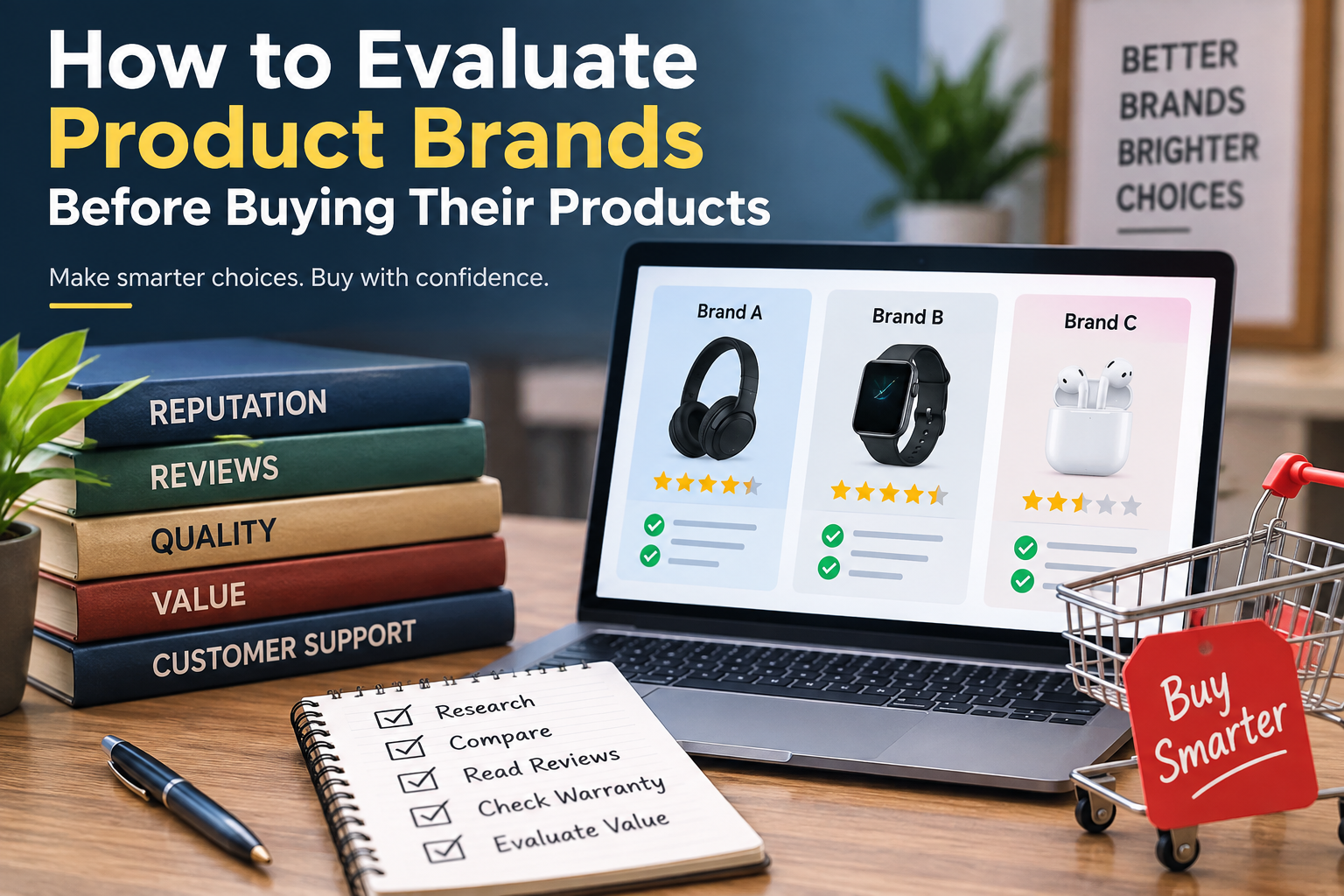
A practical way to avoid making an emotional purchasing decision is to score each brand.
For example, rate competing brands from one to five in categories such as:
| Category | Brand A | Brand B | Brand C |
|---|---|---|---|
| Reputation | |||
| Product quality | |||
| Customer reviews | |||
| Warranty | |||
| Customer support | |||
| Durability | |||
| Transparency | |||
| Value | |||
| Overall fit |
The purpose is not to create a mathematically perfect ranking. Instead, the scorecard forces you to consider multiple factors instead of choosing whichever brand has the most recognizable name.
Don’t Confuse Price With Quality
Higher prices can sometimes reflect better materials, stronger support, longer warranties, or more sophisticated engineering. But a high price does not automatically prove superior quality.
Likewise, a low-cost brand may offer excellent value if it delivers reliable performance without unnecessary extras.
The objective should be to determine what you receive for the money, rather than assuming expensive means better or cheap means inferior.
A Better Way to Make the Final Decision
Evaluating a product brand should ultimately be an evidence-based process.
Start by understanding your own requirements. Research the brand’s reputation, investigate product quality, read customer reviews critically, compare competitors, examine warranty and support policies, and calculate the likely long-term cost.
Most importantly, separate brand familiarity from brand reliability. A recognizable name can make a purchase feel safer, but actual evidence about quality, customer experience, durability, and value provides a much stronger basis for the decision.
When those factors consistently point in the same direction, you can approach the purchase with greater confidence—and with a much better chance of choosing a product that remains useful long after the initial excitement of buying it has disappeared.