How to Identify Biased Product Reviews
Product reviews can make buying decisions much easier—but not every review is equally trustworthy. Some are based on genuine hands-on experience, while others may be influenced by advertising relationships, affiliate commissions, sponsorships, free products, or a desire to generate clicks.
That does not automatically make a review useless. A reviewer can receive a free product or earn an affiliate commission and still provide an honest, well-researched assessment. The important question is whether the review gives readers enough transparent information to understand potential conflicts of interest and judge the evidence for themselves.
Learning how to identify biased product reviews can help you separate useful buying advice from content designed primarily to persuade you to purchase. For a broader framework covering the factors that should influence a purchase, see The Complete Guide to Choosing the Right Products.
What Makes a Product Review Biased?
A product review is biased when the information, analysis, or recommendation is significantly influenced by interests other than providing an objective assessment of the product.
Bias can take several forms. A reviewer might exaggerate the benefits of a product because they earn money from sales, minimize important drawbacks because the manufacturer provided the product, or compare products in a way that favors a particular brand.
However, bias is not always obvious.
A review can sound professional, contain detailed specifications, and still present an incomplete picture. The most reliable approach is therefore to examine how the reviewer reached the recommendation, rather than simply judging the tone of the article.
1. Check Whether the Reviewer Discloses Relationships
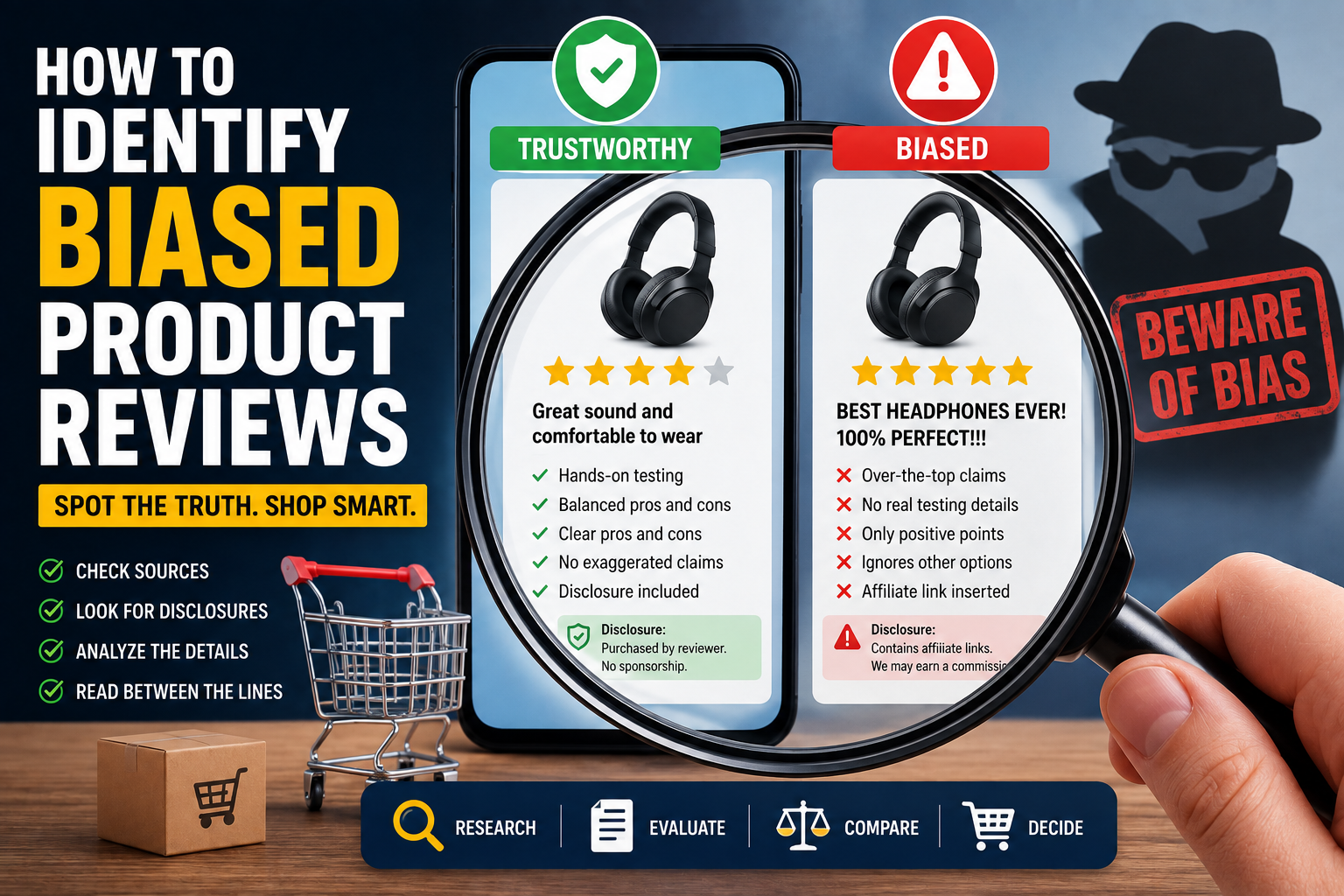
One of the first things to look for is a disclosure about the reviewer’s relationship with the manufacturer, retailer, or product.
A review may mention that:
- The product was provided free of charge.
- The reviewer purchased the product independently.
- The article contains affiliate links.
- The company sponsored the content.
- The reviewer received compensation.
- The reviewer attended a manufacturer event.
- The reviewer has an ongoing commercial relationship with the brand.
A disclosure does not necessarily mean the review is biased.
In fact, transparent disclosure can be a positive trust signal because it gives readers important context before they evaluate the recommendation.
The bigger warning sign is a review that appears commercially motivated but provides little or no explanation of the relationship.
2. Look Beyond the Star Rating
Star ratings are convenient, but they can hide important details.
A product receiving five stars might have excellent performance but poor battery life, limited compatibility, expensive accessories, or a high long-term ownership cost.
Instead of asking only, “What rating did it receive?” examine:
- Strengths
- Weaknesses
- Performance
- Build quality
- Ease of use
- Reliability
- Compatibility
- Price
- Long-term ownership considerations
- Intended user
- Alternative products
A trustworthy review should explain why the reviewer reached the final rating.
A score without supporting reasoning provides little useful evidence.
Understanding the difference between sticker price and overall value is also important when assessing a recommendation. The Product Value Guide provides a broader framework for judging what you actually receive for the money you spend.
3. Pay Attention to Missing Criticism
One of the easiest ways to spot potential bias is to look for what a review does not discuss.
Every product has trade-offs. Even excellent products have limitations.
If a review spends hundreds or thousands of words describing advantages but barely mentions disadvantages, readers should investigate further.
Ask:
What would someone dislike about this product?
If the review never answers that question, it may be presenting an incomplete picture.
This is especially important for expensive purchases where disadvantages can have a significant impact on ownership.
4. Be Careful With Extremely Positive Language
Language can reveal the purpose of a review.
Phrases such as:
- “The perfect product”
- “Absolutely unbeatable”
- “You need this”
- “Best product ever”
- “No competition”
- “A must-buy for everyone”
are not automatically evidence of dishonesty, but repeated emotional language should encourage closer examination.
Objective reviews generally distinguish between facts, observations, and opinions.
For example, saying that a laptop weighs a particular amount is a factual claim. Saying that it feels premium is an observation or subjective judgment. Saying it is “the best laptop available” is a broader opinion that requires comparison and supporting evidence.
The more sweeping the claim, the more evidence the reviewer should provide.
5. Check Whether the Review Shows Real-World Testing
A useful review should explain how the product was evaluated when appropriate.
For electronics, that might include testing:
- Battery life
- Performance
- Display quality
- Camera performance
- Connectivity
- Heat management
- Software features
- Durability
- Everyday usability
For household products, it could involve:
- Ease of installation
- Cleaning
- Noise
- Maintenance
- Efficiency
- Build quality
- Long-term usability
The exact testing method depends on the product.
The key question is:
Did the reviewer actually examine the product in a meaningful way?
Reviews that merely repeat manufacturer specifications without adding independent observations provide limited value.
For another perspective on assessing whether a product is likely to hold up over time, see How to Determine Whether a Product Is Durable and Reliable.
6. Compare the Review With Manufacturer Claims
Manufacturers naturally present their products in the best possible light.
That is part of marketing.
A product page might highlight its fastest performance, longest battery life, strongest materials, or most advanced features. A good independent review should go beyond those claims.
Look for evidence that the reviewer independently assessed important claims.
For example, if a manufacturer advertises exceptional battery life, a useful review might explain how long the product lasted under realistic conditions and how that compares with competing products.
This distinction between manufacturer claims and independent observations is one of the most important parts of evaluating a review.
7. Examine the Comparisons Carefully
Comparison articles can be particularly useful—and particularly vulnerable to bias.
A comparison should evaluate competing products using reasonably consistent criteria.
Suppose a reviewer compares two smartphones. If one phone is praised for camera quality while the other is criticized for camera limitations, the reader should be able to understand how those judgments were reached.
Look for comparisons involving:
| Factor | What to Examine |
|---|---|
| Price | Are comparable configurations being compared? |
| Performance | Were similar tests used? |
| Features | Are important features covered for both products? |
| Usability | Are strengths and weaknesses discussed equally? |
| Reliability | Is there evidence or long-term experience? |
| Value | Does the recommendation consider different budgets? |
| Target user | Is the recommendation appropriate for different buyers? |
A biased comparison may apply different standards to different products.
When comparing products more broadly, it can also help to understand the difference between mainstream value and premium positioning. Best Value vs Premium Products Explained explores how those trade-offs affect purchasing decisions.
8. Check Who Benefits From the Recommendation
Consider the commercial structure behind the content.
If a website earns an affiliate commission when readers purchase a particular product, there is a financial incentive to generate purchases.
That does not invalidate the review.
Affiliate-supported websites can produce excellent buying guides. But readers should understand that the recommendation exists within a commercial environment.
Look for clear disclosures and examine whether the article still discusses alternatives, disadvantages, and situations where the recommended product may not be the best choice.
A strong buying guide should help readers decide whether to buy—not simply encourage them to buy.
9. Look for Alternatives and “Who Should Not Buy” Sections
One of the strongest signs of useful buying advice is a willingness to tell readers when a product isn’t suitable.
For example, a review might say:
- This product is excellent for beginners but unnecessary for professionals.
- It offers strong performance but poor value for budget buyers.
- It works well for small spaces but is unsuitable for larger households.
- It has impressive features but requires expensive accessories.
- Another product may be better for users who prioritize battery life.
This kind of qualification demonstrates that the recommendation is based on fit, rather than simply declaring one product universally superior.
There is rarely a single best product for everyone.
10. Investigate the Author’s Expertise
Author information can provide useful context.
Depending on the subject, look for:
- Author biographies
- Relevant professional experience
- Testing methodology
- Previous reviews
- Editorial standards
- Corrections policies
- Contact information
- About pages
Expertise matters particularly for specialized products.
A reviewer evaluating professional photography equipment, networking hardware, power tools, medical devices, or financial software may need a deeper understanding of the subject than someone simply summarizing specifications.
The goal isn’t to assume that only credentialed professionals can write useful reviews. Instead, look for evidence that the author understands the product category and has genuinely engaged with the subject.
11. Distinguish Specifications From Experience
A common weakness in product reviews is simply rewriting the manufacturer’s product description.
Specifications are useful, but they are only one part of a buying decision.
For example, a review can list:
- Processor
- Memory
- Storage
- Screen size
- Battery capacity
- Weight
without explaining what those specifications mean in everyday use.
A stronger review connects specifications with practical consequences.
Instead of merely stating that a device has a certain amount of memory, the reviewer should explain what that means for multitasking, demanding applications, or the intended user.
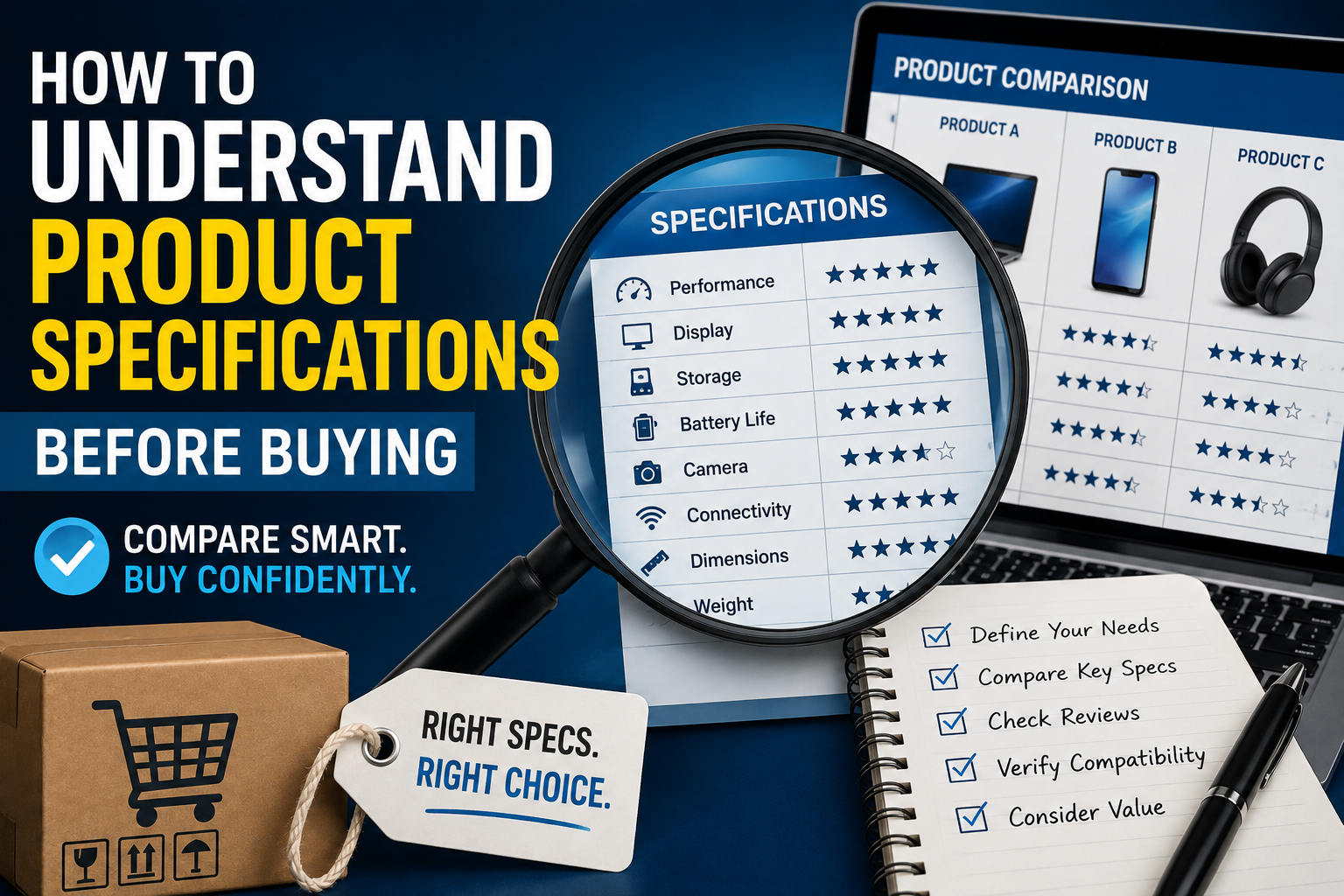
Readers can also learn more about interpreting specifications in How to Understand Product Specifications Before Buying.
This is where genuine experience can add value that a product page cannot.
12. Read Reviews From Multiple Sources
No single review should necessarily determine an expensive purchase.
For major buying decisions, compare several independent sources.
Look for areas where reviewers agree.
If multiple reviewers independently identify the same weakness, that may be more meaningful than one reviewer describing the product as flawless.
At the same time, differences between reviews can also be informative.
One reviewer may prioritize performance while another focuses on ease of use. Both perspectives can be valid for different audiences.
For a more systematic approach to interpreting individual reviews, see How to Read Product Reviews Like an Expert.
The objective is not to find a reviewer who agrees with you. It is to build a more complete understanding of the product.
13. Check the Date and Product Version
Product information can become outdated.
A review may refer to:
- An older software version
- An earlier hardware revision
- A discontinued model
- An outdated price
- Features that have since changed
- Accessories that are no longer available
Before relying on a review, confirm that it applies to the exact product you’re considering.
This is particularly important for technology products, where software updates can significantly change functionality over time.
An old review isn’t necessarily bad. It simply needs to be interpreted within its original context.
14. Watch for Affiliate-Focused Review Patterns
Affiliate content is not inherently unreliable, but certain patterns can reduce its usefulness.
Be cautious when an article:
- Recommends a product almost immediately.
- Contains numerous purchase links.
- Repeats the same product name excessively.
- Uses aggressive calls to action.
- Provides little criticism.
- Makes sweeping claims without evidence.
- Offers few alternatives.
- Focuses heavily on conversion rather than education.
A genuinely useful buying guide should still answer the reader’s questions even if they ultimately decide not to purchase anything.
For broader guidance on evaluating commercial recommendations and making decisions based on your own priorities, see How to Make Better Buying Decisions When Choosing Products.
15. Understand That Positive Reviews Can Still Be Honest
A common mistake is assuming that every positive review is biased.
A product can genuinely be excellent.
Likewise, a negative review is not automatically more trustworthy than a positive one.
The important factors are:
- Evidence
- Transparency
- Testing
- Balance
- Reasoning
- Relevant expertise
- Clear methodology
A well-supported five-star review can be more trustworthy than a poorly researched one-star review.
The goal is not to find negative opinions. It is to find well-supported opinions.
A Simple Product Review Credibility Checklist
Before trusting a review, ask these questions:
| Question | What a Good Sign Looks Like |
|---|---|
| Is there a disclosure? | Commercial relationships are clearly explained |
| Was the product tested? | The reviewer describes meaningful hands-on evaluation |
| Are drawbacks included? | Weaknesses receive specific attention |
| Are claims supported? | Evidence or testing accompanies major claims |
| Are alternatives discussed? | Other suitable options are acknowledged |
| Is the author identifiable? | Relevant experience or expertise is visible |
| Is the review current? | Product version and information are up to date |
| Is the methodology clear? | Readers can understand how judgments were made |
| Is the recommendation qualified? | The reviewer explains who the product suits |
| Is the tone reasonable? | Claims are specific rather than excessively promotional |
The more boxes a review checks, the more confidence you can place in its analysis.
Why Independent Judgment Still Matters
Even a transparent, thoroughly tested review cannot completely eliminate subjectivity.
Different buyers have different priorities.
One person may value price above everything else. Another may care about performance, durability, design, repairability, portability, or ease of use.
That’s why the best product review isn’t necessarily the one that tells you exactly what to buy. It is the one that gives you enough reliable information to make the decision yourself.
Before purchasing, identify your own priorities and compare them with the reviewer’s criteria.
Make the Review Work for You
Identifying biased product reviews is ultimately about reading critically rather than automatically trusting—or rejecting—online recommendations.
Look for transparency about commercial relationships, meaningful product testing, balanced discussion of strengths and weaknesses, clear methodology, relevant expertise, and comparisons that use consistent standards.
Most importantly, don’t confuse confidence with credibility. A review can sound authoritative while offering very little evidence.
The strongest buying decisions come from combining trustworthy reviews with your own requirements, independent research, and a clear understanding of what you’re actually paying for.