How to Make Better Buying Decisions When Choosing Products
Buying something new can seem simple: find a product, compare a few prices and choose the one that looks best.
In practice, good purchasing decisions are rarely that straightforward.
A product can have excellent reviews but be unsuitable for your needs. The cheapest option may become more expensive over time. A highly rated product may include features you will never use, while a less popular alternative may offer exactly what you need at a lower price.
Better buying decisions come from understanding what you actually need, comparing products on meaningful criteria, evaluating the total cost and considering how a product will perform over time. For a broader framework covering the entire product evaluation process, see The Complete Guide to Choosing the Right Products.
Whether you are buying electronics, appliances, furniture, clothing, tools or everyday household products, a thoughtful process can reduce waste and increase the likelihood that you will be satisfied with what you purchase.
Start with the problem, not the product
One of the most common buying mistakes is beginning with a specific product before identifying the problem you want to solve.
For example, someone might decide they need a new laptop and immediately start comparing popular models.
A better starting point is to ask:
- What will I use the laptop for?
- How often will I use it?
- Which tasks require the most performance?
- Do I need portability?
- How much storage do I actually need?
- What features are essential?
- What limitations would make the product frustrating to use?
These questions establish the requirements before marketing claims and brand popularity influence the decision.
The same principle works for almost anything.
If you need a vacuum cleaner for a small apartment, your priorities may be different from those of someone cleaning a large house with several pets. If you need headphones for commuting, noise isolation and comfort may matter more than features designed primarily for professional audio work.
Define the job before choosing the tool.
Separate needs from wants
Once you understand the problem, divide your requirements into two categories: must-have features and desirable features.
A must-have feature is something the product genuinely needs to perform your intended task.
A desirable feature is something that would be convenient but is not essential.
This distinction prevents feature overload.
Modern products often contain long lists of specifications designed to make them appear more advanced. But every additional feature can increase cost and complexity.
Before paying more, ask:
Will I actually use this feature?
If the answer is no, it should probably have less influence on your decision.
Set a realistic budget
A budget is more useful when it is established before you become attached to a particular product.
Once consumers find a product they really like, they may gradually increase their spending to justify getting it.
Setting a range in advance can help prevent that.
However, the lowest possible price should not automatically become the goal.
Instead, consider the amount you are comfortable spending for the level of performance, reliability and longevity you require.
A sensible budget might include:
- Purchase price
- Delivery costs
- Installation
- Accessories
- Replacement parts
- Maintenance
- Subscriptions
- Energy consumption
- Potential repair costs
This gives you a more realistic picture of what the purchase will actually cost.
For a deeper look at how to judge whether the benefits you receive justify the money you spend, see the Product Value Guide.
Compare products using the same criteria
Comparisons become difficult when every product is evaluated differently.
Create a short list of criteria that matter to you and use them consistently.
For example, when comparing smartphones, you might consider:
| Criteria | Product A | Product B | Product C |
|---|---|---|---|
| Price | |||
| Battery life | |||
| Camera quality | |||
| Performance | |||
| Storage | |||
| Software support | |||
| Warranty |
The exact criteria should change according to the category.
For a washing machine, energy efficiency and capacity may matter more than screen quality. For office furniture, ergonomics and durability may be more important than appearance.
A structured comparison makes trade-offs easier to see.
Do not compare specifications in isolation
Specifications can be useful, but individual numbers rarely tell the whole story.
A camera with a higher megapixel count is not automatically better in every situation. A laptop with a faster processor may still provide a poor experience if it has inadequate cooling or insufficient memory.
Similarly, a television with an impressive display specification may not be the best choice if its software is frustrating or its viewing environment does not suit the technology.
Specifications should answer a practical question:
What does this number mean for the way I will use the product?
If a specification has no meaningful effect on your use case, it should probably not dominate the buying decision.
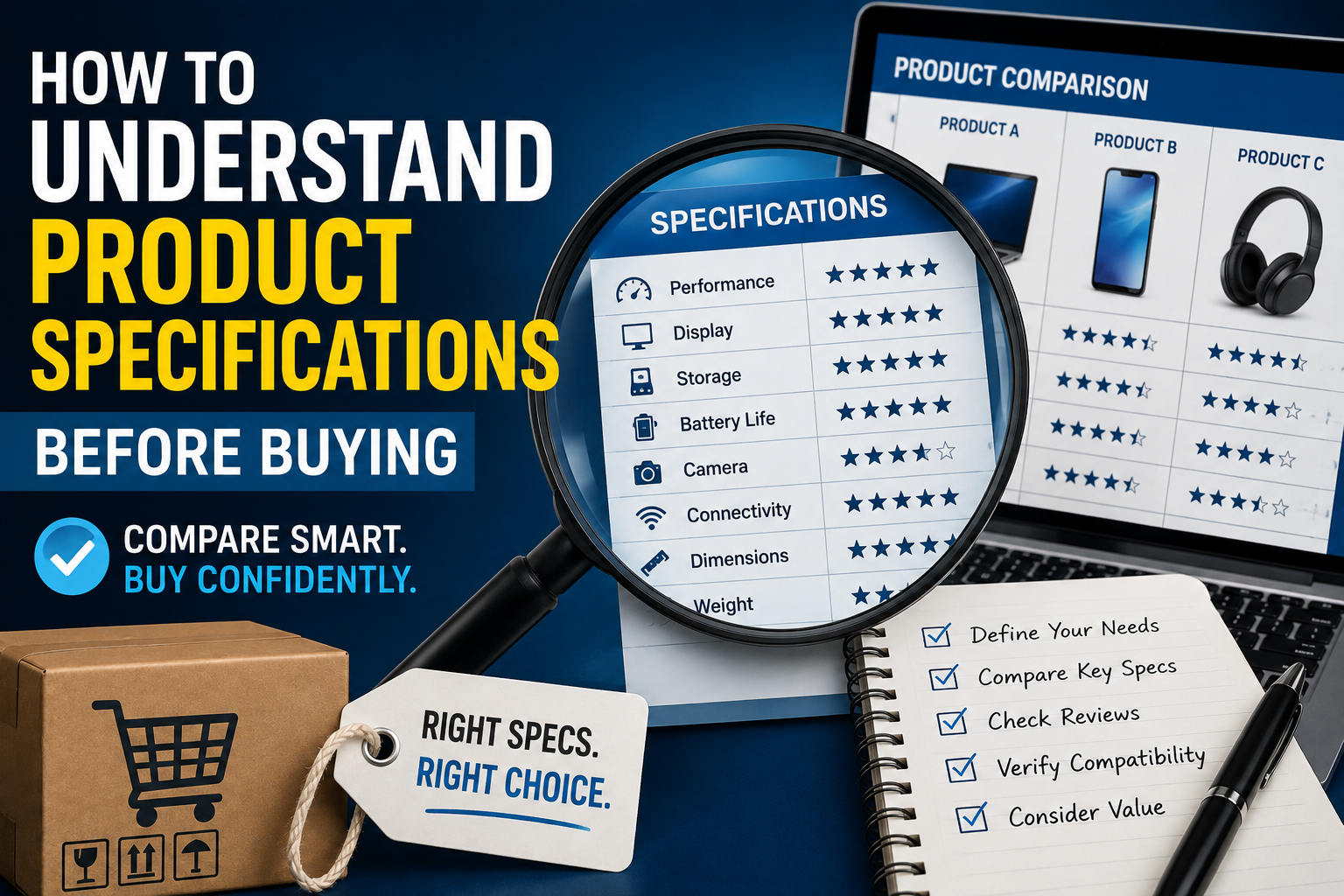
For more guidance on interpreting technical information before making a purchase, see How to Understand Product Specifications Before Buying.
Read reviews for patterns, not just ratings
Star ratings are useful as a starting point, but they rarely provide enough information on their own.
A product with an average rating of 4.5 out of 5 may have thousands of reviews describing very different experiences.
Look for recurring themes.
Do multiple reviewers mention:
- Poor battery life?
- Difficult setup?
- Comfortable operation?
- Weak construction?
- Excellent customer support?
- Software problems?
- Unexpected noise?
- Strong performance?
- Parts that wear out quickly?
One negative review may represent an unusual experience.
When the same criticism appears repeatedly, however, it becomes much more meaningful.
The goal is to identify patterns rather than isolated opinions.
For a more detailed approach to evaluating individual reviews and separating useful evidence from promotional language, see How to Read Product Reviews Like an Expert.
Consider who wrote the review
Not every review has the same value.
A professional reviewer may spend days or weeks testing a product across different scenarios. An ordinary customer may provide valuable information about long-term ownership.
Both perspectives can be useful.
Professional reviews are often helpful for:
- Controlled comparisons
- Performance testing
- Technical analysis
- Feature evaluation
- Understanding strengths and weaknesses
Customer reviews can be useful for:
- Long-term reliability
- Everyday usability
- Delivery experiences
- Customer service
- Problems that emerge after extended use
The strongest buying decisions often combine both.
Be cautious with extremely positive reviews
Reviews that sound overly enthusiastic can deserve closer examination.
Statements such as “perfect,” “best product ever” or “changed my life” provide little useful information without specific evidence.
A more useful review explains why the reviewer liked or disliked the product.
Look for details about how the product was used, what expectations the buyer had and what happened over time.
Specific experiences are generally more informative than emotional language.
Pay attention to negative reviews too
Negative reviews can reveal weaknesses that promotional material will never mention.
But they also need context.
A reviewer complaining that a product does not perform a specific task may be describing something the product was never designed to do.
Another customer may have received a defective unit rather than experiencing a problem common to the entire product line.
Ask:
Is this a product-wide problem, a setup issue, an unusual failure or simply a mismatch between the product and the buyer’s expectations?
That distinction can prevent you from rejecting a good product because of an isolated complaint.
Check independent sources
When a purchase is expensive or important, do not rely on a single source.
Compare information from several places, such as:
- Manufacturer specifications
- Independent reviews
- Customer feedback
- Retailer information
- Consumer organizations
- Professional testing
- Warranty documentation
- Product manuals
Different sources answer different questions.
A manufacturer is the best source for official specifications, but an independent reviewer may be better positioned to discuss real-world performance.
Using several sources makes it easier to identify contradictions.
Understand the difference between sponsored content and independent reviews
Some product content is created in partnership with manufacturers or retailers.
Sponsored content is not automatically useless, but readers should understand how the relationship may influence the presentation.
Look for disclosures indicating whether the reviewer received payment, free products or other compensation.
Independent testing does not guarantee that every conclusion is correct, but transparency gives you more information about how to interpret the recommendation.
If you want to examine these issues more critically, How to Identify Biased Product Reviews explains the warning signs to look for in commercial and independent review content.
Consider the total cost of ownership
The purchase price is only one part of the financial decision.
A cheap printer, for example, may require expensive ink. A low-cost appliance may consume more electricity. A budget power tool may require replacement batteries or accessories.
Total cost of ownership can include:
Purchase price + operating costs + maintenance + accessories + repairs − resale value
You do not need to calculate this precisely for every purchase.
But for expensive or frequently used products, thinking beyond the initial price can reveal major differences between alternatives.
For a more detailed framework for evaluating these ongoing expenses, see Product Ownership Costs: Complete Guide to True Cost.
Think about durability
A product that lasts twice as long may be better value even if it costs more initially.
Durability can be difficult to predict because manufacturers do not always publish detailed failure rates.
Look for evidence such as:
- Construction materials
- Warranty length
- Availability of replacement parts
- Repairability
- Long-term owner reports
- Product history
- Manufacturer support
A longer warranty does not guarantee superior quality, but it can provide useful information about the manufacturer’s willingness to stand behind the product.
For a deeper examination of how to assess these factors before buying, see How to Determine Whether a Product Is Durable and Reliable.
Check the warranty before buying
Warranty terms are easy to ignore when you are excited about a purchase.
They become much more important when something goes wrong.
Check:
- Warranty duration
- What components are covered
- What exclusions apply
- Who pays shipping
- Whether labor is included
- How repairs are handled
- Whether the warranty is transferable
Also distinguish between a manufacturer’s warranty and a retailer’s return policy.
They serve different purposes.
Think about repairability
When products fail, consumers increasingly face a choice between repairing them and replacing them.
Products designed with accessible replacement parts, standard components and repair documentation can potentially remain useful for longer.
Repairability is particularly relevant for expensive electronics, appliances, tools and other products that would be costly to replace.
Before buying, ask:
If something important breaks, can it realistically be repaired?
If the answer is no, the product may have a shorter practical lifespan than its specifications suggest.
Consider compatibility and ecosystems
A product rarely exists in isolation.
Phones connect to accessories. Computers connect to peripherals. Smart-home devices connect to platforms. Software depends on operating systems.
Before purchasing, check whether the product works with the equipment and services you already own.
An inexpensive device can become expensive if you discover that you need to replace several existing accessories to use it properly.
Compatibility also matters for future upgrades.
A product that locks you into an ecosystem may be convenient today but restrictive later.
Think about software support
For connected products, hardware is only part of the ownership experience.
Smartphones, tablets, computers, smart televisions, security cameras and many household devices depend on software.
Important questions include:
- How long will the manufacturer provide updates?
- Does the product require an account?
- Are important features subscription-based?
- What happens if the manufacturer’s service shuts down?
- Can the device continue working without an internet connection?
A product that performs well today may become less useful if software support ends quickly.
Avoid buying based solely on brand reputation
Brand reputation can provide useful information about quality, support and reliability.
But a famous brand does not automatically make every product the best choice.
Companies produce products across different price categories and quality levels.
A lesser-known brand may sometimes offer excellent value, while a famous manufacturer may release products that are poorly suited to a particular need.
Use brand reputation as one factor rather than a substitute for evaluating the product itself.
For a deeper look at how to assess a manufacturer’s track record without relying on brand recognition alone, see How to Evaluate Brand Reputation Before Buying a Product.
Be careful with “best product” lists
Buying guides often use phrases such as “best overall,” “best budget option” and “best premium choice.”
These categories can be helpful, but remember that “best” is usually relative.
The best product for one person may be completely wrong for another.
A premium camera may be ideal for a professional photographer but unnecessary for someone who takes occasional family photographs.
A large refrigerator may be excellent for a large household but waste space and energy in a small apartment.
Instead of asking:
What is the best product?
Ask:
What is the best product for my particular needs, budget and circumstances?
That is a much more useful question.
Look beyond the current version
Product generations change quickly, especially in technology.
Before buying, check whether a newer model has recently launched or is expected soon.
This can affect your decision in several ways.
The newest model may justify its higher price because of meaningful improvements. Alternatively, the previous generation may now offer excellent value because its price has fallen.
Do not automatically assume that the newest version is the smartest purchase.
Look at the actual improvements.
Consider when to buy
Prices can change because of product launches, promotions, inventory levels and seasonal sales.
If you do not need the product immediately, some flexibility can help.
However, constantly waiting for a better deal can become counterproductive.
A useful approach is to establish a price that represents good value and purchase when a suitable product reaches that range.
The goal is not necessarily to pay the absolute lowest price ever recorded.
It is to pay a reasonable price for a product that meets your needs.
Beware of artificial urgency
Marketing often creates pressure to buy immediately.
Messages such as “only two left,” “sale ends tonight” or countdown timers can encourage impulsive decisions.
Sometimes the urgency is genuine.
Sometimes it is simply a sales technique.
For non-essential purchases, give yourself time to think.
A short pause can reveal whether you actually need the product or were simply reacting to an attractive offer.
Calculate the cost per use
For products you expect to use frequently, cost per use can provide a useful perspective.
Suppose one pair of shoes costs more but is worn several times a week for years, while a cheaper pair needs frequent replacement.
The more expensive purchase may have a lower cost per use.
The same principle applies to tools, appliances, furniture and other frequently used products.
Instead of asking only:
How much does it cost?
Consider:
How much value will I get from it?
Think about environmental impact
Buying decisions also have consequences beyond the individual consumer.
Consider factors such as:
- Product lifespan
- Energy consumption
- Packaging
- Repairability
- Recyclability
- Materials
- Shipping
- Replacement frequency
A durable product that remains useful for many years can reduce the need for repeated purchases.
That does not mean the most expensive or heavily marketed product is automatically the environmentally responsible choice.
Look for specific evidence rather than vague sustainability claims.
Do not confuse price with quality
Higher prices can sometimes reflect better materials, engineering, support or durability.
But price alone is not proof of quality.
Luxury branding, marketing expenses and brand positioning can also increase prices.
Likewise, low prices do not automatically indicate poor quality.
The most useful question is whether the product provides sufficient performance and reliability for the money.
This is the essence of value.
For a closer look at the relationship between pricing, perceived value and what actually determines whether a product is worth its price, see How Product Pricing Works and What Determines Whether a Product Is Worth Its Price.
Give more weight to factors that matter most
Not every criterion deserves equal importance.
Imagine you are buying a laptop.
If portability is essential, weight may matter more than a slightly faster processor. If you edit video professionally, processor and graphics performance may matter much more.
A simple scoring system can help.
For each criterion, assign an importance level from 1 to 5. Then rate each product on how well it satisfies that criterion.
You can multiply the importance score by the product rating to produce a rough weighted comparison.
This does not turn a buying decision into perfect mathematics.
It simply prevents relatively unimportant features from overshadowing the things that actually matter.
Think about your future needs
A product should ideally meet your needs for a reasonable period of time.
That does not mean buying far more capability than you need today.
Instead, consider whether your requirements are likely to change soon.
For example, a student who expects to begin editing videos next year may want a computer with enough performance to accommodate that change.
But buying excessive capacity for a possibility that may never happen can waste money.
Aim for reasonable future-proofing, not unlimited specifications.
Know when a cheaper product is the better choice
Sometimes the smartest decision is the inexpensive one.
If two products perform the required task equally well and have similar reliability, paying substantially more for additional features may not provide meaningful value.
This is particularly true for simple products.
You do not need the most advanced version of something simply because it exists.
A product that reliably solves the problem at a reasonable price can be a better purchase than a premium alternative whose extra capabilities remain unused.
Know when spending more makes sense
The opposite is also true.
Paying more can be justified when the additional cost produces meaningful benefits.
Examples may include:
- Significantly better durability
- Lower operating costs
- Better safety
- Longer software support
- Stronger warranty coverage
- Important performance improvements
- Easier maintenance
- Better ergonomics
The key is to connect the extra spending to a specific benefit.
“More expensive” is not a benefit by itself.
Use a cooling-off period for expensive purchases
For major purchases, consider waiting before completing the transaction.
During the cooling-off period, ask:
- Do I still need it?
- Does it solve the problem I originally identified?
- Have I compared alternatives?
- Can I comfortably afford it?
- Have I checked the warranty?
- Are there ongoing costs?
- Am I buying it because I need it or because the marketing made it feel urgent?
If the product still makes sense after the excitement fades, you are more likely to be making a deliberate decision.
Build a repeatable buying process
Better buying does not have to be complicated.
A simple process can be repeated across product categories:
1. Define the problem
What are you actually trying to accomplish?
2. Identify essential requirements
Which features are genuinely necessary?
3. Set a budget
How much can you reasonably spend?
4. Find several alternatives
Avoid comparing only one product against itself.
5. Check independent information
Look at professional reviews, customer experiences and official specifications.
6. Compare total value
Consider performance, durability, operating costs, warranty and support.
7. Check compatibility
Make sure the product works with your existing setup.
8. Consider future needs
Think about how long you expect to use it.
9. Watch for unnecessary pressure
Do not let artificial urgency make the decision for you.
10. Buy when the evidence supports the decision
Once the product meets your requirements at a reasonable value, make the purchase confidently.
Better buying is about value, not perfection
There is rarely a single product that is objectively perfect for everyone.
Every purchase involves trade-offs.
One product may offer better performance. Another may have a lower price. A third may provide better durability or customer support.
The goal is not to find an imaginary product with no weaknesses.
It is to find the option whose strengths matter most to you and whose weaknesses you can accept.
By starting with your needs, comparing products consistently, questioning marketing claims, examining real-world reviews and considering the full cost of ownership, you can make purchasing decisions with much greater confidence.
The smartest buyer is not necessarily the person who finds the cheapest deal or buys the most advanced product. It is the person who understands what they need, what they are paying for and how much value they are likely to receive long after the excitement of the purchase has disappeared.