NVIDIA Reportedly Eyes Perplexity Investment as AI Search Competition Intensifies
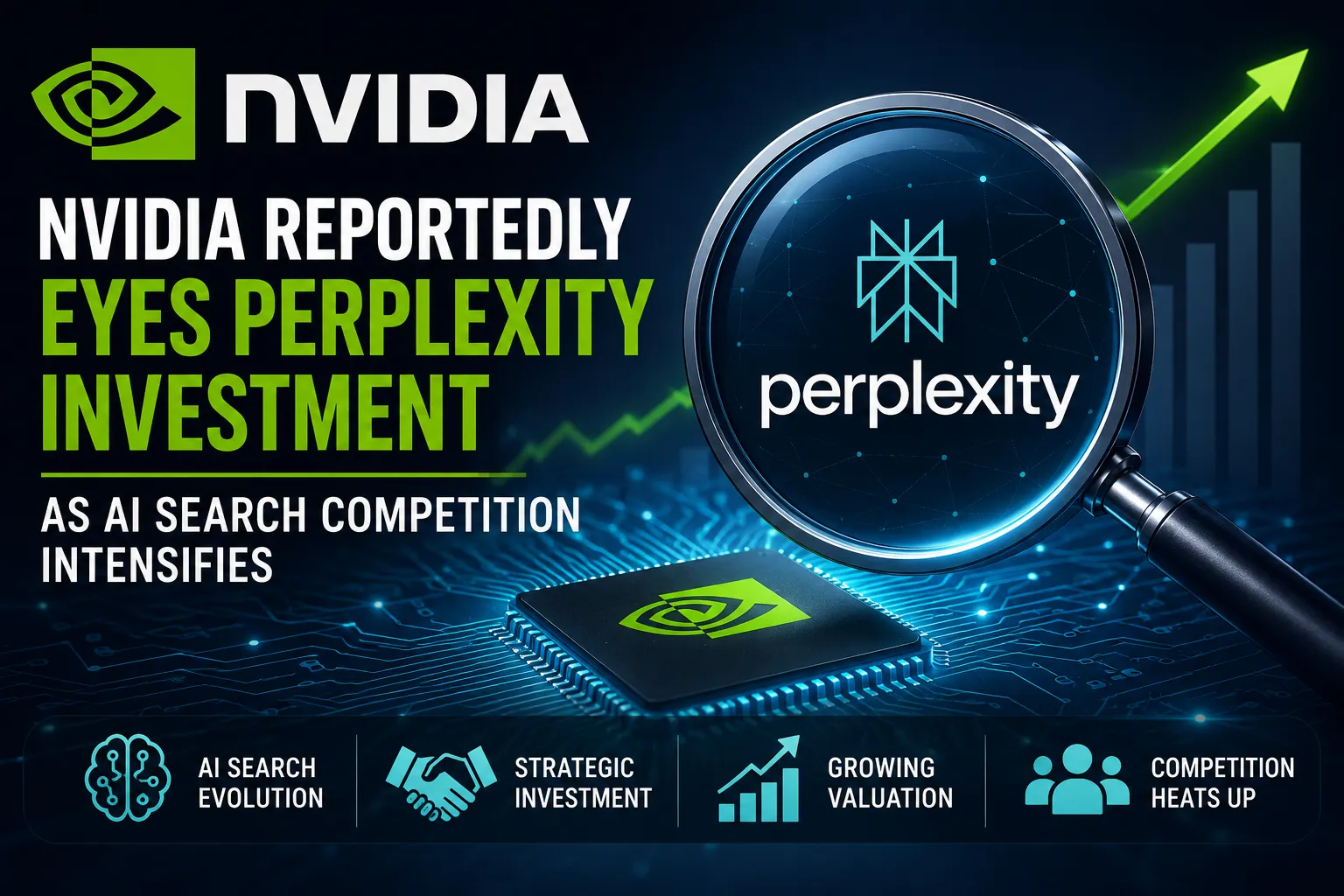
NVIDIA is reportedly considering another investment in Perplexity, potentially valuing the fast-growing AI search company at more than $30 billion as competition to traditional search engines increasingly shifts toward conversational and agentic artificial intelligence.
According to The Information, NVIDIA is discussing participating in a multibillion-dollar equity financing for Perplexity. Reuters reported the development on August 24, noting that it could lift Perplexity’s valuation by more than 50% from the roughly $20 billion valuation associated with its previous financing. Reuters also said it could not independently verify the original report. (Reuters)
If completed, the investment would deepen an already close relationship between the world’s leading AI-chip supplier and one of the most prominent challengers in AI-powered search.
NVIDIA and Perplexity Are Already Closely Connected
The potential investment would not represent NVIDIA’s first financial or technological connection with Perplexity.
Perplexity has previously attracted NVIDIA as an investor, while the two companies have also worked together on AI infrastructure and software. NVIDIA said earlier this year that Perplexity was among the companies adopting its open AI models for agentic applications. (NVIDIA Investor Relations)
Perplexity has also been using NVIDIA technology to support its AI products, making the relationship strategically important for both companies.
For NVIDIA, supporting successful AI applications can create additional demand for the computing infrastructure required to run them.
For Perplexity, access to NVIDIA’s hardware, software ecosystem and industry relationships can help it scale AI services as demand for increasingly sophisticated search and agentic systems grows.
A Potential $30 Billion-Plus Valuation
The reported financing would represent a significant increase in Perplexity’s value.
In September 2025, Perplexity reportedly secured $200 million in new funding at a valuation of about $20 billion. Reuters noted at the time that the figure had not been independently verified. (Reuters)
The new discussions could place the company above $30 billion, representing an increase of more than 50% from that previous valuation.
That would be a striking jump for a company that is only a few years old.
It also reflects the broader investor enthusiasm surrounding AI companies that can turn generative AI into products used regularly by consumers and businesses.
Perplexity Is Moving Beyond Traditional Search
Perplexity originally gained attention by offering an AI-first alternative to conventional search.
Instead of presenting users with a page of links and requiring them to open multiple websites, the service uses artificial intelligence to synthesize information and provide conversational answers.
That model has placed Perplexity in direct competition with established search businesses while also helping establish a broader category of answer engines.
But the company’s ambitions have expanded beyond answering questions.
Its newer products increasingly focus on AI agents capable of carrying out tasks rather than simply retrieving information.
Perplexity Computer Could Be a Major Growth Driver
One of the most important developments is Perplexity Computer, an AI agent designed to perform multi-step tasks.
Perplexity says its Personal Computer product can work across local files, Microsoft 365 and the web. The company said in July that Computer had already performed more than $9.4 billion in “labor-equivalent work” for users since its launch earlier in the year. (Perplexity AI)
The company’s expansion into workplace software could be particularly significant.
Rather than competing only for a share of search queries, Perplexity is attempting to become a layer through which users perform research, create documents, analyze information and complete other digital tasks.
That puts it in a much broader competitive field.
AI Search Is Becoming an Increasingly Crowded Market
Perplexity is no longer competing only with traditional search engines.
OpenAI, Google and other major AI companies are developing increasingly capable systems that combine search, reasoning and agentic capabilities.
Google has enormous advantages because of its existing search infrastructure, enormous index of web content and established user base.
OpenAI has a large consumer audience and increasingly sophisticated AI products.
Perplexity’s challenge is to convince users that an independent AI-first search and research platform can deliver enough value to justify using it alongside—or instead of—those established services.
The competition is therefore shifting from simply who has the best search index to who can become the user’s primary interface for finding and acting on information.
The Browser Could Become the Next Battleground
The competition is also moving into web browsers.
Perplexity previously made headlines with its AI browser ambitions, including an unsolicited $34.5 billion offer for Google’s Chrome browser in 2025. Reuters reported at the time that the company’s Comet browser was designed to perform tasks on a user’s behalf. (TechCrunch)
The significance of AI browsers goes beyond replacing one search box with another.
A traditional browser primarily helps users navigate the web.
An AI browser can potentially understand what a user wants, find information, interact with websites, summarize content and carry out multi-step tasks.
That could fundamentally change the role of search.
Instead of asking, “Which website should I visit?”, users could increasingly ask an AI system to complete the task itself.
NVIDIA Has More Reasons to Back AI Applications
NVIDIA’s interest in Perplexity also fits a much larger strategy.
The chipmaker has increasingly moved beyond simply selling GPUs and other hardware.
It is building an ecosystem around AI infrastructure, models, inference software and applications.
In March, NVIDIA said its open-model ecosystem was being adopted by Perplexity and other AI companies for agentic applications. (NVIDIA Investor Relations)
The company has also been investing in AI startups and forming partnerships that give it exposure to different parts of the AI technology stack.
In July, NVIDIA announced a strategic partnership and investment in Safe Superintelligence, the AI company founded by former OpenAI chief scientist Ilya Sutskever. (NVIDIA Investor Relations)
That suggests NVIDIA increasingly sees strategic value in having relationships with companies developing the software and applications that ultimately drive demand for computing.
NVIDIA’s Business Model Is Tied to AI Adoption
There is a straightforward economic logic behind this strategy.
If AI applications become more popular, demand for computing increases.
If an AI search engine handles millions or billions of queries, those queries require inference—the process through which an AI model generates responses.
More sophisticated agents can require even more computing because they may perform multiple reasoning, search and tool-use steps to complete a single task.
NVIDIA therefore has an incentive to support an ecosystem in which AI applications become increasingly capable and widely used.
The company’s own strategy increasingly reflects this view.
NVIDIA recently announced partnerships with major financial firms aimed at mobilizing more than $500 billion in third-party capital for AI infrastructure over time. (NVIDIA Investor Relations)
The broader objective is clear: make AI computing infrastructure increasingly available while expanding the ecosystem that depends on it.
But the Investment Raises Strategic Questions
A potential NVIDIA investment in Perplexity would also raise questions about the increasingly interconnected nature of the AI industry.
NVIDIA supplies much of the computing hardware needed by AI companies while simultaneously investing in some of those same companies.
That can create mutually beneficial relationships, but it can also make it harder for investors and observers to determine where genuine independent demand ends and ecosystem-driven growth begins.
Similar concerns have emerged around other AI infrastructure deals involving NVIDIA.
The company argues that the enormous expansion of AI workloads requires unprecedented investment in computing capacity.
Critics, however, have questioned whether some arrangements within the AI ecosystem could contribute to circular financing dynamics, in which companies invest in one another while also becoming customers.
The reported Perplexity discussions will likely attract some of the same scrutiny.
Perplexity’s Rapid Growth Helps Explain the Interest
The reported investment would be easier to understand given the company’s recent growth.
According to the latest reporting, Perplexity’s annualized revenue has climbed to more than $750 million, compared with less than $250 million at the beginning of 2026. The Information attributed part of that growth to Perplexity Computer. (Reuters)
That is significant because the AI market is increasingly shifting toward a question of monetization.
It is one thing for an AI company to attract millions of users.
It is another to persuade customers to pay for AI services consistently.
Perplexity’s reported revenue growth suggests that the company is making progress in converting AI usage into a substantial business.
Microsoft Is Also Part of the Bigger Picture
Perplexity’s expansion is not happening in isolation.
The company previously entered into a reported $750 million agreement with Microsoft to use Azure cloud services, according to Reuters. (Reuters)
That relationship illustrates how AI startups increasingly depend on partnerships with major technology companies.
AI applications require enormous computing resources, while cloud providers offer the infrastructure needed to deploy those applications at scale.
At the same time, startups such as Perplexity are developing the user-facing products that can generate demand for that infrastructure.
The resulting ecosystem is becoming increasingly interconnected.
What NVIDIA Could Gain From a Larger Perplexity Stake
A deeper relationship with Perplexity could offer NVIDIA several potential advantages.
More demand for AI inference
Search is one of the most naturally recurring AI workloads. Every question requires computing, and more sophisticated answers can require considerably more processing.
Exposure to AI agents
Perplexity’s move into computer-use agents gives NVIDIA exposure to a potentially important category beyond conventional chatbots.
A stronger software ecosystem
NVIDIA has spent years building a software ecosystem around its hardware. Supporting application companies can strengthen the overall platform.
Strategic insight
Working closely with AI application developers can give NVIDIA a better understanding of the workloads customers will need to run in the future.
A stake in the AI search market
If AI becomes the primary interface for accessing information online, owning a piece of a leading AI search company could become strategically valuable.
What It Could Mean for AI Search Users
For consumers, the biggest impact may not be the investment itself but the competition it helps finance.
AI search products are becoming faster, more capable and increasingly integrated with other digital tools.
Competition could push companies to improve:
- Search accuracy
- Source attribution
- Real-time information retrieval
- Personalization
- AI reasoning
- Browser integration
- Voice interaction
- Agentic task completion
- Enterprise productivity tools
The result could be a fundamental shift in how people interact with the internet.
Instead of navigating through dozens of links, users may increasingly delegate research and routine online tasks to AI systems.
Google Still Has Enormous Advantages
Despite the attention surrounding Perplexity, it would be premature to assume that Google’s search dominance is about to disappear.
Google has decades of experience indexing the web, enormous distribution through Android and Chrome, extensive advertising infrastructure and a massive global user base.
It also has its own rapidly developing AI capabilities.
Perplexity’s advantage is different.
It was built around AI search from the beginning rather than adapting a traditional search business to the generative-AI era.
The coming competition will show whether that focus is enough to overcome the distribution and infrastructure advantages of established technology companies.
A Potential IPO Could Be Another Milestone
Perplexity CEO Aravind Srinivas has previously indicated that the company is considering going public in 2028. Reuters reported that the company intends to pursue that timeline regardless of how markets respond to other major AI listings. (Reuters)
A new financing round at a valuation above $30 billion could therefore have implications beyond immediate access to capital.
It could establish a benchmark for the company’s value ahead of a potential public offering.
At the same time, a higher private-market valuation creates greater expectations.
Perplexity would eventually need to demonstrate that its revenue growth, margins and user adoption can justify an increasingly ambitious valuation.
The Bigger Battle Is Over the Future of Search
The reported NVIDIA-Perplexity investment is significant because it illustrates how quickly the definition of search is changing.
Search engines historically helped users find information.
AI systems increasingly aim to understand information, summarize it and act on it.
That distinction could reshape the technology industry.
If AI agents become the primary gateway between people and the internet, search could evolve from a list of results into an interactive operating layer for digital tasks.
Perplexity is trying to establish itself in that emerging market while companies such as Google and OpenAI are pursuing their own approaches.
NVIDIA, meanwhile, is positioning itself closer to the infrastructure and software powering the entire transformation.
The Next Phase of the AI Search Race
For now, the NVIDIA investment remains a reported discussion rather than a completed transaction. But the possibility itself highlights how strategically important AI search has become.
Perplexity’s reported jump from a $20 billion valuation to potentially more than $30 billion reflects investor expectations that AI-powered search and computer-use agents could become major technology platforms. (Reuters)
If NVIDIA does participate in the new financing, it would reinforce a broader trend in which the companies supplying AI’s computing infrastructure are increasingly investing in the applications that consume it.
The ultimate winner of the AI search race, however, may not simply be the company with the most powerful model. It could be the company that best combines search, reasoning, reliable information, software tools and autonomous action into something people use every day.
And that makes the battle over AI search far more consequential than a competition between different ways of displaying web results.