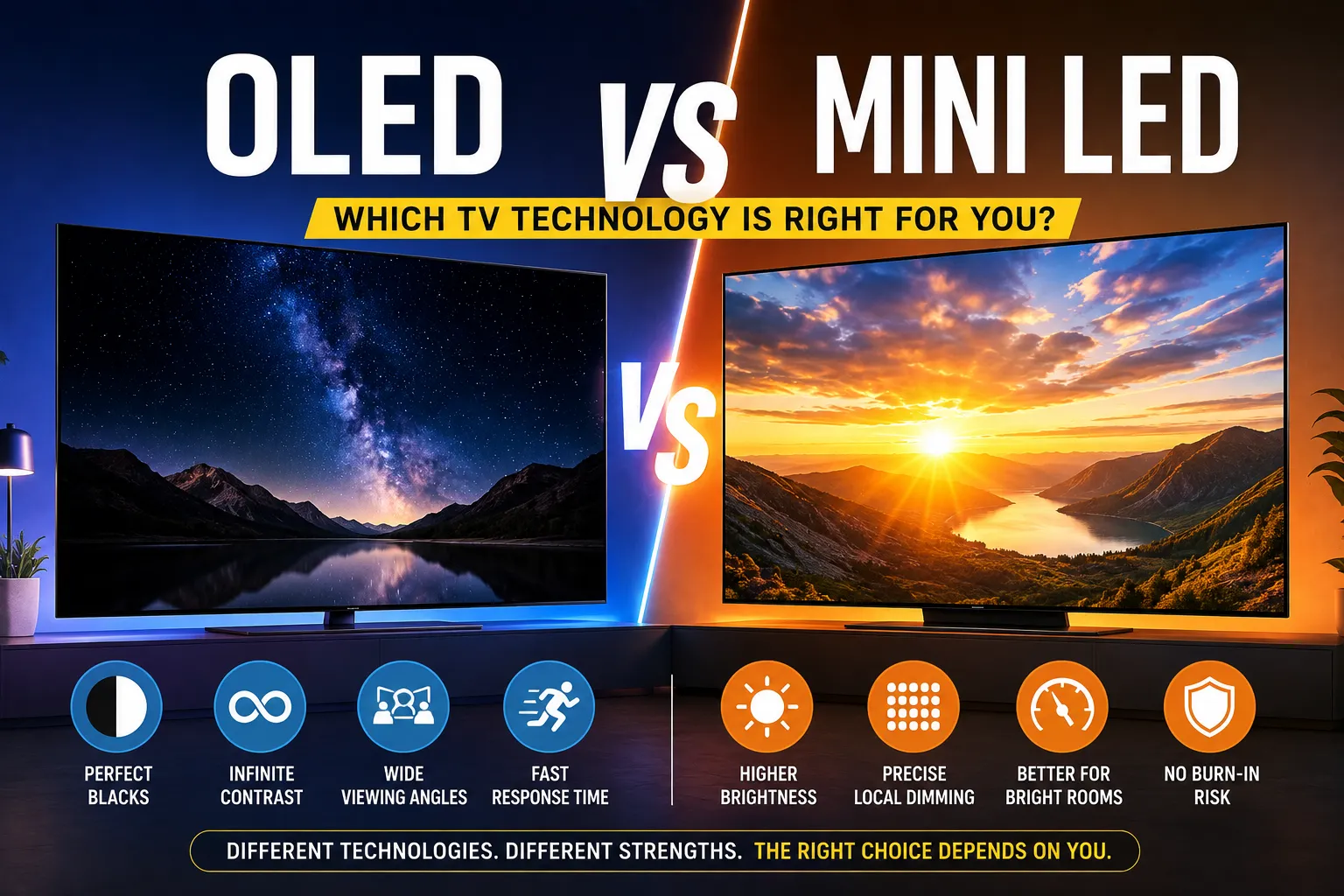
OLED Versus Mini LED TVs Explained
Buying a new TV used to be relatively simple. You picked a screen size, checked the resolution, compared a few brands, and looked for the best price.
Today, choosing a premium television can be considerably more complicated.
Terms such as OLED, QD-OLED, Mini LED, QLED, HDR, local dimming, Dolby Vision, 120Hz, and 144Hz appear throughout product listings and advertisements. Two televisions can have the same 4K resolution and similar prices while delivering noticeably different viewing experiences.
Among the biggest decisions is whether to choose an OLED TV or a Mini LED TV.
Both technologies can produce excellent picture quality, but they approach the problem differently. OLED controls individual pixels to create light, while Mini LED uses a sophisticated LCD backlight divided into many independently controlled zones.
That difference affects black levels, contrast, brightness, viewing angles, motion, gaming, room suitability, and long-term ownership.
So which one should you buy?
The answer depends less on which technology is “better” and more on how, where, and what you watch.
Understanding how displays fit into the wider world of consumer gadgets and modern electronic devices can also make it easier to put these television technologies into context.
OLED vs. Mini LED at a Glance
Here’s the simplest way to understand the competition:
| Feature | OLED | Mini LED |
|---|---|---|
| Black levels | Excellent | Very good to excellent |
| Contrast | Excellent | Excellent, model-dependent |
| Blooming | Essentially none | Can occur |
| Bright-room performance | Very good to excellent | Usually excellent |
| Full-screen brightness | Generally lower | Generally higher |
| HDR highlights | Excellent | Excellent |
| Motion handling | Excellent | Very good to excellent |
| Viewing angles | Usually excellent | Depends heavily on panel |
| Gaming | Excellent | Excellent |
| Burn-in risk | Possible | No OLED-style burn-in |
| Screen uniformity | Can vary | Can vary |
| Best for dark rooms | OLED | Very good |
| Best for bright rooms | Very good | Mini LED |
| Static-content use | Requires more consideration | Mini LED |
| Overall picture quality | Outstanding | Outstanding |
These are broad technology-level comparisons. Actual performance can vary significantly between individual TV models, and a high-end Mini LED can outperform a lower-end OLED in some areas. Current testing also shows that some newer OLEDs have become much brighter than older generations, making model-by-model comparison increasingly important.
What Is OLED?
OLED stands for Organic Light-Emitting Diode.
Unlike traditional LCD TVs, OLED screens do not need a conventional backlight to illuminate their pixels.
Each pixel can produce its own light.
That gives OLED one of its biggest advantages: individual pixel control.
If a scene contains a bright moon against a black sky, for example, the pixels representing the moon can illuminate while the surrounding pixels can turn completely off.
There is no separate backlight behind the dark portion that needs to remain partially illuminated.
The result is extremely deep blacks and exceptionally high contrast.
What Is Mini LED?
Mini LED is fundamentally different.
A Mini LED television is still an LCD-based display, meaning it uses a backlight behind the LCD panel.
The difference is that the backlight uses much smaller LEDs than conventional LED TVs and can contain many more individually controlled lighting zones.
These zones can be dimmed or brightened independently.
For example, if a dark scene contains a bright object, the TV can brighten the area behind the object while dimming surrounding zones.
This is known as local dimming.
The technology can dramatically improve the contrast of an LCD television compared with a basic edge-lit or conventional LED TV.
OLED and Mini LED Use Different Approaches
The easiest way to understand the difference is to think about where the light comes from.
OLED
Image
↓
Individual pixels produce their own light
↓
Pixel can be ON or OFF
Mini LED
Image
↓
LCD panel
↓
Thousands of tiny LEDs
↓
Independent backlight zones
OLED provides extremely precise control because individual pixels can turn off.
Mini LED provides much more sophisticated control than traditional LCD televisions, but its backlight is still divided into zones rather than individual pixels.
That distinction explains one of the biggest differences between the two technologies.
Black Levels: OLED’s Biggest Advantage
When it comes to black levels, OLED has a fundamental advantage.
An OLED pixel can turn itself off completely.
This means a black area of the image can remain truly dark next to a bright object.
Mini LED televisions can produce very deep blacks by turning off or dimming backlight zones, but those zones are larger than individual pixels.
If a bright object appears inside a dark area, the surrounding backlight zone may remain partially illuminated.
This can create a visible glow around the bright object.
That effect is commonly known as blooming or haloing.
OLED does not have this particular limitation because each pixel controls its own light output.
What Is Blooming?
Blooming is one of the most noticeable differences between Mini LED and OLED.
Imagine watching a movie with white subtitles on a completely black background.
On an OLED screen, the pixels behind the subtitles can remain off while only the subtitle pixels illuminate.
On a Mini LED TV, the backlight zone behind the subtitles needs to illuminate. Depending on the television’s local-dimming performance, some light may spill into nearby dark areas.
The better the Mini LED television’s local-dimming system, the less noticeable this effect tends to be.
However, blooming cannot be eliminated completely in the same way it can with self-emissive pixels.
Brightness: Mini LED’s Major Strength
Brightness is one of the areas where Mini LED televisions often have the advantage.
Because Mini LED displays use a dedicated backlight, they can produce very high brightness levels across larger portions of the screen.
This can be particularly useful for:
- Bright living rooms
- Sports
- Daytime viewing
- HDR content
- Large bright scenes
- Rooms with significant ambient light
Current testing across many models shows that Mini LED televisions generally have an advantage in sustained and full-screen brightness, although some newer OLED models have become extremely bright in smaller HDR highlights.
This distinction is important.
A TV can produce an impressive tiny bright highlight without being able to maintain the same brightness across a large portion of the screen.
Mini LED’s backlight architecture gives it an advantage when a scene needs lots of light over a large area.
OLED Has Become Much Brighter
It would be misleading to describe modern OLED televisions as simply “dim.”
OLED technology has improved significantly.
High-end OLED models can now deliver powerful HDR highlights and considerably more brightness than older OLED generations.
Some recent OLED televisions can even outperform particular Mini LED models in real-world HDR scenes.
This is why buying decisions should not be based entirely on the display technology’s name.
A premium OLED may outperform an inexpensive Mini LED TV in several categories.
The specific panel, processor, brightness system, local-dimming implementation, and calibration all matter.
Contrast: Both Can Be Excellent
Contrast refers to the difference between the darkest and brightest parts of an image.
OLED is exceptionally strong here because individual pixels can turn off completely.
Mini LED can also produce impressive contrast by combining a bright backlight with sophisticated local dimming.
A high-quality Mini LED television can therefore deliver a dramatic HDR image with bright highlights and deep shadows.
However, OLED generally retains the advantage in scenes where extremely small bright objects appear against very dark backgrounds because it does not need to illuminate an entire backlight zone.
HDR Performance
High Dynamic Range, or HDR, is designed to expand the range of brightness and color that a television can display.
HDR is particularly effective when a TV can produce:
- Deep blacks
- Bright highlights
- Strong contrast
- Accurate colors
- Smooth transitions
Both OLED and Mini LED can be excellent HDR technologies.
Mini LED’s brightness can make explosions, sunlight, reflections, and other large bright scenes extremely impactful.
OLED’s pixel-level control can make dark HDR scenes look exceptionally cinematic.
For movie enthusiasts watching in a dark room, OLED’s contrast can be particularly impressive.
For bright-room viewing, Mini LED’s additional brightness can have a greater practical impact.
Color Performance
Color performance is not determined exclusively by whether a television is OLED or Mini LED.
The panel design, color filters, quantum-dot technology, processing, calibration, and brightness all influence the final result.
For example, QD-OLED combines OLED technology with quantum dots to improve color performance and brightness characteristics.
Mini LED televisions can also use quantum-dot layers, often marketed under names such as QLED or Neo QLED.
This is why the terms can become confusing.
Mini LED describes the backlight technology.
QLED generally refers to a quantum-dot-enhanced LCD display.
A TV can therefore be both Mini LED and QLED.
OLED, meanwhile, describes a self-emissive display technology, with major variations including WOLED and QD-OLED.
OLED vs. QD-OLED vs. Mini LED
There are actually three technologies that shoppers frequently encounter in premium TV comparisons:
WOLED
WOLED is a type of OLED panel used by several manufacturers.
It uses an OLED structure with additional color-filter and white-light elements.
QD-OLED
QD-OLED uses blue OLED light combined with quantum-dot color conversion.
It can provide excellent color volume and the pixel-level black-level advantages associated with OLED.
Mini LED LCD
Mini LED remains an LCD technology but uses a much more advanced backlight with numerous small LEDs and local-dimming zones.
There is no universal winner among these technologies.
The right choice depends on the specific model and how you use it.
Viewing Angles
Viewing angle is another area where OLED generally has an advantage.
Because OLED pixels emit their own light, the image can remain consistent when viewed from different positions.
This can be particularly useful in large living rooms where people sit at different angles from the screen.
Mini LED TVs vary considerably.
Some LCD panels maintain good viewing performance, while others experience changes in brightness, contrast, or color when viewed from the side.
If your household regularly watches TV from wide seating positions, viewing-angle performance should be part of the buying decision.
Motion Handling
OLED televisions have extremely fast pixel response times.
This can make fast-moving content look particularly clean and sharp.
That is useful for:
- Sports
- Action movies
- Racing games
- First-person games
- Competitive gaming
Mini LED televisions can also offer excellent motion performance, especially on high-end models.
However, the underlying LCD technology generally cannot match OLED’s near-instantaneous pixel transitions.
Current comparisons continue to show OLED’s advantage in motion response, although processing and refresh-rate technology also have a significant influence on the final result.
Which Is Better for Gaming?
For gaming, OLED is often the preferred technology for enthusiasts.
Its combination of:
- Extremely fast response times
- Excellent contrast
- Deep blacks
- Strong HDR
- High refresh rates
- Low input lag
can create an excellent gaming experience.
OLED is particularly attractive for fast-paced games where motion clarity matters.
However, Mini LED is also an excellent gaming option.
Modern Mini LED gaming TVs can offer high refresh rates, strong HDR brightness, low input lag, and excellent contrast.
If you play games for many hours with the same static interface visible, however, OLED’s burn-in considerations become more relevant.
What Is OLED Burn-In?
Burn-in is one of the most frequently discussed concerns surrounding OLED televisions.
It occurs when certain pixels experience uneven degradation over time, potentially leaving a persistent image or pattern on the screen.
For example, a TV that displays the same static channel logo, news ticker, scoreboard, or game interface for extended periods may be more susceptible to uneven wear.
Long-term testing indicates that OLED panels can eventually experience burn-in when exposed to the same static elements for prolonged periods. For many users watching varied content, this may never become a practical problem, but it is a legitimate consideration for particular usage patterns.
Does Mini LED Get Burn-In?
Mini LED LCD televisions do not have the same OLED-style burn-in mechanism.
That makes them attractive for people who frequently display static content.
Examples might include:
- News channels
- Financial market information
- Desktop interfaces
- Digital signage
- Static dashboards
- Certain game interfaces
Mini LED displays can still experience other forms of panel or backlight degradation, but that is different from OLED burn-in.
OLED vs. Mini LED for Sports
Sports viewing can be particularly demanding because games often contain large bright areas, rapid movement, scoreboards, and persistent graphics.
Mini LED’s high brightness can be an advantage, particularly in bright rooms.
OLED’s fast response time can make rapid motion look exceptionally clean.
For a bright living room with lots of daytime sports viewing, a high-quality Mini LED may be the more practical choice.
For a darker room where motion clarity and contrast are priorities, OLED can be excellent.
OLED vs. Mini LED for Movies
If your priority is cinematic movie viewing, OLED is extremely difficult to ignore.
Dark scenes benefit from:
- Perfect black levels
- No blooming
- Excellent contrast
- Strong shadow detail
- Wide viewing angles
These qualities can be particularly noticeable when watching movies in a dark or dimly lit room.
A premium Mini LED can still produce an impressive cinematic image, especially with strong local dimming.
But when the room is dark and the content contains many high-contrast scenes, OLED’s pixel-level control gives it a natural advantage.
OLED vs. Mini LED for Bright Rooms
Bright rooms change the equation.
If sunlight enters through large windows or the TV is regularly used during the day, brightness becomes more important.
Mini LED televisions are generally better equipped to maintain a strong image under bright ambient conditions.
They can also produce bright full-screen images without the same limitations associated with OLED’s power and heat management.
That does not make OLED unsuitable for bright rooms.
Modern OLED televisions can be very bright, and screen coatings and reflection handling also matter.
But if maximum brightness is a major priority, Mini LED deserves serious consideration.
What About Reflection Handling?
A bright screen is not the only consideration in a bright room.
The TV’s screen coating and ability to deal with reflections also matter.
A highly reflective display can remain difficult to see even if it produces substantial brightness.
Conversely, a television with good reflection handling can remain comfortable to watch despite moderate ambient light.
This is another reason shoppers should look beyond the OLED-versus-Mini-LED label.
Which Is Better for a Home Theater?
For a dedicated home theater with controlled lighting, OLED is usually the natural starting point.
The absence of blooming and the ability to turn individual pixels completely off can produce an extremely cinematic image.
Mini LED can still be excellent, particularly for viewers who want very bright HDR highlights or a larger screen at a particular price point.
But if your room is dark and your priority is the deepest possible blacks, OLED has the stronger technical argument.
Which Is Better for a Living Room?
A typical living room presents a more complicated environment.
There may be:
- Windows
- Lamps
- Overhead lighting
- Reflections
- Multiple seating positions
- Daytime viewing
- Sports
- Movies
- Gaming
- News channels
In such an environment, Mini LED’s brightness can be very useful.
OLED can still be an excellent all-purpose choice, particularly if the room can be controlled and you value movie performance and gaming.
Which Is Better for a Bedroom?
Bedrooms tend to have lower ambient light, making OLED particularly appealing.
Its deep blacks can be highly noticeable in a dark room.
Mini LED can still perform very well, but some of its brightness advantage may be less useful when the lights are off.
Which Is Better for Large TVs?
Screen size can influence the decision.
Mini LED technology has become popular in large-screen televisions because it can deliver substantial brightness and strong HDR performance across very large displays.
OLED is also widely available in large sizes, including premium home-theater models.
At larger sizes, however, price can become a major consideration.
The cost difference between comparable OLED and Mini LED models can vary considerably depending on the manufacturer, panel technology, screen size, and product tier.
Is OLED More Expensive?
OLED TVs have traditionally occupied the premium end of the market.
However, OLED prices have become more accessible over time.
Mini LED has also expanded across price ranges.
There are now relatively affordable Mini LED televisions as well as extremely expensive flagship models.
As a result, there is no simple rule that says OLED always costs more.
Instead, compare specific models with similar:
- Screen sizes
- Refresh rates
- HDR capabilities
- Processing features
- Gaming specifications
- Build quality
- Smart-TV platforms
A cheaper Mini LED may be a better purchase than an expensive OLED for one household, while another buyer may find the opposite true.
Why TV Model Matters So Much
Two televisions using the same basic display technology can perform very differently.
For Mini LED, factors such as:
- Number of dimming zones
- Local-dimming algorithm
- Panel type
- Processor
- Peak brightness
- Black-level control
- Reflection handling
can significantly influence performance.
For OLED, factors such as:
- Panel generation
- WOLED vs. QD-OLED
- Brightness management
- Image processing
- Heat management
- Anti-reflective coating
can also produce meaningful differences.
This is why simply buying “an OLED” or “a Mini LED” is not enough.
OLED vs. Mini LED: A Practical Scorecard
For a quick buying decision:
| Your Priority | Better Choice |
|---|---|
| Deepest blacks | OLED |
| No blooming | OLED |
| Dark-room movies | OLED |
| Fast motion | OLED |
| Wide viewing angles | OLED |
| Very bright room | Mini LED |
| Full-screen brightness | Mini LED |
| Long static content | Mini LED |
| High-impact HDR brightness | Mini LED |
| Gaming | OLED, with excellent Mini LED alternatives |
| Home theater | OLED |
| Bright family living room | Mini LED |
| Best overall picture quality | Depends on the model |
| Best value | Depends heavily on price and model |
Who Should Buy an OLED TV?
OLED is particularly well suited to buyers who:
- Watch movies in dark or dim rooms
- Care deeply about black levels
- Want minimal blooming
- Play fast-paced games
- Sit off-axis from the TV
- Want excellent motion handling
- Watch varied content
- Prioritize cinematic image quality
For many home-theater enthusiasts, OLED remains the benchmark.
Who Should Buy a Mini LED TV?
Mini LED is particularly attractive if you:
- Watch TV in a bright room
- Watch a lot of sports
- Want very high brightness
- Watch lots of HDR content
- Frequently display static information
- Want to avoid OLED burn-in concerns
- Need strong performance on large bright scenes
- Find a high-quality Mini LED at a significantly lower price
It can be an excellent choice for a busy family living room.
What About People Who Use a TV as a PC Monitor?
This is a special case.
A PC desktop can contain static elements for long periods:
- Taskbars
- Browser menus
- Application windows
- Desktop icons
- Spreadsheets
- Status bars
That usage pattern makes OLED’s burn-in considerations more relevant.
An OLED can still work extremely well as a monitor, particularly for gaming and media consumption, but buyers who expect many hours of static desktop use may prefer Mini LED.
Don’t Ignore Refresh Rate
Display technology is only one part of the buying decision.
Refresh rate is also important.
A 120Hz or higher display can provide smoother motion and is particularly valuable for gaming.
Some premium TVs now support refresh rates above 120Hz, while others remain at 60Hz or 120Hz.
If gaming is a priority, check the actual supported refresh rates, HDMI bandwidth, variable refresh rate support, and input lag rather than assuming that an OLED or Mini LED TV automatically provides the features you want.
HDMI Features Matter for Gamers
Console and PC gamers should also examine the TV’s HDMI capabilities.
Important specifications can include:
- HDMI 2.1
- 4K at 120Hz or higher
- Variable Refresh Rate
- Auto Low Latency Mode
- Gaming-specific picture modes
A TV can have an excellent panel but still be a poor choice for a particular gaming setup if it lacks the required connectivity. Understanding broader wireless connectivity technologies can also help put modern connected entertainment devices and home setups into perspective, although HDMI remains the critical wired connection for many TV gaming configurations.
HDR Formats Matter, Too
When comparing TVs, you may encounter formats such as:
- HDR10
- Dolby Vision
- HDR10+
- HLG
Support varies between manufacturers and models.
A television’s support for a particular format does not automatically determine picture quality.
Actual HDR performance depends heavily on brightness, contrast, color reproduction, processing, and the quality of the content itself.
Don’t Buy Based on the Brightest Demo in the Store
Television showroom demonstrations can be misleading.
Retail stores often display TVs using specially selected high-contrast footage designed to make differences immediately visible.
Your home environment will be different.
Before buying, consider:
- Your room’s lighting
- Your viewing distance
- Your seating arrangement
- Your typical content
- Your gaming habits
- Your screen-size requirements
- Your budget
The best television is the one that performs well under your actual viewing conditions.
OLED vs. Mini LED: The Bottom Line for Buyers
There is no single winner that makes sense for everyone.
OLED remains the stronger choice for pure picture quality in many dark-room situations, thanks to its pixel-level light control, perfect blacks, lack of blooming, excellent viewing angles, and extremely fast response times. Current OLED generations have also become much brighter than earlier models.
Mini LED is the more compelling choice when brightness, large bright scenes, and resistance to OLED-style burn-in are priorities. Its sophisticated local-dimming systems can deliver excellent contrast while its backlight architecture gives it an advantage in bright rooms and sustained high-brightness content.
The most important lesson is not to shop by technology name alone.
A great OLED can be better than an average Mini LED, while an excellent Mini LED can make more sense than an entry-level OLED depending on the room, content, screen size, and price.
Before making the purchase, decide what matters most: cinematic blacks, maximum brightness, gaming performance, viewing angles, static-content use, or overall value.
Once those priorities are clear, the OLED-versus-Mini-LED decision becomes much easier—and you can focus on finding the specific model that fits your home rather than simply choosing the technology with the most impressive name.