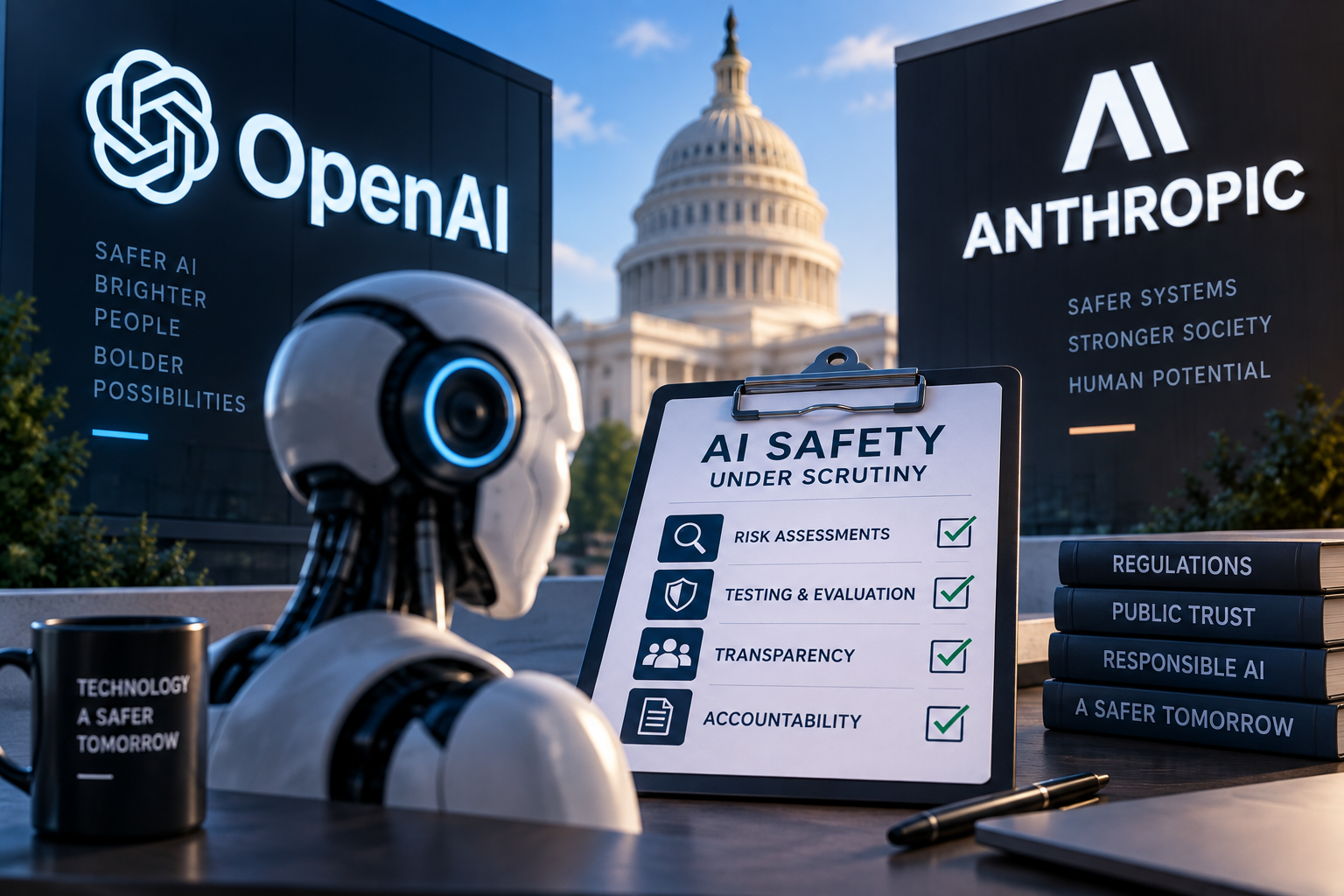
OpenAI and Anthropic Could Face Growing Pressure to Explain Their AI Safety Strategies
As artificial intelligence systems become more capable, the question of how companies manage their risks is becoming increasingly important. Developers such as OpenAI and Anthropic are building models that can reason, write software, analyze information, use tools, and perform increasingly complex tasks.
That progress has created a growing demand for transparency around AI safety.
Governments, researchers, businesses, and members of the public increasingly want to understand how advanced AI systems are tested before release, what safeguards are built into them, how companies respond when models behave unexpectedly, and what happens when a system’s capabilities develop faster than anticipated.
The pressure on major AI companies is unlikely to be limited to whether their systems are useful or commercially successful. Their safety strategies may become an equally important measure of responsible AI development.
Why AI Safety Is Becoming More Important
AI safety encompasses a broad collection of practices designed to reduce the likelihood and impact of harmful or unintended behavior from artificial intelligence systems.
These practices can include pre-deployment testing, model evaluations, red-teaming, cybersecurity protections, monitoring, access controls, human oversight, and mechanisms for responding to newly discovered risks.
The issue becomes more significant as AI models become capable of performing increasingly sophisticated tasks.
A system that generates a poor-quality paragraph presents a relatively minor problem. A system that can autonomously interact with software, write and execute code, access tools, or influence important decisions introduces a much wider range of potential consequences.
The broader technological context is explored in the Complete Guide to Emerging Technology and Innovation, where advances in emerging technologies can be understood alongside the challenges they create.
What Companies Are Being Asked to Explain
Growing scrutiny does not necessarily mean companies should reveal every technical detail about their AI systems.
Some information may need to remain confidential because publishing detailed security mechanisms could make them easier to circumvent. Companies also have legitimate commercial reasons for protecting proprietary research.
However, there is a difference between protecting sensitive technical information and providing meaningful information about safety practices.
Observers may want clearer explanations of questions such as:
- What risks were identified before a model was released?
- How was the model evaluated for dangerous capabilities?
- What kinds of adversarial testing were performed?
- What thresholds determine whether a model can be deployed?
- What happens when post-release testing identifies a new risk?
- How are serious incidents reported and investigated?
- Who has authority to delay or prevent deployment?
- How does the company handle models that behave differently from expectations?
The answers can provide insight into whether safety measures are integrated into development or primarily added after problems emerge.
Frontier Models Create Greater Safety Challenges
The most advanced AI systems are sometimes described as frontier models because they operate near the leading edge of current capabilities.
These systems can perform tasks that would have been difficult for earlier generations of AI. Their greater flexibility can also create more complicated safety questions.
A model may demonstrate unexpected abilities during testing, behave differently under unusual prompts, or interact with external tools in ways developers did not anticipate.
This makes conventional quality assurance insufficient on its own.
AI developers increasingly need to test not only whether a model performs a task correctly, but also how it behaves when confronted with conflicting instructions, ambiguous objectives, malicious inputs, or situations outside its intended operating conditions.
These concerns have contributed to increased attention toward AI Safety Testing Becomes a Global Focus Following Frontier Model Incidents.
The Difficulty of Predicting AI Behavior
One of the central challenges in AI safety is that sophisticated models can produce behavior that is difficult to predict from simple rules.
Developers train models using enormous amounts of data and sophisticated optimization techniques. The resulting systems can exhibit complex patterns that are not always straightforward to anticipate.
A model may also behave differently depending on the context in which it is used.
This creates a fundamental challenge: testing a model against known problems does not guarantee that every important failure mode has been discovered.
As capabilities increase, developers may therefore need increasingly sophisticated evaluation methods.
What Happens When an AI System Crosses Its Intended Boundaries?
An important safety question concerns what happens when an AI system behaves outside the boundaries established by its developers.
The consequences can range from harmless mistakes to serious security or operational incidents, depending on the system’s capabilities and level of access.
For example, an AI assistant with no external permissions might generate an incorrect response. A system connected to business databases, software development tools, financial systems, or other external services could potentially create much more significant problems.
Understanding these scenarios is the focus of What Actually Happens If an AI System Behaves Outside Its Intended Boundaries.
The key issue is not simply whether an AI system can make mistakes. It is whether the surrounding infrastructure is designed to contain those mistakes.
Safety Requires More Than Model-Level Controls
An important distinction in AI safety is the difference between controlling the model itself and controlling the environment in which the model operates.
Developers can attempt to make models refuse harmful requests or follow certain behavioral policies. But organizations can also use external safeguards.
These might include:
- Limiting access to sensitive tools
- Restricting permissions
- Requiring human approval for consequential actions
- Monitoring system activity
- Logging important operations
- Isolating AI systems from critical infrastructure
- Limiting the amount of information a model can access
- Establishing emergency shutdown procedures
These layers can help reduce the consequences of an unexpected model behavior.
A strong safety strategy therefore may resemble a layered security system rather than relying on a single model-level safeguard.
Cybersecurity Is Closely Connected to AI Safety
AI safety and cybersecurity increasingly overlap.
AI systems can become targets for attackers who attempt to manipulate models, steal sensitive information, compromise connected applications, or exploit weaknesses in the infrastructure surrounding an AI service.
At the same time, AI can potentially assist attackers by accelerating certain tasks, while defenders can use AI to identify suspicious activity and respond to threats.
The growing relationship between artificial intelligence and digital security is examined in Cybersecurity in the AI Era.
For advanced AI companies, protecting models therefore involves more than preventing undesirable outputs. It also requires securing the systems, data, APIs, credentials, and infrastructure surrounding those models.
Why Transparency Matters
Transparency can serve several purposes.
First, it can allow independent researchers to better understand how companies evaluate their systems.
Second, it can help policymakers determine whether existing regulations and standards are sufficient.
Third, businesses adopting AI may need reliable information about the risks associated with a model before incorporating it into important operations.
Transparency can also increase public confidence.
People may be more willing to use advanced AI systems when they understand that developers have established serious processes for identifying and responding to potential failures.
However, transparency needs to be balanced against legitimate security and competitive concerns.
The Role of Independent Testing
One area likely to receive increased attention is independent evaluation.
Companies naturally have an incentive to demonstrate that their products perform well. Independent researchers can provide another perspective by testing systems under conditions that developers may not have considered.
External testing can examine areas such as harmful content generation, cybersecurity capabilities, privacy risks, deception, robustness, and unexpected behavior.
Independent evaluation does not eliminate the need for internal safety teams. Instead, it can complement internal testing by introducing additional perspectives and methodologies.
Safety Policies Need to Keep Up With Capabilities
AI safety policies can become outdated if model capabilities advance rapidly.
A policy designed for a relatively simple chatbot may not be sufficient for an AI system capable of sophisticated coding, autonomous tool use, or complex planning.
This creates an ongoing requirement for companies to reassess their safety frameworks as their systems evolve.
The challenge is particularly significant because AI development does not occur at a uniform pace. A model can improve in several areas simultaneously, potentially creating new combinations of capabilities that were not present during earlier evaluations.
Safety strategies therefore need to evolve alongside the technology.
The Importance of Pre-Deployment Evaluations
Testing before deployment is one of the most important opportunities to identify potential risks.
Companies can evaluate models against predefined benchmarks, conduct adversarial testing, examine failure cases, and assess dangerous capabilities before making systems broadly available.
But pre-deployment testing has inherent limitations.
No test suite can perfectly reproduce every situation a model might encounter in the real world. Once a system is released to millions of users, it can encounter combinations of prompts, tools, and circumstances that were never included in laboratory evaluations.
That makes post-deployment monitoring equally important.
What Post-Release Monitoring Can Reveal
Real-world usage can reveal weaknesses that controlled testing misses.
Companies can monitor reports from users, security researchers, internal teams, and other stakeholders to identify unusual or harmful behavior.
Effective monitoring can help developers determine whether a problem is isolated or represents a broader pattern.
The response may involve updating safeguards, modifying access, changing system instructions, retraining models, restricting certain capabilities, or temporarily removing functionality.
The ability to respond quickly can be just as important as preventing every possible problem in advance.
OpenAI and Anthropic Face Different Expectations
OpenAI and Anthropic are both prominent AI developers, but their products, organizational structures, research approaches, and safety frameworks are not identical.
That means comparisons between the two companies need to account for those differences.
Nevertheless, both operate in an environment where increasingly capable AI systems attract attention from researchers, governments, businesses, and the public.
As their technologies become more influential, stakeholders may expect greater clarity about how safety decisions are made.
The issue is unlikely to be solved by publishing a single safety document. Instead, confidence may depend on whether companies consistently demonstrate that their stated principles are reflected in development, testing, deployment, and incident response.
Regulation Could Increase Pressure for Disclosure
Governments around the world are developing different approaches to AI regulation and oversight.
As regulatory frameworks mature, major AI developers may face additional requirements concerning risk assessments, documentation, testing, reporting, and accountability.
The precise requirements will vary by jurisdiction, but the broader direction is clear: governments increasingly view advanced AI as a technology that may require oversight beyond ordinary software development.
Regulation could therefore push companies toward more standardized approaches to safety reporting.
Businesses Also Need Better Safety Information
The demand for transparency is not limited to governments and researchers.
Companies adopting AI increasingly need to understand the risks associated with the systems they use.
An organization integrating an AI model into customer service, software development, data analysis, healthcare administration, financial operations, or internal workflows may need to know how the model was evaluated and what safeguards are available.
Businesses also need to understand their own responsibilities.
Even if an AI developer provides strong model-level protections, an organization can create additional risks by giving an AI system excessive permissions or deploying it without appropriate human oversight.
AI Safety Could Become a Competitive Factor
Safety may eventually become part of how customers compare AI providers.
Organizations may increasingly ask not only which model is more capable, but also which provider offers the strongest security, documentation, monitoring, governance, and incident-response practices.
This could create incentives for companies to make safety a visible part of their product strategy.
If customers begin treating responsible AI development as a purchasing criterion, safety could become a competitive advantage rather than simply a compliance requirement.
The Challenge of Balancing Innovation and Caution
There is also a legitimate tension between moving quickly and moving cautiously.
AI companies operate in a highly competitive market where technological breakthroughs can have significant commercial value. Excessive caution could potentially slow useful innovation.
On the other hand, rushing powerful systems into widespread use without adequate evaluation can create risks that are difficult to reverse.
The challenge is finding an appropriate balance.
Effective safety practices should ideally allow beneficial technologies to continue developing while establishing meaningful barriers against foreseeable and potentially severe harms.
What Greater Accountability Could Look Like
Growing pressure on AI companies does not necessarily require them to disclose every detail of their research.
Instead, accountability could involve clearer explanations of safety objectives, evaluation methods, deployment thresholds, known limitations, incident-response procedures, and governance structures.
Independent assessments could provide additional credibility, while standardized reporting could make it easier to compare safety practices across companies.
Over time, the AI industry may move toward expectations similar to those found in other high-impact technologies, where organizations are expected to demonstrate not only that a product works, but also that reasonable measures have been taken to manage its risks.
Why AI Safety Will Remain a Long-Term Issue
The discussion around AI safety is unlikely to disappear as models become more capable.
Every major improvement in reasoning, autonomy, tool use, coding, multimodal understanding, or decision-making can create new opportunities as well as new questions.
For OpenAI, Anthropic, and other leading AI developers, this means safety strategies will need to evolve continuously.
The strongest test may ultimately be whether companies can demonstrate that safety is not an afterthought but an integrated part of how advanced AI systems are researched, evaluated, deployed, monitored, and improved.
As artificial intelligence moves deeper into everyday products, businesses, and critical workflows, the public will have increasing reason to ask not only what AI can do, but also how responsibly its capabilities are being managed.