OpenAI Leadership Shake-Up: Why Brad Lightcap’s Departure Matters for the AI Company
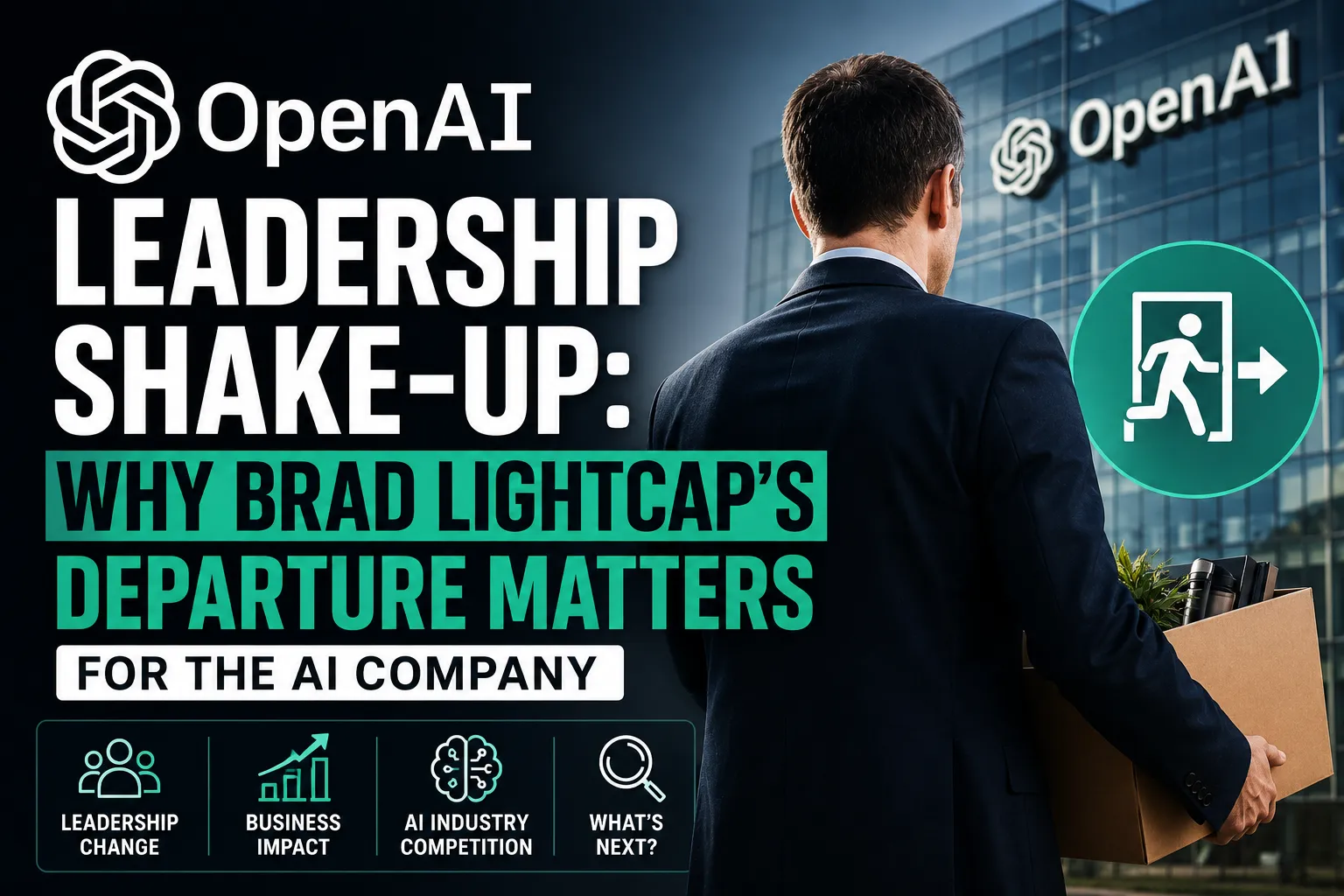
OpenAI is entering another period of leadership change after longtime executive Brad Lightcap announced that he is leaving the company to start something new.
Lightcap’s departure is notable because he was not simply another senior executive. He joined OpenAI in 2018 and helped build many of the operational and commercial functions that supported the company’s transformation from a research organization into one of the world’s most valuable AI companies. His exit therefore raises broader questions about OpenAI’s leadership structure, its next phase of growth and the intense competition for experienced AI executives.
Importantly, Lightcap has not publicly said that he is leaving because of a specific dispute or problem at OpenAI. In his departure message, he expressed confidence in the company’s people and mission while indicating that he wanted to pursue new projects.
Who Is Brad Lightcap?
Brad Lightcap joined OpenAI in 2018, when the company was still primarily known as an artificial intelligence research organization rather than the global consumer and enterprise technology company it is today.
He eventually became chief operating officer, with responsibility spanning important parts of OpenAI’s business and operations.
In 2022, OpenAI formally announced Lightcap as COO, describing his role as involving finance, legal, people and operations as well as business and commercial strategy.
His responsibilities expanded further in March 2025. OpenAI said at the time that Lightcap would oversee global deployment, business strategy, partnerships, infrastructure and operational excellence.
That background helps explain why his departure is attracting attention beyond the usual executive reshuffle.
Why Brad Lightcap’s Departure Is Significant
The immediate news is simple: a senior OpenAI executive is leaving.
The larger story is what his departure represents.
OpenAI has been undergoing repeated changes to its executive structure as the company attempts to scale its products, enterprise business and infrastructure while maintaining its focus on increasingly capable AI systems.
Lightcap’s role changed substantially during that process.
In April 2026, OpenAI moved him from his broader COO responsibilities into a special-projects role focused on complex deals and investments. Denise Dresser, OpenAI’s chief revenue officer, took over some of his commercial responsibilities.
His latest move therefore represents the end of a longer transition rather than an abrupt change in responsibilities.
From COO to Special Projects to Departure
The sequence of events provides important context.
Lightcap spent years building and managing major operational functions at OpenAI.
In March 2025, his role expanded as OpenAI sought to strengthen its business and global operations.
By April 2026, however, the company had reorganized responsibilities again.
Lightcap was moved into a special-projects position reporting directly to CEO Sam Altman, with responsibilities involving complex deals and investments. Some of his previous commercial duties moved to Dresser.
Now, only a few months later, Lightcap is leaving the company altogether.
That makes the departure less about a single personnel change and more about the continuing evolution of OpenAI’s organizational structure.
What Lightcap Built at OpenAI
One reason the departure matters is the breadth of Lightcap’s contribution.
According to reporting on his departure, Lightcap helped establish early versions of several business and operational functions, including:
- Finance
- Legal
- Human resources
- Corporate security
- Go-to-market operations
- Partnerships
- Business operations
That is significant because OpenAI’s transformation required much more than advances in machine learning.
The company had to build the commercial infrastructure necessary to support millions of users, enterprise customers, developers and increasingly complex relationships with technology and infrastructure partners.
Lightcap was part of that transformation from its earlier stages.
OpenAI Is No Longer the Same Company It Was in 2018
The scale of OpenAI’s transformation helps put the leadership changes into perspective.
OpenAI announced in March 2026 that it had closed a funding round with $122 billion in committed capital at an $852 billion post-money valuation. The company said its consumer reach through ChatGPT was increasingly becoming a distribution channel into the workplace, while its API and Codex products were expanding its developer and enterprise footprint.
That is a dramatically different organization from the one Lightcap joined eight years earlier.
OpenAI now operates across several major fronts:
- Consumer AI
- Enterprise software
- Developer APIs
- AI coding tools
- AI infrastructure
- Research
- Partnerships
- Large-scale computing
- Agentic AI
Managing such a company requires a different organizational structure from managing a relatively small research laboratory.
A Broader OpenAI Leadership Reshuffle
Lightcap’s departure also comes after other high-profile changes.
In 2026, OpenAI has continued reorganizing responsibilities across product, business and leadership functions.
Greg Brockman, OpenAI’s co-founder and president, was given a larger role in product strategy as the company moved toward combining its product efforts around a more unified experience.
Lightcap’s responsibilities were also redistributed earlier in the year.
These changes suggest that OpenAI is trying to align its organizational structure with a company increasingly focused on deploying AI products at enormous scale.
That does not necessarily mean the company is experiencing internal instability.
Large technology companies routinely reorganize as their products, markets and strategies change.
But the frequency and seniority of the changes make OpenAI’s leadership structure an important story to watch.
What Happens to OpenAI’s Business Operations?
One of the immediate questions is how Lightcap’s departure will affect OpenAI’s business operations.
The answer is likely to be less dramatic than the headline might suggest.
Many of Lightcap’s former responsibilities had already been redistributed before his departure.
Denise Dresser had taken on some commercial responsibilities, while Lightcap had shifted toward special projects.
This means OpenAI has already been preparing for a post-Lightcap structure.
The more important question is whether the company can maintain continuity across the areas Lightcap helped build.
Those include relationships, partnerships, operational systems and institutional knowledge developed over years.
Why Executive Departures Matter in AI
Leadership departures are particularly significant in the AI industry because experienced executives and researchers are in extremely high demand.
AI companies are competing not only for customers and computing resources but also for people who understand how to build, deploy and commercialize advanced AI systems.
When a senior executive leaves a major laboratory, there are several potential consequences:
- Institutional knowledge leaves with them.
- Competitors may gain access to experienced talent.
- New startups can emerge around former executives.
- Existing leadership teams may receive greater responsibilities.
- Company strategy can shift.
- Employees may reconsider their own career options.
Lightcap has already indicated that he intends to build something new, although details of the venture have not been publicly disclosed.
That makes his next move potentially important for the wider AI ecosystem.
Could Lightcap Start Another AI Company?
It is reasonable to expect significant interest in what Lightcap does next.
His departure message reportedly said he plans to “start something new” and suggested that he would remain focused on important challenges emerging as AI becomes more capable.
However, it would be premature to assume exactly what his next company will do.
There is currently no confirmed public information establishing:
- The company’s name
- Its product
- Its funding
- Its valuation
- Its founding team
- Its launch date
The safest conclusion is that Lightcap intends to pursue a new venture or set of projects, while the details remain unknown.
The Growing AI Talent Exodus
Lightcap’s departure also fits into a broader pattern across the AI industry.
Former executives, researchers and engineers from leading AI companies have increasingly launched startups of their own.
This creates an unusual dynamic.
The leading AI laboratories are simultaneously:
- Building increasingly powerful technologies.
- Creating employees with highly valuable expertise.
- Producing potential future competitors.
A senior employee who leaves a major laboratory can take years of experience in AI research, product development, organizational management or commercialization into a new company.
For investors, that can make departures from major AI labs worth watching even when the departing employee does not immediately announce a new venture.
What This Means for Sam Altman
For CEO Sam Altman, the departure removes a longtime colleague who had been involved in OpenAI’s growth for years.
OpenAI’s own leadership announcement in 2025 described Altman and Lightcap as having worked together for years, including before OpenAI.
That relationship matters because senior executives at rapidly growing companies often serve as institutional anchors.
At the same time, OpenAI has accumulated a much larger leadership team than it had when Lightcap joined.
The company’s current structure includes executives and leaders responsible for research, product, infrastructure, revenue, finance and other functions.
The question is therefore not whether OpenAI can replace one individual in isolation.
It is whether the organization can maintain strategic coherence while its leadership responsibilities continue to evolve.
OpenAI’s Next Challenge: Scaling AI Into a Business
OpenAI’s financial scale makes its next phase particularly important.
The company says its strategy increasingly involves connecting consumer adoption, enterprise deployment, developer usage and access to computing resources.
That model requires an organization capable of operating at enormous scale.
The company’s challenge is no longer simply:
Can we build powerful AI models?
It increasingly involves questions such as:
- Can those models become profitable products?
- Can enterprises deploy them reliably?
- Can OpenAI maintain access to sufficient computing capacity?
- Can the company compete with Google, Anthropic, Meta and other AI developers?
- Can it turn AI agents into useful products?
- Can it maintain customer trust?
- Can it attract and retain exceptional talent?
Leadership structure becomes important because each of these questions requires coordination across multiple parts of the organization.
The Agentic AI Shift
OpenAI’s organizational changes are also occurring as the industry moves beyond traditional chatbot experiences toward agentic AI.
Agentic systems are designed to perform tasks, use tools and potentially take actions on behalf of users rather than simply responding to individual prompts.
Research using OpenAI’s Codex usage data has documented rapid growth in agentic AI adoption during the first half of 2026, including expansion beyond the original developer audience.
That transition could require companies to rethink how they organize products and engineering teams.
OpenAI’s 2026 product restructuring, including a greater role for Greg Brockman in product strategy and the consolidation of product efforts, has been framed around the company’s push toward an agentic future.
Lightcap’s departure therefore arrives at a particularly consequential moment.
Does the Departure Signal Trouble at OpenAI?
It would be tempting to interpret another executive departure as evidence that something is wrong inside OpenAI.
The available evidence does not establish that.
Lightcap has publicly expressed optimism about OpenAI’s team and mission, while reports do not identify a specific dispute as the reason for his departure.
At the same time, repeated leadership departures are worth monitoring.
The right question is not simply:
“Did another executive leave?”
It is:
“What pattern emerges from the company’s leadership changes over time?”
If OpenAI continues losing senior executives while simultaneously reorganizing major functions, investors, employees and competitors may reasonably pay closer attention to its organizational strategy.
If the company successfully fills those roles and continues executing, the changes may ultimately prove to be ordinary evolution at a rapidly scaling company.
What Employees and Investors Will Watch Next
Several developments could provide clues about the significance of Lightcap’s departure.
Who Takes Over His Remaining Responsibilities?
OpenAI’s previous restructuring had already moved many of his functions elsewhere. The company may now further formalize that arrangement.
Does OpenAI Announce More Executive Changes?
Additional departures or appointments could reveal whether the company is completing a planned restructuring or undergoing a broader transformation.
What Does Lightcap Build Next?
His next venture could become one of the most closely watched startups founded by a former OpenAI executive.
How Does OpenAI Execute Its Business Strategy?
The company’s ability to convert enormous AI investment into sustainable products and revenue will ultimately matter more than any individual executive change.
Does Talent Continue Leaving Frontier AI Labs?
The movement of experienced AI employees into startups could reshape the competitive landscape.
What Brad Lightcap’s Exit Means for OpenAI’s Future
Brad Lightcap’s departure is significant because it closes an important chapter in OpenAI’s transformation.
He joined when the organization was still far removed from today’s massive consumer, enterprise and infrastructure footprint. Over the years, he helped build the operational and commercial machinery required to support that growth.
Now OpenAI is entering a different phase—one characterized by enormous capital requirements, increasingly capable AI systems, enterprise adoption, agentic products and intense competition.
Lightcap’s exit does not, by itself, demonstrate that OpenAI is in trouble. His responsibilities had already been redistributed, and he has expressed confidence in the company’s people and mission.
But it is an important signal of how quickly the AI industry is changing.
The next chapter may be just as significant as the one that came before it: OpenAI is no longer simply trying to prove that advanced AI is possible. It is trying to build an enormous, durable technology business around it—and the people who helped build the first version of that company are increasingly deciding what comes next for themselves.