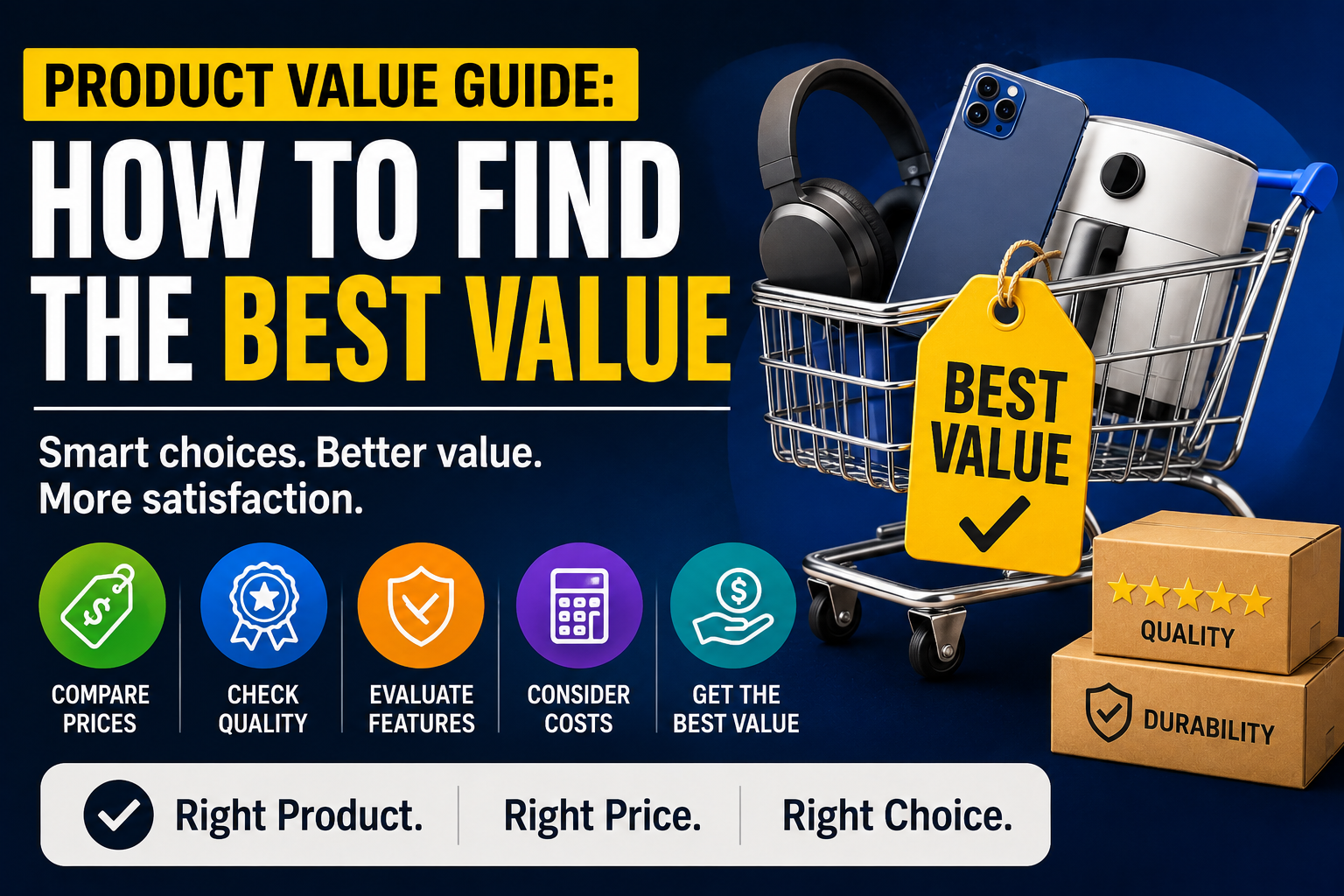
Product Value Guide: How to Find the Best Value
Buying a product is rarely as simple as choosing the cheapest option.
A low-priced product can become expensive if it breaks quickly, performs poorly, requires costly accessories, or needs to be replaced sooner than expected. On the other hand, the most expensive option is not automatically the best choice either. You may end up paying for features you rarely use.
The real goal is to find the best value: a product that delivers the right combination of quality, performance, useful features, reliability, ownership costs, and price for your particular needs.
This product value guide explains how to compare products intelligently, identify hidden costs, evaluate quality, and make purchasing decisions based on long-term value rather than price alone.
What Does Product Value Mean?
Product value is the overall benefit you receive from a product compared with the total cost of owning and using it.
A simple way to think about it is:
Product Value = Benefits and Performance ÷ Total Cost of Ownership
The calculation does not have to be mathematical in every purchase. The important idea is that price is only one part of the decision.
A product offering strong performance, durability, useful features, and low maintenance costs may provide better value than a cheaper alternative.
For example, imagine two products:
- Product A: $50 and lasts one year
- Product B: $90 and lasts three years
Product A has the lower purchase price, but Product B may offer considerably better long-term value.
This is why smart buying requires looking beyond the price displayed on the product page. For a broader framework covering the complete buying process, see The Complete Guide to Choosing the Right Products.
Price Is Not the Same as Value
One of the most common purchasing mistakes is assuming that cheaper automatically means better value.
Price tells you what you pay initially. Value tells you what you receive in return.
A cheaper product can represent poor value when it has:
- Shorter durability
- Poor performance
- Limited functionality
- Expensive replacement parts
- High maintenance requirements
- Weak warranties
- Poor customer support
- Compatibility problems
- Expensive accessories
Similarly, an expensive product can provide poor value if most of its premium features are unnecessary for your situation.
The best purchase is usually the product that provides the right capabilities at a reasonable total cost. Understanding how product pricing works and what determines whether a product is worth its price can make these comparisons easier.
The Seven Elements of Product Value
When comparing products, consider these seven areas rather than focusing exclusively on price.
1. Purchase Price
The purchase price is the starting point.
Before comparing prices, make sure you are comparing genuinely similar products.
Check:
- Product size
- Configuration
- Capacity
- Included accessories
- Warranty
- Version or generation
- Storage or memory
- Service package
- Included subscriptions
A product with a lower headline price may come with fewer accessories or capabilities than a seemingly more expensive competitor.
2. Quality
Quality refers to how well a product is constructed and how consistently it performs its intended function.
Depending on the category, quality may involve:
- Materials
- Construction
- Components
- Manufacturing
- Fit and finish
- Reliability
- Performance consistency
Quality can be difficult to judge from photographs alone.
Look for detailed specifications, independent testing, user experiences, warranty information, and evidence of long-term reliability.
3. Durability
Durability describes how well a product withstands normal use over time.
A durable product can potentially reduce replacement costs.
When evaluating durability, consider:
- Expected lifespan
- Build quality
- Materials
- Repairability
- Availability of replacement parts
- Resistance to normal wear
- Manufacturer support
Not every product needs to last for decades. The appropriate lifespan depends on the product category and intended use.
For a more detailed assessment, see the Complete Guide to Evaluating Product Reliability Before Buying.
4. Performance
A product should perform the job you actually need it to perform.
More performance is not always better.
For example, someone who occasionally edits photographs may not need the same computer as a professional video editor. Someone who takes occasional weekend trips may not need the same luggage as a frequent traveler.
The key question is:
Does this product provide enough performance for my needs?
Avoid paying a premium for capabilities that will rarely be used.
5. Features
Features can increase a product’s usefulness, but only when those features matter to you.
A product with 30 features is not necessarily better than one with 15.
Ask:
- Which features will I actually use?
- Which features are essential?
- Which features are merely convenient?
- Are any features duplicated?
- Do premium features require additional subscriptions?
The best-value product often has the features you need without unnecessary extras.
6. Ownership Costs
The purchase price is only the beginning of the financial commitment.
Ownership costs can include:
- Maintenance
- Repairs
- Replacement parts
- Accessories
- Consumables
- Software subscriptions
- Energy usage
- Insurance
- Installation
- Upgrades
- Transportation
These expenses can significantly change the value equation.
For a deeper look at these expenses, see the Product Ownership Costs: Complete Guide to True Cost.
7. Warranty and Support
Warranty coverage can provide important protection against certain defects or failures.
However, don’t judge a warranty solely by its length.
Check:
- What is covered?
- What is excluded?
- How are claims handled?
- Who pays shipping?
- Is repair or replacement provided?
- How long does the process typically take?
- Is customer support readily available?
A strong warranty does not make a poor product good, but reliable support can add meaningful value to a quality product.
What Is Total Cost of Ownership?
Total Cost of Ownership (TCO) is the complete cost associated with buying, using, maintaining, and eventually replacing a product.
A simplified formula is:
TCO = Purchase Price + Operating Costs + Maintenance + Accessories + Repairs − Residual Value
Not every product will have all of these costs.
For example, a household appliance might involve:
- Purchase price
- Electricity
- Maintenance
- Replacement filters
- Repairs
A laptop might involve:
- Purchase price
- Accessories
- Software
- Repairs
- Battery replacement
- Cloud storage subscriptions
Considering TCO helps prevent surprisingly expensive purchases.
How to Compare Products Properly
A good comparison should evaluate products using the same criteria.
Instead of asking:
“Which one is cheaper?”
ask:
“Which one gives me the capabilities I need at the lowest reasonable total cost?”
Create a simple comparison table before purchasing.
| Factor | Product A | Product B | Product C |
|---|---|---|---|
| Price | — | — | — |
| Quality | — | — | — |
| Performance | — | — | — |
| Durability | — | — | — |
| Features | — | — | — |
| Operating costs | — | — | — |
| Warranty | — | — | — |
| Repairability | — | — | — |
| Accessories included | — | — | — |
| Overall value | — | — | — |
This approach makes trade-offs much easier to see.
Start With Your Needs
Before researching products, define what you actually need.
This prevents a common problem known as feature creep.
Feature creep happens when shoppers continually add requirements until they are considering products far more expensive than necessary.
Start by dividing your requirements into three groups.
Must-Have Features
These are requirements the product absolutely needs.
Nice-to-Have Features
These improve convenience but are not essential.
Unnecessary Features
These are capabilities you are unlikely to use.
This simple exercise can dramatically narrow your choices.
Understanding the Price-to-Performance Ratio
The price-to-performance ratio compares what a product delivers with how much it costs.
A product with a strong price-to-performance ratio provides substantial useful performance without requiring a disproportionately high price.
However, this metric should be used carefully.
For example, a product may have excellent technical performance but poor durability. Another may offer slightly lower performance but significantly better reliability.
That’s why price-to-performance should be considered alongside quality and ownership costs.
How to Evaluate Product Specifications
Specifications are useful, but they can also be misleading.
Manufacturers often highlight numbers that make products appear impressive.
A specification only matters when it affects real-world use.
For example, when comparing electronics, shoppers might encounter specifications covering:
- Processor speed
- Memory
- Storage
- Display resolution
- Battery capacity
- Camera resolution
A higher number does not automatically mean a better experience.
The important question is how the specifications translate into practical performance. If technical terminology is difficult to interpret, How to Understand Product Specifications Before Buying provides a more focused explanation.
Look Beyond One Specification
Avoid making a purchase based on a single impressive number.
Instead, evaluate the complete system.
For example, a device with substantial storage may still have poor overall performance if other components are inadequate.
Similarly, a product with a powerful motor may not be the best choice if its design makes it difficult to use or maintain.
How Reviews Can Help You Find Value
Reviews can reveal information that specifications cannot.
Useful reviews often discuss:
- Real-world performance
- Ease of use
- Reliability
- Noise
- Battery life
- Comfort
- Setup
- Maintenance
- Problems discovered after extended use
However, not every review deserves equal weight.
Look for reviews that explain why the reviewer reached a particular conclusion.
A statement such as “This product is excellent” provides little useful information.
A detailed explanation of how the product performed in specific situations is much more valuable.
Look for Patterns
One negative review does not necessarily indicate a serious product problem.
Likewise, several enthusiastic reviews do not guarantee long-term quality.
Look for recurring patterns.
If multiple independent users report the same issue, it deserves attention.
If reviewers consistently praise the same characteristic, that may be evidence of a genuine strength.
Be Careful With Sponsored and Promotional Reviews
Some reviews may contain affiliate relationships, sponsorships, advertising, or other commercial incentives.
That does not automatically make a review unreliable.
The important question is whether the reviewer provides transparent methodology and balanced information.
A trustworthy review should make it possible to understand:
- What was tested
- How it was tested
- What worked
- What did not work
- Who the product is suitable for
- Who should avoid it
You can also learn how to distinguish promotional content from genuinely useful evaluations with this guide on How to Identify Biased Product Reviews.
The Importance of Independent Testing
For products where performance or safety matters, independent testing can be especially valuable.
Testing organizations, experienced reviewers, professional publications, and technical experts may provide information that is difficult to obtain from product listings alone.
For expensive purchases, triangulating information from several credible sources is often better than relying on one review.
Beware of False Bargains
A discount does not automatically make a product a good deal.
Before purchasing a heavily discounted item, ask:
- Was the product previously sold at the advertised price?
- Is this an older model?
- Is a newer version available?
- Is the discount tied to a subscription?
- Are important accessories sold separately?
- Does the product have poor reviews?
- Is the warranty adequate?
- Is the product being discontinued?
A lower price is useful only if the product remains suitable for your needs.
How to Identify a Product’s Sweet Spot
In many product categories, there is a point where spending more produces meaningful improvements—and another point where additional spending mainly buys luxury or specialized features.
This can be called the value sweet spot.
For example:
- Budget products may satisfy basic requirements.
- Mid-range products may provide the best balance of quality and price.
- Premium products may offer specialized capabilities.
- Luxury products may prioritize materials, design, exclusivity, or prestige.
The sweet spot depends on the buyer.
A professional may find a premium product worthwhile because additional performance directly affects income.
A casual user may get better value from a mid-range alternative.
Consider the Cost Per Use
For frequently used products, cost per use can be a helpful way to evaluate value.
A simple calculation is:
Cost Per Use = Total Cost ÷ Number of Uses
Suppose one product costs $120 and is used 240 times.
Its purchase cost works out to:
$120 ÷ 240 = $0.50 per use
A cheaper $70 product that is used only 70 times would cost:
$70 ÷ 70 = $1 per use
This does not prove that the first product is better, but it provides another way to evaluate frequent-use purchases.
When Buying Cheap Makes Sense
There are situations where buying the least expensive suitable product is perfectly reasonable.
Consider the cheaper option when:
- You will use it infrequently.
- The product has a short expected lifespan.
- Performance differences are insignificant.
- Replacement is inexpensive.
- You are testing whether you actually need the product.
- The product is a temporary solution.
The objective isn’t to avoid inexpensive products.
The objective is to avoid false savings.
When Spending More Makes Sense
Paying more may be worthwhile when the additional cost provides a meaningful benefit.
This can include:
- Better durability
- Higher reliability
- Lower operating costs
- Better safety
- Longer warranty coverage
- Better repairability
- Significantly improved performance
- Lower maintenance requirements
Before paying extra, identify the specific benefit you’re receiving.
If you cannot explain what the additional money buys, reconsider the upgrade.
Common Product-Buying Mistakes
Choosing Based Only on Price
The lowest price may ignore durability, maintenance, and performance.
Buying More Features Than Necessary
Extra features can increase the price without improving your experience.
Ignoring Compatibility
A product may be inexpensive but useless if it does not work with your existing equipment or systems.
Forgetting Accessories
Some products require additional components before they can be used properly.
Ignoring Maintenance
A cheap product with expensive consumables may cost more over time.
Trusting Star Ratings Alone
A rating without context doesn’t tell you whether the product is right for your needs.
Buying the Newest Model Automatically
A newer version may offer improvements, but an older model can sometimes provide better value when its essential capabilities remain sufficient.
Failing to Consider Resale Value
Some products retain significant value after purchase while others depreciate rapidly.
Resale value can matter when you expect to upgrade frequently.
A Practical Product Value Scorecard
For important purchases, you can create a weighted score.
For example:
| Category | Weight | Score |
|---|---|---|
| Performance | 25% | — |
| Quality | 20% | — |
| Durability | 20% | — |
| Features | 10% | — |
| Ownership Cost | 10% | — |
| Warranty & Support | 10% | — |
| Ease of Use | 5% | — |
Multiply each score by its weight and add the results.
The exact weights should change depending on the product.
For a professional tool, performance might receive the highest weight.
For a household appliance, reliability and operating costs may be more important.
For a budget purchase, price might receive greater weight.
A Simple Five-Step Buying Process
You don’t need a complicated spreadsheet for every purchase.
For most products, follow these five steps:
Step 1: Define the Job
What exactly do you need the product to accomplish?
Step 2: Set a Realistic Budget
Determine how much you can comfortably spend without compromising other financial priorities.
Step 3: Shortlist Three to Five Options
Avoid comparing dozens of products indefinitely.
Step 4: Compare Total Value
Evaluate price, performance, durability, features, ownership costs, and support.
Step 5: Check for Deal-Breakers
Before purchasing, look for compatibility problems, poor reliability patterns, expensive subscriptions, missing accessories, or inadequate warranties.
For shoppers who are making purchases online, the Online Shopping Guide can provide additional guidance on evaluating the purchasing process itself.
Questions to Ask Before Buying
Before completing a purchase, ask yourself:
- What problem does this product solve?
- How frequently will I use it?
- Which features do I actually need?
- How long do I expect it to last?
- What will it cost beyond the initial purchase?
- Are replacement parts available?
- Does it work with what I already own?
- What does the warranty cover?
- What do independent users say about long-term performance?
- Would a cheaper model meet my needs?
- Would spending slightly more provide a meaningful improvement?
- Am I buying because I need the product or because of a temporary promotion?
The Best Value Is Different for Everyone
There is no universally perfect product.
The best value depends on:
- Your budget
- Your priorities
- How often you use the product
- Your performance requirements
- Your expectations for durability
- Your willingness to maintain or repair it
- The importance of convenience
- Your long-term plans
A product that represents excellent value for one person may be unnecessary for another.
That is why the strongest buying decisions begin with needs rather than brands, features, or discounts.
Making Better Purchases With a Value-First Mindset
Finding the best value isn’t about spending the least amount of money. It’s about making sure the money you spend produces a useful and lasting benefit.
Start by defining what you need, compare products using consistent criteria, investigate real-world performance, calculate ownership costs, and pay particular attention to durability and reliability. When two products appear similar, the one with lower long-term costs and better practical performance may be the smarter choice—even if its initial price is higher.
Most importantly, resist the temptation to treat every purchase as a race for the biggest discount. A genuinely good deal is not simply a low price; it is a product that delivers the right combination of quality, usefulness, performance, and longevity for the money you spend.