Stripe Buys OpenRouter as AI Model Routing Becomes a Bigger Part of the AI Economy
The artificial intelligence industry is entering a new phase in which the biggest challenge is no longer simply building better AI models. Increasingly, businesses need to decide which model should handle which task, how much that request should cost, and what happens when a model or provider becomes unavailable.
That shift is helping turn AI model routing into an important piece of technology infrastructure.
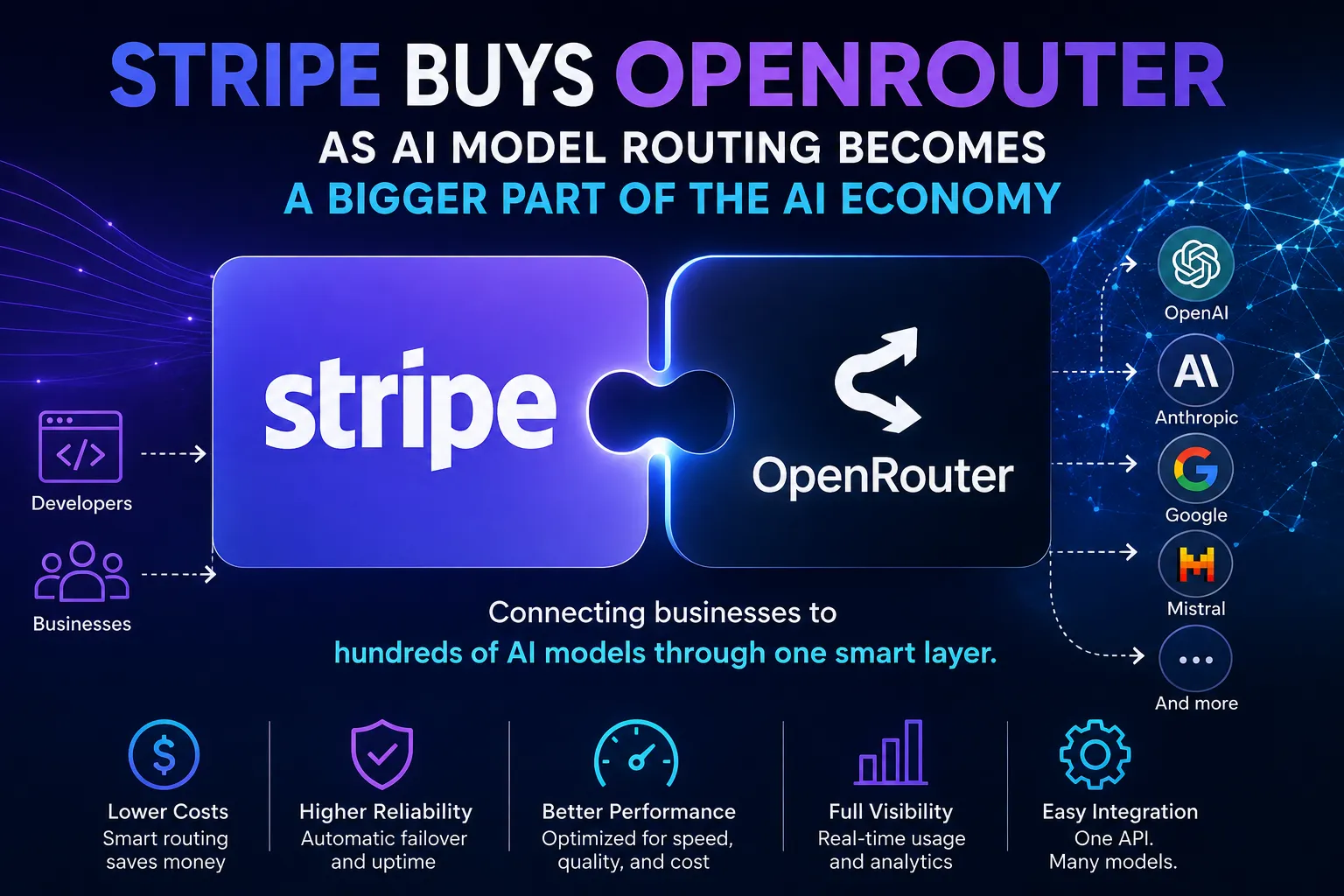
Against that backdrop, Stripe has agreed to acquire OpenRouter, the AI platform that gives developers access to hundreds of models through a unified interface. The deal, announced in August 2026, is reportedly worth more than $7 billion, with other reports putting the value above $8 billion. The exact purchase price has not been publicly disclosed. (Reuters)
The acquisition represents a significant expansion for Stripe. A company best known for online payments is positioning itself closer to the infrastructure through which businesses consume and pay for AI.
What OpenRouter Actually Does
OpenRouter operates as an intermediary between AI applications and model providers.
Instead of building separate integrations for every AI model, developers can use OpenRouter as a common interface to access a large selection of models. The platform has expanded rapidly and said in May that it served more than 8 million developers and provided access to more than 400 models. It also reported weekly usage of about 25 trillion tokens at the time. (OpenRouter)
That architecture becomes increasingly useful as companies move away from relying on a single AI provider.
An application might use one model for:
- Complex reasoning
- Another for summarization
- A cheaper model for routine requests
- A specialized model for coding
- A multimodal model for images or video
- A different provider when the primary service is unavailable
The routing layer can help developers manage these choices without rebuilding their entire application every time they change models.
Why AI Model Routing Matters More Now
The economics of AI are heavily influenced by inference costs.
Every time an AI application processes information, it consumes computing resources. For language models, usage is commonly measured in tokens. As businesses integrate AI into customer service, software development, search, research, data analysis, and autonomous agents, those costs can become a significant operating expense.
A company therefore has an incentive to ask a simple question:
Does every task need the most expensive model?
Often, the answer is no.
A routing system can direct simple requests toward less expensive models while reserving more capable systems for tasks where their additional performance is worth the cost.
That makes routing increasingly important as organizations move from AI experimentation toward large-scale production.
Stripe Already Had a Relationship With OpenRouter
The acquisition does not represent Stripe’s first involvement with OpenRouter.
Earlier in 2026, Stripe announced that OpenRouter was using its financial infrastructure for payments, invoicing, tax management, and fraud protection. Stripe described OpenRouter as a platform giving millions of developers access to hundreds of AI models through one interface. (Stripe)
That existing relationship gives Stripe an unusually close view of the economics surrounding AI model consumption.
OpenRouter’s customers generate AI usage. AI usage generates token costs. Those costs need to be tracked, billed, and ultimately paid for.
Stripe already operates in several parts of that economic chain.
The acquisition potentially brings those pieces closer together.
From Payment Processing to AI Economic Infrastructure
Stripe’s strategy has increasingly extended beyond simply processing credit-card payments.
The company has invested in tools for billing, usage-based pricing, tax management, fraud prevention, and financial infrastructure for internet businesses.
AI creates a particularly interesting opportunity because AI services often have consumption-based economics.
A traditional software subscription might charge $20 per month regardless of how frequently the customer uses it.
An AI application may need to account for:
- Number of requests
- Tokens consumed
- Model selected
- Processing costs
- Compute requirements
- Different customer usage patterns
- Changing provider prices
Stripe can potentially help businesses connect those usage patterns with billing and payments.
OpenRouter adds another layer by sitting between the application and the underlying AI models.
The Rise of the Multi-Model AI Stack
The AI industry was initially dominated by a relatively simple architecture: developers selected an AI provider and built applications around its models.
That approach is becoming less attractive for some businesses.
Model capabilities, prices, context windows, latency, reliability, and specialized features can change rapidly. A company that depends entirely on one provider may have limited flexibility when those variables change.
Multi-model infrastructure offers an alternative.
Instead of asking which AI company will dominate forever, developers can build applications capable of working with several models.
That creates demand for infrastructure that can manage the complexity.
OpenRouter is effectively positioned in that layer.
Cost Optimization Is Becoming a Competitive Advantage
AI model prices have fallen dramatically in some areas as competition and efficiency have increased.
But lower prices do not automatically make AI applications profitable.
A business still needs to understand how much it spends on inference and how those expenses relate to revenue.
Imagine an AI-powered customer service application handling millions of interactions.
If every request is automatically sent to a premium model, costs could rise substantially.
A routing system could potentially classify requests and use different models depending on complexity.
For example:
| Task | Potential Model Strategy |
|---|---|
| Simple classification | Lower-cost model |
| Basic customer question | Efficient general model |
| Complex reasoning | More capable model |
| Coding task | Specialized coding model |
| Image analysis | Multimodal model |
| Provider outage | Automatic fallback |
The objective is not necessarily to find the cheapest model.
It is to find the best balance between cost, quality, speed, and reliability.
Reliability Is Just as Important as Price
AI routing is not only about saving money.
Production applications also need reliability.
If a model provider experiences an outage, latency spike, capacity constraint, or other technical problem, an application that depends entirely on that provider may suffer.
A routing layer can potentially redirect traffic to another provider.
OpenRouter has described intelligent routing features involving provider-level failover, cost optimization, latency optimization, and quality-aware routing. (OpenRouter)
For businesses operating AI systems at scale, that redundancy can become valuable infrastructure rather than an optional convenience.
AI Agents Could Make Routing Even More Important
The emergence of AI agents could further increase demand for model-routing systems.
A traditional chatbot might send one request and return one response.
An agent can perform multiple actions:
- Interpret a request.
- Search for information.
- Analyze data.
- Write code.
- Call external tools.
- Evaluate the result.
- Try another approach.
- Produce a final answer.
Each step could potentially benefit from a different model.
An agent might use a fast model for routine decisions and a more powerful model for difficult reasoning.
As agents perform more tasks independently, choosing the right model at each stage could become a fundamental part of AI application architecture.
Why Stripe May Want This Position
Stripe has spent years building infrastructure around the movement of money on the internet.
AI introduces another rapidly growing category of digital economic activity.
The company can potentially see both sides of the equation:
AI consumption → model routing → usage measurement → billing → payment
Owning or integrating the routing layer could give Stripe a closer relationship with the economic activity generated by AI applications.
This is particularly relevant because Stripe already provides tools for usage-based billing and has expanded its AI-related financial infrastructure.
The company has also acquired Metronome, a usage-based billing platform, strengthening its capabilities in consumption-driven pricing. (The Information)
A Huge Valuation Jump for OpenRouter
The size of the acquisition is one of the most striking aspects of the transaction.
OpenRouter had raised $113 million in a Series B announced in May 2026 and reported a valuation of about $1.3 billion at that stage. (OpenRouter)
Reports surrounding the Stripe acquisition have placed the transaction value dramatically higher, ranging from more than $7 billion to above $8 billion, while earlier negotiations were reported to have approached $10 billion. (Reuters)
That enormous increase illustrates how quickly investors and major technology companies are repricing infrastructure associated with AI.
It also suggests that AI model access and orchestration are increasingly being viewed as strategic infrastructure rather than merely developer tooling.
What the Deal Means for AI Developers
For developers, the most important question may not be the headline acquisition price.
It is what happens to OpenRouter as part of Stripe.
OpenRouter’s appeal has partly come from its ability to provide access to many different AI providers through one interface. Its platform has been built around the idea that developers should not have to commit their entire application to a single model provider.
Stripe now owns that gateway.
That could provide OpenRouter with substantially more resources for infrastructure, enterprise services, billing, and global expansion.
But developers will also watch closely for any changes to pricing, neutrality, model availability, data policies, and platform strategy.
Could Model Routing Become a Major AI Infrastructure Layer?
The acquisition suggests that routing may become one of the important layers between AI applications and model providers.
A simplified AI application stack could increasingly look something like this:
Users
↓
AI Applications and Agents
↓
Model Routing / AI Gateway
↓
Multiple AI Model Providers
↓
Compute Infrastructure
The routing layer can potentially handle:
- Model selection
- Cost optimization
- Traffic management
- Failover
- Usage tracking
- Provider selection
- Performance monitoring
- Enterprise controls
As the number of available models increases, this layer could become more valuable.
The Bigger Shift in the AI Economy
The Stripe-OpenRouter deal highlights an important change in how the AI economy is developing.
The industry’s early focus was largely on who would build the most powerful model.
Now, another question is becoming equally important:
How will businesses efficiently use all of these models?
There may not be one universal AI model that is best for every task.
Instead, the future could involve a diverse ecosystem in which businesses dynamically combine models based on performance, price, speed, reliability, and specialized capabilities.
That creates opportunities not just for model developers, but also for the infrastructure companies that connect those models to the wider economy.
What Comes Next for AI Infrastructure
Stripe’s acquisition of OpenRouter is significant because it connects two rapidly developing areas: AI infrastructure and digital commerce.
OpenRouter brings experience in managing access to a growing universe of AI models. Stripe brings financial infrastructure, billing capabilities, global payment reach, and an established base of internet businesses.
The combination could help define a new category of infrastructure in which AI model consumption is treated much more like an economic utility: measured, optimized, routed, billed, and continuously adjusted.
The biggest lesson from the deal may therefore be bigger than Stripe or OpenRouter. As AI becomes embedded in everyday software and business operations, the companies controlling the layers between AI models and the businesses using them could become just as strategically important as the companies building the models themselves. (Reuters)