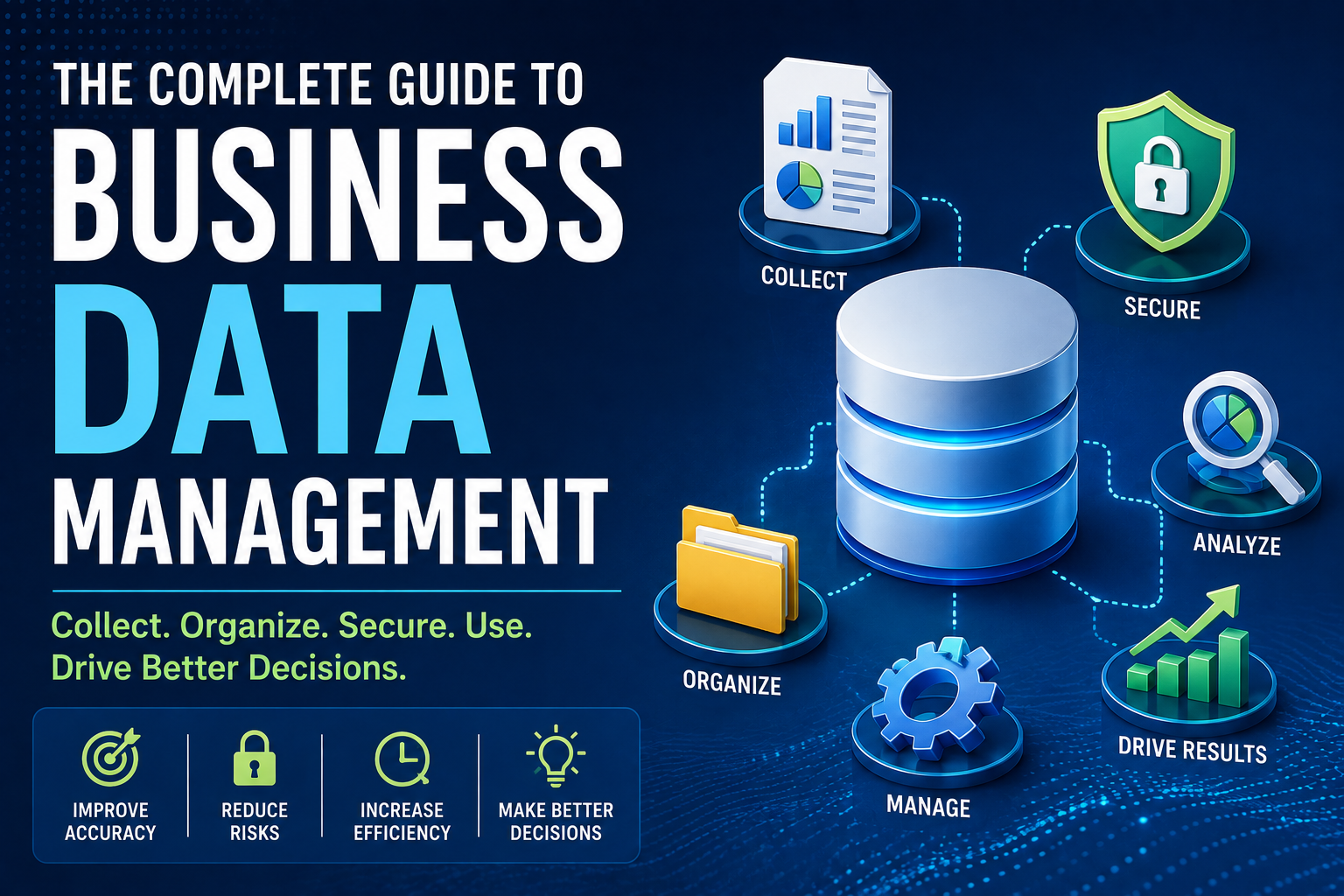
The Complete Guide to Business Data Management
Data has become one of the most valuable resources available to modern businesses. Customer information, financial records, operational metrics, employee data, sales records, and digital interactions all contribute to how organizations understand their operations and make decisions.
But collecting large amounts of information is only part of the challenge. Businesses also need to ensure that data is accurate, secure, accessible, organized, and used responsibly.
That is the role of **business data management.
A well-designed data management strategy can help organizations turn scattered information into a reliable business resource while reducing unnecessary costs, security risks, and operational confusion.
This guide explains what business data management is, why it matters, how organizations manage data throughout its lifecycle, the role of data governance and quality, data security, analytics, artificial intelligence, and how businesses can build a practical data management strategy.
Business data management is also an important part of the wider technology environment that supports modern organizations. The Complete Guide to Business Software provides broader context on how business applications and technology systems work together to support organizational operations.
—
## What Is Business Data Management?
Business data management is the process of collecting, organizing, storing, protecting, maintaining, and using data throughout an organization.
It covers the entire lifecycle of business information, from the moment data is created or collected to the point where it is archived or securely deleted.
Business data can include:
-
Customer information
-
Sales records
-
Financial information
-
Inventory data
-
Employee records
-
Marketing data
-
Website analytics
-
Product information
-
Operational data
-
Supplier information
-
Business performance metrics
Effective data management ensures that the right people can access reliable information when they need it while preventing unauthorized access or inappropriate use.
For businesses building modern technology environments, data management is closely connected with broader cloud computing strategies, databases, analytics, APIs, and IT infrastructure. For a broader explanation of how databases fit into the modern data ecosystem, see the Complete Guide to Databases.
—
## Why Data Management Matters for Businesses
Poorly managed data can create problems throughout an organization.
Duplicate customer records, inconsistent spreadsheets, outdated information, missing records, and disconnected systems can make even simple business decisions more difficult.
Effective data management can help businesses:
-
Improve decision-making
-
Reduce duplicate information
-
Increase data accuracy
-
Protect sensitive information
-
Improve operational efficiency
-
Support regulatory compliance
-
Reduce storage and technology costs
-
Strengthen customer experiences
-
Make analytics more reliable
-
Support automation and artificial intelligence
The value of data comes from its usability and reliability, not simply from the amount of information a company stores.
Organizations also need reliable systems for storing and processing this information. Database technology provides much of that foundation, as explained in our complete guide to database software.
—
## The Data Management Lifecycle
Business data generally passes through several stages during its lifecycle.
### 1. Data Creation and Collection
Data may be created directly by employees, customers, applications, devices, websites, or business systems.
For example, an online store may collect:
-
Customer contact information
-
Orders
-
Payment-related records
-
Product searches
-
Website interactions
-
Shipping information
Businesses should determine what information they actually need before collecting it.
Collecting unnecessary data increases storage requirements and can create additional privacy and security responsibilities.
### 2. Data Storage
Once collected, information needs to be stored appropriately.
Organizations may use:
-
Databases
-
Cloud storage
-
Data warehouses
-
File servers
-
Enterprise applications
-
Backup systems
Storage decisions should consider factors such as accessibility, performance, security, scalability, cost, and retention requirements.
Businesses moving their data environments to the cloud should also understand the broader complete guide to cloud computing for businesses.
### 3. Data Processing
Raw information is often not immediately useful.
Businesses may need to clean, transform, categorize, combine, or analyze data before it can support business activities.
For example, sales information from different regions may need to be standardized before executives can compare regional performance accurately.
### 4. Data Usage
Different teams may use the same information for different purposes.
Marketing teams may analyze customer behavior, finance teams may examine revenue, while operations teams may use data to improve processes.
Access should therefore be based on legitimate business requirements rather than giving every employee unrestricted access.
### 5. Data Archiving
Some information needs to be retained even when it is no longer used regularly.
Archiving can move older information into appropriate storage while keeping it available when required.
### 6. Data Deletion
Data should not necessarily be kept forever.
When information is no longer needed and there is no legitimate reason to retain it, organizations may need to securely delete it according to their policies and applicable requirements.
A defined retention and deletion process can reduce unnecessary exposure.
—
## The Main Components of Business Data Management
Data management is broader than simply maintaining a database.
Several interconnected disciplines contribute to a strong data management program.
### Data Governance
Data governance establishes the rules, responsibilities, policies, and decision-making processes that determine how data should be managed.
A governance program may define:
-
Who owns particular datasets
-
Who can access information
-
How data quality is measured
-
How information is classified
-
How data should be retained
-
How privacy requirements are handled
-
How data-related decisions are made
Without governance, different departments may develop their own approaches, resulting in inconsistent practices.
This governance layer also connects closely with broader technology oversight. Organizations that want to understand how technology responsibilities, accountability, risk, and decision-making are structured can explore what IT governance is and how organizations manage technology decisions, accountability and risk.
### Data Quality Management
Reliable decisions require reliable information.
Data quality can be evaluated using characteristics such as:
-
Accuracy
-
Completeness
-
Consistency
-
Timeliness
-
Validity
-
Uniqueness
For example, if the same customer appears three times in a database with slightly different contact information, the organization may struggle to determine which record is correct.
Data quality processes can identify and resolve these inconsistencies.
### Master Data Management
Master data management focuses on maintaining consistent versions of important business entities.
These may include:
-
Customers
-
Products
-
Employees
-
Suppliers
-
Locations
A company with multiple systems may otherwise have different versions of the same customer or product.
Master data management can help establish a more consistent view across applications.
### Metadata Management
Metadata is information that describes other data.
For example, metadata might explain:
-
Where a dataset came from
-
When it was created
-
Who owns it
-
What a field means
-
How frequently it is updated
-
How the information should be used
Good metadata makes business information easier to understand and discover.
### Data Security
Data security protects information against unauthorized access, alteration, destruction, or disclosure.
Common safeguards include:
-
Access controls
-
Encryption
-
Authentication
-
Multi-factor authentication
-
Security monitoring
-
Backups
-
Network protections
-
Endpoint security
Security should be considered throughout the data lifecycle rather than added only after information has already been collected.
—
## Data Governance and Data Ownership
One common challenge organizations face is uncertainty about who is responsible for data.
A strong data management program assigns clear ownership.
A **data owner may be responsible for decisions regarding a particular category of information, while data stewards may help maintain its quality, definitions, and day-to-day management.
For example, a finance department might own financial reporting data while a customer service team manages certain customer records.
Clear responsibilities help prevent situations where everyone assumes someone else is responsible for maintaining data quality or security.
—
## Building a Strong Data Architecture
A company’s data architecture describes how information is collected, stored, connected, processed, and delivered across its technology environment.
Modern organizations may use a combination of:
-
Relational databases
-
Cloud databases
-
Data warehouses
-
Data lakes
-
Data lakehouses
-
APIs
-
Business intelligence platforms
-
Enterprise applications
Organizations also need appropriate IT infrastructure for businesses to support these systems.
The appropriate architecture depends on the organization’s size, requirements, existing systems, data volumes, and business objectives.
There is no single architecture that works equally well for every organization.
—
## Data Integration
Businesses frequently have information spread across multiple applications.
A sales platform may contain customer information, an accounting system may contain payment records, and a marketing platform may contain campaign activity.
Data integration connects these systems so information can move between them appropriately.
Integration can help reduce manual data entry and provide teams with a more complete view of business activity.
APIs are an important part of many modern integration strategies. Businesses and developers can learn more about this topic in the APIs and Integrations Guide for Developers.
However, integration also requires careful planning. Connecting poorly governed systems can simply move inconsistent data from one application to another.
—
## Business Intelligence and Data Analytics
Well-managed data provides the foundation for analytics.
Business intelligence tools can help organizations examine information through:
-
Dashboards
-
Reports
-
Performance indicators
-
Data visualizations
-
Trend analysis
For example, a company might combine sales, inventory, and customer data to understand which products are performing well and where operational problems are occurring.
The quality of the analysis depends heavily on the quality of the underlying data.
Businesses looking to turn information into actionable insights should also understand the complete guide to data analytics for business.
Business intelligence can then help organizations convert those insights into practical decisions. Learn more in our guide to how business intelligence helps businesses make better data-driven decisions.
—
## Data Management and Artificial Intelligence
Artificial intelligence has increased the importance of reliable business data.
AI systems depend on data for tasks such as:
-
Analysis
-
Classification
-
Forecasting
-
Recommendation
-
Automation
-
Search
-
Knowledge retrieval
Poor-quality, outdated, duplicated, or incorrectly labeled information can reduce the usefulness of AI-powered systems.
Businesses adopting AI should therefore treat data governance and data quality as foundational capabilities rather than secondary concerns.
Modern AI systems can also depend on databases, cloud infrastructure, APIs, analytics platforms, and structured data systems working together.
—
## Protecting Business Data
Data protection is one of the most important responsibilities within data management.
Organizations should understand which information is sensitive and apply appropriate controls.
Sensitive information may include:
-
Personal information
-
Financial records
-
Authentication credentials
-
Confidential business documents
-
Intellectual property
-
Customer records
-
Employee information
### Access Control
Employees should generally have access only to the information they need for legitimate work.
This principle is often described as **least privilege.
Reducing unnecessary access limits the potential impact of compromised accounts or accidental data exposure.
### Encryption
Encryption can help protect information while it is stored or transmitted.
Even if unauthorized parties obtain encrypted data, properly implemented encryption can make the information significantly more difficult to use.
### Backups
Backups provide an additional layer of resilience.
Organizations should determine:
-
What needs to be backed up
-
How frequently backups occur
-
Where backups are stored
-
How long they are retained
-
Who can access them
-
How recovery is tested
Businesses that want to develop a stronger recovery strategy can also review the Data Backup Guide.
A backup strategy is most valuable when organizations know that the backups can actually be restored.
—
## Data Privacy and Responsible Data Use
Data management and privacy are closely connected.
Businesses should understand why they collect information, how it will be used, who can access it, and how long it should be retained.
Privacy responsibilities vary depending on factors such as the organization’s location, customers, industry, and the types of information it handles.
Rather than treating privacy as a separate technical issue, businesses can incorporate privacy considerations directly into their data management processes.
—
## Common Business Data Management Problems
Organizations often encounter similar challenges as their data environments grow.
### Data Silos
Data silos occur when information remains isolated within individual departments or systems.
Silos can make it difficult to create a complete picture of customers, operations, or financial performance.
### Duplicate Data
Multiple copies of the same information can create confusion and increase storage and maintenance requirements.
### Inconsistent Definitions
Different departments may use the same term to mean different things.
For example, one team may define an “active customer” differently from another.
Creating shared definitions can improve reporting consistency.
### Outdated Information
Old contact details, product records, employee information, or financial data can reduce the usefulness of business systems.
Regular maintenance and validation can help keep information current.
### Poor Documentation
Employees may struggle to understand a dataset if there is no documentation explaining where it came from, what its fields mean, or how it should be used.
### Excessive Data Collection
Collecting information simply because it might be useful someday can increase costs and create unnecessary security and privacy risks.
Good data management emphasizes purposeful collection.
—
## Common Data Management Mistakes
### Relying on Spreadsheets for Everything
Spreadsheets can be useful, but they can become difficult to manage when organizations use them as substitutes for systems designed to handle large or interconnected datasets.
### Ignoring Data Quality
Analytics cannot compensate for fundamentally unreliable source data.
### Giving Too Many People Access
Broad access increases the potential consequences of compromised accounts and accidental disclosure.
### Keeping Data Indefinitely
Data retention should have a business or legal justification rather than being based on the assumption that more information is always better.
### Buying Tools Before Defining Processes
Technology alone cannot create effective data management.
Organizations should first establish their objectives, responsibilities, policies, and workflows before selecting technology.
—
## How to Create a Business Data Management Strategy
A practical strategy can begin with several core steps.
### Step 1: Identify Critical Data
Determine which datasets are most important to business operations and decision-making.
### Step 2: Map Data Sources
Document where information is created, stored, processed, transferred, and used.
### Step 3: Assign Ownership
Give appropriate teams or individuals responsibility for important datasets.
### Step 4: Establish Data Standards
Create consistent definitions, naming conventions, quality requirements, classification rules, and access policies.
### Step 5: Improve Data Quality
Identify duplicate, incomplete, outdated, or inconsistent information and establish processes for correcting it.
### Step 6: Strengthen Security
Apply appropriate authentication, authorization, encryption, monitoring, backup, and recovery measures.
### Step 7: Establish Retention Rules
Determine how long different types of information should be kept and how unnecessary information should eventually be removed.
### Step 8: Monitor Performance
Track data quality, security events, access patterns, system performance, and other relevant indicators.
### Step 9: Continuously Improve
Data management should evolve alongside the business. New applications, employees, customers, regulations, and technologies can all change data requirements.
—
## Measuring Data Management Success
Organizations need measurable indicators to determine whether their data strategy is working.
Useful metrics can include:
-
Data accuracy rates
-
Duplicate record rates
-
Data completeness
-
Time required to find information
-
Number of data-quality issues
-
Security incidents
-
Unauthorized access attempts
-
Backup recovery performance
-
Data-related operational costs
-
Compliance findings
The most useful metrics should connect data management activities to actual business outcomes.
—
## The Business Value of Better Data
Effective data management can create benefits that extend beyond the IT department.
Sales teams can work with cleaner customer information. Finance teams can produce more consistent reports. Executives can make decisions using more trustworthy metrics. Operations teams can identify inefficiencies more quickly.
Customers can also benefit when organizations maintain accurate information and handle personal data responsibly.
In this sense, data management is not simply about storing information. It is about creating an environment in which information can reliably support the organization.
—
## Creating a Data-Driven Business Culture
Technology and policies are important, but organizational behavior also determines how effectively data is managed.
Employees should understand:
-
Why data quality matters
-
How sensitive information should be handled
-
Which systems should be used
-
Who is responsible for important data
-
How to report data problems
-
What information should not be shared
When employees understand their role in data management, organizations are better positioned to maintain consistent practices as they grow.
—
## Preparing Business Data for the Future
The amount and variety of business information will continue to grow as organizations adopt cloud services, connected devices, automation, analytics, and artificial intelligence.
This makes disciplined data management increasingly important.
Organizations that establish strong foundations around ownership, quality, security, governance, integration, and responsible use can adapt more easily to new technologies.
Businesses may also need to understand how information is structured at a technical level. Concepts such as arrays, objects, trees, graphs, and other data structures influence how software stores and processes information.
The goal is not to collect as much information as possible. It is to ensure that the information an organization does collect remains **accurate, understandable, secure, accessible, and useful.
—
## Turning Business Data Into a Reliable Asset
Business data management is ultimately about trust.
Employees need to trust the information they use. Customers need confidence that their information is handled responsibly. Executives need reliable data for important decisions, and technology systems need consistent information to function effectively.
Organizations that treat data as a managed business asset rather than an accidental byproduct of operations can build a stronger foundation for analytics, automation, security, and long-term growth.
As businesses become increasingly dependent on digital information, effective data management will remain one of the fundamental capabilities separating organizations that merely collect data from those that can consistently turn it into business value.